Bach and Dr. Seuss   (2016Jun20)

Monday, June 20, 2016                                            1:09 PM

Dr. Seuss on Gun Control

We are born and we live—we love and we give

We believe what we wish and we think sometimes too

Sometimes we are faithful and sometimes, untrue

When we are not peaceful we’re provocative

People are silly—just watch them and see

People get ugly—you know they can be

People like laughing—it’s such a relief

But then we like fighting—and that causes grief

People are silly—if I wasn’t one

I’d say let them all walk around with a gun

I wouldn’t even mind taking a bullet from one

If I didn’t have a wife, a daughter, and a son.


(please note: this poem is in the style of Dr. Seuss, not actually by him.)

It’s a lazy day. Happy summer. I recorded one of Bach’s French Suites. Ordinarily I wouldn’t bother posting it, but I want to forget about the troll that bugged me a few days ago, so I’m posting more classical music videos. This one is no better than that one, because I don’t play all that good—but I hereby declare that to be okay. Anyone that doesn’t like it—doesn’t have to watch it.

I also managed an improv. The set-to with the troll took my mind off my biggest problem, which has nothing to do with my playing bad classical music. I’ve always played classical music badly. I usually tell myself that it’s background research—I only play the classical for practice—to get ideas and improve my technique—for when I improvise. Because I’ve been pleased with my growth in that area—some of my improvs are quite listenable.

I know this because I burn CDs and listen to them while lying around or reading. I started doing that way back when I was still using a Sony cassette recorder and never posted anything. The idea was to hear myself in playback and see what I sounded like to another person. I learned a lot—enough so that, at some point, I actually began to enjoy listening to my own CDs. They still couldn’t stack up against store-bought music, but they were good enough that, when factoring in that I had made them myself, it was nice to listen to.

But lately I don’t know. I’ve always sounded kinda the same, but I was always trying new things. I think lately the problem is that I’ve accumulated a bunch of ‘tricks’ that I like, and I use them too much—it’s getting repetitive. So I’ve recorded some improvs lately that I didn’t think were good enough to share online because they’re just too much like stuff I’ve already posted. I don’t know, maybe it’s just getting old. I have been improvising for like thirty five years by now—maybe I’ve just reached my peak and I don’t have it in me to do any better.

Anyhow, for today’s recordings’ titles, I recycled my drawings from the last post—I’m not making many new drawings, so I have to make the most of what’s left in my old archives.


..

Journal Entry (2016Jun19)

20160619XD-OldDrawings_08(SMALLER)

Thursday, June 16, 2016                                          4:43 PM

This rush to the gun stores—I don’t get it—how often are these peoples’ homes being invaded? Just how primitive is life outside of Westchester? Westchester has people who feel the need for self-defense, too—where is this fear coming from?

There’s a dichotomy to civilization—we create communities that are stable, where you don’t have to have a gunfight to survive, where you can walk down the street with a high degree of certainty that you won’t be attacked. People like me take that at face value—and reason that introducing firearms into the environment only increases the danger. But then we start to imagine that people might sneak around and break in and rob us, rape us, or kill us. We start to think that our lives are at risk. But I find it hard to maintain that paranoia against the lack of anything like that ever happening in my neighborhood. That stuff doesn’t happen where I live—or if it happens, it’s less frequent than a bolt of lightning.

There are places where violence is common. That’s different—I can’t speak to that, because I have no idea what it’s like. But I am among the vast majority of people living in developed countries where violence is rare and quickly attended to. And for people like me, owning a gun is just asking for trouble—it’s unlikely to be needed, and far too likely to cause problems simply by being there.

It’s not a dichotomy so much as a distancing of ourselves—the world is still a place of terrible struggle, with war and poverty stalking the earth. Our protected pockets of civility exist by virtue of military defense preventing encroachment by the barbarous hordes—and civilian police who are (mostly) restrained against oppression of their charges. In other words, we understand that our peace is built on fighting happening elsewhere—and that, therefore, violence is still useful and necessary—just not where we live.

20160619XD-OldDrawings_07(SMALLER)

But having created these areas of ease and civility, shouldn’t we use them as such? We are in no danger of becoming the Eloi to the Morlocks of violence—when we have these mass shootings, we also often see formerly peaceful residents become, in an instant, people who risk their lives, and sometimes give their lives, to defend those around them. What we have not yet seen is anyone who is carrying and has the presence of mind to return fire. So what does that tell you about guns and self-defense?

I’m in no hurry for my chance to find out if I have a hero inside me—but I will face that when and if. What I won’t do is spend a lifetime preparing for my worst imaginings, pumping myself up for a battle that isn’t being fought.

It’s totally logical, you know. In a race, looking back, looking around for your rivals—that’s the worst thing you can do. You want to drive forward completely focused on the goal. Equally, in life you want to focus on the goals ahead—any time you spend being petty towards others is a waste of effort and it can even make you lose your stride. If you face the world openly, gladly, and without malice, you create less friction in your passage—you might even get others to wish you well and support you. That’s how I see it—and even if I have built this rationale on a personality that is naturally disposed that way, that doesn’t negate its efficacy.

I’m uncomfortable around people—but even I know that being generally positive about things is the easy way to get along with others. There are times when I’m forced to disagree or contradict—and I’m all too eager to do that—but I have learned that, even then, the minimum amount of conflict is to be sought. I have to restrain my killer instinct, or I run the risk of making a worse wrong of being ‘right’. Arguing can do that to people—and I am one of the worst offenders in that regard.

20160619XD-OldDrawings_06(SMALLER)

It’s fairly simple to turn that around—to make the point that wrong must be attacked with vigor and stomped into the ground, even when it’s hard on people—but I still maintain that it is the wrong that needs stomping, not the person. When Senators Tim Scott and Lindsay Graham spoke before the Senate today, they both cited the stunning character of last year’s church-shooting victims’ family survivors, when they forgave the man who killed their relatives in open court.

And when you examine our prison problem, you see its roots in our stubborn insistence that prison continue, as in darker, more ignorant times, to be punishment and not rehabilitation. I am not the only one who gets carried away with a sense of vindication—but there are people of such strength of character that they can rise above their passion. I’d rather those people had the so-many-millions of twitter-followers that lesser beings accumulate—but then, they probably have better things to do than tweet.

20160619XD-OldDrawings_03(SMALLER)

Friday, June 17, 2016                                               11:42 AM

So there I am, just doodling along, enjoying my peaceful life—and then this stranger posts a derisive comment on my YouTube post, laughing at how badly I play Mendelssohn on the piano. Now, I know I’m not going to win any prizes for my piano playing—but I don’t need to be laughed at by strangers-what the hell?

They say life is a competition—and I suppose that’s true. But in many ways and in many cases, life is a competition because we make it one. And we prefer to compete with people we know we can beat—come on now—is that really competition, or is that just bullying? I play the piano—I’m not naturally gifted—I play because I enjoy the challenge. Finding someone worse, and laughing at them is not a challenge—it’s easy—and it’s sad. Pitiful, really.

I felt bullied, so I reported his comment as bullying. I’m glad that YouTube has that function—though I’m a little concerned that the guy’s YouTube channel might get wiped. Then again, I didn’t ask for his ridicule—and if his life’s work gets erased just because he picked on me, well, maybe he’ll think twice next time. We live and we learn. Who’s laughing now?

I get so upset at random, unnecessary cruelty that it gets me crazy—I can’t stop obsessing over the question of why someone would just add random ugliness to the universe. I guess it makes him feel better about himself—better than if he gave compliments to the pianists that are better than him. I really don’t know—it mystifies me. And, of course, I’d like to kick him in the face—cowards from the other side of the Atlantic Ocean can insult strangers all too easily, safe in the knowledge that they can’t be found and confronted. I’d love to surprise him on his doorstep—I may not play piano well, but I bet I can kick his ass.

Still, that would be as unnecessary as his rudeness—because twisted trolls like that are punished by their own existence. He may have sent a tiny parcel of hate my way, but he’s soaking in it. Happiness, for him, is a long ways off—and not getting any nearer anytime soon.

20160619XD-OldDrawings_04(SMALLER)


Saturday, June 18, 2016                                           8:56 AM

I’m An Asshole   (2016Jun18)

I can be such an asshole. I’ve tried to train myself to be a nice guy, but it’s a very thin façade. As soon as someone is an asshole to me, I turn right back into one myself and give back as bad as I get. And I wanted so much to believe I am a nice guy. Sure, you think I’m a nice guy—but you’ve never been mean to me. Whenever someone is mean to me, I spend hours, days, obsessing over how I can be even meaner right back. That’s not nice—but it is me. I’m like a colony of fire ants—ordinarily, I’m just a lump in the dirt—but if you kick a hole in it, all these vicious little insects start crawling around looking for something to bite.

Poor impulse control? An overdeveloped sense of vengeance? Plain old spitefulness? Or perhaps all three. I’m frustrated by the enormous gulf between who I want to be and who I really am. Sure, if everyone just leaves me alone—or if everyone says only nice things to me—I can keep it together. But that doesn’t really count—it’s how you respond under pressure that’s the true test of character. The worst part of it is deciding that my tormentor is a miserable excuse for a human being, then realizing I’ve been goaded into being just as bad, or worse. I start by hating them and end up hating myself.

Let’s see if I can’t shift some of the blame—maybe that’ll make me feel better. What is the return on insulting strangers? Why should someone I don’t know decide, ‘hey, let’s ruin this guy’s day by crapping all over his posts’? Shouldn’t I show up on their doorstep, introduce myself, and kick their asses? How else are they ever going to learn? Sometimes I reason that the troll is surely bullying lots of people—and he’s picked the wrong guy this time. I tell myself that they need to be responded to, if only for the other victims who are too hurt to respond, too insecure to reject the facile judgments of some online brat. That makes sense, doesn’t it?

20160619XD-OldDrawings_05(SMALLER)

But then I start to question my motives—am I just latching onto an excuse to vent my own anger? Is this guy some broken, twisted nightmare who will only get worse from all the scorn I send his way? Still, when challenged, I feel obligated to fight back.

There’s a big paradox to this—and it extends beyond this particular scenario. Whenever someone is a miserable person, there’s a pretty good chance they’ve been made miserable by people or circumstances. Their personalities have been deformed by abuse of some kind—do I really want to add some more bad vibes? But then, having been molded into monsters, can I really just ignore the abuse they direct toward myself or others?

It’s like crime. To a certain extent, one could make the argument that all crime is insanity—a person who does anti-social stuff has been made to think it’s acceptable to commit crimes—by want, by abuse, by desperation. By the standards of a law-abiding citizen like myself, they’ve lost control of themselves—and that’s insanity. By the same token, all prisons should function primarily as mental hospitals—the inmates are only there because their minds have failed to register the need to meet society’s minimum standards of behavior.

But most people are as bad as I am—we think, ‘well, they did something bad—they should be punished—we’ll worry about their state of mind later’. That’s sloppy thinking—and even sloppier ethics. And where does it get us? Overcrowded prisons whose only rehabilitation programs are sodomy and gang initiation. Yeah, that’ll work.
20160619XD-OldDrawings_02(SMALLER)

Sunday, June 19, 2016                                             10:56 AM

Father’s Day   (2016Jun19)

What a great day. The sun is shining. I got presents from my wife and kids. I had a pretty good morning session at the piano (sorry, no recording). I’ve been playing from a songbook “Happiness is… Italian Songs”, a gift from my good friend Randy. Today I discovered it included ‘Cosi Cosa’, which you Marx Bros. fans might remember from the shipboard-feast scene in “A Night At The Opera”. A few of these songs also have grace notes and whatnot that make me feel like I’m channeling Chico at the piano—I’m really a sucker for Italian popular songs.

It may be simply a welcome contrast to a lifetime of Irish songs, my heritage on my father’s side—both he and his own father were prone to sing in a fine Irish tenor—‘Danny Boy’, ‘Irish Eyes Are Smiling’, etc. My dad would sometimes get an entire bar or restaurant full of people to sing along, after a nice meal and a few drinks. As a boy it embarrassed me, but as I got older I realized there was a certain magic to it. And his dad actually sang for loose change in bars sometimes, during the Depression when there was no other work to be found. My grandmother would describe how my infant father slept under one of the tables as his father entertained.

It is impossible to be a father without feeling the obligation to be the strong man, the defender, the provider—and those instincts struggle mightily under the onus of disability. My wife and kids have cared for me through many years of illness—and I’m very grateful—but it’s hard to maintain any self-respect as a complete dependent. I don’t recommend it. But what a great family I have!

20160619XD-OldDrawings_01(SMALLER)

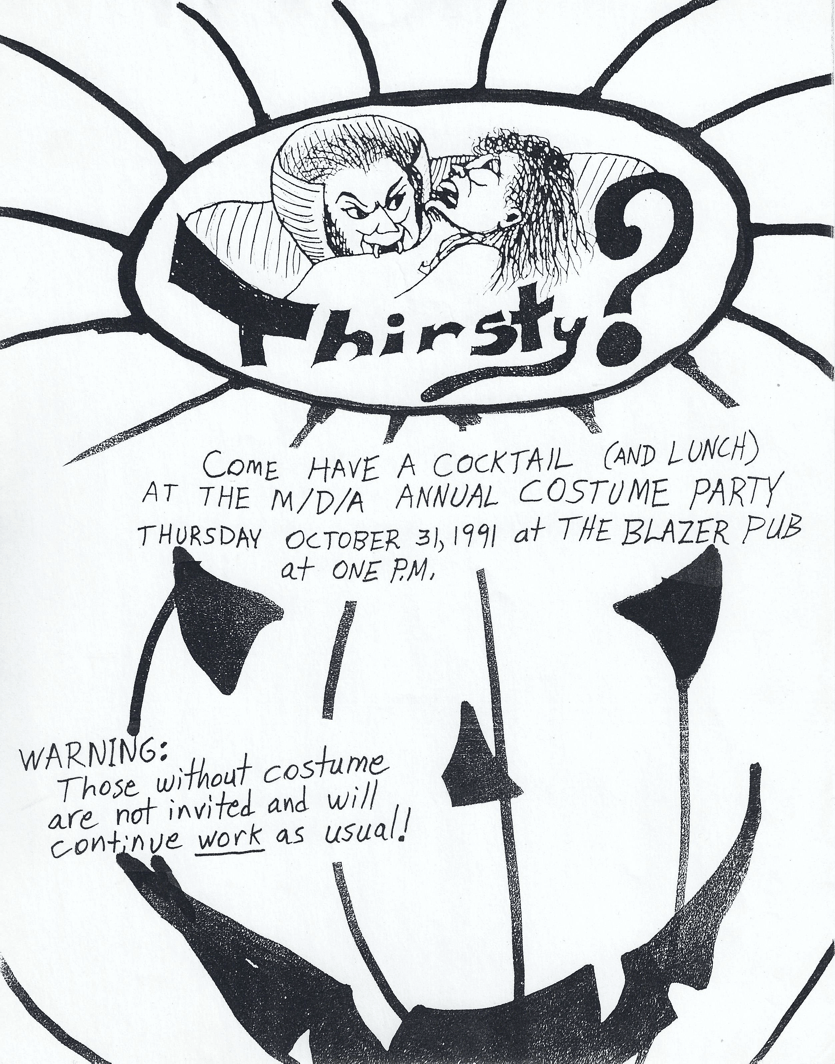
A note on the artwork: The eight drawings used in this post are scans of old drawings from back in my still-healthy-enough-to-draw-a-straight-line days. I had lost too much fine motor control to do fine art, but I could still do cartoons, flyers, and illustrations. Some of these are from the bittersweet final years of still hanging on to my job–so I’m nostalgic about them for two reasons.

Confusion About Violence   (2016Jun16)

Thursday, June 16, 2016                                          10:00 AM

Some motherfucker has commented on my YouTube post of one of Mendelssohn’s ‘Songs Without Words’ saying, “What a laugh! lol.” So I went to his YouTube channel to see what he was about—he had a post of the same piece, which he played very well, liked a trained pianist. My recording was definitely inferior—I don’t play very well—but I still didn’t understand why he felt the need to deride me—who made him the Internet Music Police, anyway?

Maybe he didn’t mean to be mean—I jump to conclusions about that, because he wouldn’t be the first troll on my YouTube channel and I’m kinda sensitive about my piano-playing. Maybe he’s just trying to make friends and he’s even more socially inept than I am—but that would be giving him a truckload of benefit of the doubt. A friendly comment would have made a point of laughing with me rather than at me.

But that leaves the question of ‘why would anyone bother?’ Who surfs YouTube looking for videos to make fun of—and how would a person’s life become so vacuous that being unpleasant to strangers would become a pastime? He may very well have been trying to upset me—but all such comments only confuse me—don’t people have anything better to do?


I’ve made many comments on other people’s YouTube posts—but I never bother unless I want them to know how much I enjoyed their music, or thank them, or encourage them to keep playing and posting. Here on WordPress I find myself sometimes trading barbs with someone who offends my sensibilities—but on YouTube? If I don’t like a YouTube post, I just stop listening—I don’t go out of my way to tell someone I don’t like their music. That’s like telling someone you don’t like their religion—or their face. It’s just rude.


I don’t like violence—I don’t understand how it keeps being such a big part of our lives. It never produces anything but more violence. Maybe I’m just lucky enough to live a life where violence doesn’t come up—but even in situations where violence is commonplace, I still don’t see it doing anyone any good.

And trolling seems to me much more an advertisement of loneliness than any kind of criticism I would take seriously.

Truth, Eventually   (2016Jun15)

Tuesday, June 14, 2016                                            4:40 PM

What a beautiful day—but I wasted it staying indoors the whole day. I’m not feeling too well. Sometimes I feel just miserable—I always have trouble dealing with that. It doesn’t take much to put me off my game.

Wednesday, June 15, 2016                                     10:50 AM

Another beautiful day. I try to avoid the news—tragedy, massacre, terrorism, gun violence, anti-gay-hate-crimes, and demagoguery—the only good to come of it is the straight talk coming out of the White House. President Obama has some unpolitic things to say about gun lovers, the GOP, and their off-the-leash candidate—but all common-sense comments, long overdue for a public figure to say them publicly. It always does my heart good to see someone on TV who isn’t spouting absolute garbage.

I can’t help noticing that the talking heads have distorted ‘fairness’ to the point where insanity and ignorance have equal weight to mature reason. For example, I’ve heard Hillary Clinton’s statements described as ‘attacks’ on Trump. But if Trump is evil and idiotic, and someone says so, are they really attacking him, or are they simply describing him accurately? Is honesty an attack? I didn’t think so, but the media have taken ‘objectivity’ to the point where they don’t ‘judge’ a person’s words, even dishonest hate-speech and demagoguery, as being anything other than the ‘other side’ of an argument. In effect, they’ve institutionalized evil.

This mania for ratings and promotion of conflicts has made the news media a force for bad in the world. Journalism used to be thought of as an exposer of truth—but today’s TV journalism actual manages to confuse the truth by making it merely one ‘point of view’. That makes me angry—and every day I am less inclined to check in with the news, knowing that their distortions will only upset me. I increasingly find that my own take on what’s happening never sees air time nowadays until at least a month later, after the heat has left the story and all the yahoos have moved on to the next issue.

Only then will they say something like ‘but Obamacare is working’ or ‘but the Iran nuclear deal is holding’. They never say such things while there are still clicks to be had discussing the fear-mongering doubts and hollow arguments of the naysayers. They are literally milking the stupidity of every issue, avoiding any sensible remarks until the smoke clears—and while I used to think that conservatives were the main thing slowing us down and holding us back, I now see the media as a contender for first place in that competition.

Laughing At Logic   (2016Jun12)

20130325XD-Goog-Imag-Marc_Chagall_0280

Saturday, June 11, 2016                                           11:05 AM

Just because you may be ignorant and misinformed doesn’t mean that you don’t have the courage of your convictions—which is sad. It is unfortunate that the burning fervor we feel towards our beliefs has no connection to their veracity. Who knows how much of what I wholeheartedly support and staunchly defend is utter bullshit? Wouldn’t it be nice if we only felt right about something when it actually was right? I wish truth had the ring of truth to it.

20130811XD-GooglImag-827ea

By the same token, it would be nice if the people who were right about one thing were right about everything—or even if people who lie could be counted on to always lie. Any kind of standard would be good—but we are people, not machines—and proud of the fact that we have no standard—to each his or her own, as we like to say. Which means: “I have my truth, you have yours—and even if they are opposites, they are both still valid.”

rackham8

The fact that such a statement is bullshit on its face doesn’t keep us from enshrining that belief as ‘freedom of speech’. In America, you have the right to be stupid, or pretend to be stupid (i.e. lie) in public statements—and even if you’re proven wrong, you don’t have to shut up. If you are right and I am wrong, I still get to spend a lifetime, if I wish, spreading my wrong to as many people as I can convince—that’s the American way.

delightW

This is particularly troubling when we remember that psychological experiment proving that those rooting for one side see every play in a game differently than observers rooting for the other side. Wrong ideas can spread but, worse, wrong thinking can color our interpretation of events—our every perception of what is happening. Here in ‘free-speech’ land, it has become a war of perceptions—and mass media becomes a powerful weapon in that struggle.

frontis

Logic is omitted from this equation—just as it is excluded from democracy itself—when the majority rules, the minority never get what they want. Satisfying the majority is referred to as the ‘greatest good for the greatest number’—but it also assumes that some people are not going to get their way—and that’s okay. It’s not a good system—but it’s the best we can do. The fact that American democracy isn’t entirely democratic—that our votes are only counted after the elite have picked the candidates we have to choose from—complicates the question even further—but even pure democracy, as an ideal, is a guarantee that people in the minority will not get what they want.

20130811XD-GooglImag-harding__mary_e-the_squire_s_arrival

But don’t get me wrong—if there are faults inherent in free speech or democracy, that doesn’t mean we have it as bad as people who live in Libya, Syria, China, Mexico, Colombia, or Bangladesh. Those people live amid chaos and violence that make my squawks about American ideals pretty nit-picky. Sometimes, when I take a walk, I decide to sing and dance a little bit while I walk—and there are countries where that will get you jailed, shot, or stoned to death. So, yeah, democracy is okay by me. I think Churchill said something about democracy being a terrible form of government—but it’s better than all the others.

20151106XD-Rijk_Windmolen

Free speech and democracy are wildly imperfect—but we defend them with our lives because they allow for a very important fact—nobody can be counted on to be right all the time. We need to be able to criticize our society and its leaders—to speak freely, even if that means we have to give the same privilege to an asshole. No law or law-maker is perfect, so we need to ask for everybody’s opinion and go with the one which (or whom) most people approve of—and that’s where democracy comes in. We allow for the minority being disappointed because we figure the odds are better that the solution most people desire is the correct one.

20151106XD-Rijk_Allegory_of_the_science

However, because of free speech, we allow for a misinformed electorate—which creates the possibility of the majority being misled. And that’s where this year’s election gets dicey. With significant portions of the electorate convinced that they are being lied to by their leaders, their media, and even their textbooks—one has to wonder what’s left to them as sources of information. And so now America has to deal with the phenomenon of people who ‘know’ what they want to know, and deny any knowledge that they don’t want to accept. That’s not the way I was raised, but freedom of speech says it’s all okay.

It’s all very complicated. It can make a person feel old, sometimes.

20130224XD-NASA-Mercury_messenger


.

Book Review: “Soledad : Dark Republic Book I” by D. L. Young  (2016Jun11)

20160611XD-DLYoung_Soledad

Saturday, June 11, 2016                                           2:22 PM

A near-future Texan dystopia is the setting for this tale of a young soothsaying-witch who travels the badlands in search of her lost family. Rich in detail, from the ways of the isolated bands and freelancers to the characters who accompany her in her search for the truth, this story posits a very believable, if highly unpleasant, future history for the lone star state.

D. L. Young grabs you right away and holds on pretty tight for the duration of this slim novel—but, if it seems too short, note that the title suggests more to come. I read it in one sitting and found the time flew by. And I commend the ending of this book—it leaves one thinking—and for me, that’s the best ending a book can have. It seems excellent fodder for Hollywood so I suggest you read it now, before they make the movie. Good story-telling, good writing—what’s to complain about?

No story can be grand without a grand evil—and Mr. Young has come up with a doozy or two—though I won’t spoil it for you. While modern technology makes any near-future story a case of speculating on where existing tech will be in twenty or so years—and that can be both awe-inspiring and terrifying—I miss the old days, when a Sci-Fi story had a big idea behind it. To be fair, Sci-Fi is well-traveled territory—and big ideas aren’t just lying around like they used to be. Plus, there’s a lot more of it being published (or e-published) these days. While that ensures that the number of so-so Sci-Fi books will expand, we may still hope that the ‘good reads’ will increase, as well. This book is certainly a good read, and its writer a good find.

I’ve read a lot of science fiction—I mean a lot. At sixty, I can fairly say that I’ve obsessed over Sci-Fi for fifty years, for most of that time averaging a book a day—and a good 90% of them being Sci-Fi anthologies or novels. I’m about as familiar with story-telling as a person can be, short of actually being a fiction writer. Inevitably, nowadays, most fiction I read resonates with the echoes of the many stories where a similar idea, plot-point, character-type, etc. was used.

I never read many Westerns—but I made a point of reading “The Virginian” by Owen Wister, because I had read that it was the first book to use Western tropes such as ‘dueling at high noon’, or the ‘pretty schoolmarm’, and other such clichés that we now find re-worked in an appalling genre whose readers (and movie goers) apparently favor iconic sensationalism over originality. But not all Western writers are completely beholden to Mr. Wister. The genre has accumulated many more tropes and clichés from more original contributors. And we must accept the fact that a genre so limited in space, time, and culture can only offer so many scenarios suitable for dramatic storytelling.

I’ve always considered Science Fiction to be quite different in that respect—there are no constraints of time, space, culture—or much anything else—and that is partly the point of Sci-Fi, to begin with. Yet, like Westerns, once the mass market gets involved, there arises an audience for re-workings of the most popular and sensational set pieces—war in space, robot uprisings, alien invasions, time travel, etc. The most insipid aspect of mass market Sci-Fi is its drooling cousin, the comic-book super-hero genre—the only redeeming feature of which is that it makes me less annoyed at the conflation of Sci-Fi and Fantasy—at least Fantasy shares some of the infinite, boundless vision of Sci-Fi, even if it pollutes it with fairy dust.

All of this is a roundabout way of reaching my point—that Sci-Fi, though all about ideas, is now amenable to some mining of the past. It is still nigh onto plagiarism to write an entire ‘collage’ consisting only of the popular ideas of others—but an original work can be excused for borrowing parts and pieces. The annals of Sci-Fi contain some of the most brilliant brain-work of the last century—many of our actual technologies were invented by Science Fiction writers—so if we’re going to start pointing fingers, we’ll have to confess that we all live in somewhat of a ‘plagiarism’. Further, there are aspects of outer space survival, orbital mechanics, etc., that have left the arena of speculation—so repetition in that respect is merely an eye for realistic detail.

‘Inventing worlds’ itself was originated by Frank Herbert, just as inventing societies, cultures and languages was pioneered by Ursula Le Guin (in Sci-Fi—Tolkien, of course, did it earlier with Fantasy). But such breakthroughs are in the nature of opening a door that no one else had hitherto seen—and it is only natural that writers should jump on the band-wagon of greater possibilities—subsequent writers don’t copy them so much as learn from them. And in this respect, Sci-Fi lit has a proud heritage of conceptual plagiarism—much like literature as a whole.

So, while “Soledad” has a few bells and whistles that will seem familiar—and a discernible patina of Paolo Bacigalupi’s “The Water Knife”—it is still an original story told in a unique voice. As an old salt in the sea of Sci-Fi, I’ve learned to excuse the familiar elements of the modern Sci-Fi-writer’s toolkit and embrace the newness it is used in service of. Especially when the writing is good.


While They Still Know Everything   (2016Jun09)

Thursday, June 09, 2016                                          1:02 PM

Okay, here it comes. I’ve gotten so caught up in the last week or so of politics that I’m letting myself be baited by Facebook posts and comments, until I’ve turned into an angry, dismissive apologist for Hillary Clinton. But with so much stupidity flying around, when I get into combat mode I find myself in a target-rich environment.

Bernie made a great contribution to the national discourse—but in so doing, he also energized young people to switch from debating Klingon parts of speech to debating the many conspiracy theories and smear campaigns against Hillary. No matter what they’re told, they have an endless array of mud-slinging trivia to answer with—her supporters, like myself, are overwhelmed with the tidal wave of shit that’s been generated by the haters for longer than most of Bernie’s camp have been alive.

And of course, being young, they are all omniscient—it’s exhausting. They are too young to know or remember that the initial insults hurled at Hillary were largely anti-feminist-based, back when you could still go in that politically-incorrect direction.

Hillary originated in a time when the GOP still stood for anti-feminism, anti-integration, anti-social services—before they learned to gloss over that nonsense—and she was their boogey-woman-in-chief, the sole target of all their viciousness. That all these super-liberal kids are taking up the GOP banner and marching with it is intensely tragic to me.

Biography comes into it, now, as well—I wish people would ask themselves what that long career—First Lady in Arkansas, First Lady in the White House, NY Senator, Presidential hopeful, Secretary of State, and now again Presidential campaigner—would look like if they had lived through it. Would they do everything perfectly? Would they never change their position on a single issue? And that’s not even factoring in the insistent, burning hate being thrown her way every goddamned day. Secretary Clinton doesn’t claim to be perfect—she doesn’t claim to be superwoman—she’s a politician who has done a variety of incredibly tough jobs. As they say, any jackass can kick down a barn—it’s takes a carpenter to build one.

 
In closing, let me share an idea my son told me—as a response to the GOP’s refusal to hear Obama’s Supreme Court nominee—let them know that when Hillary takes office, she’s going to appoint Obama—that’ll learn’em. My son is a genius.


.


Hint: 1600   (2016Jun07)

hillary-clinton-foreign-policy-speech-06022016-large-169

Tuesday, June 07, 2016                                            6:48 PM

The New York Times ran an article about the endless, daunting, slogging journey that Hillary Clinton has traveled to become the nominee—not just years, but decades, of being the woman with a target on her back—for partisans, for media, for troglodyte he-men women-haters everywhere—for over a quarter-of-a-century now of public service. Yet the New York Times says, “even now, we’re not really sure what she believes in”. I call bullshit. We know—it’s just too simple and straightforward for the media to digest—Secretary Clinton believes in service—she wants to do good, with practical programs and political solutions that help people, especially people in need.

That such blanket sincerity doesn’t fit the narrative they’ve shaped for her—and the fact that ‘good intent’ as a political platform has no zippy label just yet—make it impossible for the media to suss out ‘what she believes’—because she doesn’t believe in a sound-bite or a slogan. The Times points to her difficulty settling on a slogan—without ever questioning whether that’s a bad thing or maybe a good thing. They call her a Democratic Party insider—but that really only means she’s been mixing it up on the political playing-field for a long time—all the dire partisanship is directed towards her. It’s not going both ways—Hillary’s focus has always been on doing the job, not defeating the ‘other side’.

And as far as political platforms go, I like the sound of ‘getting things done, being serious, and not playing to the gallery’. That’s my kind of party—particularly if we’re talking about a champion to face the hydra-headed monster that is the Oval Office.

Let’s turn to the other side now—Trump has claimed his racist ranting was ‘misunderstood’. Well, I’m sorry—but he’s disqualified either way—either he’s a monster—or he’s incapable of coherent speech. My money’s on a little of both, but it doesn’t matter. Ask yourself if you feel as qualified for the Presidency as Trump is—if you, a regular Joe or Joe-ette, would be no worse than he as leader of the free world. I certainly qualify—and that concerns me. Yes, you can grow up to be anything—but you can’t decide to play concert violin on a Friday and book Carnegie Hall by Monday—that’s a fantasy. And we all know how you really get there.

If Armageddon came, and all the politicians and officials were swept away, then, yes, I suppose Trump would be as good a choice as anyone. But we have a whole country full of hard-working states-persons and experienced leaders—one of the best is running against him. I suggest a test for Mr. Trump—someone ask him for the mailing address of the White House—see if he can come up with that poser.

But No Cigar   (2016Jun07)

Tuesday, June 07, 2016                                            12:10 PM

Poor Bernie! He’s done a great job of dragging the Democrats back to the socialist agenda that made FDR’s New Deal and LBJ’s War On Poverty. If the Democrats aren’t all about social justice and social services, then they don’t really stand for anything. The centrist agenda that helped Hillary’s husband get elected may have been politically expedient, but it also hollowed out the core of what we’ve come to expect from the Democratic Party.

But Bernie’s done it—he’s forced Hillary to publicly advocate for a war on income inequality—leaving her with baggage she will find difficult to misplace, once elected. Still, I think it’s a mistake to assume that she’s done so unwillingly—anyone familiar with her early work, co-founding Arkansas Advocates for Children and Families, and other initiatives, will recognize that she is happy for the opening that Sanders’ campaign afforded her. It wasn’t Hillary who spent the last two decades backing away from social programs and banking regulations—it was her entire party, going for the easy vote.

Had Hillary attempted to run on her present platform, without Sanders’ competition as a foil, she would have been branded a wild extremist. So, well done, Bernie. Though, to be fair, it is these last decades of centrist, business-friendly politics that have created a situation where people are ready for socialism’s resurgence, whether from Bernie or Hillary.

Now, the big problem is simply this: Bernie is a human being—and not just that, he’s an old man. He’s spent the last two years being cheered by throngs of adoring young people, championing justice for the little guy, fighting the good fight. It’s going to be very hard for him to just turn around and go home. He was so close. But be of good cheer, Bern-feelers—Hillary hasn’t promised as much, but I believe she will deliver on more of her promises than Bernie ever could. In the end, that will give you more of what you’re looking for, just not everything. The rest we can talk about in four years.

The Wizard   (2016Jun06)

Monday, June 06, 2016                                            6:13 PM

Walt Disney created the animated film “The Sword In The Stone”, based on part one of T. H. White’s classic, “The Once and Future King”—it is a well-known story of how young Arthur grew and learned from his tutor, Merlin. Aside from all the magic and wonder of the story, my young, book-worm self was jealous of the young king’s schooling. Not that I wished to study nature by being turned into a fish or a bird for an afternoon—though that was certainly cool—no, I wanted an old scholar to inundate me with arcane and disparate knowledge. I wanted to delve into gigantic, dusty tomes and perform burbling, sulfurous experiments with curlicued distillation-piping and whatnot. I wanted to learn the proverbial ‘everything’.

20160606XD-DISNEYS_Merlin_04

There’s a reason why pre-digital civilization impressed on youth the value of a ‘liberal arts’ education. Metaphors, analogues, and cross-references form a large part of our intellectual development—learning about one thing teaches us about much more than that one thing. The reasoning went that a greatest possible multiplicity of things learned allowed the greatest possible number of avenues for reasoning and problem-solving. In modern terms, it created the most complex network within the brain.

Science of old, starting from way back, when it was still alchemy and ‘sorcery’, had an image problem—outright scientific study was a good way to get burnt at the stake or run out of town. Secrecy led to obscurity—and early scientists went to great lengths to complicate their elucidations, making them seem more impressive—and excluding those without the drive to wade through all the double-talk. You can still observe this behavior today, in the insider-speak of tech-geeks.

In addition, science could only cut across the Old World’s many cultural boundaries by using a lingua franca—or two, really—Latin and Ancient Greek. That is why the nomenclature for many scientific terms is derived from these dead languages—they were only ‘dead’ in the technical sense. The pope could issue a papal bull in Latin and send copies to every church in Western Europe and beyond.

Both the church and the early philosophers used these languages to provide a standard that crossed boundaries of local language—and originally, a Classical education was a literal term—students learned the classics, which meant learning the classic languages they were written in. You’ll tend to see a lot more Latin in the arts, and a lot more Greek in mathematics and the sciences—there are reasons for that which I won’t get into here.

20160606XD-DISNEYS_Merlin_03

Digital enhancement of education techniques, job-market prep, and economic competition are all factors that tend to reduce the educational experience to a monaural playback, trimmed to its ‘essentials’. And that, of course, is when the educational system is functional to begin with. But education is the perfect example of something being more than the sum of its parts—and the more parts to an education, the greater the total sum.

Merlin wasn’t trying to teach Arthur to become a wizard—but he was trying his best to give the boy a wizard’s perspective—a knowledge of, if nothing else, the breadth of knowledge. He did this because he knew that a king could never be wise without some perspective. And if the history of technology has taught us anything, it is the importance of perspective—burning oil can be very useful, but burning too much oil is a problem; growing a lot of food can protect us from famine, but eating too much food can make us unhealthy.

20160606XD-DISNEYS_Merlin_02

And now, as global warming re-shapes our coastlines and submerges islands, as low-earth orbit becomes a navigational hazard due to decades of space launches, and as YouTube makes it possible for terrorists to indoctrinate teens a half a world away, we need breadth of perspective like never before. STEM is a great initiative, but as our science progresses, we are more than ever dependent on our ability to extrapolate and explore the consequences of each new and changing aspect. Engineering new gadgets is just the starter pistol—what happens when the whole world gets a new ability, a new insight? Sometimes you get Angry Birds, sometimes you get ISIL online—sometimes both.

Narrowing our field of view to the mere engineering and manufacture of new tech, without the humanities, without history, without the insight of creative expression—that’s a recipe for disaster. Yes, keep STEM—it’s a great idea—but don’t stop there. The more advanced we get, the less we can afford the luxury of shortsightedness. People always want more tech, or more money, or more guns—but the smart people always want the same thing—we want more ‘More’ in our vision—because we know that that’s where all that other good stuff came from in the first place—and much more.

Balance is an unappreciated virtue—as an example, consider: we have made so much progress in digital programming that we are possibly on the cusp of creating a machine that can out-think us. Cool, right? But those with a broader perspective have pointed out that a machine that’s smarter than us just might be a risky proposition. Well, I don’t expect humanity will be overwhelmed with common sense overnight—so I guess we’re about to find out. Are you ready to meet the Wizard?

20160606XD-DISNEYS_Merlin_01


..

Spoiler?   (2016Jun05)

Sunday, June 05, 2016                                             12:31 PM

Back when Trump first entered the Presidential contest, there was speculation that he was a Democrat-spoiler—a troublemaker who only got into the Republican primary to help guarantee Hillary’s lock on the coming election—and perhaps raise his Q-rating in anticipation of his next reality show.

Having out-stupided all his GOP rivals and made a shambles of the GOP platform (such as it is) he is now making racist pronouncements regarding the judge presiding over his rip-off-‘university’ lawsuit—on a daily basis. His campaign has never troubled itself with the ‘boots on the ground’ machinery that the ‘real’ politicians use to get out their constituency. And he seems to go out of his way to do and say things which make the GOP leadership either squirm mightily—or have to repudiate outright.

I think it’s time to revisit the spoiler theory. Trump is in this race alright—he’s campaigning for Hillary, as far as I can tell. For a while there, it looked like the most ignorant portion of the GOP base would make of his parody a serious campaign, whether he wanted to become president or not. But Trump has always been resourceful, and he has found a solution—be blatantly racist. No one in America can get away with being publicly, pointedly racist—and Trump thus guarantees that anyone extreme enough to maintain their support for him will only expose their own small-minded-ness.

It is possible that he’s still serious—that his current race-baiting is in response to the positive image briefly generated by violence from those anti-Trump protestors in California—maybe he’s trying to spur them on to greater excesses, allowing him to play the victim. But it’s not working out that way. His anti-Americanism isn’t making people angry—it’s leaving them breathless with amazement at the depths of his bigotry. We all look at each other and ask, ‘Is this really happening?’ Even his top aides are shrugging their shoulders at his insanity, speechless.

Trump is a showman. But his latest performances have been tight-rope walks along the edge of civility. I figure his next move is probably going to be a statement against Religion—which would both devastate ‘his’ party and drive the country as a whole to new fits of outrage and disbelief. And just imagine how mortifying it will be for all of us atheists to find ourselves on Trump’s side of an issue! It’s enough to send me back to church.

At this point, if Trump were to be elected, I wouldn’t move to Canada—I’d move to North Korea and help them design those nuclear missiles that can reach the US mainland. If the country I’ve grown up loving and respecting is that much of a lie, it’s time to wipe it from the face of the earth. One way or the other, Trump is definitely a spoiler.

People Physics   (2016Jun04)

Saturday, June 04, 2016                                           2:48 PM

People ape physics in many ways. They follow the Uncertainty Principle—if you observe them, you change them—as reality TV has amply proved. If you confine people too tightly, their excess friction will eventually cause an explosive reaction giving off heat as waste energy. And, of course, when people go up—they must come down—no individual unit can exceed its mortality. (I suppose death is the Gravity in that equation.) And people abhor a vacuum.

It’s true, we’re worse than Mother Nature. There is no room in any house that doesn’t fill up with stuff. There is no parcel of land in the middle of a city that accidentally went unused. People search the obituaries to find vacant apartments—and usually find the deceased’s relations have beaten them to it. There is no space on a long line where the person before it and the person behind have simply agreed to let there be a little gap there—it doesn’t happen.

Finances are the supreme example—every time I got a raise, my outlay matched it and then some. I didn’t do anything—I didn’t say to myself, ‘it’s time to add some expenses’. I simply found myself using all the money I had. I’d done the same with the smaller salaries—logic insists that I could have had money left over—but, no.

The rich people in San Francisco have packed themselves together so tightly that there’s no living space left for the help—their service workers have to commute from far off—and their already meager wages lose a big chunk to transportation costs. I wouldn’t stand for it. I’d organize the service workers in San Francisco and get them all jobs somewhere they can still find a place to live—let those rich bastards do their own chores until they get a clue, and agree to wages plus commuting costs.

I loved seeing the news yesterday about the Chicago Police releasing a bunch of videos of police behavior where a civilian was either killed or hospitalized. The lady who’d worked towards this ongoing program (there will be regular releases from now on), Sharon Fairley, chief administrator of the Independent Police Review Authority, called it an historic step forward for transparency in the city’s police force. What I loved was that there was this one prominent hold-out cracker who pooh-poohed the whole thing as ‘dangerous’ or some such BS—and the talking head asked the lady to respond—and she said, “Well, he’s wrong.” There should be a lot more of that in the news. Sometimes—a lot of times—some stupid politician is just wrong—end of sentence. An orange one comes to mind.

People as a group can be very geometrical—you tempt them this way, you shove them that way, you can pretty much call the shot—you know where they’re headed afterwards. And smart politicians look at it that way—not as a template for manipulation, as a demagogue would do, but as a blueprint for social progress. I always liked it when President Obama points out that doing something the same way for fifty years and getting no results was crazy. A lot of society’s ills come from just that tendency—to keep doing what we’re doing, even when someone is telling us it’s not working.

It’s hard to tell, especially in legislation, whether something is a healthy letting go of a wrong-headed assumption, or a half-baked imposition invented by lounge-liberals or beer jocks. There are so many laws that need to be undone (the patriot act is an example) and so many things not enshrined into law that we must nevertheless defend to the death (like separation of church and state). I have great respect for a good politician—leading people, in any capacity, is about as easy as herding cats. But designing legislation—making a piece of paper create a better life for his or her constituents—that’s an art form. I just got a chill—that exactly what Hitler said! Am I Hitler?! Oh, I hope not. Wouldn’t it suck to realize you’re really Hitler? Jeez.

Actually, it makes sense—Hitler was not a good painter, so he decided to go into politics as a modern ‘art form’—and he was even worse at that, despite some initial rave reviews. But he was right—politics is art. The trouble with that is there are so few great artists.

Book Review: “The Sound of Time: A Novel” by Julian Barnes (2016Jun03)

Friday, June 03, 2016                                               11:37 PM

Friday’s here—and just as I often don’t get fully awake before noon, I feel like I’m just getting warmed up whenever the end of the week rolls around. Old and in poor health is no way to suck the marrow from life. But I find I have company, or rather, competition.

That is to say that I’ve just finished reading Julian Barnes’ excellent historical novel, “The Noise of Time: A Novel”, touching on the life of Dmitri Shostakovich—a Russian composer of the Soviet era, and a favorite of mine since my early teens. I clearly remember mentioning the name to my mother one day, mispronouncing it, and being surprised that she corrected my pronunciation of his name—firstly because I realized he was famous enough for my mother to know his name, and secondly because I had been enamored of his music for months, while saying his name wrong (I had been thinking of him as Shos-TOCK-ovich!)

The Russians take pride in their deep sadness—as an American, I’ll never get that, but I get it, kind of. Masochism, irony, and melancholy are tools I have used myself in defense against a dysfunctional reality. But my life, and my troubles, are of an American smallness, in comparison to Barnes’ description of the living hell Shostakovich found himself in. He was a sensitive composer trapped in Stalin’s Russia, forced to publicly denounce his own works, and the works of his hero, Stravinsky—and other close friends and respected musicians; in danger for years from ideologues and politicians trying to ferret out disloyalty, even in thoughts and feelings, especially among artists—and even more especially in composers who had achieved global fame.

The book reminded me of the stories I heard about Soviet Russians living in terror of anonymous squads who came and took them in the night, often never to be seen again—and about the ideological tyranny that deposed aesthetics as the yardstick against which their art was ‘measured’—and sometimes condemned, along with the artist’s life.

Stalin’s rule, up to 1953, was so bloody that upon his death and the ascension of Khrushchev, it was said that ‘the Soviet had become vegetarian’. Although it may be more proper to say that the Soviet ceased to be cannibalistic, since Stalin’s machine had been devouring his own people. And Shostakovich was apparently a pretty nervous fellow—at the height of the pseudo-ideological criticisms of his music, he spent every night, for weeks, waiting at the elevator to be taken away by the KGB so that they wouldn’t have to burst into his apartment and drag him away in front of his wife and child. Barnes writes that Dmitri was just one of many people who observed this nighttime ritual during the terror known as Stalin’s Cult of Personality. Shostakovich’s life was one horror show after another—and it didn’t help that he was fairly well-off, compared to the average Soviet Russian—that just gave him more to lose.

As a boy, my favorite of his works was the last movement of his fifth symphony—but as I matured, I learned to prefer the rest of the symphony. According to Barnes’ story, Shostakovich was forced to add the final ‘triumphal’ movement to the symphony because the foregoing movements were so unremittingly ‘pessimistic’—and so he composed the final movement ironically. To my callow ears, and to the politburo, it sounded glorious (which saved Shostakovich’s life, and career)—but as my tastes matured I came to find the last movement somehow brash and ugly, and prefer the music that comes before—and now I know why, I suppose. Much is made in the book of the fact that when confronted with brainless tyranny, the only safe rebellion is in irony—but that irony over time gets lost in itself.

This book is no happy story, but it is something perhaps better—a fascinating story about strange and awful truths, and the horrendous lies that hide them, for a time at least. I have long since given up hope of finding in great artists’ lives any kind of reflection or explanation of the exaltation of their creations—but this book actually matches up the bleakness heard in most of his music with the day-to-day life of its composer. I read it in one sitting—something I’m only pushed into nowadays by irresistibly good writing and an enthralling story.

Barnes quotes Shakespeare at one point, mentioning that his Sonnet LXVI resonated with the artists of Soviet Russia, particularly the line, “And art made tongue-tied by authority”. I had to go look at the whole poem and I am struck, not for the first time, by how apropos Shakespeare always is, no matter how modern we think we have become:

  Tired with all these, for restful death I cry,

  As to behold desert a beggar born,

  And needy nothing trimm’d in jollity,

  And purest faith unhappily forsworn,

  And gilded honour shamefully misplac’d,

  And maiden virtue rudely strumpeted,

  And right perfection wrongfully disgrac’d,

  And strength by limping sway disabled

  And art made tongue-tied by authority,

  And folly—doctor-like—controlling skill,

  And simple truth miscall’d simplicity,

  And captive good attending captain ill:

     Tir’d with all these, from these would I be gone,

     Save that, to die, I leave my love alone.

(Shakespeare, William (2011-03-24). Shakespeare’s Sonnets (p. 132).  . Kindle Edition.)

I love that line about “And folly—doctor-like—controlling skill,”—geniuses so often appear to fools as people who need to be ‘cured’, or at the very least, ‘corrected’. The poem as a whole is fitting for a Shostakovich biographical novel—he too was often tempted by thoughts of suicide, harried by the ubiquitous surplus of malevolent injustice crowding every aspect of his life.

That’s my take on the book—-lacking a segue, here’s two improvs from earlier today–hope you like them:


..


It’s About Us   (2016Jun03)

hillary-clinton-foreign-policy-speech-06022016-large-169

Friday, June 03, 2016                                               11:41 AM

I love Hillary Clinton! She made a speech yesterday that clearly explained why Trump is not a candidate, but a threat. She said that even if she wasn’t running herself, she would be doing everything she could to make sure he was never President of the United States. Best of all, she condemned him with his own words—the wild public statements that he makes in passing, to jazz up his base, become evidence—when held up to the light—that he shouldn’t even have a driver’s license, never mind a public office. And as she described the nightmare of a President Trump, in the situation room, during a national crisis—a chill ran down my spine—what a friggin nightmare!

The media couldn’t even wait until she was done speaking before they started to leaven her statements with chyrons about Paul Ryan finally bowing to the inevitable, saying he would vote for Trump, because he would make GOP dreams into law. To me, that only confirms what Hillary was saying—it’d be a nightmare. It doesn’t seem to occur to the GOP that the reason they can’t satisfy their base is because their base wants to fundamentally change America into a nation of fear and anger and weakness.

There is no contest—when our choices are between Hillary Clinton and Donald Trump. As far as I’m concerned, the GOP has failed to produce a viable candidate—they’re stuck with Trump, their booby-prize for courting ignorance for so many years, but no one sees his potential presidency as good, or safe, or helpful. Even his supporters don’t expect him to keep America going—they hope he’ll turn the whole thing upside-down. If I didn’t live here, I’d say let’em have their way—see how they like it. But, as Hillary said, America is still full of reasonable, well-meaning people who are proud to be Americans and want to see America continue to lead the world toward freedom.

A democracy tries to do the greatest good for the greatest number. An election is a chance to get what we want. But it is also a litmus test of the electorate. If Hillary Clinton doesn’t win this election in a landslide, I’ll be personally disappointed—but I’ll also know something about the majority of American voters. I’ll know that we have become too ignorant to look out for our own self-interest, suckers for any used-car-salesman who happens to talk a good game. This election isn’t about the candidates—it’s about us.

Word Dump (2016Jun02)

Wednesday, June 01, 2016                                                         2:20 PM

Fresh Rant   (2016Jun01)

I receive spam from charities and from political parties—asking for my financial help—I don’t even let them make me feel guilty anymore, I just resent being reminded how I could use a little financial help of my own. Since when did politics require millions of people to donate their hard-earned money to run TV ads? And don’t talk to me about crowd-funding—you know what we used to call crowd-funding? An extended family—that’s crowd-funding for people you know and love.

I’m not interested in helping other people—I’m interested in helping the people around me, the people close to me. Contrary to Tea-Party opinion, I prefer to pay taxes and let the government sort out people’s problems—it has its faults but it’s bound to do a better job than I can do on my own.

I understand that most charitable services are run by religious organizations—because the church used to be the gathering point for a community, where its larger issues were discussed and dealt with. The decline of religion as a binding force of the community has hurt efforts to deal with the homeless and underserved—being without a religion doesn’t keep me from mourning the coherency of that community-model—but it’s evaporated now and greater government involvement, supported by taxes, makes much more sense in today’s agnostic climate.

I also don’t like TV ads for fancy cars—of the millions of people watching TV, the vast majority of us can’t afford to go out and buy a Jaguar, BMW, Mercedes, Cadillac—not even a Lincoln. It pisses me off—especially knowing that, even if I could somehow buy one of those fancy cars, it would quickly be joy-ridden, tire-slashed, paint-keyed, and generally dinged until it looked just as crappy as the rest of the cars on my block. Plus, I could never afford the insurance rate, or the maintenance—which are as pricey as the car.

But I’d rather watch ads for fancy cars than listen to side-effects warnings for a drug for a disease I don’t have. My doctor will tell me when I need a drug, and which one, thank you—take your drug ads and shove’em. Still, when you consider buying a car, even a little, ‘cheap’ one, puts the normal person in hock for several years—what purpose is served by making that same hard-working, and now indebted, person feel bad about a major purchase? Ads for fifty and sixty thousand dollar cars washing over the TV screen every night—why not have ads for becoming a business owner, or president? Those are just as far out of my reach—and would annoy me only slightly less.

Income inequality has gotten completely out of hand—it makes me glad I’m old—if I were a younger man, I’d join the throng of protestors outraged that the same system that keeps them in groceries is the system that keeps them in their place—nowhere but working for the Man and getting paid less than a living wage for it. I’d run around organizing protests, campaigning for Bernie—and I’d be too young to realize how futile all of that is—the ones with the gold make the rules.

Then the futility of the whole thing would dawn on me and, being a young man, my mind would turn to ways of making mischief for the people I saw as oppressors. That would be so sixties-retro, like the second coming of the SLA or something. And like them I’d eventually end up in jail or on the run—though it isn’t nearly as easy, now, to disappear from the grid like those sixties fugitives who popped back up in the eighties and nineties, too old to live like that anymore.

But the truth is the ones with the gold only make the rules when the electorate is too numb to their own self-interest to let them—and we have done a lot of that over the last three decades. Political movements like Bernie’s would have to start on the backlog of injustice all those lobbyists have been shoving through both the Congress and all fifty state legislatures for decades. It would take us a while to get back to the income equality—in taxes—we enjoyed in the mid-twentieth century, before we could even start in on making things better—we have to roll back some of the ‘worse’ first.

The main trouble is that you can’t give to one person without somehow taking from another—and rich bastards sound just like normal people when they whine about having to make a sacrifice—usually, even whinier. They try to frighten us by pointing out that, when we get rich, we’ll have the same ‘oppression’ hanging over our heads—yeah, that’s my big concern.

And the media adds to the problem by representing ‘two sides’ of the issue—but it’s not really two sides, when one side is a handful of rich fucks and the other side is hundreds of millions of people. That is particularly true when the rich fucks own the media, as they do today.

But that is a condition as much as an issue—certainly nothing that can be solved with a clever blog-post. About the only thing optimistic about the media situation is that it leaves so much unexplored material that a ‘counter-media’ can start to get sponsorship (as opposed to ownership) for journalism that covers the many things being avoided and overlooked by the establishment media. We hear so much about meta-data and ‘drilling down’—but we still see news that is endlessly busying itself with minutiae and wow-factor and click-bait.

If Edward R. Murrow had our modern resources for research and analysis, he’d be giving us very different stuff. He liked to follow things to their future consequences—his attacks on McCarthy were driven by a deep concern for this country’s future and the future of its people’s rights and freedoms. If he were confronted with the kind of accelerated change we’re experiencing right now, I’m sure he would be reporting on certain days’ events only as they relate to what will happen in five, ten or twenty years’ time.

Modern people are flooded with information—and everyone with experience in that will tell you—when data comes at you like a fire-hose, you don’t get lost in the minutiae—you look for patterns and trends. You can’t understand our culture through a single person or a single period of time. When reporters ask a bystander how they feel about what just happened across the street—it gives me a pain. Reporters with access to global resources and instant data should be virtuosos of pattern-analysis, artisans of the long-term take-away on any given issue—and lots of reporting on how issues interlock with each other—just as the peoples of the world are now beginning to interlock their fates across the globe.

Maybe it was my age, at the time, but when I was younger a talking head was always bright, sharp, educated, and informed—the TV was the smartest ‘person’ in the room. Now we get Harvey Levin and TMZ. Jeez, what a tool. I mean journalist.

There’s one good thing about the media becoming a mindless monster—they’re finally starting to chow down on the Donald. Yes, Donald—the media is your friend—until it isn’t. Even innocent people are helpless in the face of their onslaught—did you really think a scumbag like yourself could just play it like a harp, and emerge unscathed? Keep dreaming, Mr. wanna-be-president.

Trump’s attempt to ‘fool all the people all the time’ is a perfect example of how democracy requires an informed electorate. The left wing of the presidential campaign is focused on income-inequality—and for good reason—but we should take this election season as a warning. We need to improve our educational system, and do it right quick. No one as ignorant as Donald Trump should have ever gotten this far—and he never would have, if he wasn’t reaching a deep reservoir of shamefully ignorant Americans.

Plus, our country’s failure to finance higher education for everyone is part and parcel of the march towards permanent income inequality—we’ll never level the playing field without offering equal access to information and knowledge.


Wednesday, June 01, 2016                                               6:08 PM

Proud

I’m proud.

I’m proud to be me.

I’m proud of my family.

I’m proud of my principles.

I’m proud of my understanding.

I’m proud of my neighborhood.

I’m proud of my country.

I’m not sure if I’m right to be proud

But that doesn’t stop me.

Give me my dignity or you’re looking for a fight.

Doesn’t matter if I’m dignified.

What—do I gotta put on a show for you?

Just take it for granted that I’m as good as you are.

Even if I’m wearing sweatpants—they don’t signify.

I am as good as you are.

Pretending I’m not just puts you down—not me.

I used to enjoy wearing a good suit

But I never made the mistake of thinking

It made me better than someone else.

I used to be a manager—telling people what to do—

But I never made the mistake of thinking

I was better than them.

I made mistakes alright, just not that one.

That’s a doozy.


Jeez—dat ain’t even a poem—I don’t know what you call that crap.

Sometimes I just write to hear myself type, I think.


Thursday, June 02, 2016                                          10:38 AM


I wasn’t going to post any of the above—it all seemed kinda whiney and introspective—but some of the points I tried to make were being echoed by President Obama during his PBS Town Hall with Gwen Ifill last night—so I am emboldened to the point of posting.

Seriously   (2016May31)

Tuesday, May 31, 2016                                                     11:34 PM

I take myself seriously—probably too much so. But it’s all of a piece—there are people that wouldn’t be able to take themselves seriously as a writer or musician, or artist, without some validation or recognition or encouragement. But I do it without any of that good stuff—the taking it seriously makes me take myself seriously, even when there’s no apparent evidence that I should.

20130310XD-PlanetRise(Branded_BkgrndGraphic_4UpLoad)

See, I don’t worry about whether I’m good or not—I was lucky, as a kid, to be gifted with a pencil and paper—lots of people told me I was good at drawing. But some people weren’t impressed. I noticed that. I wondered ‘how can I please a lot of people, yet fail to please everybody?’ I would come to discuss other peoples’ drawing—and find that I liked some that other people didn’t like, and lots of popular artists didn’t appeal to me.

20151026XD-Pastels_01b_Z

So I see the whole question of “Am I any good?” as a slippery one. Then I had the bad luck to fall in love with playing the piano—without any ability to play the piano. I was objectively bad. I played anyway, because I wanted to play—and I thought, ‘who knows, maybe I’ll get better.’ Well, I didn’t. I got better than I was, but I never got ‘good’. I felt safer with piano—I knew I could spend the rest of my life practicing and still have plenty of work to do. I enjoyed being challenged by something I was bad at more than being good at something I was talented at.

20141008XD-Sketches (53)_KingODFrostGiants_03(trimmed)

Then I got sick—and now my hands shake—so I can’t draw good anymore. I don’t really miss it. I miss people asking me to make custom-drawn birthday cards and flyers and stuff like that—I loved being useful—but I don’t miss trying to think up something to do on a blank piece of paper. After a while that became a lot of pressure. One of the things that made me a big draughtsman was I loved attracting an audience—people used to love to watch me draw—for a while, I’d be quite a showman about it—playing to the audience. That made sitting in a room, drawing pictures, to show people only after they were completed, seem unsatisfying.

20141008XD-Sketches (58)_

These days, I see some performance artists do a big painting for an audience, maybe dancing around while they throw paint at the canvas—and I think ‘good for you—you found a way to make it work for you.’ I should have realized, back then, that I enjoyed drawing for spectators—I wouldn’t have gotten so tired of drawing. I stopped doing the ‘performance-drawing’ because I noticed I let the quality of the artwork go, just to score points with the crowd—it’s too bad I couldn’t just have accepted that as a fair trade-off. (If I take myself too seriously now, it’s nothing to how too-serious I was as a kid.) But, spilt milk under the bridge, etc.

20150529XD-Illus_Scan_07

Anyhow, the point is, I’ve been doing stuff throughout my life without any serious concern about whether I was good or not. I’ve come to recognize that as a blessing. There are so many people who don’t draw, who don’t play an instrument—because they’re worried about being good at it. To me that’s not the point, at all. It’s the doing, not the judging. If you do something—and you get some good from doing it—you’re done. Whether other people approve or not. I always hear disapproval as encouragement to try harder.

20150531XD-Drawings (2)

I’m never worried about what other people will think—I’m only concerned with doing my best. And because I’m all about the trying, I take it very seriously. Which turns into taking myself seriously. It’s all of a piece. But I’m sure it makes me insufferable, most of the time. Sorry about that.

FamPh 572

The Weather—and Joseph Henry (2016May27)

Friday, May 27, 2016                                               9:21 AM

Yesterday was very warm—up in the eighties—and last night everyone turned on their air conditioning to go to bed (at least that’s how I figure it) and the power went out. Whatever the actual cause, though, we did have candles and cell phones from 9:30 PM until just before midnight. Once I got over being upset about it, I had a lovely time lying in the dark with the cross-breeze coming through the window—quiet, until the neighbors revved up their generators (I keep meaning to get us one).

There’s so little quiet in modern life—I miss it. That’s one of the great things about parks and trails and such—they don’t just preserve the wildlife, they preserve the quiet, too. Here on the Eastern Seaboard it’s become impossible to find total silence. My older brother moved to upstate New York for some years, back in the eighties—way out in the woods, far from any town—and a good ways from his nearest neighbors. But all he heard all summer long was chain-saws—and he was building a house himself, which was hardly silent. Even completely undeveloped places still have planes flying overhead or highways heard in the distance.

What is sometimes referred to as the Bos-Wash Megalopolis may not be the center of civilization, but it’s certainly in the top three concentrations of civilized development—and silence is not the only thing it has lost. It’s lost its darkness as well—New Yorkers who travel to the high desert out west, or down south to the Caribbean, will find themselves dazzled by the star-crowded sky enjoyed when the ambient city street-light isn’t washing out all but the brightest heavenly bodies.

Our water disappeared too—well, the clean water. It’s hard to imagine all the factory waste and sewage needed to make the Ohio River flammable—and even the mighty Hudson, despite Herculean efforts to clean it up, is hardly a crystal stream. Even the Great Lakes (and they don’t call them ‘great’ for nothing)—can you imagine how much crap we had to dump to pollute all five? It strains the imagination.

Diversity is another victim of civilization—this part of New York State once boasted bears, wolves, wildcats—and carrier pigeons so numerous as to block out the sun when a flock flew overhead. Not that I’d want to meet a bear or a pack of wolves in my front yard—but that’s what’s supposed to be here—that and so much more.

On the occasion of Joseph Henry’s death, he was memorialized at Princeton, where he had held a professorship prior to heading up the Smithsonian Institution in DC. I provide a link to the full article, but I wanted to show you some of my favorite quotes from this eulogy for my favorite historical figure:

https://books.google.com/books?id=Dk4tAAAAIAAJ&pg=RA1-PA139&num=19&source=gbs_toc_r&cad=4#v=onepage&q&f=false

Smithsonian Miscellaneous Collections, Volume 21

‘Memorial Discourse by Rev. Samuel B. Dod–delivered in the College Chapel, Princeton’

‘As a student of science he was ardent and enthusiastic in his love for the chosen pursuit of his life. He did not dally with it as a pastime, nor prosecute it with the greed of gain, nor pursue it with the ambition of making himself famous among men.’

‘He was characterized by great reverence in the pursuit of truth. Singularly modest as to his own powers and attainments, he never suffered the advancement of his own opinions to warp his judgment or govern his investigations; he held the progress of truth dearer than the success of a theory. And nothing moved his gentle nature to greater indignation than the pretensions of the charlatan or bigot in science.’

‘He says, when put on trial for his character as a man of science and a man of honor, “My life has been principally devoted to science and my investigations in different branches of physics have given me some reputation in the line of original discovery. I have sought however no patent for inventions and solicited no remuneration for my labors, but have freely given their results to the world; expecting only in return to enjoy the consciousness of having added by my investigations to the sum of human knowledge. The only reward I ever expected was the consciousness of advancing science, the pleasure of discovering new truths, and the scientfic reputation to which these labors would entitle me.” And verily I say unto you, he hath his reward.’

‘As an investigator, Professor Henry was characterized by great patience and thoroughness in his work of observation, and by broad, well-considered, and far-reaching generalizations. He distrusted the so-called “brilliant generalizations” with which those favor us who love speculation rather than study. He never took anything for granted, never despised the details of his work, but carefully established, step by step, those data on which he based his conclusions. In 1849 he says, “Since my removal to Princeton I have made several thousand original investigations on electricity, magnetism, and electro-magnetism, bearing on practical applications of electricity, brief minutes of which fill several hundred folio pages. They have cost me years of labor and much expense.”

A letter from Joseph Henry is appended by the Rev. Dod to this memorial discourse, in which Henry describes the outline of his work inventing the telegraph many years before Morse. Robert Morse, using tech developed for him by an associate of Henry’s, filed a patent for his ‘invention’, the telegraph—without having ever studied electricity. This is, to me, doubly devilish due to the prior instance, in which Michael Faraday and Henry discovered the principle of electro-magnetic induction almost simultaneously, with Henry, if anything, getting there first, but never given any share of credit.

Henry describes his legal fracas with Morse, explaining that he never wished to profit from his invention, and thus never applied for a patent, preferring to maintain the dignity of science. As he writes, “In this perhaps I was too fastidious.”—talk about an understatement. To end the discussion, he says, “To Mr. Morse however great credit is due for his alphabet, and for his great perseverance in bringing the telegraph into practical use.” To which we modern readers of this note may insert the implied ‘asshole’.

It is interesting to note in the story of early industrial-era science the concomitant birth of legal scrambles for credit which evolved into today’s battles over ownership of intellectual property. The Constitution mentions intellectual property in Article I, Section 8: “The Congress shall have Power … To promote the Progress of Science and useful Arts, by securing for limited Times to Authors and Inventors the exclusive Right to their respective Writings and Discoveries.”

Then there was the Patent Act of 1790, followed by the Patent Act of 1793 (between which only 55 patents were granted). But by the Patent Act of 1836, 10,000 patents had been granted. The Patent Act of 1836 was remarkable in creating the first Patent Office. It is no accident that all this legal and legislative activity coincided with the development of steam power and electro-magnetic technology. New inventions have always been looked back upon fondly for their elevation of the human condition—but there wasn’t a one of them that wasn’t also an immediate cash cow—and thus a bone of contention as well.

That Henry failed to perceive this is an example of the old dichotomy—a man with exceptional scientific insight rarely displays the same insight into human nature. There can be little doubt that Henry was a good man—but he was at a loss in dealing with lesser men.

It always seemed to me that the human brain confronts each of its child owners at some point, asking them if they want to observe what’s really happen in the universe, or if they want to observe the ritualized dance of what society perceives as happening—you can’t have both. But maybe that’s just me.

Higglety-Pigglety   (2016May25)

Wednesday, May 25, 2016                                               12:21 PM

Pete’s late—looks like no jam today. And I just got my microphone working! Oh, well. Oh, wait—maybe he comes at one, instead of noon? I can’t remember—maybe he does. Damn this swiss-cheese brain of mine.

Well, Jessy is expecting—which is great. Spencer is working on historical fiction for gamers (I’m not really sure—something like that) and he asked me for some medieval music examples recently, for research—he’s started up gardening and mowing, now that spring has sprung—which is also great. And Claire—well, as usual, Claire is unbelievable—life-drawing classes almost every day, a watercolor painting-tutorial day at the Botanical Gardens recently, and a drawing class in Katonah once a week. (She’s really becoming a phenomenally able graphic-artist). And that’s all beside the daily (at least) trips to the gym—and her ongoing work on her resume for her dream-job. Plus, she takes care of me, Spencer, and the house (with her other hand—ha ha).

So, let’s see—Claire was a prize pianist and music student in her youth, raised two toddlers as a young adult, got her Bachelor’s in computers and worked for an online-encyclopedia company during her programmer phase, then took care of her dying husband so well that the bastard never died, then went for her Master’s in occupational therapy, got in shape with pilates, yoga, and the gym, started drawing lessons—and is about to get a new job in her new OT career, at the same time as becoming a new grandmother. Lazy—that’s Claire—she’ll be sixty in a couple of years—and what will she have to show for it? Some people.

I used to have a life—boy, those were the days—but that was so long ago I can hardly remember what it was like. Okay, it’s one-twenty now—even if Pete was coming at one, he’s late now—looks like no jam today. Guess it’s time to go watch TV. Damn. Well, there were new movies on the menu yesterday—I hope one of them is worth watching.

Son of a bitch—Pete’s here!

Wednesday, May 25, 2016                                               6:20 PM

Okay, Pete came—we had a great session—then he had to go home—and I had a cheeseburger—now I’m just editing the video—and writing a blog about the political news of today.

Wednesday, May 25, 2016                                               8:41 PM

Okay, the best thing in the new movie listings is Zoolander II—hardly inspiring, although I’ll probably watch it. Ben Stiller really makes me laugh—when he isn’t making me puke—I think his masterpiece, “There’s Something About Mary”, redefined the boundaries of good taste in a comedy film—and it’s something of a genre these days. I can take that stuff, up to a point, but my gross-out limit is a very low bar.

I’ve gotten my rough cuts of the jam session edited—three improvs and a medley of eight Burton Lane tunes. The first improv sounded to Pete like calypso music, but I thought it sounded more like I was having a fit, so I call it ‘Calypsis’.

The other two improvs came out real nice—me in my best voice, I felt. You decide. One, “Either Way”, is three minutes, the other, “Twilight of the Gourds”, is a minute and a half—but still, all told we got about 32 minutes of video for the day—not too shabby.

Let’s talk about our Burton Lane songbook-covers video—first and foremost, none of this is Pete’s fault—he just puts up with my eccentricities. And, yes, this is some pretty sloppy piano-playing. But there are some moments of interest—and we did have fun joking around. If it were just me, I’d probably have second thoughts about posting this—but with Pete there, it’s still pretty entertaining, most of it. So, listen, don’t listen—either way, you’re right.

Thursday, May 26, 2016                                          11:38 AM

Afterword:

Last night I had my choice—sleepless, or sleep with nightmares. I finally got a few hours of shut-eye, but now that I’m up, my back is killing me. Which all goes to show that I had more excitement and fun yesterday than this old carcass is prepared to deal with. That’s a bad thing, kinda—but it’s also a pretty good thing, if you think about it. It’s not like I don’t get occasional nightmares and backaches—without having any excuse at all—and a good day is a good day, regardless of tomorrow.

While We’re Young   (2016May25)

Wednesday, May 25, 2016                                               6:20 PM

I saw a couple of things on the news that I’d like to discuss.

Hillary got spanked today by the State Department—but like the Supreme Court Justice non-hearings and the Benghazi blame-a-thon, the whole e-mail-server debacle could have been handled far more swiftly if competent people had had any hand in it. There was no earthly reason for all this stuff ‘just happening’ to pop up right when her presidential campaign rounds the home stretch. But the GOP has always been more concerned with the timing of their accusations than with their probity. Now, onto whether she actually did anything wrong.

Here we get a display of ingenuousness you won’t see every day—according to the State Department, Hillary did, in fact, do wrong. That she did exactly what her predecessors did is hidden in the back pages—or, as the State Department likes to put it: ‘If she’d asked us, we would have told her no.’ The implication that Hillary Clinton has to ask the State Department to do its job doesn’t seem like a weird idea to them—though it does to me.

Plus this whole business is about new tech. It reminds me of when I was a young programmer—I coded computers for almost two decades, but when I tried to get a new job, I wasn’t qualified because I didn’t have one of those new IT degrees. The fact that there were no such majors, or degree programs, until the nineties didn’t signify for anyone but me, I guess.

To accuse Hillary Clinton, who’s even older, of high crimes because she didn’t use new tech right—well, that’s something only the GOP would think to do. Emails are not mentioned in the Constitution—they didn’t even exist until a decade or so ago. Pretending that there are hard-and-fast rules about them, that only Hillary Clinton is guilty of a faulty ‘tech launch’—that’s pretty effing precious, don’tcha think?

But I’m not too worried about Hillary—her opponent is still laughable. It is only Trump’s supporters who are scary—the man himself is a joke. The idea that there are enough stupid people in this country to elect him is terrifying—but he still makes me laugh. He’s like a first-grader that managed to steal a grown-man suit, and is fooling everyone.

But back to the GOP—words fail, ya know? GOP officials in eleven states are suing President Obama’s administration over the new transgender bathroom-law issue, saying it’s a ‘social experiment’—like that’s a bad thing, by definition. I guess they forget that America was the original social experiment.

I’ve listened closely to their arguments for opposing transgender bathroom rights (wondering how anyone could seriously object without exposing their bigotry) and their main tactic is a subtle bias in the use of the word gender, as if that word still has two, and only two, meanings. Well, that and the usual BS about how they need a century or two to wrap their heads around any new idea. (‘While we’re young, people!’—as my dad used to say.)

Their insistence on repeating things like ‘one gender or the other’, or ‘boys and girls’—it’s just their way of insinuating that all this new gender-identity stuff is airy-fairy foolishness. In today’s political climate, they hesitate to say that, plainly and aloud (as if we don’t know how they feel) but they strain themselves mightily trying to say it without actually saying it. NC Governor McCrory practically injures himself with such contortions—he’d be hilarious if he wasn’t so revoltingly forked-tongued.

President Obama’s election should have put an end to excessively bigoted comments in the media—but it didn’t. The Supreme Court’s ruling on gay marriage should have done the same—and it didn’t. I don’t just resent the ugliness of such people—I resent that they drag us all backwards. Racism has been ruled on, repeatedly. Gay rights have been ruled on, also repeatedly. It’s fucking over. Get on the bus, or stay home—don’t parade your idiocy around like it’s a political platform. We grown-ups have got shit to do.

TV Day   (2016May24)

Tuesday, May 24, 2016                                            2:42 PM

As a retired citizen, I enjoy the luxury of the occasional TV-day. Today was a pip—partly cloudy with showers—and check out Turner Classic Movies’ line-up for today:

6:15 AM  musical      Rhapsody in Blue (1945)

Synopsis: Fictionalized biography of George Gershwin and his fight to bring serious music to Broadway.

Rhapsody in Blue is a story that is as enchanting as the music of it’s central character, the legendary George Gershwin. Robert Alda plays the talented composer in this moving… More

D: Irving Rapper. Robert Alda, Joan Leslie, Alexis Smith, Oscar Levant, Charles Coburn, Julie Bishop, Albert Basserman, Morris Carnovsky, Herbert Rudley, Rosemary DeCamp, Paul Whiteman, Hazel Scott. Hollywood biography of George Gershwin is largely pulp fiction, but comes off better than most other composer biopics, capturing Gershwin’s enthusiasm for his work, and some of his inner conflicts. Highlight is virtually complete performance of title work.


8:45 AM  drama        Song Without End (1960)

Synopsis: Musical genius Franz Liszt betrays his lover to court a married princess.

A music-filled bio drama examining the stormy life and career of renowned Hungarian pianist Franz Liszt, whose scandalous love affair… More

Dir: Charles Vidor Cast:  Dirk Bogarde , Capucine , Genevieve Page .


11:00 AM         drama        Song of Love (1947)

Synopsis: True story of Clara Schumann’s battle to save husband Robert’s health and resist the romantic overtures of Johannes Brahms.

The intertwined lives of the three musical legends form a Song of Love a sumptuously produced and skillfully played biopic set to 11 musical pieces that include Schumann’s Arabeske… More

D: Clarence Brown. Katharine Hepburn, Paul Henreid, Robert Walker, Henry Daniell, Leo G. Carroll, Gigi Perreau, Tala Birell, Henry Stephenson. Classy production but slow-moving story of Clara Schuman (Hepburn), her composer husband (Henreid) and good friend Brahms (Walker).


1:00 PM  musical      Till The Clouds Roll By (1946)

Synopsis: True story of composer Jerome Kern’s rise to the top on Broadway and in Hollywood.

D: Richard Whorf. Robert Walker, Van Heflin, Lucille Bremer, Dorothy Patrick, many guest stars including Judy Garland, Kathryn Grayson, Lena Horne, Tony Martin, Dinah Shore, Frank Sinatra, June Allyson, Angela Lansbury, Cyd Charisse, Virginia O’Brien. Soggy biography of songwriter Jerome Kern uplifted by song numbers featuring some high-powered MGM talent. Highlights include Lansbury’s “How D’Ya Like to Spoon With Me,” Lena’s “Why Was I Born?,” Judy’s “Look for the Silver Lining,” and mini-production of Show Boat.


3:30 PM  musical      Song to Remember, A (1945)      (70th Anniversary)

Synopsis: The famed composer Chopin sacrifices everything, even love, for his native Poland.

Cornel Wilde plays Frederic Chopin in this richly detailed bio-pic which highlights the famous composer’s relationship with the unconventional author George Sand (Merle Oberon)…. More

D: Charles Vidor. Cornel Wilde, Paul Muni, Merle Oberon, Stephen Bekassy, Nina Foch, George Coulouris, Sig Arno. Colorful but superficial biography of Chopin (Wilde) with exaggerated Muni as his mentor, lovely Oberon as George Sand; good music, frail plot.


5:30 PM  musical      Great Waltz, The (1972)

Synopsis: Musical biography of Johann Strauss, the man known as “The Waltz King.

Dir: Andrew L. Stone Cast:  Horst Buchholz , Mary Costa , Rossano Brazzi


Not that I watched all of it—and some of these films are already familiar to me from frequent viewings—it’s just nice to know that I can retire to the TV at any time of the day and watch a nice old classic. TCM has plenty of days when they focus on different themes that I love less—so I enjoy it when they serve up a heaping helping of schmaltz—preferably with lots of music. Katherine Hepburn emoting her way through Clara Schumann’s ‘life’—can you beat that for schmaltz? “Song Of Love” is also notable for perhaps being the film with the most actors spending the most time pretending to play virtuoso piano.

I get diminishing returns from TCM these days—partly from becoming over-familiar with certain classics, and partly from TCM broadening its repertoire to include a lot of movies that have historical, even artistic merit—but are still pale shadows of whichever classic film they are a descendant of. I use to watch any movie TCM put on, if I hadn’t seen it before—but sometimes they get into a theme like ‘noir’, which I can only take so much of. And the ‘silents’, while majestic, some of them, take a certain mood to appreciate—and I’m rarely in that mood at midnight.

TCM is the ultimate example of how one movie can be watched repeatedly, like eating comfort food—it doesn’t entertain so much as soothe the soul. Examples (for me) include: “I Remember Mama”, “Dark Victory”, “Casablanca”, and “Random Harvest”. I could list others all day. Other movies I like to catch at ‘the good part’, but I rarely sit through all of.

As I watch the new movies that appear on my On Demand menu, I’m struck by how a new movie, by and large, doesn’t call for a second viewing. In fact, I often have trouble remembering if I’ve watched some new movies—the experience was that unremarkable, even after paying for the privilege. But a really good movie—that’s something else again—it’s a mystery. A mystery that I’m sure Hollywood would love to solve. I bet it’s something that the crew and lesser players could tell them—it’s probably something to do with the interaction of the players. But then again, a good story is essential—like I say—it’s a mystery.

Monopoly   (2016May23)

Monday, May 23, 2016                                            11:32 AM

What is improvement? If we get too extreme in bodybuilding, we become muscle-bound, unable to move about as easily as someone who doesn’t exercise. We often comment that there is a thin line between genius and madness—and the competition to be the ‘smartest’ puts college students at risk of nervous breakdowns and suicides, as well as brilliant careers. Business executives who perform at their peak can easily succumb to ‘burn-out’ in the same way.

Success and wealth for a parent rarely translates into success for their children—being raised wealthy robs them of the struggles that tempered their parents’ steel. More lottery winners go broke or have life crises than the rare few who survive being made instantly rich.

Extremes are dangerous—even little extremes can be unsettling. If I have a pile of books I’m looking forward to reading, I get confused about which book to read first. I think they call that ‘rich people’s problems’. Not that I’m in the one-percent—but I am, like most Americans, fabulously wealthy compared to any third-world citizen. And the existence of ‘rich people’s problems’ itself is proof that ‘improving’ one’s lot in life can be more accurately described as acquiring different problems.

But I don’t wish to oversimplify—one of ‘rich people’s problems’ is that other people are poor. This makes Charity an exercise in which rich people, with ‘rich people’s problems’, try to help people with poverty problems. Notice how charity never consists of simply handing poor people money. It’s an ‘if you teach a man to fish’ thing—rich people don’t see redistribution as a solution. They want to enable the poor to join them in a competition the rich have already won—it’s like lending money to the loser when you’re winning in Monopoly—you want to keep the game going.

And Monopoly is a good illustration of modern capitalism—most Monopoly games reach that point where all the potential plans have been played out and purchased, where one player has almost everything and the rest are a dice-throw away from bankruptcy. That’s why many Monopoly games don’t reach the finish—the end becomes a foregone conclusion long before. Monopoly, at the start, is full of possibilities—end-game Monopoly is more an on-rushing train. Likewise, American Capitalism started out as a world of possibilities and is now in a straight-jacket of previous purchases. Just as the second amendment made sense for muskets, but became madness for automatic assault weapons—success is a one-time thing.

America has trouble with success—our early financial success was based on the use of slaves—our early wealth of natural resources trained us to become despoilers of nature—our early adoption of public education made us think we were smarter than everybody else—and our invention of the atom bomb made us think we were in charge of the whole world. Every time Americans win we learn a false lesson from it.

Basing everything on money rather than birth seemed like a freeing sort of approach—you could, through personal effort, rise. Your future had potential that went undreamed-of in a class-based society. That image persists, even now, when all the years of effort by others has gelled into a rigged game. Wealth once again comes almost entirely through inheritance—and opportunities for the common man have become as rare as in the time of kings and serfs. Capitalism is no longer the handmaiden of Freedom—and it has become something darker.

A fragile web of distribution keeps food on supermarket shelves, gas in the stove, oil in the heater, water from the tap, sewage down the toilet, and electricity to the phone-chargers. Disruption of the system is dangerous to us all—destroying the establishment would mean a return to primitivism. The infrastructure of capitalism holds us hostage—it makes us need it. And the need to earn a wage holds us prisoner—which makes us need employers. The rich have more power over the rest of us than kings or pharaohs could ever imagine—yet we call this society a free one. Like children of an abusive father, we have no place else to go.

Changing capitalism won’t be easy—we can’t rebel against it—if we attack it we only hurt ourselves. A subtle, drawn-out political process is the only possible escape. Yet see how easily we are diverted and entertained by our politics—that’s not an accident. If people took politics seriously, we’d be talking about change in a pragmatic way, instead of shouting buzzwords at each other—we might enact some changes—and that is the only real threat the one-percent are facing. I wish we knew that as well as they do.

Weekend Fun   (2016May22)

Saturday, May 21, 2016                                           6:58 PM

What a day—what a day.

Ah.

Sunday, May 22, 2016                                              12:23 PM

Yes, I know—it’s cheap and silly and stupid—but sometimes I just get desperate for a new sound. I thought, ‘maybe I could turn on the dishwasher or some other appliance—maybe a car engine idling—I don’t know—Oh wait—I know, I’ll play that ocean waves CD at a really high volume, so I sound like I’m playing piano on the beach.’  Yeah, right—no way it’ll sound like a cheap stereo playing ocean waves in another room. Hey, we do what we can—we work with the tools we have. And speaking of which—yes, I’m singing show tunes with a voice that sounds more like a torture victim’s than a vocalist’s—but I like the song, so deal with it.


…)


Justice   (2016May21)

Saturday, May 21, 2016                                           11:17 AM

Hillary Clinton was the first First Lady to have an office in the West Wing as well as the Residence. She was the first First Lady to have a married a President who wasn’t threatened by the idea of her becoming involved in his work as head of state. There were other presidents (most notably FDR) who tolerated, or ‘let’ their spouses have a public voice—but Bill was the first to welcome his wife’s involvement beyond charity, and into policy. And he very wisely asked her to handle Health Care Reform, because back then a president needed a lightning rod to touch that issue—but it was her efforts that helped lead to the political environment that eventually allowed Obamacare to win through.

It was also the starting gun for the GOP witch-hunt that Hillary Clinton has endured since the nineties. A recent article pointed out that she is the first political figure whose attackers have spawned a multi-million-dollar industry. Personally, my response was, and continues to be, sympathy. Even if her policies were misguided, which they aren’t, that would still not justify the vitriolic and personal attacks that right-wing politicians have made a lifestyle.

And it became clear that their dislike stemmed not just from opposition to progressive policies, but their opposition to women’s equality—to the GOP, Hillary is the uncrowned queen of Women’s Lib. And it is no coincidence, as some would have it, that America will be one of the last developed countries to elect a female head of state, when and if we finally do that.

Their frustration led them down the road of truth-twisting and fact-denying, which in turn led to their present candidate—a clown with no shot at beating her for the office of president. Their minds are turning in their graves (having stopped breathing, when Bush Jr. was elected) and their heads are ready to explode, seeing their nemesis so close to victory. I say it’s only justice.

Welcome to Paradise   (2016May20)

Friday, May 20, 2016                                                         2:00 PM

Hillary Clinton offers us our best chance at maintaining respect abroad and keeping us safe and economically healthy at home. Plain and simple. And that is partly due to her lifelong commitment to progressive but pragmatic government—an area in which Bernie Sanders certainly out-talks her, but doesn’t come close to out-performing her. And no one who cares a fig for social justice would ever consider her GOP opponent. Case closed.

But there is a mountain-range of BS to get yourself lost in. I recommend avoiding the cable news shows—at this point they’re trying so hard to drum up a contest between the most-fit candidate and history’s least-fit presidential candidate, that they stir up the mud between Hillary and Bernie, just to hug the shores of rational thought a little while longer. For any self-respecting journalist to suggest that there is a contest between Hillary and the orange clown is going to take several deep breaths, considering what a deep dive into the ridiculous that represents.

Certainly it is ethically allowable to report on the wave of mouth-breathers whose Orangutanal champion has emboldened them to crawl out of the woodwork in the name of political incorrectness, dog-whistle bigotry, and fear-mongering. But to report on his every smirk as if it stood up to Hillary’s lifetime of experience and service—please.

Politics is boring—if it wasn’t dry as dust, slow as molasses, and frustrating as hell, we’d have less voters and more candidates. Thus it’s understandable that journalists yearn for some point of interest, a scandal or a feud—anything to raise the pall from this deathly boring subject. But to abet a rising tide of demagoguery simply for the sake of ratings—that’s beyond the pale. If it weren’t the Media itself, the media would be all over this stupidity.

If they want human interest, they could easily delve into the depths of humiliation the GOP must be feeling right now—after cultivating idiocy in its base for decades, the chickens have come home to roost with a vengeance. I hear the late-night comics joking about it, but I don’t hear any serious journalists discussing it. Why should that be?

The party with a permanent nose-bleed from getting on its high horse has suddenly decided that rules were made to be broken, that platforms can conform to changing times, that the stupid have spoken—and they’re okay with that. Policies that they used to hate so much they shut down the government can now be easily overlooked, if only their candidate says so. That must be a bitter pill to swallow.

Not to mention the cognitive dissonance in realizing that supporting their nominee could destroy their platform—Trump is no Republican. And that is the miracle of him—who’d have ever imagined that American politics could find something worse than the Republicans? It boggles the mind. I urge everyone to vote for Hillary—if for no other reason than to get that horror-show off the airwaves. Just imagine it—a whole news cycle without Trump in it. Ah, paradise!

Closing In   (2016May17)

Tuesday, May 17, 2016                                            11:03 AM

SAM_2207I was always one of those too-enthusiastic people—teachers’ pet in schools, messing up on jobs by trying too hard when everyone else was happier skating along—you know, an unbearable eager-beaver—easy to trick, easy to tease, and otherwise—undesirable company. I’m the same way about learning and words and stuff—that’s why the first thing strangers and bartenders say to me is usually “So you went to college, huh?” This is funny in a sad way, since I never actually got a degree—in spite of several colleges and universities. When I was younger, still in school, it was “You talk funny.” or just “Speak English.”

SAM_2206

So, naturally, I get over-excited about the presidential election—a situation where rational judgement seems so obviously called for, and yet somehow precluded from the process. If the cable news shows keep repeating the word “Trump” a thousand times a day, every day, until November—we just might elect him—not because the man is fit for the office—or polite company, but because of the ubiquitous nature of his ‘brand’.

SAM_2205

I’m also tired of the cable news shows manufacturing their own reality for the sake of drama—no one ever mentions Hillary without including the words ‘disliked’ or ‘mistrusted’. But she just won another primary last night—if everyone hates her so much, why is she still the obvious favorite? The idea that this sensible, responsible civil servant might lose out to a nightmare-clown with delusions of grandeur makes me ill. But like I said, I’m too serious most of the time—some people seem to be enjoying the whole circus.

SAM_2204

I’d be one of them—it’s not as if the establishment doesn’t deserve a good kick in the teeth—if I weren’t certain that the GOP candidate is a greater threat to us than to the establishment. And Bernie’s no better—making a lot of rash promises without the first clue about the process of reaching those goals. Bernie is a wish-list come to life—he’s pointing out what’s wrong with capitalism—without any admission that we are capitalists, and that changing the system without wrecking the system is not something you can do overnight. I’m starting to wonder if Bernie Sanders isn’t just the second coming of Joe Lieberman—a Jewish Democratic presidential candidate who’s a closet Republican—and he’s just a spoiler for Hillary.

SAM_2202

Gandhi once pointed out that throughout history, in all the great struggles, good always emerged victorious in the end. And I can see how that might be—good makes for a stronger team than evil. But I fear that the opposite is also true—that in peacetime, behind closed doors, evil eventually and inevitably creeps in and builds a nest. Without any obvious call for self-sacrifice or any effort to act as a team, people have more opportunity to indulge themselves—and in time, self-indulgence becomes the norm.

SAM_2201

America has become so great, or to coin a phrase—‘huge’—that we can utilize a mere one percent of our people to wage global war—leaving the other ninety-nine percent free to quietly grub for money. It’s the worst of both worlds. I’m not a fan of wars or disasters—but it fascinates me that we are at our best in the midst of calamity. It’s such an intense heightening of spirit that if we try to act that way—in the middle of a quiet, peaceful day—we seem crazy.

SAM_2200

Just about 300 CDs—that’s a rough estimate of my total collection. I’m closing in on the last few piles to be ripped to the hard drive. After the months of ripping, I’m somewhat disappointed that there’s not more—the process seemed endless. But if you figure an average play-length of 60 minutes per CD, that comes to twelve-and-a-half days of continuous music—nearly two weeks of non-stop 24-7 sound—and roughly $2,400 worth of intellectual property.

Oddly enough, my first impulse—as I approach the completion of the ripping project—is to start thinking of how I’d like to burn new CDs of selected tracks! It’s a detail we rarely consider—to truly enjoy a large music collection, it needs to be ‘DJ-ed’ into interesting play-lists. Store-bought CDs have to be single-themed, whereas a listener prefers to hear a variety of tracks (and some are better than others, too). I like to hear a little classical, a little rock, and a little new age—sometimes I even throw in some of my own piano recordings. Thus, I have nearly as many CDs ‘burned’ as CDs store-bought—but since my home-made CDs are comprised of selected tracks from the store-bought, I didn’t have to rip the home-made ones.

When burning personally-DJ-ed CDs, it’s important to print a jewel-case playlist-insert—after ten or twenty CDs, if you don’t have what you’ve already burned clearly visible, you’ll go crazy—or you’ll end up with a few tracks that show up on several CDs—it’s better to keep track. Also, if you use a short label-name to handwrite on the CD itself, then use that ‘label’ as the title for your printed graphic, you don’t have to do a lot of hand-printing on the CD. Does anyone remember trying to print all the track titles onto that tiny square of cardboard in a cassette-tape case? I like having a printing press in my house—even if it is an HP.

SAM_2199

..

When Asked About Quantum Mechanics (2016May16)

20160107XD-NASA-MagneticReconnection

May 16th, 2016

The simple answer is that quantum physics is newer, and therefore more advanced than what we call mechanical physics (or ‘regular’ physics). However, modern quantum mechanics, our present-day method of studying physics (nuclear, chemical, or astronomical) is so complex that its 1st quarter-century, from 1900-1925, is now referred to as ‘Old Quantum Theory’. In that first, primitive form, Niels Bohr and a bunch of other guys noticed that electrons orbit a nucleus at different levels—never in-between the levels. They called the ‘steps’ from one level to another ‘quanta’ (the plural of ‘quantum’, both from the Latin quantus ‎(“how much”).

20160107XD-NASA-SuperMassiveGalacticCoreBlackHole

Actually, they used ‘quantum’ to refer to the miniscule amount of energy lost or gained when an electron moved from one orbit to another. They realized that quanta are limited—down at that level, energy doesn’t slide smoothly up and down a scale, but jumps from one quantum level to another. And this is just one of the ways in which very-small-scale (or nuclear) physics differ from what we call macroscopic physics (like throwing a baseball or flying a plane).

20140827XD-NASA-Sol_Dyn_LateSummerFlare

Another example is indeterminacy—usually referred to as Heisenberg’s Uncertainty Principle. What Heisenberg said was: you can’t see a thing without bouncing something off of it—usually a photon of light. But when things get very, very tiny you can’t bounce something off of it without moving it, or changing it somehow. So he concluded that you can’t look at something without changing the thing you’re looking at. It’s a great principle because it’s true of sub-atomic particles, but it’s also true of people—even of groups of people—if you watch them, they notice you’re watching them—and they change their behavior. But that’s not physics—it’s more like a coincidence.

20130411XD-NASA-svezta_iss035e013901-946

The biggest obstacle to understanding quantum mechanics is that it’s based on the idea that there are more dimensions than we know of, or are aware of—the usual three dimensions of Space, and the fourth dimension of Time. They theorize that there are many more dimensions—maybe eleven or twelve, nobody really knows yet. The dimensions we know of seem so basic, so much a part of reality, that’s it’s nearly impossible to imagine what a fifth or sixth dimension would do, or where it would go. But mathematics can let theoretical physicists play around with the idea and try to get something out of it that humans can understand, at least partly. Still, you can see why there aren’t a lot of theoretical physicists—it’s kind of a headache.

Fermi's Motion Produces a Study in Spirograph

Also, Multiple Dimensions pose the same problem as Dark Matter or Dark Energy—we only have so much empirical evidence to work with—the rest is all theories—and those theories, being about things we don’t see, or can’t comprehend, make it hard to come up with real-world experiments that could prove the theories.

20130224XD-NASA-Mercury_messenger

To prove the existence of the Higgs boson (the ‘God’ particle) CERN had to build the Large Hadron Collider, which straddles the border between Switzerland and France—it is a circular structure 17 miles in circumference. It took ten years to build it. Peter Higgs came up with the theory in 1964—but he didn’t win the Nobel Prize until 2013. There were several other scientists involved, but I don’t want to complicate this more than I have to. The famous Stephen Hawking experienced the same sort of thing—he theorized the Big Bang in his graduate thesis, and described theoretical properties of Black Holes—and had to wait many years before people stopped laughing at him and started respecting him for being right—just like Higgs.

20130216XD-NASA-Flux-RopesOnSun

This is not the first time theory came long before experimental confirmation—when Einstein wanted to prove that gravity bent light, he devised an experiment that measured the apparent position of Mercury just before it passed behind the Sun. Because that light would have to pass by a big gravity-well like the Sun, the light gets bent and the apparent position of Mercury would differ from the known position of Mercury. The experiment had to be delayed because World War I U-boats made it impossible to go to the exact place on Earth where the observations had to be made—Einstein’s Special Theory of Relativity wasn’t published until after the war, when the experiment could finally be done. And that was before Quantum Physics even came into the picture.

20130411XD-NASA-Sol-SunSpot

So, if pressed, I would have to say that the main difference between Mechanical Physics and Quantum Physics is that Mechanical Physics is human-oriented—Newton based his Laws of Motion and Universal Gravitation on careful observation—he described what he saw, and pointed out the mathematical relationships of physical phenomena, for instance, that gravity decreased in proportion to the square of the distance between two objects.

20130402XD-NASA-NYCatNight

Quantum Mechanics, on the other hand, is based on accepting that human limits are not the end of the story—that the universe is a strange place with more to it than we can see, or even imagine. It even opens up the possibility that a human brain may not ever be able to fully understand the universe—which makes Quantum Mechanics a glorious, even quixotic, quest for knowledge.

20121205XD-NASA-SuperTyphoonBopha

..

End Times   (2016May14)

takanawa

Saturday, May 14, 2016                                           12:29 AM

If the end times come and the orange excrescence is voted president by a majority of Americans, we will have become victims of our own success, just like every empire before the American. When this country started out, we kicked out a king by force of arms—that’s commitment. Then we quelled a few rebellions and fought the War of 1812, after carefully designing a brand-new, unheard-of form of government.

great-wave_s01

Then we got stuck on some of the finer points and fought a Civil War over them. People attended their local town halls as religiously as they went to church. People sued each other as a hobby—the source of the term ‘litigious’—and not to rip someone off, like they do today—these people sued over the principle of the thing. Yes, it was stupid, in excess—but it was excessive involvement in self-government.

Ravi001

Women’s Liberation tried unsuccessfully to get an Equal Rights Amendment passed in the 1970s—but the real fight, the one women fought until they won, was for the right to vote, back at the turn of the previous century—they knew, as the Civil Rights movement knew later on, that all power, and change, comes from the power to vote.

20120910XD-MarcChagall-Solitude(1933)

Today we have even forgotten that it is self-government. Things have run fairly smoothly, if you’re in the mainstream (i.e. white, male, Christian, rich, etc.) and the idea that we all attend town hall on a regular basis is just a bit of quaint whimsy in “Gilmore Girls”—to lend it that old-timey New England flavor. Today’s ‘town halls’ are just a cable-news-show format for politicians. And today’s litigious aren’t political cranks—they’re rich people hiring lawyers to rip off poor people. Lobbyists, political patrons, and commercially-biased journalists have more influence on present politics than the voters do.

DavidBonAlps

As the world, and our country, became more crowded, more hurried, and more complex, our politics devolved into the simplicity of a sporting event, which the voters watch on TV and then vote for their ‘team’—no one expects our government to react decisively on behalf of the people, as Roosevelt did with the New Deal, or as Johnson did with the Civil Rights Act. Today’s politicians are only required to react to the 24-hour-news-cycle’s latest story, knowing that tomorrow’s story will gloss over any cracks in their reasoning.

20110412XD-WllmBlake0x

It reminds me of when I was a young, first-time car owner—I knew that maintaining a car was a thing—but I’d never done anything with my car except get in and drive around—I thought putting the gas in was all the maintenance that mattered. One day, I ran out of oil and my engine block seized up—ever since then, owning a car has been much more hassle and less fun—but I use a car now without destroying it.

rackham9

We’ve been driving America for quite a while now, arguing over which turns to take—but nobody is worrying about whether the oil needs changing, or if the tires are bald. We’re too busy driving the car to take care of it. And it’s going to end up smoking by the side of the road—I know. America is in danger of falling victim to its own success—we take it all as given, like it can’t ever go away. The truth is that our wonderful lives are the product of a lot of effort that we no longer see—or see the need for.

Nizami-Khamsa-HaftPaikar c1430

America invented Public Education because we recognized that people can’t govern themselves if they are ignorant—it has become a world standard, that we are now falling behind on. That’s not a good sign. Education and journalism—real journalism—are two things that helped make America great—losing both of them is going to hurt us more with every passing day. We may not see it right now, but we’re losing important pillars of democracy—and without democracy in the mix, capitalism becomes fascism by paycheck.

pom12

I’d say we could use another World War—they always seem to perk us up—but we went and made nuclear bombs and screwed that whole thing up. I guess it’s time for some other country to advance humanity’s cause. That’s the only good news in all this—the American Empire may be headed the way of all empires—but there’s always another empire just around the corner. And let’s face it—if your elected leader is Donald Trump, it’s time to call it a day.


GoddessS0


ttfn….


Nice Day   (2016May09)

Monday, May 09, 2016                                            3:19 PM

Gosh ain’t it great? Is there anything quite so delightful as a face full of sunshine after a week of rainy days? No, I don’t think so. And I don’t usually go outside, you know—bugs and mud and why would you, right? But today, oh yeah—today I went out and stuck my head up, like a flower, drinking in vitamin D like someone had added sugar.

I’ve been practicing some Brahms over the weekend, and earlier this morning—from the first volume, with the sonatas and all those variations, and just a few of the kind of pieces that make up my usual stomping grounds, volume two. I tell you, I spent about an hour just trying to play this one original theme—trying to ignore the forty pages of complex and challenging variations that only virtuosos bother with, that come after the Thema. Brahms isn’t happy unless you have to be Hercules to play the damned chord.

But today I’ve been enjoying Edward MacDowell’s “Sea Pieces”—there is one Song from that piano suite which is often included in Selected Easy Classical Piano books, but the rest of the pieces are quite challenging. I enjoy it after Brahms, because it seems easier after that monster’s sheet music—and I get a break in the middle, where that easy Song is. One of these days, I’ll be able to play most of it without stopping.

I’m feeling good today—things are going well—Claire’s finally over that awful cold that stalked her for over a week—Jessy’s in her last trimester and taking off from her job to take it easy. And I played a recital on Friday. Okay, now I’m gonna stop, because inventorying my memory for good stuff has just reminded me of some not good stuff. But I’ve felt worse, that’s all I’m saying.


I just found this new guy on YouTube, Bryan Schumann–ain’t he great?


The Yearly Recital   (2016May07)

Saturday, May 07, 2016                                           9:00 PM

Sherryl Marshall had her annual recital next door last night—I traditionally kick things off, since I’m shameless enough to do it—and it helps put the others at ease to see me mess things up (which I do) and not have the world come to an end. Everybody gets up and sings a song or three—I did “Masquerade”, “Maybe”, and “Marching Along Together”, all from the 1930s, and all (as Claire pointed out) from the ‘M’ section of my songbook. I’ve played my parents’ old songbook for decades, but still I had to rehearse these three for a few days beforehand, just to be comfortable performing them in front of other people (something I only do this one time each year, excepting Xmas-caroling sing-alongs).

Afterwards, when I got home, I was like an old car that keeps backfiring for a while after you turn off the ignition—spazzing and making involuntary exclamations—like the police were coming for me or something. I’m really not cut out for public performance. But then there is also a feeling of having made it through an ordeal, which is very satisfying. I spent most of today just basking in the fact that it was over with, and that I hadn’t screwed it up too badly.

I don’t get out of the house much. It’s wonderful of Sherryl to include me in these annual recitals—I’m not even one of her students. She says it makes the other students comfortable to see a neighbor there, that it makes it more casual—but I think she’s just being very kind to her shut-in, next-door neighbor. And these annual concerts help to remind me why I don’t try to perform more often on my own—it’s terrifying. I only do it that once each year—I don’t know how Sherryl has the courage to do it for a living. But then, she’s a real musician—a professional—and I imagine that gives a person more confidence when they stand up in front of a crowd.

I wish I could offer you some video from the concert, but I left my camera at home—I didn’t expect my singing to be worth recording. This re-enactment video will show you why—I guess I do better under pressure. Or maybe it was the setting—I don’t know.


Also, I want to wish all you mothers out there a very happy mother’s day!

G’night.


Money and Time (2016May07)

Money

Friday, May 06, 2016                                               11:33 AM

America was relatively young and full of beans after the second World War—the middle class exploded, salaries climbed to the sky, and poverty reached a record low of 11% in 1974—a figure we haven’t seen since. My whole adult life has been witness to our economic decline—so I can easily understand people wanting to ‘go back’ to better times. But grow up, already—hey, I’d like to be twenty-one again, too—but that ain’t gonna happen. We call it the ‘past’ for a reason.

And America, having reached those historic highs by being America, is never going to recover that prosperity by undoing the social progress that is America’s defining feature. That’s a bill of goods being sold to us by the finger-pointers, who blame various groups for something that is systemic—the changes in global and domestic economy that have brought us to where we are now are not going to be fixed by targeting some ethnic or religious faction—and certainly not by blaming the poor.

Business used to be a social contract that included stockholder profits in the equation—it has been whittled down to where it now concerns itself solely with that one objective—and as always happens when greedy people oversimplify a situation, we are seeing a lot of dysfunction in business—especially in the area of employment. For one thing, nobody has had a raise since 1980. People don’t make money in America anymore—a few people own money, and the rest of us have to scramble for the scraps. You’re not gonna fix that by blaming the Mexicans—or the Chinese. You’re only going to fix that problem by returning to a world where employees matter to their employers.

And if America has let itself become too accepting of child-slave-labor products from overseas, we’re not going to fix that by importing that cold-blooded attitude back here to America. Businesses have been very eager to cancel their interests in North Carolina due to gender-rules in bathrooms—when are we going to stop importing goods from countries that treat their workers like serfs? It doesn’t help that our politicians spend more time and energy on rationalizing our dysfunctions than on finding solutions—but the real problem is that too few people have too much say, and those rich bastards have hearts of stone. The easy answer is just to kill all the rich people. Maybe after they spend a few days ducking bullets, they’d re-acquire some respect for the people that actually create their fortunes.

It’s a puzzle, alright—how can we keep getting new gadgets, new discoveries, new insights—and the result always turns out to be a bigger mess than we’ve ever had to deal with before? How can we have unheard-of productivity and at the same time suffer under unemployment and low wages? What the hell? Someone has rigged the table and we’re all getting taken.

Time

Thursday, May 05, 2016                                          11:37 AM

Our kids were born in the 1980s. I was born in 1956, my parents in the 1930s, my grandparents were born in the 1910s—we’ve been a very 20th century family for quite a while. Here we are, 16 years into the next millennium, and I’m about to become grandfather to our first 21st-century kid. To him or her, my entire century will be a vague notion in a schoolbook; I will be a strange, wrinkled old man; his or her world will be something I never fully understand.

You can see why people are so fascinated by stories of time-travel—time-travel isn’t that much different from a genie granting wishes—you can have whatever you want, but the genie will put a fatal twist on it that you didn’t see coming. Time is such a troublemaker that even if we could jump around in it, we would still have problems with it.

My biggest problem with time is that time only goes quickly by when I’m happy. What’s with that? What evolutionary advantage is there in losing track of time when you’re happy? Maybe it’s our bodies saying to us, “Well, there’s no danger here—don’t pay any attention.” If danger can heighten our awareness, then perhaps happiness does the opposite. Maybe that’s why orgasms are so brief—it’s Mother Nature getting us back in the game, so we don’t get eaten in the afterglow. Happiness is a blank space to our instincts, and they just shut down until we return to the drudgery of survival. And perhaps that’s why an old codger like myself is mistrustful of happiness—we are at our most vulnerable when happiness turns off our alarm system. Perhaps that’s why the Puritans were so dead set against being happy—it has similarities to intoxication.
Then again, I have to wonder why I’m so afraid of being vulnerable—I made it sixty whole years without ever having to use a gun or a knife—or even my fists. It reminds me of how bad my fear of dogs once was, without ever being bitten—there was a mean dog on our street, but it never bit me—it just strained against its chain, making the most angry barks and growls. I think I was frightened by its display of viciousness—it obviously wanted to confront something. Also, I think people treated their dogs worse back then—mean dogs don’t come out of a vacuum—they are a reflection of their owners. I was no less afraid of people—they had more bark to them, back then, as well.

Nowadays, fear grows and grows—and it has less cause than ever. I go through night-terrors and anxiety attacks without any reason—I’d be more comfortable with actual dangers—at least those can be faced down. This vague, unfocused terror is a thing unto itself—it just is—what do you do with that shit?

Lesley Stahl has come out with a new book, “Becoming Grandma”, about the wonders of being a grandmother—she claims there is an actual biochemical change in a person who is granted a grandchild—I hope she’s right. Claire and I are fairly dancing with anticipation. And time bustles on.

It’s The Little Things   (2016May02)

Monday, May 02, 2016                                            3:02 PM

When it comes to the fine arts, we are always prepared to follow the examples of those how have come before—in spite of also recognizing that past artists are of a greatness few can match. Thus we end up with grade-schoolers trying to emulate Mozart or Da Vinci, which is all well and good, especially if the youngster in question has a spark of talent that needs fanning into flame. But, as I have often put forward before, I believe the arts should not be a fenced-in preserve for the talented.

When we are in kindergarten, or even K-thru-3, we often sing songs together—this is both educational and fun, and little notice is paid to a lack of rhythm or tonal ear by any one child—though there is often material there for a critic, to be sure—and greatness is put to the side. Entire schools would gather for ‘auditorium’, which usually ended with a sing-along.

Later on, as early as high school, ‘choir’ becomes a class subject, weaning out those with little interest or ability. That’s fine—that’s understandable—it is school, after all, and they’re there to learn. But are all those other children meant to spend the rest of their lives without a song? That seems rather unlively to me. So I have been a one-man protest movement for music—aided these last ten years by YouTube, which allows my amateur efforts to reach far beyond the few people that walk past our house and sometimes hear tinkling inside.

Lately, I’ve had a few good improvs—but they’ve only lasted a minute or so. I have had to teach myself to sometimes be satisfied with that—there is a temptation to keep going, to create something of awesome architecture, like the musical greats of the past. But I am not a ‘musical great’—I’m not even a ‘musical so-so’—so if I record a mere minute of something nice, I try to accept that with good grace rather than try for something more traditional. And you would be surprised, as I have often been, by just how slowly the seconds tick by when you’re trying to be creative at the keyboard—a minute of decent improvisation is no small feat, not for me anyhow.

Also, while improvising, the longer one plays the more likely one will fall back on old tropes, familiar filler that one has used before—and one edges away from true improvisation and turns more towards rehearsal of the familiar. This is okay once in a while, but it should be recognized as such, or one’s improvs will come to sound like a familiar refrain. One’s personal musical style will make that problem enough without willingly pursuing the familiar. I’m proud that my daughter has told me that she can always tell it’s me at the piano—but I’d feel much differently if she had said I always sound the same.

Anyway, here are today’s selections—two very short improvs and one that is longer but is really three separate improvs (in different keys) in one video. Then there’s a long one that isn’t quite audience-ready—it’s a sample of the practicing of classical composers that I do to help keep my improvs changing and growing. One of my favorite songs is the old classic by Spanky McFarlane, “Sing Your Own Kind Of Music”—lyrics to live by, I’ve always thought.

Mommy, Where Do Republicans Come From?   (2016Apr29)

Friday, April 29, 2016                                              9:50 AM

Republicans are stupid. Republicans politicians are just smart enough to get paid by the rich and by corporations for advocating stupid legislature, but the Republican voter is unabashedly stupid, voting against his or her best interests, voting against science, voting against common sense. Republicans politicians cultivated stupidity in the party’s ranks for many years—‘teaching the controversy’ on many issues that sensible people considered settled, using ‘dog-whistles’ to attract certain ‘patriotic’-seeming hates, and persistently reassuring white Christian males that they were the apex of humanity (all that ‘equality’ nonsense aside).

So when twelve or so Republican presidential candidates took the field, way back when, they were all different flavors of stupid—you had conventional stupid (a la Bush Dubya, or rather, brother Jeb), religion-crazed stupid (a la Cruz), overtly corrupt stupid (a la Chris Christie), and just plain bat-shit crazy stupid, which appears to be the shoe-in for nomination. The Republicans wanted their voters good and stupid—but then were shocked to find that they supported the stupidest candidate that ever ran for the office. That’s pretty stupid.


Then they all got behind Ted Cruz, whom Boehner recently described as ‘the most miserable son-of-a-bitch I’ve ever worked with’—a man reviled by virtually all of his colleagues—merely because he was the only viable alternative to their front-runner, who they hate even more for his being an outsider, with his own brand of stupid. Any reasonable, intelligent group of people would have thrown up their hands at this point—but not the Republicans. Now that Trump has forced himself upon them, you can be sure that they will back his candidacy with the same wooden-headed stubbornness that they use to deny racism, climate change, or the nature of homosexuality.


The front page of the Times today has a story about how Trump is attacking Clinton with veiled sexism—and that the Democrats are ‘scrambling’ to find a way to counter this attack. I find that obtuse. And I’m upset that Republican stupidity has found legitimacy in the media, purely on the basis of its having become their political platform. I’m sorry, Republicans (and the NY Times) but stupid is stupid—it doesn’t need to be defended against, except when talking to Republicans. Trump’s appeal is confined to people angry enough to want conflict instead of compromise—even with the evidence of how conflict within the legislature paralyzes our government staring them in the face. These voters don’t want things done right, they want things done fast—thinking about whether it’s right or not is just more of that ‘political correctness’ that they blame for all their problems.

In fact, a vote for Trump is a way of quoting that old John Candy flic, “Canadian Bacon”, where a guy at the bar says, “There’s a time for thinking and a time for action—and this is no time for thinking.”  In the movie, it’s meant as a joke, a witty one-liner—but for Trump, it’s a campaign slogan that his adherents would unthinkingly agree with.

We have a two-party system, so naturally we think of them as equals—but there is no equivalence between Trump and Clinton. Clinton is a lifelong public servant with knowledge and experience far beyond the average citizen—Trump is an average citizen with a lot of money and a big mouth. And I think I’m being kind with the use of ‘average’—‘below average’ might be more correct.

Americans, by and large, are not fans of big thoughts or deep thinking—that’s nothing new. But we used to elect people to office who were smarter than us, just so they could do the thinking for us. This idea of electing someone just as stupid as the least of us, because he ‘represents’ us, is a new low. Apparently, even once every four years is too often to ask American voters to think.

Most people could have told you a year ago that Trump would be the Republican, and Clinton the Democratic nominee, and that Clinton would crush him in the general. We’ve all known this for some time. But the media persist in scaring us, creating dramatic tension (and ratings) by constantly asking the question, “Will America be stupid enough to vote in Trump?” Everyone knows the answer is a resounding ‘no’. But the media can’t accept that—there’s no excitement in a foregone conclusion—so they take a page from the Republicans, and ‘teach the controversy’.

Movies With Madness (Three Reviews) (2016Apr28)

20160428XD-Nina

Thursday, April 28, 2016                                        4:11 PM

Movie Review: “Nina”

I watched “Nina” on VOD yesterday—a film about Nina Simone, the legendary blues singer (incredibly played (and sung!) by Zoe Saldana) at the end of her career, facing instability, alcoholism, and illness, with the help of a male nurse, Clifton Henderson (as played by David Oyelowo) and marking a triumphant return to the United States with a live free concert in Central Park. Oddly, historical records indicate that she performed at the New Jersey Performing Arts Centre in Newark upon her return to the US—and that it wasn’t ‘free’—but Nina Simone did perform in Central Park several times in her earlier career.

Other reviewers and critics take issue with lighter-skinned Ms. Saldana playing the very much darker High Priestess of Soul—but while I can understand a rejection of ‘blackface’ white performers playing black people—I think it’s going a bit far to complain of one African-American woman playing another. It makes more sense to complain that Zoe Saldana is too young and too thin—but this is a biopic, not a documentary, and her performance is often riveting, even if the historical accuracy of both her depiction and the story-line goes a bit by the boards. As with Jamie Foxx’s “Ray” (2004), “Nina” is as remarkable for the star’s vocal efforts as it is for the purported subject—though I wouldn’t have minded hearing the actual, recorded voice of the late Nina Simone sing a few bars at some point in the movie.

But you can just do what I did—go to YouTube afterwards and check out the real Nina Simone singing all the songs from the movie and more—that’s as much of a treat as the movie—and since the movie got me there, hooray for the movie. But see the movie first or you’ll never get over the very real difference in both appearance and vocals.

20160428XD-TheLadyInTheVan

Movie Review: “The Lady In The Van”   (2016Apr28)

I was eager to see “The Lady In The Van” because Maggie Smith gives good ‘crabby old lady’—and she certainly doesn’t disappoint in this movie that could have been written for her, if it wasn’t based on an actual woman. Still the film is based on the 1999 play—and takes place even earlier, in the seventies—so perhaps the film was only made to showcase Ms. Smith.

She plays a poor and confused woman who lives out of a van, which she parks in various places in the neighborhood until stricter parking regulations (and perhaps complaining residents) make it necessary for her to park in a driveway—that of the playwright, Allen Bennett, who forms a limited friendship with this loner who has reached the age when being a loner becomes problematic. The film is as much about the man as the lady—and both are seen by the Gloucester Crescent inhabitants as odd ducks. As with many stories about fragile, vulnerable people, the common run of humanity is portrayed as coarse and unsympathetic—from the whispering neighbors to the van-rocking toughs.

One striking element is the conflict between the personal care of Alan Bennett and the more ‘public’ care offered by the periodic appearance of a social worker—to be nice by nature is far different from being nice by the rulebook. It is especially telling when dealing with the mentally unstable, where a little patience and understanding can do so much more than the brusque attentions of a civil servant.

A few movies, like “The Lady In The Van”, are remarkable also in showing us Yankees how very different the British can be—it is so easy to assume that they are just ‘differently-American’, when they are really quite another thing altogether. This film, in showing both the similarities of such situations and their differences, informs us just how foreign England can be.

While Alex Jennings’ and Maggie Smith’s performances contain a lot of humorous touches, the overall plot is insurmountably bleak, so I wouldn’t watch it unless you’re in the mood for something good and serious.

20160428XD-InfinitelyPolarBear


Movie Review: Infinitely Polar Bear (2015)

I just watched “Infinitely Polar Bear” (it just showed up on cable this weekend) written and directed by Maya Forbes, starring Mark Ruffalo, Zoe Saldana, Imogene Wolodarsky, and Ashley Aufderheide. I’m a long-time fan of both principles—I could go on all day about Mark Ruffalo and Zoe Saldana—neither one has been in a movie I didn’t like. Imogene Wolodarsky and Ashley Aufderheide did a great job being directed by Imogene’s mom, Maya.

It was my favorite kind of movie—it was so engrossing that I immediately stopped being aware of watching a movie, got sucked completely into the story, and got that heartbroken/furious-combo feeling when it ended because I wanted it to keep going so badly. Mark Ruffalo plays a bi-polar father who makes you worry for his kids—in spite of his generally appearing to be a better father than most. But the best part of the movie is when it shows the madness of sanity against the relief of his specific bi-polar symptoms—his grandmother is crazy, his neighbors are crazy, the waiter in the restaurant is crazy—but all in ‘sane’ ways that society finds acceptable. At the same time, his madness makes him a better person in many ways—even while it cripples his ability to relate to the sanely-crazy.

It also shows that sometimes the only one hurt by insanity is the person himself—or herself—that being different is its own punishment in a world full of people busily trying to fit in. We tend to have more sympathy for a hero that resists peer-pressure than for a hero who isn’t aware of it—but in both cases, the reactions of others are the others’ problems, not the hero’s. The film shows the girls being educated by their father’s disability—rather uncomfortably, but in the end, to good purpose. I found it all very uplifting—maybe I relate a little too strongly to a crazy father.

Manufacture This   (2016Apr27)

Wednesday, April 27, 2016                                              9:28 AM

A recent NY Times article points out that Manufacturing, the former giant of economic growth, is shrinking in the manpower it requires to meet demand. This means that manufacturing jobs aren’t disappearing to other countries—they are simply disappearing. And the increase in service industry jobs, with their meager pay, is only contributing to the income-inequality gap. The article suggests “health care, education and clean energy” as an alternative growth strategy—but I see this as an avoidance of the central issue.

The algorithm of capitalism is unraveling. It was once a given that creating a manufacturing base in a developing country would lift its citizens into a first-world economy—but a chart in the article shows how the return on manufacturing development, over time, has lost its ability to raise a given nation’s populace in either income or education. Eduardo Porter, the author of the article, uses this data to prove that the presidential campaigners’ promises to return manufacturing to the USA, even if fulfilled, would not create the wished-for boom in either employment or income, any more than it currently does in India or China.

It makes me impatient to see the issue parsed so precisely—to my mind, the overall concepts of capitalism—ownership, employment, demand—are as outdated as the specific case of manufacturing jobs. But I realize that changing an accepted paradigm is like turning a cruise ship—slow and full of inertia. And it doesn’t help that capitalism has become America’s political brand-identity, as well as a way to organize society—which adds a ‘loyalty’ factor to conservative thinking on the matter. But it is past time for America to return to its original brand-identity—that of Yankee ingenuity—because a post-capitalist global economy will certainly require a great deal of innovative thinking.

This is a link to the NY Times article mention above: http://www.nytimes.com/2016/04/27/business/economy/the-mirage-of-a-return-to-manufacturing-greatness.html

To invent something that makes a person’s life easier is called convenience. To invent something to make manufacturing and farming easier is called automation. We see them as two different things—this is what makes the decline of jobs a problem, to the point where legislation is passed in California trying to prevent further development of automation tech in agriculture—because it’s taking jobs away from the state. Not that it will do them any good—the Luddites never win—it’s like King Canute commanding the tide to back off.

More importantly, it misses the point—automation should be a good thing. The idea that civilization could produce enough to meet demand without a single employee should be a good thing. The only reason it isn’t is because capitalism is based on presuming that to be an impossibility. Capitalism says, ‘go out, get a job, and earn a salary—that’s how modern people make a living’. But if the living is being made without human participation, we need to find a new way to disburse our production to a globe of unemployed. The answer will sound a lot like socialism—although it will go even further, if faced squarely.

The real trouble is power—the answer to ‘the end of jobs’ will have to involve a lot of reasoning based on fairness, not on demand or need. Business owners, corporate board members, bosses of every kind will lose not just their petty tyranny over employees, but lose their power entirely—that power is based on capitalism and it will disappear along with it. It would be impossible to convince the one percent that they should surrender their power willingly—but ultimately they face a choice just as much as the rest of us. Workers are also customers—unemployed or underpaid workers can’t produce the revenue the one percent’s system is based on. So, while the worker faces the more immediate threat, the end-game involves us all.

We see the one-percenters tentatively embracing Ludditism—in the pushback against renewable energy and in the aforementioned union efforts to stop or slow automation in the workplace. We also see it in their transformation of our once wide-open avenues to higher education into overpriced preserves for the training of young one-percenters—and a source of mortgages paid on knowledge and accreditation by the rest of our children. But holding back technology and education will have no long-term effect on the coming changes—competition is also built into capitalism, so one way or the other, the whole paradigm is going to fail—has to fail, eventually. The only question is will we be enlightened about it, or we will make it into a fist-fight? Three guesses. And here’s a hint: Star Trek was fiction.

Music Monday (2016Apr25)

Monday, April 25, 2016                                          12:34 PM

Earlier in Western history, composers did not become famous as pop stars do today. Music in general did not get broadcast by any media. You knew the nursery rhymes of your neighborhood, the work songs, the dances, lullabies, love songs—folk music—but it wasn’t ‘folk’ to you, it was all of music, as far as you knew. Musicians had to spread their works on foot, like Johnny Appleseed, and many of them were popularizers of music, as much for their careers as for their love of music.

That is why there is a national flavor to each Old World country’s music—there really wasn’t a great deal of interaction between musicians who lived hundreds of miles away. We see composers, and later on, virtuoso performers, travel farther and reach more people, causing more concert halls and opera houses to be built, as transportation improves—until the invention of the phonograph and the radio begin to act as distributors of music, separate from the musicians themselves.


We think of classical music striving towards a greater freedom of expression, from the confining rigors of Gregorian chant to the wild liberty of the expressionists and the modernists—but that freedom was as much forced on them as fought for. Religious, political, and technological revolutions all caused upheavals in the norm, creating spaces where composers worked without the confinements of a generation earlier. That’s why we call the great composers geniuses instead of revolutionaries—they didn’t battle their way into new music, they discovered it within their imaginations. The tawdry battle between conservative and progressive music critics always lagged behind, creating a sense of resistance to change—but the musicians always simply filled a vacuum and left it to others to sort it out.


I’m always aghast at the contrast between old and current music—all those centuries of seeking the magic formula, the series of sounds that would thrill the audience—finally adding syncopation, blues notes, and latin rhythms to drive the excitement-level ever upwards—until the electric guitar came along, with that electronic buzz that satisfies people in a way that an entire symphony orchestra or big band never could, regardless of the composition of notes. Amplification added something unnatural as well—and suddenly four boys from Liverpool could fill Shea Stadium with adoring listeners.

It’s not that I hold it against rock and roll—I love the Beatles as much as the next member of my generation—it’s just so easy, it seems like cheating. The greenest beginner on an electric guitar can enthrall a roomful of music lovers—meanwhile a hundred musicians have to study for a lifetime to play a Stravinsky ballet suite—and it doesn’t have the drawing power of a Jimi Hendrix solo. People just love the alien sound of electronics—they can’t get enough of it. I think the “Switched-On Bach” album is probably Bach’s biggest sales hit of all time—and it’s because it was all performed on a Moog synthesizer.


It’s not as if electrification was the first music tech—keyboards were invented—bellows-driven organs, steam-driven calliopes, cranked hurdy-gurdies, paper-roll pianos, and spring-driven music boxes. And there’s the subtle plumbing that turned a pan pipe into a modern flute, a bugle into a trumpet—and all the mysterious varnishes and the carpentry of resonance that goes into making a fine string instrument—those Stradivariuses aren’t worth a king’s ransom for nothing. The modern piano-forte—what we call a concert Steinway these days—was such a masterwork of technology that many people link its emergence with the greatness of Beethoven’s piano sonatas—he was the first composer to have access to the modern version of a keyboard. He certainly makes use of its dynamic possibilities—no one could’ve written all those triple fortes and triple pianos for a harpsichord—or, at least, no one could play any dynamics without a hammer-action to control the volume.

Even today, music drives tech innovation—no musician is satisfied with what has come before—they’re always searching for something new—both in the music and in how it is played.


Have a good week.

Back to the Drawing Board   (2016Apr21)

Thursday, April 21, 2016                                        12:14 PM

Most everyone is pretty excited about Harriet Tubman being put on the face of the twenty-dollar bill as of 2020. The news did manage to find this one yahoo, who gave the standard line about how he ‘respected’ Harriet Tubman and all, but there’s such a thing as tradition. Where do they find these people? Yes, racism is an old and venerated tradition in this country—the Confederate flag is tradition—murdering black people in the name of law and order is a fine old tradition. What would we do without tradition? Assholes.

And, speaking of—ain’t it great that Putin is re-starting the Cold War? This jamoke is increasing submarine activity throughout the world’s oceans as (get this) a response to the increasing rivalry. Rivalry? You want to rival the U.S., Vlad? Try stocking your supermarkets. Try putting a car in every garage. Russia has the greatest natural resources on Earth—and it ought to, it’s the biggest chunk of dirt there is—but they persist in starving and blaming the outside world for it. All that money they spend on their military—who the fuck wants to invade Russia? I sure as hell wouldn’t even go there on vacation.

I mean, I love Tchaikovsky, Tolstoy, Rachmaninoff, Chagall—lots of great Russian artists—a fabulous culture. But it is a culture borne of sadness and suffering. I guess we shouldn’t blame them—how many millions did Stalin kill, after Hitler failed to kill them all, after the Revolution failed to starve them all to death? They’ve had a rough century. Yet, instead of bettering themselves at home, they continue to look for some sort of world domination. Let me tell ya something, Russia—the USA has ‘world domination’, and you can have it. While you’re blowing all your cash on submarines, we’re sending most of ours off to try to feed and vaccinate every ungrateful hell-hole the world has to offer. We barely have enough left over to pay for the fighter jets we don’t really need.

This rise in nationalism is a real throw-back—a sign that most of the world is being run by octogenarians who still think like we live in pre-industrial times. Troops don’t take a field of battle anymore. Drones rain down death from a game console in Dubuque. Zika-bearing mosquitos pose a greater existential threat to the Americas than any army could possibly mount. A teenager with an I-Pad could wipe the databases of every bank in the world. Fuck nationalism. And submarines? Nuclear-missile submarines? What the actual fuck, Russia?

Actually, wait a minute—let’s talk about submarines. They are enclosed ecosystems with complex technology—kind of like the world is becoming—and on a submarine, everyone works together—or they all die on the bottom of the ocean. Working together is a very smart thing to do. Maybe that’s why we don’t do it—people don’t like to do the smart thing. Maybe we should declare the Earth a space-submarine and draft everyone into a world navy—a little discipline and cooperation goes a long way. But the worst people always end up in charge of things—its nature’s way of keeping humans animals—oh well, back to the drawing board.

Sunshine Session   (2016Apr18)

Monday, April 18, 2016                                          5:05 PM

Pete and I went for two today—and came up with an extended session which I am pleased to share with you here—three improvs, six cover songs, and a piece by Domenico Scarlatti, no less—it was quite the take and I am now very tired—we don’t usually get so ambitious on these monthly get-togethers.

Now you can say that the covers—and certainly the Scarlatti—are terribly done and I can’t really argue with you. I post these more for the fun we had than for any great contribution to YouTube. But I stand by the improvs—they’re not so bad—and I don’t care what you think. Nothing inspires me more than to have a drummer play along with me—and Pete’s the greatest.

We start, as always, with an improv—today’s first improv was a warm-up, kinda Spanish-ey (I like to steal rhythms from Rodrigo) but not quite the greatest thing ever. That’s the trouble with improvisation—you can’t just ‘start’, you have to work your way into it—and I fear I lose listeners sometimes just because you have to give us a minute before we get anything going. Listeners don’t usually give that kind of slack to a YouTube video—but there’s no way around it, for me.

Here’s the chronology of today’s two part set:

Improv – When The Deep Purple Kush

Domenico Scarlatti‘s Sonata – Longo 23

Improv – Bluesome

Cover: “Crystal Blue Persuasion”

Cover: “All My Loving”

Cover: “Crimson and Clover”

[break]

Improv – Stone Soup

Two (2) 1960 Covers:  “Gee Whiz” & “Silence Is Golden”

Cover: “Sugar Sugar”

As you can see, the second round was shorter and less ambitious—but I’m still impressed that we had a second round at all. Only at the beginning of our sessions would I try something crazy like the Scarlatti—but I got that out of the way (and out of my system)—and trust me, you really haven’t played Scarlatti until you’ve had tympani backing you up—even if it is only bongo drums. There are many fine pianists (and harpsichordists) on YouTube, so you can hear the piece played properly (I gave you the Longo number) if you wish to do a search.

The second improv came out that way because Pete said, after the Scarlatti, “Hey, let’s try something more bluesey.” So I improvised using mostly seventh chords, which is my way of sounding bluesey. I’d play like Art Tatum if I could—but again, just search on “Art Tatum” if you want to hear some real blues piano.

I had a great time today—we played some of my favorite piano arrangements of cover songs from the sixties—and there was a third improv that we tried to be spacey with—like an acid trip on the piano—but I don’t know, I was pretty tired out by then. We had a great, sunny day to play in—so for today we bill ourselves as the Buds-Up Sunshine Band (with apologies to K.C., et. al.)

We talked a bit about a podcast—but as we discussed it, I realized that I always pick activities that can’t be rushed or scheduled. If I had to do an improv once a week on schedule—well, I couldn’t do it. It’s just like the poetry or the drawing—I can only do what I’m inspired to do; I can’t just decide it’s time to play an improv. Besides, I have my good days and bad days—getting together with Pete once a month is about as busy as I can manage—and even then, some months are better than others. Fortunately, today was kickass.


Th’th’that’s all, Folks!

Good Morning    (2016Apr16)

Friday, April 15, 2016                                                5:03 PM

Doggerel


“Auugh!”, as Charlie Brown used to say

—Though I prefer the traditional “Grrr!”

“Doh!” sez Homer Simpson—though I like a solid “Damn!”

On Firefly they say “Fracking” when they might as well say “Darn”.

I say “Golly-Gosh” a lot, ‘cause I know it won’t do no harm.

But if I’m really in a huff a give a loud “Harrumph!”

Just so you’ll know I’m pretty close to losing all my shit.

‘Cause when I get to swearing there’s no telling when I’ll quit.


Saturday, April 16, 2016                                          12:24 PM

Good Morning

Lately I’ve been getting a busy signal from my brain—‘temporarily out of order’, ‘please wait—maintenance in progress’—whatever it is that makes my brain useless for anything except self-preservation. But today I’ve awoken with the feeling of fresh canvas—as if my brain is saying ‘yes, of course you can be creative—what are you waiting for?’

It’s kinda like when my hands are too shaky—I can’t play the piano, no matter how much I want to or how hard I try—but in a larger sense, in that my head is the ‘shaky’ part and if I push it, only garbage comes out. But as I say, today—fresh canvas, clear sailing, blue skies—however one puts it. And I don’t know where to start—should I just relish this feeling of power and potential for a while or should I jump right in and start doing?

Creativity cuts both ways—I can revel in sumptuous daydreams, just privately enjoying my own imagination—or I can attempt to hitch my Pegasus to some earthly activity—a poem, a drawing, an improv—which is a greater adventure, but has its pitfalls. My head is signaling that my creative juices are once again flowing—but I’ve yet to hear from the body, which decides every day on a different amount of gas in the tank.

Some days the body fairly screams for activity—pushing me out the door for a walk around the block, or doing a little spring cleaning on some especially dusty part of my work area. This is rare, though. Most days I’m lucky if I have the wherewithal to do some CD-ripping while I sit here typing. I complain about having to do this but truthfully I’m grateful for a little busy-work that falls within my competency—and I kinda dread the day when I’m done with the ripping. There’s something reassuring about having some simple job to do whenever I feel idle—feeling totally useless is one of the great drawbacks to disability. It can really eat away at your self-image.

Posting a poem, picture, or recording can be very satisfying—it feels like an accomplishment. Getting responses, in the form of likes, shares, or comments, really adds to that feeling—but sometimes the total lack of response can undo all that good feeling. Often, in desperation, I’ll ask Claire to look at my post and give me an opinion—she usually reassures me that I haven’t wasted my time. I have to be careful—I want attention—to a point—but not so much attention that I feel obliged to return that attention to others—I want to be admired without the hassle of admiring someone else’s stuff. I’m self-involved—what can I say?

Most people see a lack of energy as the inability to get sweaty doing hard work—it’s so much more than that. The brain uses energy—a chess player burns more calories than a weight-lifter. And that energy goes into learning, into appreciating what others do, and in doing your own stuff. Without energy, I learn less and am less interested in what others are doing—so when I do my own stuff, it’s claustrophobic—I’m trying to weave new patterns by rearranging old memes. Back in my healthy days, my creativity was a response to the torrent of new input of ideas, images, and concepts found in the world around me—now I’m trying to squeeze creativity out of a vacuum of house-bound, isolated idleness. The law of diminishing returns stands as a specter, always at my elbow.

I wouldn’t dwell on it—but there really is an exclusion that comes with age. I can’t hang out at a college student union or a local bar or any of the places that I remember enjoying—I’ve outgrown them—and even if I don’t accept that, the young people there will let me know in no uncertain terms just how out of place they consider an old geezer at their haunts. In a private setting, good manners usually prevent anyone from rubbing it in—but out in public, the elderly stand out. I think the sight of old people makes the young uncomfortable—we are proof that their fantasy will someday metamorphose into something like us—and with us out of sight, they are protected from that unpleasantness.

People fear death and wonder why—since it comes to everyone. But age is the real boogeyman—just as inevitable, sooner arrived at, and visibly uncomfortable—death is a mysterious and sudden end to everything, but age is a lingering torture of diminishments—activity, freedom, and comfort all shrinking with each year. Sure, it builds character like nobody’s business—but once your character has finished building itself, what then? Like T. S. Eliot says, we acquire a perfect understanding of our lives, just when it has gotten past time for that understanding to do us any good.

One’s children are a temptation—how easy it would be to try to attach myself to their lives, to make a surrogate life for myself by intruding in theirs—there’s no end of excuses I could make—my experience, my knowledge of the world and of people, a lifetime of skill and wisdom. But by doing that, I’ll only delay the time when they begin to think for themselves—by ‘helping’ them forward, I’d really be pushing them somewhere I never got to, for my own reasons—it just wouldn’t do.

No, age is the ultimate hard lesson—there’s nothing you can do but learn it—if you struggle against it, it just makes you look foolish.


Sunday, April 17, 2016                                            5:32 PM

Scarlatti

I just finished a very difficult piece by Scarlatti—something I’ve practiced for decades and today was the best stab at it I ever took—so when I finished, I stood up and said, “Where’s my thunderous applause? Why don’t I hear thunderous applause? Something’s gone terribly wrong if I’m not hearing thunderous applause—and I’m not hearing thunderous applause—heads will roll.” In this way I comfort myself for doing well in an empty room. And of course I didn’t have the camera on—but that’s a funny story.


I recorded a quick trifle in the front room, and brought the camera into the living room, where the baby grand is, but then decided not to set it up and turn it on. I told myself, “You know, if you turn the camera on, somewhere there’ll be a noise—and you’ll get upset that the recording is ruined—and it’ll be a whole thing—so just leave the camera off.” So I did. And, boy, did I call it—the world’s most annoying dishwasher timer went off about twenty times before it finally quit—but I was able to just keep playing—because no one else was listening and I didn’t give a damn about the timer myself. I love it when I’m right. But that’s when I was comfortable enough to play the Scarlatti, to a marked lack of thunderous applause. You win, you lose, I always say.


Murder on 34th Street

This brings me to “Miracle on 34th Street”—the bane of atheists everywhere. I just caught the last half of it—the modern, Mara Wilson version. I prefer the original, Natalie Wood version—but this 1994 version is even more devastating to atheists. The trouble with “Miracle on 34th Street” is that it addresses the biggest problem for atheists—what about the children?

The central theme is encapsulated in this quote from the film: “If you can’t accept anything on faith, then you’re doomed for a life dominated by doubt.”  Or, even worse, this one: “If this court finds that Mr. Kringle is not who he says he is, that there is no Santa, I ask the court to judge which is worse: A lie that draws a smile or a truth that draws a tear.”  We can use a ‘get tough’ policy when we are speaking to adults—but what about children?

We parents want to give our children something to believe in—nothing has caused me more doubt and worry than to raise our children without any religion—not because I believe in one of them, but because it is Santa Claus on steroids—something to believe in with a vengeance, as it were. I yearned to offer my children this imaginary comfort—and if I could have offered them the magic without all the poison it contains, I would have. Yet in the final analysis religion’s darkness outweighs the sparkle of fairy dust—I couldn’t indoctrinate my children into one of those shams and still look at myself in a mirror.

I was often tempted to lie to my children while they were growing up—some of the questions they asked made me sick to answer truthfully—because people can get very ugly—and the ugliest of them seem to gravitate towards the money and the power, thus shaping our society far more than the wishes of the vast majority ever enter into it. We live in a world where the unethical is often legal and the ethical is always bad business. To prepare our children to meet that world we have to warn them of some of the worst humanity has to offer—not that I laid it on that thickly, but even the barest outlines of society can be unpleasant to explain to innocents. This is especially true when you live to see a smile on their faces.

So, as pleasant as it might have been to spin them a yarn about angels and doves and pearly gates, I gave them the truth as I saw it. I don’t regret it. There are some nasty people out there who profess a strong faith in god—and if you ask them they’ll tell you all about him—some of them even talk to him. I’d have been damned if I was going to raise my kids to be prey for those types of crazies.

Bushes   (2016Apr14)

Thursday, April 14, 2016                                                  8:11 PM

Hope you all got your taxes done—I didn’t. I just couldn’t get off the ground today. Some bad poetry, some bad writing, then some so-so piano. Maybe you did better.


On listening to a CD at my computer

Tinny trumpet echoes over bassoon

Bull fiddles thrust a basso tune at the moon

A symphony orchestra beams from my speakers

As I sit at my desk by myself I hear seekers

One hundred musicians from years ago

Play for me under the monitor’s glow

So I’m not really here—not while the note sounds

With music my transport, no trip’s out of bounds.


Dear Captain:

Be ready to cast off at first light. We mustn’t miss the tide.

The Harbormaster assures me that no pirate ships have been sighted within the Bay or its environs for several weeks. Nevertheless, be sure that we have sufficient gunpowder (and in water-tight barrels) should the need arise.

If you need me, I’m stopping at the Helm and Anchor. I’m looking forward to our voyage with more than a little excitement, as the map shows signs of great opportunity in Northern waters.


So I’m not really here—not while the note sounds

With music my transport, no trip’s out of bounds.


Dear General:

Please come at once. Our situation is more extreme than we realized. Supplies are short and the enemy has us tightly hemmed in—I pray this messenger can get through to you. I tell you our prospects are fading and without your help we will not last a fortnight. Avoid the high pass.


So I’m not really here—not while the note sounds

With music my transport, no trip’s out of bounds.


The MIDI-converter is playing with my head. I just noticed that its only labeled “MIDI” on the B channel, so I switched the piano cables to the B ports and plugged the USB back into the PC—and the darn thing is installing itself. I still don’t think it’s going to work. Piece of junk.

I was right. Still doesn’t record through SONY Music Studio. Piece of junk.

Journal Entry   (2016Apr12)

20160411XD-Flowers_05

Saturday, April 09, 2016                                          10:27 PM

In high school I wrote a term paper comparing T. S.Eliot’s “The Waste Land” with Lewis Carroll’s “Alice In Wonderland”—a spurious pairing based on both titles inferring the existence of a ‘land’ of some sort. On first reading I found T. S. Eliot rather opaque—so I was able to make a case that both works involved a lot of nonsense. My teacher was probably so glad that someone bothered to read Eliot that she forbore from destroying my facile interpretation of his poem—I think I got a high grade based solely on the ambition of my reading.

But having been introduced to Mr. Eliot, I was off and running. I read all his poems and most of his plays—then I read most of his essays—then I read critical analysis of Eliot’s life and works, seeking some explication of this rather difficult poet. In the process, I was led to read parts of the Bible, some Shakespeare plays, some poetry by Marvell and Donne, Jessie Weston’s “From Ritual To Romance”, and a good chunk of Fraser’s “The Golden Bough”. At one time I could recite “Burnt Norton” from memory—though at sixty now, and having read all the Four Quartets many times over, I think I understand the poem better now than I did when I could recite it.

Eliot is a strange influence on a young man—he was both after and before his time. He was after his time in the sense that Old World propriety meant more to this native of St. Louis than to the inhabitants of the modern-day London where he spent his adult life. He was before his time in many ways—not least of which being his rejection of religion in his youth and his return to it later in life—not unlike the born-again backlash against secularism that would sweep America a decade after his death.

20160411XD-Flowers_01

Eliot being as much a philosopher as a poet, studying his work as an adolescent may have made me old before my time, at least mentally. Looking back on it, I feel that studying Eliot made me old before my time in much the same way that being ill for so long, and even dying momentarily on the table during my eleventh-hour liver transplant, made me dead before my time. In my mind the two are similar in having made me an outsider among my contemporaries and robbing me, in a sense, of the innocence enjoyed by most people—both the carefree-ness of youth and the ignorance of death most adults maintain right up to the end. But there is room for doubt as to whether those things affected me or if I just have that sort of personality.

Because of this feeling I have a tendency to feel irritable whenever my thoughts turn to social ills, politics, or man’s inhumanity to man—I know that most people give these things only cursory attention now and then, rather than becoming obsessed with our immature behavior as a race. Most people cling to the assumption that humans shouldn’t be any better than they ought to be—but my ‘old geezer’ perspective rants and raves at our insistence on such ingenuousness. I look ahead so persistently that I never enjoy the present—it is a maturity shared by few. And that’s the way it should be—it is foolish to take the world’s troubles on one’s shoulders, when there is little to be done about it other than fret.

‘One day at a time’ is considered great wisdom by many—to me, it smacks of the grasshopper—wasting away the present, without a thought for tomorrow’s troubles. But then, I’m no big fan of ‘surrendering to a higher power’ either. So no twelve steps for me—I get along without them, but I’m glad they work for other people.

20160411XD-Flowers_06

Monday, April 11, 2016                                          11:53 AM

Yes, I know that Monday has a bad rep amongst the working—but for those of us who are unable to work, Monday has a sweetness to it that workers could never imagine. After being disabled it took me years to get over the vestigial thrill of the weekend. Every Friday night I would get that conditioned response—relief that the weekend was finally upon us—but what followed were two more days just like all the rest, if not less enjoyable.

Stores close early on the weekends—those that open on Sunday at all—and you can’t call any place of business to work out a billing or customer service problem. The weekend roadways, should I venture out, are crowded and slow. House-bound people tend to watch a lot of TV—and weekend TV sucks. (Okay, I’ll give you “Madame Secretary” and John Oliver on Sunday night, but that’s it.)

20160411XD-Flowers_02

All weekend long it’s mostly sports on TV—I could never acquire a taste for televised sporting events—believe me, I’ve tried. Even Turner Classic Movies (TCM) deserts me—Slip Mahoney and the Gang in the morning and silent films at night. The news channels (which I dislike enough on weekdays) run ‘caught on tape’ prison documentaries instead of live reporting—which is very apropos—weekends on TV are a lot like prison. All of this makes perfect sense—the vast majority of people have lives—and those lives are busiest on the weekend—why run top programming for an empty room?

I’ve learned to love Mondays. On Monday the New York Times crossword is as easy as it’s going to get—and Jeopardy is once again on at seven—those may seem like little things, but they loom large when one’s life has few other high-points. Weekend food is usually leftovers and take-out, so the food is better on Monday, too. Everyone else is starting their week and that excitement comes through a little, even if there’s a lot of tail-dragging that goes with it. When weekends involved a lot of partying, I used to have a terrible time on Monday morning—now that I can’t have that sort of fun, enjoying Mondays is my booby-prize, I guess.

20160411XD-Flowers_07

Tuesday, April 12, 2016                                          9:50 AM

There is so much music. I own so many CDs that a strong man couldn’t carry them all in one trip—stacks and stacks of them pile up as I continue re-ripping my collection to my new external hard drive—and all I can think about as I go through them is how much music is missing. My old LP collection was more complete, and I never lose that urge to buy enough CDs to equal that former glory—but that old collection was largely built up during my dad’s tenure as VP of Direct Mail at BBDO, back in the sixties. It included the Deutsche Gramophone recordings of the complete works of Beethoven (about twelve volumes of six records each) and the entire Time-Life classical music series (another pallet-full of records)—an avalanche of recordings he was given as free samples in the course of determining their mail-order ad campaigns. (We used to joke that he should talk Mercedes Benz into doing a Direct Mail campaign.)

I am one of five siblings, but neither my parents nor my siblings showed any interest in classical music back then—all the free records went to me and no one was jealous about it—in fact, I often fought over the living room hi-fi with my siblings—they much preferred Rock and R&B. I liked that music also—but I preferred variety—I wanted to listen to all music. The whole world was mesmerized by rock’n’roll back then—when I actually bought classical records  at Fox & Sutherland’s, they were going cheap—sometimes only a dollar or two, where Beatles albums were closer to ten bucks. The whole classical catalog was referred to as ‘loss-leaders’—records that were produced to enhance the reputation of the label, rather than to make a profit.

Having that in my early days, I would get huffy, later on, when some piece of classical music became popular—“Thus Spake Zarathustra” used in the soundtrack to “2001: A Space Odyssey” or “Bolero” used in the movie “10”—people would say, “You’ve got to hear this!” and in my mind I was always thinking, “Yeah, right—like I’ve never heard that before, you philistine.”

20160411XD-Flowers_04

When you listen to classical music and read classic literature at thirteen, you get used to being an outsider. But there is a way in which everyone will suddenly become an expert on something that found its way out of obscurity and into the spotlight for a time—and I find myself caught between my delight that others are finally sharing in the joy I get from these obscure sources—and resentment of my private preserve being trampled by the unwashed. But it’s not all my fault—I spent most of my time feeling outside of society and to do that day after day required that I build up some pride in being different—and there’s some unavoidable bitterness when that difference gets erased in a surge of popularity.

To make matters worse, there is so much music that even my obsession has gaps in knowledge. When ‘Classical Music’ appears as a Jeopardy category, I always assume I’ll know all the answers—but oftentimes I don’t—there’s just too much to know. Plus, ‘opera’ is the most popular form of classical music—and I’ve never much cared for opera—I don’t know much about it. Well, that’s not true—but I know less about opera than an opera buff.

It makes me laugh when Music Choice’s ‘Classical Masterpieces’ channel gives out with three factoids about the composer, that cycle on the screen while the piece is played on the audio. It’s ludicrous—they could be scrolling the composer’s complete entry from Grove’s Music Dictionary—or at the very least, the Wiki entry—in the time it takes some symphonies to play. Do they suppose that would make people less likely to watch? How information-phobic are people, anyway? They’d probably tell you that the factoids are meant to pique your interest so you’ll go google the composer yourself—but that’s just lazy.

Then again, I only turn to that channel when I’m reading—still, they could actually build up a viewership of music-geeks, if they put a little effort into it—maybe not—I don’t know. They make me irritable anyway, mis-titling and mis-crediting a surprising number of audio-tracks—so I know there’s nobody home at that company that gives a damn about classical music. I guess it’s still a loss-leader.


Here’s a song cover and an improv from yesterday:


It’s Getting Serious   (2016Apr08)

Friday, April 08, 2016                                              3:32 PM

We’ve reached an awkward point in the political process now—things are narrowing down. People begin speaking of candidates they formerly criticized as the solution to the problem of ‘the lesser of two evils’. Conversely, Bernie Sanders can no longer be unaggressive towards Hillary Clinton, and answered Charlie Rose’s question “Would you support her, if chosen?” by prefacing his ‘yes’ with “I’d consider a Trump or Cruz presidency an unmitigated disaster, so yes, I would support Hillary Clinton is she wins the nomination.” He couldn’t just say ‘yes’, like he would have a few months back—he’s got his gloves off and he’s got to keep them off.

20160407XD-BirdHearing (4)

The funniest part of this process is the simple truth that the very best possible next President of the United States would have to be dragged kicking and screaming into the Oval Office and be locked inside—sentenced, in his or her mind, to the jury duty from hell—and a hell of a way to reward years of selfless public service. Any sensible person can just look at the before and after hair-color of the last few presidents and be able to tell that the job redefines the word ‘difficult’. Only a spark of ambition would drive someone to the madness of seeking the post—and now that we’re getting down to it, that flaw is being brought to the forefront.

20160407XD-BirdHearing (1)

It’s attack time—and, hey, does anyone else get the impression that both Bernie and Hillary were more comfortable when it was still ‘gloves on’? I get the sense they are both sane enough to be uncomfortable with the egotistical sniping that the final days of a head-to-head must inevitably become. This is in marked contrast to the GOP—they’ve long since disqualified themselves from the list of respectable candidates. They are far too happy in their playpen, holding dick-measuring contests when they had an opportunity to discuss the issues for months—hell, years now. Their ambitions are front and center, completely overshadowing any sense of service or responsibility to the public—and while you may think it an old-fashioned attitude, in my view it disqualifies them from serious office, be their platforms whatever they may.

20160407XD-BirdHearing (2)

We forget sometimes that the election is not wholly a popularity contest—no matter how much we treat it as such, it remains a serious decision with mortal consequences. Sanders’ young supporters flock to him because young people don’t need convincing, they just need inspiring—and it is a good thing that they are being inspired to play a part in their own democracy—I hope it lasts beyond Hillary’s nomination. Because the problems Sanders talks about need more than a populist president to fix—those problems require a quantum-level rise in political engagement from coast-to-coast, over several election cycles, if we’re ever going to have a chance at taming the super-wealthy’s de facto march back to monarchism.

20160407XD-BirdHearing (5)

It’s daunting to think of—a quantum-level rise in political engagement, obtaining objective news sources, growing neighborhood bonds while our youth are ever more deeply seduced into the twitter-verse or VR-gaming helmets—the list of impossible things we need to do to fix the future goes on from there. We could just let the powers that be continue doing what they do—it might not be pretty, but who’s to say they won’t avoid destroying us all in the end, right? They know what they’re doing, don’t they? After all, they are in charge—even if they did grow up in an age when phones had busy-signals and cords—even if some of them don’t even understand how the world has changed—even if most of them see change as dangerous. They want the power? Let’em have it. At least, if it all goes to hell, we’ll have someone to blame. Why be so serious all the time?

20160407XD-BirdHearing (10)

Friday, April 08, 2016                                              4:15 PM

The Bird Hearing   (2016Apr08)

I went for a walk yesterday—the birds were so noisy, I went back inside and got my camera. I shot three minutes and change of bird cacophony—the video is pretty unwatchable—I was focusing on the sounds—but that didn’t stop me from making two improv videos with the same bird footage. The music is different in each, but the bird songs are the same. I suggest just listening to the audio—the video, in spite of all I did to stabilize it in post, is nauseating.

It’s kind of a shame I got so wrapped up in the birds singing—the music is pretty good on both of these—they would have been nice all by themselves, I think.


Oh, and here’s one more from the day before yesterday:


bu-bye now.

Piano   (2016Apr06)

SAM_2136

Wednesday, April 06, 2016                                              12:14 PM

I feel better about my piano-playing when I listen to some Erik Satie—but that’s a false equivalence—since his rebellious ‘ditties’ flew in the face of more than a century of standards and practices in Western music, whereas my plonking about comes long after Stravinsky, Schoenberg, Cage—not to mention Zappa. Still, there’s something similar there and it makes me feel better about myself and my playing. I’ve been practicing a lot of Chopin and Tchaikovsky lately—and those two are definitely not reassuring to later musicians but, rather, make one feel that music in general is far beyond mere mortals.

MORNING AND NIGHT


20160327XD-EasterSunday (18)

Mendelssohn, Chopin, and Tchaikovsky—it’s weird how most of my practicing boils down to these three nowadays—I used to be all about the Baroque—especially Bach, Handel, and Telemann. I still play them on occasion but in recent years I’ve developed a fondness for that intimate personal touch so prevalent in the Romantics. I’ve also progressed to where they have become more accessible—the Romantics can be more demanding of technique.

TELEMANN


20160327XD-EasterSunday (15)

I’ve been doing a lot of writing and a lot of piano-playing lately—but I haven’t had the presence of mind to include the piano recordings into the blog-posts, so this post will include several YouTube recordings I’ve neglected to share recently. Beyond that, there’s a great deal of piano-playing I won’t be sharing at all—sometimes I take a break from recording and just play—it gives me some elbow-room to take a break from being recorded. I’ve tried to learn to ignore the camera, but nothing I do seems to make me unaware of being observed—and that tightens up my playing in a way that makes playing without the camera a tremendous relief.

KLAVIERWERKE


I wrote a poem yesterday about Tchaikovsky—not a very good poem, but I can’t help that. Much has been made of Tchaikovsky being gay (true) and of his being pressured into committing suicide (false) so it’s difficult for me to imagine his life and times—however, it is true that in spite of his innovative compositions, his contemporaries sometimes criticized him for being too European and not Russian enough—kinda strange for the guy who wrote March Slav, huh?

20160327XD-EasterSunday (4)


Tuesday, April 05, 2016                                          3:16 PM


Pyotr Ilyich

My fingers plonk the keys—some Tchaikovsky

For beginners—full of Russian folk themes—

And the poor man’s life—under the thumb of

Entitled bullies and spoiled aristos.

Tchaikovsky is so delicate—so effeminate in some phrases,

Such fairy-like, walking-on-air-ish-ness—

His music is beloved—but for such a man

To live in the cold world—the horror.


I love Tchaikovsky—anyone, really, destroyed

By their own delicacy—to live is to die, and no matter

How long the course, among the many ways to die

What more glorious fate?

So many of us rail against the challenges of life.

We neglect to feel life—and our accomplishments,

Even those of grandeur, are as nothing if we fail

To build something inside us.

Pyotr Ilyich will live forever.


-© April 5th, MMXVI  by Xper Dunn

20160327XD-EasterSunday (1)

But evolving acceptance of gays has rendered the isolation and frustration of millions of gay people through the centuries a uselessly cruel tragedy—in a way, by channeling his struggles into his wonderful music, Tchaikovsky got more out of his social taboo than most gays of the past. That doesn’t lessen his suffering—but his legacy is a lot more than most gay people in his era were granted. I sometimes ponder the possibility that most of the fine arts were practiced by a predominance of gays—it being the only place where they could express themselves without being thrown in jail or burned at the stake. Then I remind myself that there’s plenty of misery available to the straight life, too—enough to evoke creative expression to equal the biblically damned.

TCHAIKOVSKY


20160327XD-EasterSunday (13)

I also played an improv to go along with my previous post about Grandma/First Lady/Senator/Secretary/Candidate Clinton—which I belatedly include herein:

GRANDMA CLINTON

20160327XD-EasterSunday (12)

Then there’s this business, which I couldn’t think up a title for, so I used a misspelled version of a current movie title:

SUM

And that brings me up to date with my YouTube postings. I hope you enjoy some or all of them….

20160327XD-EasterSunday (2)

Cruel Spring   (2016Apr04)

Monday, April 04, 2016                                                    11:40 AM

April cruel? Well, yeah—in the midst of summer we feast among bountiful greenery—but in early spring, we wrest new life from the dank, chill mud—it’s a challenge. And life is challenge—without resistance to entropy, it is a meaningless Mandelbrot pattern—without struggle, there is no need to keep pumping that blood through the veins, that sap through the roots. Anger can be a lifesaver. Want creates wealth.

That’s the basic, natural principle. But we live in what we are pleased to call a civilization—dare I claim a society?—and in such, we give nothing a free pass simply because it is natural. We legislate against certain natural urges, we pressure our peers to respect civility over instinct. And civilization seeks to minimize struggle. If strength were our only criteria, we’d elect a chimp to be emperor of the world.

Hopper15

But what if we look at it differently? Perhaps we have merely traded physical struggles for mental struggles. Our mental struggles have given us strength undreamed of by our cave-dwelling forebears—but our society is plagued by stress. We invent competitions to simulate natural selection—and those competitions are as much, if not more, about mental strength as physical ability. We begin with school grades, then advanced degrees, then job interviews—these are all competitions entirely of our own invention. And they all lead into the main event—the acquisition of money. That too is an invented competition that we choose to maintain—it is an agreed-upon, imaginary method of gauging strength and gaining power.

What we call Capitalism is just the collected agreements governing the sport of money-getting—whenever we wish to call a time-out on the game, and give something to someone for free, out of simple humanity, this is called Charity. Now, charity is cheating—why play the game if you’re going to break the rules whenever your feelings tell you to? But that is a valid question even without conditions—why play the game? Well, as with every game, the ones who are winning want to keep playing—the ones who don’t stand a chance are tired of the game. The odd thing about Capitalism is that it is a game that only a few thousand people are really enjoying—while literally billions of people would rather play something more enjoyable.

20130603XD-WinslowHomer-TheBirdCatcherse

Socialism began as an attempt to make Charity the prevailing game and restrict Capitalism to a few places, under tight controls, wherever it made sense to use it. This was thought up out of a desire for fairness—like the abolition of monarchial government, it was meant to prevent rich people from supplanting monarchy with wealth, and to give all people a fair say and a fair chance. Socialism is an attempt to make life, as well as government—of the people, by the people, and for the people. Money is power—but like the monarchy, that is only so because we choose to agree that it’s so. And Humanity isn’t power—it’s just a feeling. It’s a powerful feeling, as Christ, Gandhi, Dr. King, and others have demonstrated—but its power only manifests in unity—a single person’s humanity is just a feeling.

Still, an innate feeling has more staying power than any imaginary social construct—no matter how long Capitalism remains, the feeling of its wrongness will persist in the hearts of people. We allow for the least of ourselves—the weakest, the slowest, the least able—because they are one of us. We don’t compete with them—we cooperate with them, we include them. Capitalism is unfair because it puts competition ahead of humanity—naming the winners and losers, by law, is more important than what happens to the competitors—it enforces mandatory inhumanity—it makes us bad people.

Durerx_s

Socialism for fairness’s sake has gotten more traction in Europe than here in America—here we think of Capitalism as the supreme ideology, the giant that slew the Communist menace, the bulwark that upholds the champions of democracy and freedom. But it has never been that. Communism was an ideal—and attempts to practice it ignored human nature. The Soviet Union was a paranoid, corrupt regime that had no resemblance to Communism the idea—and the dysfunction of that regime destroyed itself, while we out-competed them on the global stage. I concede that Capitalism was more efficient than the Soviet nightmare—but that doesn’t make it good, just better than the worst idea ever.

Capitalism is straightforward—Socialism is more complex a system. But Socialism’s time has come—we are approaching a productivity ‘singularity’, a day when we have the production capacity of billions, yet only require the employment of thousands to do it. When there are no more jobs that need doing, the cracks in Capitalism’s façade will start to peek through—how can we call it competition when the field of play has evaporated? How can we say that only workers deserve rewards when there is no work to be done?

Ironically, this future conundrum doesn’t work for Capitalism’s winners, either—in a world of 99% unemployment, where are your customers? The rise of smart systems, robotics, and automation will require us to abandon Capitalism—it’s not an if, it’s a when. On the way there, while the super-wealthy cling to their unimaginable power and the rest of us become more displaced, chaos looms. I don’t advocate Socialism out of a hatred of Capitalism, but for safety’s sake—we see the future coming and I’d prefer, for my children’s and grandchildren’s sake, that we don’t freeze up like a deer in the headlights.

degas-13

As a child I watched Star Trek TOS, where, like much of science fiction, I saw a world without money—we always assume that humanity will one day achieve that Peaceable Kingdom, but we’ve never really thought about the transition phase from where we are now to that far-off, dream-like future. I think we leave that part blank because it’s a tough nut to crack—how can we ever switch gears from a roaring global economy to a thriving global village? One thing it will certainly involve is the confiscation of great power from those who presently hold it. That has always meant war in the past, and there’s little reason to suppose we could avoid it in this instance. So, how do the rest of us declare war on the only people with any power? Good luck with that one.

I suppose we could take a page from their book—the wealthy and their lobbyists have been slowly transforming our democracy, decade after decade, infusing it with special privileges and protections for the wealthy and the big corporations. Perhaps we could initiate a similar ‘frog in a sauce-pan’ strategy, where we legislate higher and higher taxes, greater public-services commitments, tighter regulations, and mandatory transparency. With a little luck we could bring them back down to our level without them ever noticing the water has begun to boil. But that would require a grass-roots political awakening that would make Bernie Sanders’ presidential campaign look like a disaffected chess club meeting. Plus, there’s the problem of legislation being limited by jurisdiction, where cash is unhindered by borders or flags—it wouldn’t do us much good to socialize America by alienating all the wealth and power to foreign lands.

20140203XD-PoundRidge

And now that I think about it—Nationalism is as spurious and divisive an influence on humanity as Capitalism. The European Union illustrates, as did the United States, that divisions between regions and cultures should find their own levels and not be closed borders separating neighbors at the point of a gun. The more advanced a society becomes, the more obvious this fact appears—that’s probably why we all dream of ‘world peace’ someday, in spite of all evidence that this will never happen—we know that it should happen.

So, easy-peasy—we end Capitalism and Nationalism and we all live happily ever after. What a relief. Enjoy the sleet on this chilly April afternoon.

Grandma Clinton   (2016Apr02)

20160402XD-GrandmaClinton

Saturday, April 02, 2016                                          1:41 PM

Trump and Cruz announced today they will unite their tickets under a platform of increased police patrols of female neighborhoods.

Well, I can’t speak for everyone here—oh wait, I’m here all alone—yes, I can! So let me just say—we all have a lot to be grateful for. First off, we’re not Trump-supporters—so we know our brains are still functioning. More importantly, we know we aren’t Trump himself—oh my god—what a nightmare to wake up in that guy’s skin, huh? Best of all, we know that even if hundreds of thousands of the zombie-electorate show up at his rallies, there are still millions of sensible adults who will vote for virtually anybody else (I call it the Cruz effect). I like to think that principle applies to the GOP in general, too—meaning there are far more voters who want an educated, experienced adult to be the leader of the free world—so it doesn’t matter—Trump or Cruz, there’s no way we end up with a GOP caveman in office come November. And—bonus—first lady president! Or is that first ex-first-lady lady president?

What do we call Ms. Clinton anyway? She was the first lady, she was a New York State senator, she was the secretary of state—pick one, or mix-and-match for a zesty new title, i.e., First Lady Senator Secretary Clinton—I like that one—that’s almost better than President Clinton (after all, we’ve already had one of those). But I don’t know—after all the years she’s served, all the attacks she endured, all the campaigns she’s run to become our political queen-of-the-hill—maybe we should just take a page from the Brits and call her, “Your Highness”. What the hell, she’s earned it.

Bernie, you say? Okay, let’s take a hard look at Senator Sanders. He’s run a one-issue campaign—and, yes, that issue is central to most American families—it strikes home like nobody’s business. And it’s long past time we looked for politicians who would stand up to the wealthy and the corporations—I can only applaud his dogged opposition to the status quo—everyone knows things are broken and the income gap is transforming our democracy into a shadow-puppet government. Personally, I would go even further and attack Capitalism itself—it has metastasized into a suicidal paradigm that threatens the very ideals that supported its growth.

But I can agree with Bernie Sanders without assuming he’d make a better president than Hillary Clinton. By running a one-issue campaign, he avoids being scanned for weaknesses on other issues. Let’s take the most obvious—the President, whoever he or she may be, will have to work in concert with the Congress. As a lifelong renegade, Bernie Sanders has always stuck to his guns—and, as a senator, that’s a good thing—we want senators who stick by their principles. But a president has to compromise, form a consensus, and mitigate adverse influences—a knee-jerk idealist may not be the best person for that position.

Then there’s ‘international affairs’—things are fluid, globally—change is the only constant—and the changes become consistently more sudden. We don’t want a newbie going through training days while the world falls apart—not when we have an old salt like Hillary waiting in the wings.

Mostly, though, it’s the breadth of the challenge that makes Hillary the stand-out choice. Yes, we have to reform our financial regulations and enact laws that promote economic fairness. But we need to do other things too. We have to keep our present economy from collapsing while we make those adjustments—and that means working with the very financiers that Sanders so persistently villainizes. Yes, we need to make college more affordable—but we also need to keep our colleges and universities the pre-eminent centers of global learning they have been. And we need to keep our colleges from becoming de facto trade schools for the big donor corporations. We need to maintain national security and we need to continue, however unwillingly, being the world police. We need to protect our environment and ourselves from pollution, toxins, and complete extinction. The list of things a president has to do, and the things a president has to deal with, is a list too long for me to write here.

Suffice it to say that becoming president solely to regulate Wall Street and to make college tuition-free—is like becoming a mother so you can breast-feed. Yes, breast-feeding will be involved—but there’s a whole lot more to it than that. Besides, how often do you get to call the President of the United States grandma? Vote for Grandma Clinton—who knows? There might be some fresh-baked cookies in it for all of us.

Inventing Religion   (2016Mar30)

Wednesday, March 30, 2016                                            7:36 PM

I’m sure some of you have older siblings and I don’t know, maybe yours was an angelic and helpful soul—but my older brothers enjoyed nothing better than to mess with me or my younger siblings. Every strange woman was a witch—every home with an overgrown lawn was haunted—every barking dog was a killer who had recently broken its chain and would probably do so again today.

caravaggio6

As children we find ourselves in a tight spot—we know that this information is almost certainly bogus—but we have no alternative sources of data. I knew my siblings were just trying to scare me—but maybe that lady really is a witch… Then we grow up and we look back on our surprising gullibility with amusement—as we listen to our older children tell our younger children the same spooky fairy tales and ghost stories.

Our parents might tell some whoppers too—Santa Claus, the Easter Bunny, and the Tooth Fairy come to mind—but they take them back once we get to a certain age. Then our teachers teach us ‘history’ that we are meant to unlearn in maturity—Washington chopping down a cherry tree, etc. These simple memes help us put pins in the timeline of history that will be replaced later by the dry facts—so to call them lies would be exaggerating things a bit. Still, by the time family, friends and teachers are done with our childhoods, we end up with a great many voided checks of education—and an awareness that communication isn’t always about fact.

20121002XD-WIKI-Bernini-LaocoonNSons

Having learned that people will tell us virtually anything in an attempt to manipulate us, we nevertheless spend the rest of our lives with an unquestioning belief in our religions. The fact that different styles of religion popped up in various regions of the world—just like languages—doesn’t dissuade us from holding firm to our faiths. The fact that religious authorities are famous for corruption and venality doesn’t dissuade us from respecting their ranks, as a group. Even having historical records showing that our religions have been modified over time by consensus of these authorities—even that does not shake our resolution to view these religions as solid and unchanging.

Then we hear of cults where people are deluded into self-destruction or slavery—and here we draw the line. Apparently, a religion that asks you to murder someone or to kill yourself is asking too much—yet all religions tell you how to live your life. The more pleasant the delusion, the more popular the faith. The difficulty we face now with Islamic extremists is that these people are simply hewing to the old, pre-industrial standards of religion—‘kill the infidel’ has been part of their faith for centuries—only the overpowering influence of Western science and technology has brought these places into acquaintance with pluralism and secular societies—and these memes, being imports, are sometimes resented rather than embraced.

paradise_lost_2x

We think of the global community as having been enlightened because they have cell-phones and fast-food outlets. We think of the Amish and tell ourselves that anyone with real old-timey religion will steer clear of technology—but that isn’t the case. Even in America we have evangelists who believe in a literal translation of the Bible—even to the point of denying fossil records and carbon-fourteen dating—but who nonetheless are perfectly comfortable using Twitter, microwaves, and Siri. In such cases, selective ignorance is required—they can study medicine, but must keep their distance from biology where it enters the realm of evolution—such as the transformation of viruses into new forms over time, or the presence of Neanderthal genes in an individual’s DNA sequence.

Plainly, everyone is open to new information, new tech, new gadgets—but new ideas are frightening and unwelcome. Information is our friend—until it isn’t—then we have to decide whether the new info is worth the loss of old assumptions. When cars are invented, the idea that we can travel a mile a minute is very welcome—when cars are found to emit toxic gasses, the idea that we have to change our cars, or stop using them altogether, is proportionately unwelcome. When close study convinced me that religion was a sham, the freedom from that delusion was quite welcome—the idea that the afterlife was, at the very least, far different, if it existed at all, was less welcome. No one is unhappier at a funeral than an atheist—we can’t even say all the comforting things that religious people find so believable.

bible2

But religion is like language in another way—we are raised on one of them and we aren’t inclined to switch to another, just for the sake of unity. Of the things that separate us, in truth, I’d place money and language ahead of religion—after all, while I don’t have a shred of belief, it is still a common feature of most people in most places—and religions, being invented, have certain common denominators. While this is sometimes used by the religious as ‘proof’ that God is everywhere, to me it seems more a connection to human nature—we invent the religions we most want to believe in.

But the older style of religion is unabashedly divisive—fear and hatred of the outsider is enthusiastically embraced—as is punishment for any show of aberration among the faithful. Power-players, especially in the Middle East, have long used this predilection as a way of exerting military and political power—and such people have little regard for the chaos they sow. Ironically, the people that ally themselves with such fundamentalism are a greater source for evil than any simple atheist like myself could ever be.

bible4

What is even stranger is that religions have historically been just that—evil and divisive—until the combination of the Reformation and King Henry VIII’s split with the church in Rome began the erosion of clerical power that ended with the founding of a country based on a forced separation of church and state. After that, religions, especially Christianity, began to be more domesticated and civilized until we have the almost completely secular America and Europe of today. That is strange because, by making themselves less intrusive, religions have made themselves harder to criticize—while, to an atheist, the delusions of lightly-held faiths and the delusions of radical extremists differ only by degree. We atheists are grateful that most of you don’t feel obliged to murder us in our sleep—but we still don’t understand why you keep ingesting the opium of the masses.

Easter Sunday   (2016Mar27)

20160327XD-EasterSunday (24)

Sunday, March 27, 2016                                          1:22 PM

20160327XD-EasterSunday (21)

I was braver when I was younger—partly because I didn’t know any better, but partly because I didn’t have any choice. I saw life’s objectives passing me by and I felt compelled to throw myself into the fray, dangerous or otherwise. I think that’s where we get the idea we can take ethical short-cuts along the way to our supposed goals—we start by learning to accept suicidally prohibitive risks under a cloud of inexperience and ignorance.

20160327XD-EasterSunday (18)

Like most people, I can look back in wonder that I survived my youth, that I actually found someone to share my life with, and that I truly lived to see my children grow up healthy and happy. What are the odds? Astronomical. And I know that, not only with hindsight, but with the experience of a parent who has imagined numberless worst-case scenarios every time one of my kids left my sight.

20160327XD-EasterSunday (15)

20130710XD-TeachuresUpdate_004 (10)_MagicKiteTail_OrigArt

It’s that whole Schrodinger’s Cat paradox—someone who hadn’t heard of me since the day of my birth would have to figure the probabilities of someone my age being born in my year surviving and thriving sixty years later. Until they heard otherwise, there remains a possibility that I failed in some way. My present existence is a matter of chance, to a large degree—as is everyone else’s. The sudden loss of someone we know always reminds us of this and the shock of that reality, brought home, is as much a blow as the loss we feel.

20160327XD-EasterSunday (4)

Why this preoccupation with risk management? Well, I was just looking out the front screen door and I saw a robin sitting on the ground at the bottom of our front stoop. I spoke to it—that usually makes them fly off, if my appearance hasn’t already done so—but it ignored me. Kinda spooky. So I opened the door—a sure-fire bird-fleeing move if there ever was one. The darn thing turned its head upside-down, looked me in the eye, and didn’t budge an inch.

20160327XD-EasterSunday (1)

20130710XD-TeachuresUpdate_004 (14)_MagicKiteTail_OrigArt

I told it, “Look, the flanking shrubberies have been used to nest before, but you get a lot of foot-traffic past here—it is our front door, after all— location, location, location. I’m not trying to tell you what to do, but you should think it over.” Then it flew away. Small animals often listen to me—I don’t know why. Maybe they like my piano-playing. I wish I could say the same for large animals.

20160327XD-EasterSunday (13)

Spring is here, the cruelest month is almost upon us. New life begins its struggle and things get hectic, wild, and spontaneous. I think the worst thing Darwin and the biologists gave us is the knowledge that evolution is only concerned with reproduction. The drones all die after having serviced their queen. The male mantis loses its head as a post-coital snack for the mother-to-be. A sixty-year-old male has about as much purpose as a fish on a bicycle—his own life may be important to him personally but Mother Nature is done with him—and she makes no bones about it.

20160327XD-EasterSunday (12)

20130710XD-TeachuresUpdate_004 (15)_GirlInRain_OrigArt

The idea that people may live longer is hilarious to me—nothing but fear of death wrapped in science. Give me eternal youth and then maybe we can talk—although even being forever fruitful presents certain mathematical difficulties—they’re not making any more real estate, as the saying goes. Plus, parenthood, like puberty, is only glorious in retrospect—few of us would choose to repeat it. Perhaps that makes Christianity more attractive than Buddhism—with reincarnation, you do this all over again—with a Christian soul, you get to go somewhere new and different. But will they have Spring?

20160327XD-EasterSunday (2)

20130310XD-PlanetRise(Branded_BkgrndGraphic_4UpLoad_2)

Improv – Batty Batty Night   (2016Mar26)

Saturday, March 26, 2016                                        8:16 PM

Wearing my new ‘Dark Knight a la Van Gogh’ tee-shirt and my ‘Starry Starry Night’ socks, I felt inspired to play an impromptu novelette, “Batty Batty Night”:

A lone figure strolls Gotham’s streets unmolested—is that a fleeting swirl of black cape atop that building?—is that the bat-signal on the belly of the night’s clouds? ….

Aside from the political and satirical cartoonists of newspapers and The New Yorker, cartooning is a group effort. I don’t know how they’ve computerized it nowadays, but it used to be the original artists drew in pencil, other artists did the inking, others the lettering, and one more for the coloring. Even the creation of a comic book super-hero was collaborative—Jerry Siegel and Joe Schuster created Superman. In 1989, Bob Kane conceded that Bill Finger was a co-creator of Batman—it was unfortunate that Finger had passed away in 1974. Wonder Woman was created by William M. Marston, his wife Elizabeth H. Marston, and Olive Byrne.

But comic books, like rock-and-roll or politics, deals in high-brow ideals, virtues, and courage—as subject matter—while the business itself is as seamy as any other—dealing in promotion, property rights, and profit. It’s as if they found a way to make a buck off of telling kids, ‘Yes, there is a Santa Claus.” But I like comics—I’m not knocking comics—they’re fun. It’s just that the comics biz is a business, like any other. People will argue over credit, prestige, and audience recognition—or simply over money.

I always had half a mind to be a comic book artist, but anatomy was never my strong suit. You have to admire the forced perspective in some of those frames—that’s tricky stuff to draw. I guess I was never happy about the tiny boxes—I preferred a bigger piece of paper—and one per drawing. They do that now, in the more modern graphic novels—full page pictures—oh well. Besides, commercial artists have to draw fast—they need to crank that stuff out—I was always slow as molasses.

Old Songs   (2016Mar23)

Wednesday, March 23, 2016                                            2:07 PM

A fresh day in early spring—this is what we’ve earned by our patience through the long, dreary winter. The daffodils have a white pallor that suits them and belies the bright yellow they will eventually achieve. Here in the foyer the front door is ajar. A light breeze is clearing out the tobacco smoke and mixing in heady earth-tones of life stirring in the mud.

20160323XD-5OldPianoCovers_GRFC

My head is clear and my mood is solid—something I’ve learned to appreciate for its increasing rarity. I’m also thankful about many other things I took for granted, back when they were so plentiful and constant I mistook them for permanent fixtures rather than the glory of youth.

20160319XD-SupermanSocks (1)

My daughter’s gift for my sixtieth birthday was socks—Superman socks, Spiderman socks—an embarrassment of super-hero socks. She knows me too well. Not every adult is comfortable sporting Superman socks—I have no problem with wearing anything silly—red plaid pants with green plaid shirt and argyle socks—I don’t care. I never leave the house—and when I do, I assume everyone’s staring at me anyway because I’m kinda neurotic—so if they really stare at my socks, I don’t think anything of it. Life can’t have too much color in it, if you ask me. I could never be cool because cool people only wear black. I’ll wait for the funeral, thanks.

Okay, so—why play these creaky old tunes? Is it ironic? Well, maybe a little—but not entirely—some of them are fun, some are funny, some are just a great tune. Take, for example, “Paddlin’ Madelin’ Home”—now this song has got the silliest lyrics ever—and I’m not entirely sure the lyrics aren’t ingenuously sexual—they’re certainly suggestive. And “Yes! We Have No Bananas”—what kind of monster could fail to love that song? It makes no sense at all—I love things that make no sense at all. And I can’t sing “The Sheik of Araby” without picturing a mob of flappers swooning over Valentino wearing too much kohl around his eyes.


Old songs—the more I play them, the dearer they become to me. I think my favorite songs are still the ones I learned in grade-school assemblies and Boy Scout campfire sing-alongs. As a teen I was always eager for the latest hits—but I think people generally prefer songs they’ve heard over and over—it’s more fun when you don’t even have to think about it to sing along.

Today’s improv, “Extra-Sharp”, is passable–but you can skip the “Player Ade” improv from a few days ago–if it were anything special, I wouldn’t have waited so long to post it.


toodle-oo!

Mr. Toad’s Wild Ride   (2016Mar21)

20140203XD-John_Jay_Homestead_2007

Monday, March 21, 2016                                                  5:57 PM

That was snow—they weren’t wrong—but it came when we were sleeping and left before lunch, melting away in embarrassment from showing up on the first day of Spring. This weather is weird. But I’m not freaking out. Climate change is a disturbing vision, but I’ve been on worse planets than this.

20150202XD-Me_n_Book(FPx 202)_CLOSE_UP

I read a lot of Dickens and other old classics way back when—those sorts of books really put you right in the picture—I could sense the streets, the parlors, the vernacular, the pace, the mores, the rhythm of the changing seasons as experienced in a prior century or two. It became clear to me that life was not always the way I was used to life being.

20100424XD-Nasa-solar-dynmcs-obsrvty-colr-temps_19339

I read science fiction, too—Verne and Huxley, Clarke and Asimov, and many others. These stories imagined a future time, with changed streets, different mores, and settings and devices that would seem strange if they appeared in our present. They sparked my imagination just as the classics had—but made me think of how the present might change over time and become something unimaginably different from what I was used to—just as my time was so very different from the days of Dickens.

20121112XD-NASA-ArtistRendtnOfSuperplanet

Now that reality has, in many ways, surpassed the wildest surmises of the sixties science fiction writers, I feel unusually well-prepared compared to the average person. While I was certainly surprised to see bookstores fade away overnight—along with stationary stores, tobacco shops, electronics stores—and sometimes whole small-town main streets full of stores and shops, replaced by a K-Mart or a Target—I was not shocked. When the state of Florida becomes a coral reef in ten years, I’ll just make sure I don’t buy property there—I’m not going to run around hysterical, like my hair was on fire. My childhood had prepared me for a changing future. I can’t help but wonder if some well-chosen science fiction reading might not be good insight for all schoolchildren.

20130526XD-Google_Blog_boy-scout-handbook

Then again, today’s kids would probably read e-books off an LCD screen—they are born into a ceaselessly changing culture and will live a ‘science fiction’ existence through their formative years—so perhaps my reading list would be unnecessary—it is certainly outdated.

20100507XD-TofflerCover

Alvin Toffler wrote his “Future Shock” in 1970—it warned of information overload and social isolation—and we are living his prophesy—though many techno-geeks in Silicon Valley would ‘sell’ that as miraculous progress, rather than a problem. It’s a tough call—but one thing that’s undeniable is that we are giving up something in exchange for our brave new world—and we don’t know ourselves well enough to judge right now whether we’ll come to regret some of those losses—we’re in a ‘new is better’ autopilot mode now.

EarthStoodStill_d1

Early Europeans deforested their continent to the point where they saw the New World’s virgin forests’ lumber as a treasure trove. Early Native Americans of both continents hunted their large game animals to extinction—so they never saw a cow or a horse until the European invaders imported them. American cities nearly choked themselves to death before they recognized the smog situation and started limiting and filtering exhaust—and now the Chinese, having done the same damned thing fifty years afterward, are just starting to legislate emissions-controls. Anyone who thinks that humankind as a group will show some self-control in the face of dire consequences is no student of history.

TimesDancers2

In the case of our new, digital culture, we don’t even know what sort of harm we’re inviting with all these changes—so we’re certainly going to keep right on merrily doing whatever we do—and even when the cracks start to show, we’ll just shrug it off and bull ahead. Sounds like a wild ride.

MrToadsWildRide

But Writing Isn’t Easy   (2016Mar20)

20140608XD-BeachFlowers 014

Sunday, March 20, 2016                                          10:12 PM

As with most days, I’ve had images fed into my head through the television all day, some of them entertainment, some news, some political—and I could recount them all for you, as if you hadn’t seen the same stuff—or, if you haven’t seen any of it, I could spare you the trouble—and let me tell you, some of it was troubling—so I won’t upset either of us by doing that. Then I could give you my opinion about it all, after carefully phrasing it so that I had some chance of being interesting or amusing—but there are people that do that for a living. Who am I to try to take the bread out of the mouths of professional pundits?

20140203XD-OldKatonahHouseMoving

Most of my political posts, especially the ones about current events, are my version of the ‘primal scream’—do you remember primal scream therapy? Do they still do that? I remember thinking—that’s a great idea—most people could use a good scream every now and then. But I’m not much for screaming, so I blog about things that upset me. The only trouble is—it usually just makes me more upset. Maybe that’s why you don’t hear much about primal scream therapy any more.

JD037T20051116

I get confused, too. There’s so much—should I debate the logic of a thing, the legality of it, the constitutionality of it, the humanity of it, the practicality of it? Should I cite history? That’s always dangerous—most history doesn’t have a beginning or an end, so if you start talking about one thing, you’re bound to run up against other things that may hurt your argument more than help it. Should I argue the semantics of what’s been said? Should I argue the meaning implied by the words? Should I just call someone an idiot—or is there more to it, something that makes that someone merely ignorant or neurotic? If I write too stridently about the ‘right thing’ will I come off as too goody-two-shoes? And if I soft-peddle the ‘right thing’ will I be consigned to that ninth circle of hell reserved for the uncommitted?

20130708XD-paintings-romanc-lorelei

Then there’s my being an atheist—should I bring that up if I think the issue is influenced by religion—or should I avoid it because it’s such a heavy thing to bring to the party? Is it better to avoid the subject for being unpleasant—or will I feel better if I’m painfully honest at all times? As with anything that involves society, there’s a part of writing that assumes you’re writing to be read—if you’re not going to think about the reader, then why are you writing? On the other hand, why are you writing if you’re not going to say what you think? Both good questions—and the question isn’t simplified any by the fact that readers’ brains come in all shapes and sizes.

Revery

I used to draw—it taught me something important. One person would look at a drawing and say they thought it great—then that person would look at another drawing and say it was a clunker. Then another person would give me the exact opposite opinions about the same two drawings. Proof positive—you can’t please everybody—there’s no such thing as good—there’s just what someone likes. Sometimes a lot of people will like the same thing—that’s just a coincidence—and there are still going to be people that don’t like a popular thing, anyway.

20110326XD-NASA-LightShow(Saturn)

Well, coincidence is the wrong word—it’s not a coincidence that people like Van Gogh’s paintings or Beethoven’s compositions—but there is something ineffable about ‘great’ art—no one can really say what makes it great. They can tell you why it’s impressive, why it’s well-designed or something—but not why the whole world wakes up one morning and declares a thing great. Still, not everybody likes Beethoven—even if it’s just because they haven’t much listened to his music—and if Ludwig can’t get a 100% approval rating, then neither can you.

20151106XD-Rijk_Book_Printing

That’s why arts teachers are always harping on just pleasing yourself—you’re your own proof-of-concept—if you like what you write or draw or play, then you have at least one person in your audience. However many people might eventually agree with you is something you can’t really do much about.

goghSun1889

Still, when I write, I’m inviting someone to spend time on reading me—and I know that I have to capture someone’s interest if I expect the whole thing to be read. You shouldn’t work to please an audience—but your work must have consideration for an audience—a subtle point, but it still makes it all very confusing. Worse still is the question of autobiography—when is TMI TMI? When does a story of my past involving someone I know stop being reminiscence and cross the line into defamation and libel—of them, or myself? Conversely, how much investment can I expect from readers if I’m too shy about my shortcomings or mistakes to tell the real story? If I write about bending the law here and there, am I telling a good story or am I publishing a criminal confession? It’s looks easy—writing isn’t easy.

20130716XD-Wiki-TheYears-Virginia Woolf378px-Virginia_Woolf_(5)_2

You’ve Got To Pay For The Lawyers   (2016Mar20)

Sunday, March 20, 2016                                          2:41 PM

Happy Vernal Equinox (1st day of Spring) everyone! It’s colder today than it was on Xmas, so of course they’ve forecast a little snow for the area.

I’ve been asked about copyright issues. First, let me disclaim any education, pre-law or otherwise—I don’t really know anything—I can only give what is my present understanding of how these things go. Firstly, aside from my downloadable e-CD, “Opus Eleven by XperDunn”, I don’t have anything profit-based online—my YouTube videos are downloadable and are all part of their Community-Usage pool of material, my blog is not subscription-based, and I have nothing for sale on E-Bay—I’m a non-profit user.

As I understand it, that doesn’t exempt me from copyright law, it just makes me a low-value target for the litigious—unlike successful artists, who it seems must spend a great deal of time and money fending off pretenders to their work, valid or spurious. Were anything of mine to go viral, or to show any revenue-earning potential, then I would have rich people’s problems—but don’t hold your breath.

As far as what you can post to YouTube, there aren’t any hard and fast rules—you can even post a favorite album of yours, if you go to the trouble of making a video out of it. But if you do that, and the band you posted doesn’t like it, YouTube’ll take it down. What I do is slightly different. I post covers of music—meaning I perform a piece of piano music on video and post that.

A lot of my stuff is classical or folk—and that stuff is in the Public Domain—which means it’s at least a hundred years old and no one can ‘own’ it. But I do a fair number of jazz and pop covers from songbooks—and in these cases both the original music belongs to someone else—and the piano arrangement rights belong to the publisher of whatever book I’m sight-reading. Here’s the weird part—I own the video of my own performance.

In the case of covers, YouTube will send you an email asking you to agree that the song doesn’t belong to you—but they leave the video posted online. I always include a ‘cover’ tag with any such post of mine, just so nobody can claim I was trying to pull something. When I’m not feeling lazy, I try to include the credits and copyright info for each cover-song in my description text as well. It may subsequently have a suggestion-link that uses your video to sell the original artists’ e-tracks—but even if they don’t use it as advertising, the cover post itself is free publicity. Unpopular YouTube channels like mine don’t get a lot of views—and if I post a really bad cover, even my channel subscribers don’t watch it—so it isn’t as if it hurts the composer—unless he or she listens to it.

Perhaps I hadn’t made it clear in my previous posts about copyright claim disputes—in my case, it’s all about the principle of the thing. My sole downloadable CD for sale hasn’t sold even once in two years, that I know of—and that’s pretty much what I expected. Only when an artist generates revenue does the issue of copyright become a serious legal matter—after all, you’ve got to pay for the lawyers. If you are a piano player, like me (or play any instrument, or if you sing) then you should feel free to post whatever you record—nobody is going to sue you. No one’s going to pay you either, but no one’ll sue you.


Enjoy your Sunday.

YouTube and CD Baby are Ripping Me Off – Part II (2016Mar13)

Friday, March 18, 2016                                            1:53 PM

Here is the text from my latest YouTube copyright dispute:

CD Baby is a service through which I uploaded a CD’s worth of digital tracks [now available for sale on CD Baby, Amazon, and I-Tunes: “Opus Eleven” by Xper Dunn]. Today I’ve received multiple Copyright Notices from YouTube telling me that CD Baby is claiming the rights to all my videos of the same mp3 tracks on the album.

Today, I’ve been notified of two specific tracks:

Video title: Improv – I’m Thru (2014Nov18) – Copyrighted song: I’m Thru – Claimed by: CD Baby

Video title: Improv – Book To Movie (2014Nov11) – Copyrighted song: Book to Movie – Claimed by: CD Baby

I may have naively clicked on some EULA approval box designed to steal my rights—but even if the law allows CD Baby to rip me off for the audio rights, that still doesn’t give them any claim on the videos—or so it seems to me.

Four previous attacks have been ended by emails stating: “Your dispute wasn’t reviewed within 30 days, so the copyright claim on your YouTube video has now been released.” And, while I’m glad that is so—it doesn’t address the overall issue—as is shown by these two new claims being made.

I would appreciate it if YouTube would respond to these reprehensible attacks on my ownership of original content created, performed, and recorded by no one but myself. Please advise.

[End of Dispute text]

So, there’s the YouTube mess continuing on—me vs. the robots that run the site, to all appearances. But that’s not all. Yesterday I had some fun with my CITI card:

Thursday, March 17, 2016                                      3:53 PM

Bunch of Billionaire Crooks   (2016Mar17)

I was paying my Citi credit card bill online when I downloaded the activity on the account and saw these charges:

3/17/2015 $7.07         Payment Safeguard 1-877-242-5987

4/16/2015 $1.22         Payment Safeguard 1-877-242-5987

6/16/2015 $0.93         Payment Safeguard 1-877-242-5987

7/16/2015 $1.52         Payment Safeguard 1-877-242-5987

8/18/2015 $1.60         Payment Safeguard 1-877-242-5987

9/16/2015 $0.30         Payment Safeguard 1-877-242-5987

10/16/2015        $0.41         Payment Safeguard 1-877-242-5987

11/17/2015        $3.04         Payment Safeguard 1-877-242-5987

Now, I’d heard of this sort of thing—a bunch of little charges on banking statements that you’re supposed to overlook—after all, it’s only little tiny charges, right?

So I called the number—it’s some kind of credit service company that covers outstanding debt payments when you lose your job or go broke generally. I think to myself—‘hell—I’m on disability—why would I buy insurance on my credit card debt?’ I figure they must have snagged me disguised as some ‘free service’ or as a banking option offered by Citi themselves—got me to check some box—or maybe allow a pre-checked box to go by without un-checking it—either way, these people did not get my name in any straightforward manner.

So I call Citi—they want my name, account#, account# of the checking account I use to pay their bills—then they wanted my pet’s name—I don’t have a pet. I was put on hold for a supervisor—by the time she got on the line, I’d remembered my daughter’s late dog’s name was probably what they had on file. But since she was a supervisor, she asked a few more ‘security questions’—she wanted to send me a verification code on my cellphone—and could she have that number? Finally she asked me what the problem was.

I told her. She had a devil of a time finding these seven charges on my account activity (even though my last year’s worth of account activity on that card comes to no more than fifty lines of charges and payments). Then she put me back on hold for the fourth time—gets back on the line—tells me she’s connected me to a Payment Safeguard representative—and hangs up.

Now I’m on the line with these people—“What can I do for you.” “Cancel my account please.” –another long hold— “Is there anything else I can help you with, today?” “If you can assure me that I won’t see any more charges on my bill, then I’m satisfied.” “Well, Mr. Dunn, depending on your billing cycle for your card, there might be one more charge—but that will be the last one.”

Yeah, right. I’ll believe it when I see it. I hate banks—bunch a crooks. I hate customer service—soulless bastards. Bunch of billionaires nickel-and-diming the rest of us into endless debt. This whole cold-blooded, mindless, inhumane system will burn to the ground some day—and they’ll be getting off easy, at that. Bastards.

A Pretty Good Day   (2016Mar16)

Wednesday, March 16, 2016                                            9:22 PM

I’ve been having a pretty good day—my blood tests came back and I’m all good—and while that leaves my recent lack of pizzazz a mystery, it’s still excellent news. Claire and I are discussing that possibility of my return to anti-depressants—at least for a few months to see if it’s an important factor in my quality-of-headspace.


I wrote a poem this morning that I found funny—I like to be funny, even if I’m not funny to everyone. Then I wrote a blog-post about how science fiction could save the world—which is also kinda funny, but not really, since the world appears in need of a little saving, in spots. And here I’ve just finished getting a decent improv on record—which I’m about to edit and upload to YouTube. Plus, I’ve just been in a better-than-usual mood all day.

Maybe it’s politics—I’m for Hillary, and the only person she needs to beat, after last night, is that mess the Republicans are stuck with. I have high hopes that America’s voters still have more than 50% sane people to match against the frighteningly large number of maniacs who actually think she’s the problem, and that billionaire bully the solution. I was worried that Bernie might get her, but his popularity appears to have grown too little too late. Nothing against the idea of Bernie as President—but as Candidate, his extremism would only drive more fence-sitters over to that GOP megalomaniac. Anyway, I’m cautiously optimistic that Hillary will end up our new president, as she should be. The idea of the alternative has already sparked a new record-high number of searches on ‘moving to Canada’—but wouldn’t it be easier if we all stay here, and Trump moves on to his next TV show (where he can only destroy viewers’ minds)? Keep it simple.

My wife thinks it’s because I got a good night’s sleep—to quote her, “You should never get up before noon, Bozo.” I don’t know—maybe she’s right. But I fear that getting up at noon one day is more a symptom of an irregular sleeping pattern than a reproducible result. Perhaps she just wants me to stay in bed (and out of her hair) ‘til noon—asleep or otherwise—ha ha. Can you blame her?

Today’s music has me first down in the dumps then up in the clouds, so I named them accordingly. I’ve been getting a great deal of sheet-music on video, but it’s all so bad I can’t watch the replay—I don’t know what the problem’s been lately—I can’t post any of it. But I still get a decent improv here and there.


Good night.


One Step Progress, Two Steps Capitalism   (2016Mar16)

Wednesday, March 16, 2016                                            4:35 PM

As the number of people who need to support themselves becomes more and more disconnected from the needs of employers because of robotics, automation, digital innovations, and smart systems, we approach a point where the economy won’t need humans—with the single discrepancy that they’ll still need customers. Scholastic failings that were once only a limitation to avenues of employment now close off any possibility of an above-board job. The number of jobs falls while the skill-set requirements climb. This is a self-imposed evolutionary winnowing effect—except that, unlike natural selection, the losers are not prevented from multiplying—they are simply excluded from the paradise at the top of the pyramid, consigned to endless deprivation and insecurity, someplace where the rich don’t have to look at them.

I’ve often advocated experimenting in a government minimum allowance policy that would be paid for by business taxes—a way of forcing business to take responsibility for the whole worker pool, instead of cherry-picking the best and leaving the rest to rot. But after consideration, it’s occurred to me that such a program would only shift the problem onto government—that the only way to equally balance the riches of productivity with the needs of all the people is to replace Capitalism and the monetary system itself with something less cold-blooded. And, obviously, this would require global cooperation—something far more complex than a national legislative reform—which makes it even farther from the realm of possibility than socializing the USA—which was pretty far out there to begin with. Still, I figure if you want to fix something, fix it right—even if it’s only in your own head.

We once had neither the sophistication nor the organization to consider a socialized society—although socialized communities have had some notable successes—and failures. We all recognize the togetherness of an extended family—but for some reason, we don’t try to widen the circle—perhaps because families can be stifling sometimes, and we don’t want to have even more people in our business all the time—that’s understandable. But we naturally accept the strength and security of that group unity—unity makes people into super-people—the bigger the group, the more united, the more unstoppable they are. One reason people don’t consider a socialized global village is, maybe, because it blows your mind.

Imagine a world where job creation was focused on offering people satisfying lives—where the arms industry and the military-industrial complex died of starvation—where space exploration wasn’t a race, or a business, but a true frontier—where we made just the slightest effort to extend our social progress to meet our technological strides. We’re talking about another planet—another species—no wonder it seems so far-fetched. That’s not a place where real humans live—sad, but true.

We know that global productivity can handle feeding everybody—if feeding everybody was our goal. And the same is true for all the practical and medical needs of every person—we are able to support them—if supporting them were our goal. But this thought—a ‘better world for everybody’—was at the back of the minds of all the people who researched and experimented and crusaded, fought and died for our modern world of freedom and equality. In a perfect world, yes—but in a Capitalist world, ‘everyone’ becomes ‘everyone with money’—and that’s a problem. Our eyes are on one horizon, but the tracks our train is riding on head the other way.

Old Books   (2016Mar13)

Sunday, March 13, 2016                                          3:13 AM

I used to burrow through the complete works of old authors—it was so comfortable in the worlds they created—a slower, more intimate and more gentle place than the present.

Just take a look at this:

“THE FOURTH CHAPTER

A MESSAGE FROM AFRICA

THAT Winter was a very cold one. And one night in December, when they were all sitting round the warm fire in the kitchen, and the Doctor was reading aloud to them out of books he had written himself in animal-language, the owl, Too-Too, suddenly said, “Sh! What’s that noise outside?”

They all listened; and presently they heard the sound of some one running. Then the door flew open and the monkey, Chee-Chee, ran in, badly out of breath.

“Doctor!” he cried, “I’ve just had a message from a cousin of mine in Africa. There is a terrible sickness among the monkeys out there. They are all catching it—and they are dying in hundreds. They have heard of you, and beg you to come to Africa to stop the sickness.”

“Who brought the message?” asked the Doctor, taking off his spectacles and laying down his book.

“A swallow,” said Chee-Chee. “She is outside on the rain-butt.”

“Bring her in by the fire,” said the Doctor. “She must be perished with the cold. The swallows flew South six weeks ago!”

So the swallow was brought in, all huddled and shivering; and although she was a little afraid at first, she soon got warmed up and sat on the edge of the mantelpiece and began to talk.”

– from: “The Story of Doctor Dolittle” by Hugh Lofting

Isn’t that delightful? Could you imagine a cozier scene? There were many things I didn’t care for in the Doctor Dolittle books—but I was hooked on the sense of contentment that radiated from each tale’s beginning and end—there were adventures—sure—but they were always bracketed by scenes of tea or a pipe-smoke, in an easy chair by a warm fireplace. It speaks perhaps more to my need for quiet and contentment than to any great skill of Mr Lofting as an author.

Or how about this fragment from an introduction to another great children’s book:

“This country is not Fairyland. What is it? ‘Tis the land of Fancy, and is of that pleasant kind that, when you tire of it—whisk!—you clap the leaves of this book together and ’tis gone, and you are ready for everyday life, with no harm done.

And now I lift the curtain that hangs between here and No-man’s-land. Will you come with me, sweet Reader? I thank you. Give me your hand.”

– from the introduction to: “The Merry Adventures of Robin Hood” by Howard Pyle

It seemed to me that no one could read such a preface without settling more deeply into their armchair and opening their mind to the verdant clearings about olde Nottingham Wood, busy with bold yeomen, rubicund friars, and good fellows who robbed from the rich and gave to the poor.

Or try this—from the introduction to a book so bound up in chivalry and honor and nobility that even the words have straight backs and stiff upper lips:

“Then to proceed forth in this said book, the which I direct unto all noble princes, lords and ladies, gentlemen or gentlewomen, that desire to read or hear read of the noble and joyous history of the great conqueror and excellent king, King Arthur, sometime king of this noble realm, then called Britain; I, William Caxton, simple person, present this book following,”

– from Will Caxton’s preface to: “Le Morte D’Arthur” (Sir Thomas Malory’s Book of King Arthur and of his Noble Knights of the Round Table)

How happy I was to find, later on, that even the adult fare of long ago was couched in intimate, trusting honesty:

“This little work was finished in the year 1803, and intended for immediate publication. It was disposed of to a bookseller, it was even advertised, and why the business proceeded no farther, the author has never been able to learn. That any bookseller should think it worth-while to purchase what he did not think it worth-while to publish seems extraordinary. But with this, neither the author nor the public have any other concern than as some observation is necessary upon those parts of the work which thirteen years have made comparatively obsolete. The public are entreated to bear in mind that thirteen years have passed since it was finished, many more since it was begun, and that during that period, places, manners, books, and opinions have undergone considerable changes.”

– Advertisement by the Authoress, To “Northanger Abbey” [by Jane Austen]

One of my favorite features of these older writers was their complete lack of concern with the length of their sentences—or with how long they took to make a point:

“Chapter I.

Treats of a Place Where Oliver Twist was born, and of the Circumstances Attending his Birth.

Among other public buildings in a certain town which for many reasons it will be prudent to refrain from mentioning, and to which I will assign no fictitious name, it boasts of one which is common to most towns, great or small, to wit, a workhouse; and in this workhouse was born, on a day and date which I need not take upon myself to repeat, inasmuch as it can be of no possible consequence to the reader, in this stage of the business at all events, the item of mortality whose name is prefixed to the head of this chapter.”

– from:  “Oliver Twist” by Charles Dickens

Even in sophistication, we find cynicism and the weight of experience translated into the subtlest of sentiments:

“The Memoires of Barry Lyndon, Esq.

Chapter I. My Pedigree and Family–Undergo the Influence of the Tender Passion

Since the days of Adam, there has been hardly a mischief done in this world but a woman has been at the bottom of it. Ever since ours was a family (and that must be very NEAR Adam’s time,—so old, noble, and illustrious are the Barrys, as everybody knows) women have played a mighty part with the destinies of our race.

I presume that there is no gentleman in Europe that has not heard of the house of Barry of Barryogue, of the kingdom of Ireland, than which a more famous name is not to be found in Gwillim or D’Hozier; and though, as a man of the world, I have learned to despise heartily the claims of some PRETENDERS to high birth who have no more genealogy than the lacquey who cleans my boots, and though I laugh to utter scorn the boasting of many of my countrymen, who are all for descending from kings of Ireland, and talk of a domain no bigger than would feed a pig as if it were a principality; yet truth compels me to assert that my family was the noblest of the island, and, perhaps, of the universal world; while their possessions, now insignificant and torn from us by war, by treachery, by the loss of time, by ancestral extravagance, by adhesion to the old faith and monarch, were formerly prodigious, and embraced many counties, at a time when Ireland was vastly more prosperous than now. I would assume the Irish crown over my coat-of-arms, but that there are so many silly pretenders to that distinction who bear it and render it common.”

– from: “Barry Lyndon” By William Makepeace Thackeray

I could read this syrup all day—it often made me despair of having been born too late—into a world that has no time or patience for such graceful effusion.

And I couldn’t just pick up such books and start reading them, like a magazine or a newspaper—these books were fine wines—they had to be set up for, settled in for, and my mind had to be quiet enough for their delicate traceries to take hold of my imagination—they were too quiet to break through to a mind caught up in 20th century busyness.

However, once well started, great books became another world, so distinct and real that I would hurry through whatever obstacles stood between me and a return to those pages—and once back there, I was not easily drawn back into consciousness of the world around me. I didn’t study these works as ‘classic literature’—I didn’t attend to the structure, plot, or characterizations—I simply consumed the story, swept up in a vicarious universe. I couldn’t even remember what I’d read—not in the way of a student—they were movies that played in my mind—my involvement was total.

Well, things aren’t quite like that anymore. Like many of my former pursuits, my reading has been rendered difficult, brief, and harder to get lost in. Plus, there isn’t much left, unless I start re-reading those same books (not a terrible idea). But reading remains my favorite thing to do—I’m a bookworm, tried and true. Give me a choice between a good book and a good time in real life—and I’ll retire to find my reading glasses and a comfortable chair.

All that being said, I made two videos today—the first is a brief improv, but the second is an interesting collection of seven short works by the baroque German composer, Georg Philipp Telemann (1681-1767), who was self-taught and became a musician against his parents’ wishes—two things I admire in any person.


Goodnight for now…

Daylight Is Their Greatest Enemy   (2016Mar12)

20160312XD-WomenPants_modesty_in_1911-50

Saturday, March 12, 2016                                        12:42 PM

In the present political climate I often wonder how the world I grew up in became so surreally chaotic. But then I realize that the staid and stuffy aspects of society that bothered me as a youngster have all been, to varying degrees, knocked into rubble—silence is no longer the answer to an ugly problem. And we have found many ugly problems had been caused by the suppression of beautiful people—real people, not just the idealized Dicks and Janes of the 1950s. That people, in all their variety, can no longer be publicly shamed for being different, in whatever way, is a great step forward—but institutionalized biases persist—and individual families’ lore makes bigotry an eternal legacy—so true equality and acceptance continue to elude America.

20160312XD-WomenPants

We have today a clash that was impossible in the 1950s—Plurality has won many Supreme Court battles, from Thurgood Marshall’s historic vindications to the recent acceptance of gay marriage—thus the laws that made equality a joke have all been deemed unconstitutional—but the personal hatred and fear still persists. The cancer of Capitalism confuses the issue enormously—especially because lots of old, bigoted, homophobic, evangelical white men have most of the money. The opium of Religion confuses the issue, too, by supporting ancient codes of morality that predate both science and medicine, i.e. they were written by ignorant people—and by making up ‘teams’, each religion vying for supremacy, as god intended—their god, anyway.

20160312XD-LongHair

In the 1960s, the growing liberal population was relegated to the ‘sub-culture’—equality and free speech used to be something of an underground movement, vulnerable to police brutality and legislative bans. Criminalizing drugs, particularly weed, was targeted at the subculture. Lenny Bruce, the stand-up comic, when he wasn’t being arrested for talking openly about sex or using profane language, was being arrested for possession. Schools banned long hair on boys and pants on girls. Looking back we are tempted to say, how trivial, how silly—but this was the level of blind conformism that those in power presumed upon themselves.

20160312XD-RaceRiots_8164530_orig

Thus ‘the establishment’ made themselves easy targets for lampoon and ridicule—and liberality became more mainstream—there was a backlash of ‘what’s the big deal with long hair and dirty words—especially while our kids are being sent into a meat-grinder in South East Asia?’ And ever since, it has been more and more the case that the establishment is now the underground movement –and the trouble is that evil thrives in secrecy—especially wealthy evil. The worst disaster to befall the Republican party in the last election was when some journalist smuggled out a tape of a meeting where they spoke plainly among themselves. When we heard Romney’s ‘47%’ comment, he lost the race. Daylight is their greatest enemy.

20160312XD-DisabledRights_LivesWorthLiving_t614

The sixties were an era of great conflict—even riots in the streets—and that was when truth and justice were ‘the underground’. Now that greed and evil are the new ‘underground’ movement, we can just sit back and wait for the end of civilization as we know it—the bastards. Like all poorly-shaped minds, they search the new liberality, cherry-picking those freedoms that allow for dirtier tricks than ever before, while ignoring the ideals behind those freedoms.

20160312XD-LennyBruce

Their idea of ‘fighting fire with fire’ is to lie and twist the truth and engender fear and loathing of one group for another, while pretending to be good businesspeople, good family people, and good Americans. I hate a bald-faced, shameless liar—and so I don’t much care for Republican politicians. At least the Democrats accept Science—I mean, really.

In a way, Trump, by presenting the GOP as the naked fascism it is, is a breath of fresh air—finally, a blatantly stupid, hateful pig who doesn’t try to pretend he’s just as intelligent and sensitive as a Democrat.

A Fine Friday   (2016Mar11)

Friday, March 11, 2016                                            6:51 PM

Pete came by today, after a long illness, but was still willing to play along—even after I tired him out with too much Chopin. I’ll spare you all the Chopin mazurkas—but here’s the jam session:


ta-da!


That S**t-Eating Grin    (2016Mar11)

Friday, March 11, 2016                                  12:26 PM

History proves, huh? I can’t even remember last night—how can you think that the past tells us anything but what we wish to hear? Yes, this happened, but that happened too—and who knows what else happened that’s being left out, or what’s been added with the ‘benefit’ of hindsight? Even in the present, we don’t know people’s mindsets—what they’re thinking, how they see things—we certainly can’t pretend we know what went through the minds of those long gone.

The only thing history proves is that we, here in the present, are the survivors of an endless struggle—a struggle with ourselves, with others, with the elements, with ignorance, with knowledge—it’s all chaos. Pinning it down to prove a point only twists the few facts we know into a narrative that proves our point—and that isn’t proof, that’s rationalizing. You can’t use history to prove anything—history is a list of experiences—that’s its value—we can learn from history.

But we don’t. We didn’t learn from Prohibition—we still have billions of dollars and millions of people embroiled in the criminalization of drugs. We didn’t learn from Sandy Hook, et. al.—we still pretend guns are a safety measure. People are stupid, but we’d rather die than admit it—the Trump rally supporters are just the cream of the crop—and even those morons have worked it out in their heads that they are the tip of the spear of common sense.

As a highly educated person, I have a warning for all you students out there—stop now, while you still have a chance of living your life without frustration and bitterness. Only the ignorant know bliss. Step one—believe in God—that’s a good start—that’ll have you deluded right from the get-go—and it makes all the other stupidities of convention that much easier to swallow. Step two—never listen to anyone who disagrees with you. Step three—be afraid—be very afraid—it doesn’t really matter what you’re afraid of—as long as it keeps your mind closed to new ideas.

There, now you can float through life without being driven mad, as I am, by the countless daily examples of humanity’s idiocy. Trust me, you won’t regret being stupid—look at that shit-eating grin on Trump’s face.

Now We All Know How Casandra Felt   (2016Mar09)

Tuesday, March 08, 2016                                        12:18 PM

Let’s face it—there are good and bad people in the world—some of us are manipulative blackguards, selfish misanthropes, or just plain miserable human beings. That’s okay—no biggy—any Buddha will tell you that you need the bad for the good to exist—or for it to be visible—whatever—I’m not sure—but you can’t have everything your own way. There are people I’d be tempted to describe as ‘bad’ people—though of course we’re all (theoretically) a combination of good and bad. Let’s just say they’re bad politically—their influence is backwards—against the tide of humanity’s enlightenment and good fellowship. They are backwards people.

20150825XD-Rijks_LossOfFaith_JanToorop

The backwards people aren’t sure it was right to let women have an equal footing—to let them vote, or choose, or have equal dignity to men. Some of them think that skin color really makes an important difference. Some are old-fashioned anti-Semites—a perennial favorite amongst the backwards—and some are new-fangled Islamophobes (so much technical jargon to legitimize the hate). They look down their noses at the disabled, the self-gendered, the self-sexualized, the non-English-speaking, and, of course, the poor—as if being different from themselves made a difference to anyone but themselves. The Backwards’ minds have the depth of puddles.

delightZ

I’ve heard we average one-in-ten people who are gay—or LGBTQ—I’m not certain which—but anyway, I figure the Backwards come out to about the same stats. At least one-in-ten people are Backwards—either closet Backwards, with enough awareness to know that the other 9/10ths see things differently—or just straight-out bigoted, ignorant bullies. No, I don’t have stats to back that estimate—but I assume I’m low-balling the real figure—don’t you? The Backwards have always been with us—they’ve fucked things up for their communities since the first community began.

durer-07

Have you ever wondered why it takes centuries of struggle to fix even one little thing—like slavery or date-rape? It’s because of these backwards people—they’re more concerned with maintaining their personal status quo than with stretching their minds to accommodate outsiders. And they love pride—the thing that makes it okay to be a jackass. And they have no shame—they scream their bullying bullshit far louder than any genius ever crowed over a great discovery—and this gives them influence over their communities far greater than their numbers ever warranted—they are the squeaky wheels on the devolution express-train. And humanity has a tendency to listen to them whenever things get scary—fear always trumps rational thought, even in normally decent people.

FightingFolks(SMALLER)

I did a little math in my head—I figure the two-party system allowed for an equal division of the Backwards between Democrat and Republican—but then the Republicans started dog-whistling to them, until now most of the Backward have found a home in the GOP. That brings them up to 20% of the group—and their zealousness brings them to the mid-30s—about Trump’s average polling target. Certain states have an ingrained culture that is friendly to the Backward (states that still fly the racist banner, for instance) while other, bluer states seem to suppress their Backwards demographic to the point where they’d actually vote for one of the other GOP candidates, just to stop him. The simplemindedness of Cruz or Rubio is excused under threat of the far more confident ignorance of our new would-be Hitler, ‘Drumpf’—even Republicans have enough sense to be afraid of this man

20150711XD-Wiki_Ingres_NapoleonSurLeTrone.

Unfortunately, presidential contests aside, Trump’s capitalist neo-fascism is just the visible part of an iceberg of such inhumanity—the wealthy think they can go on milking the rest of us without giving us any food or water—they’ve convinced themselves that society is a one-way spigot without responsibility or consequence. That this is greedy and selfish is far less important than that it is incredibly stupid. And this stupidity has also led them down the ‘dog-whistle’ path.

delightS

The wealthy court the backward because the backward are most likely to mistake authority for rectitude—or to mistake wealth as something deserved by those who have it, making the wealthy worthy of respect. To me, one glance at how the wealthy raise their feral children (like Drumpf) is enough to put the lie to such foolishness—but then, I’m not backward.

20151106XD-Rijk_Portrait_of_Dr_Gachet

Climate change goes unaddressed, non-renewable resources are treated as if infinite, and habitat loss threatens the very food chain that supports all life—even our fancy-assed civilized human lives. Income inequality is just the icing on the cake—the final handcuff that keeps the species from modifying its behavior sensibly. They buy off the legislators, the regulators, and the justice system—how else would something like the 2008 crash end up with millions of people losing everything, while rich Wall Street crooks got reimbursed for being too greedy?

An Eruption of Mount Vesuvius 1839 by Clarkson Frederick Stanfield 1793-1867

No, Trump’s attack on social justice and social progress is just the next step—now that the rich have covered all their angles, they have to prepare to be pretty draconian in their suppression of discontent among the 99.9%. Things are going to get ugly in the next twenty years—sea levels rising—water sources drying up—high-energy seasonal storm-systems worsening—and geopolitical tensions aren’t likely to ease with everything else going to hell—so things like Syria and Crimea are just going to escalate and spread. To maintain their cozy lifestyles while millions suffer a dwindling quality-of-life and the ranks of the impoverished grows as a percentage of the whole population—well, all I can say is, they’re gonna be finding all kinds of uses for military-grade surplus in the local police departments. Americans like to fight their wars over ideals—they’ve never had to fight over food or water—that’s about to change.

Fromentin-FalconHuntinAlgiers

Now the rich, if they weren’t so stupid, could change much of that forecast and point things in a more positive direction—it would not only be the right thing to do for everybody, it would undoubtedly make even their lives better. We wouldn’t all hate their guts, for one thing. And a rising tide lifts all boats. Instead the rich hustle about, picking up free fish off the suddenly dry seabed, while the rest of us wait for the tsunami that always follows such a windfall. Whether we successfully rebuff Trump is a minor detail in the big picture.

delightX

Children Please   (2016Mar04)

Friday, March 04, 2016                                            10:30 PM

It’s a frightening world. The older I get, the thinner gets the veneer of ‘grown-ups having things under control’. As a young man, I made allowances—I told myself that people in their thirties or forties were surely dependable, sensible people—and, if not all of them, then at least the ones in charge. With each successive decade of age, I pushed the imaginary grown-ups further and further into seniority—but now I am sixty and there’s no place left to hide. We are all of us children—grasping, whining, and playing games.

And I realize that the ‘grown-ups’ I imagined were just that—imaginary. They were what I hoped grown-ups would be—but human beings only become more experienced, not more mature. We adapt to the ‘independence’ and ‘responsibility’ of adulthood—some of us better than others—some faster than others—but we never lose the urges, the impatience, or the selfishness—we are either goaded or peer-pressured or legally forced into subliming our inner children. Still, they eagerly await any opportunity to indulge themselves once more.

Knowing that the world is run by overgrown children—that dependable, sensible people are like unicorns—isn’t nearly as upsetting as the realization that I will never be a ‘grown-up’—I will never have that easy grasp of wisdom and self-control that I always imagined was the reward for growing older. This isn’t a recent realization—it’s just come to the forefront of my thoughts due to the threatening specter of millions of Americans possibly voting for a puss-bag in an orange hair-piece.

I knew this country was in trouble when they debuted that show, “Are You Smarter Than A Fourth-Grader?” and nobody could beat the fourth-graders. I died a little inside when stats started to show that American education was falling behind the rest of the developed world—hell, we invented public education. I suppose future historians will mark the day that more Americans voted for “American Idol” contestants than voted in the prior election. Grown-ups would have maintained this country’s greatness and moved it forward—but we are doing what all empires have always done—we’re pissing it all away—and now I know why—people are children.

Super Leap Week   (2016Mar01)

20121002XD-WIKI-Bernini-LaocoonNSons

Tuesday, March 01, 2016                                                  5:18 PM

I know what would fix our economy—raises. Nobody’s been given a raise since the 1980s. You could double the salary of any working person today, and they’d still be underpaid if calculated by the same increases the wealthy have enjoyed these last few decades. But no—the wealthy fret about how the world would end if we had a $15/hour minimum wage. Are you kidding me? Who could live on $15/hour? And if you can’t run your business without paying a living wage—then you can’t run your business—you’re incompetent. Since when does a business plan include victimizing your employees? Well, I take that back—literally all business plans do that, and always have.

20121002XD-Rodin-TheKiss(Detail)

It seems strange to me that employers make half their money short-changing their customers—and the other half from short-changing their employees. Shouldn’t we just shoo these people away? We haven’t converted to an ‘office-free’ economy—we’ve converted to a ‘security-free’ economy—at least to employees.

MadonnaInCloudsNegtv

And a business is not a person. Until a business can feel pain, it will never be a person—and it will never deserve the rights and considerations of a person. That’s just legal mumbo-jumbo being promulgated by the rich. Let’s shoo all them off too.

bacchus2

I’m serious—terrorists at least have the decency to chop your head off and make a clean end to it—American employers want to enslave us and abuse us until the end of time—who’s really worse? Capitalism has gotten out of hand—and the only way to restore the balance is to make the streets our workplace, dismissing all CEOs, lawyers, entrepreneurs, and HR personnel. Shoo’em off, that’s what I say. Their mismanagement is going to let our infrastructure rot away and be buried beneath the waves of global warming, anyway—dismissing these entitled fops wouldn’t cause any less disruption than their continued oversight will produce. We’ll just feed them the same line they feed everyone else—‘Hey, it’s not personal—it’s just business’. It is unfortunate that wealth confers power, without conferring one whit of good judgement. It that sense, it greatly resembles violence.

caravaggio6

Harumph! Anyway—let’s talk about something important—how’s Hillary doing? It is Super Tuesday, and the sun’s getting low in the sky—though, if you ask me, Leap Day is pretty special—making ‘super’ Tuesday something of an anticlimax. It’s just a bunch of primaries. Still, if I imagine myself in Hillary’s shoes (and yes that does feel uncomfortable) it must be a thrilling day.

botticelli3

I’ve gone from sight-reading through Chopin’s book of mazurkas to his book of nocturnes—I have hours of recordings I’ve spared my listeners—I enjoy sight-reading through good music like that—but I don’t keep to tempo—and I go back and correct myself when I flub a passage—it’s a lot more like actual reading than it is performance—it’s quite unlistenable. I just do it for myself—it’s really fun. And after I find favorites, and do them over and over, I eventually get to play them better. I used to post some of the work—nowadays I only post the finished product—when I’ve gotten it as far as I’m going to get it. But that’s a tough call—take today’s nocturnes—they’re not great, but they’re a lot better than the other four that I’m not posting.

The improvs are a poser as well. I try to make them all different and, technically speaking, they are all different. But inasmuch as they’re all ‘me’, they’re pretty much all the same, too. So I post them all, even knowing that some judicious editing would make my YouTube channel far more attractive. But when you post nearly every day, it gets to be like writing a journal—you’re too busy writing it to ever read it back to yourself. Same with this blog—sometimes I go look at a post from a year or two ago, and I think to myself, ‘Huh! Did I write that?’

Okay then.

botticelli5

Music and Death   (2016Feb28)

Sunday, February 28, 2016                                               1:34 PM

I’ve just been listening to a bootleg CD, a gift from my friend, Chris, of a live concert of Peter Blegved at St. Ann’s in Brooklyn. It filled me with the sense of music being both powerful and personal—you pick your own words, you tell your own story, you make up your own tune. What could be more empowering? What could be more intimate?

I appreciate all that from a distance, though. You won’t catch me onstage in Brooklyn singing to a crowd of people (like they’d have me). There has to be a motive force to get a person onstage—I have nothing I wish to share that urgently with other people—typical of someone who’s always had trouble communicating. To me, it’s a struggle. It’s so easy to be misunderstood—and that’s when people are paying attention to begin with. All it would take is one heckler and I’d be outta there. I think of entertainment as show business, emphasis on the ‘business’—music, itself, is another thing entirely.

I guess that’s what I’m trying to say by posting thousands of piano videos on YouTube—I love music, but I’m no entertainer. I don’t really invite people to listen to my playing—more that I’m asking people to share my love for the music I’m struggling to recreate (in the case of the classical and other sheet music covers). I put the improvs out there because I don’t mind people listening to them, not because I think I’m the second coming of Tchaikovsky or something. Perhaps an illustration would help clarify—sometimes I listen to one of my better improvs and I think to myself, “Hey! That almost sounds like real music.”

It might help my self-esteem if I didn’t have such a deep appreciation of music—I’ve always been a fan of classical music, first and foremost. I like all the other kinds, but if I had to pick just one—classical. I like rag, swing, jazz, rock, blues, funk, folk, and show-tunes, too. Between the great composers and the great performers, the virtuosi and the rock-stars, Glenn Gould to Jimi Hendrix to the Bulgarian Soviet Female Vocal Choir, my mind is awash in the glory and the diversity and the ecstasy of centuries of great music. So when I plonk away on my Mason-Hamlin baby grand, it’s unlikely that I’ll get a swelled head.

Conversely, I never have to worry that I’ll run out of things to do—there’s always more music to learn, there’s always more music to invent, there’s always room for improvement in my technique—it’s an infinite hobby that offers nothing like an endgame—perfect for someone who’s feeling his years.

My illness has been serious enough to offer ample opportunities to contemplate death. I consider it unhealthy to dwell upon, but only when it remains in some distant sometime—when you hear it knocking, it’s only natural to give it some thought. Funny that my one great fear, it turns out, is the embarrassment—‘He was right in the middle of something—he actually thought he was going to keep on living—what a schmuck!’  I imagine the dirty clothes I hadn’t got around to putting in the hamper—all the loose ends that a person assumes they’ll ‘get to’ eventually. I could almost spend the rest of my life making sure I leave a neat room behind me, with no unfinished projects lying around. How sad for my family to have to tidy up after what I presumed would be the rest of my life—you know?

I don’t think anyone fears the actual dying itself—it’s the absence of the life that’s impossible to get my head around. What good’s a universe without me in it, right? At some point, I will no longer have a vote on what constitutes reality—I’ll be completely non-participating. That just doesn’t seem right—it’s eerie.

And it is unhealthy to dwell on—I’ve found that being sick enough to feel compelled to face death is a horrible curse—we’re not meant to face the infinite. Our lives are meant to be lived as if they are open-ended—admitting death’s inevitability spoils that. So I really shouldn’t even be writing about it—it’s not fair to you, dear reader. Forget I said anything.

Drunks Tussling   (2016Feb27)

Saturday, February 27, 2016                                             4:33 PM

In a reasonable world, Hillary Clinton would win the presidential race in a walk—and if I’m living in an unreasonable world, I’d just as soon not have my face rubbed in it. If, god forbid, a Republican did win, that would be a tragic-enough disaster, without making me listen to these people—as I have already for more than a year—for the rest of this year. I’ve listened to them ad nauseam—and in their case, that’s about three minutes in—do I really have to bear the sound of Trump’s voice until November? Hasn’t he said enough idiotic things?

I remember our last Republican president—do you? He was an idiot—he got us in a war by mistake—he destroyed our economy—he didn’t speak in complete sentences—and what sentences he managed to get out had made-up words in them. Cruz or Rubio would be just as bad—maybe worse—and the nightmare scenario of a Trump presidency conjures up the movie-title-to-be: “The Return Of Fascism” or maybe “The Rise Of American Fascism”.

We are all aware that there is a contest between these three Republicans—it’s all the news, all the time—but to me it resembles a bunch of drunks tussling on the sidewalk just outside a bar-room—my concern for who wins is nothing compared to my concern that a cop will come along and get them off the street before a passer-by gets hurt. But there are no cops on CNN, or in journalism generally. News shows can keep airing this stuff—but I’ve got better ways to spend my time than watching a stupidest-man contest.

Likewise, while I appreciate Bernie forcing Hillary to add a focus on income inequality to her platform—I don’t want to hear any more about how he’s going to make college, health-care, and whatever else, free for everyone—yes that’s the way it should be—there are a lot of things that aren’t the way they should be in this country—but nothing happens on inauguration day—and Hillary is better prepared for the day after inauguration—both domestically and internationally. I don’t think Bernie supporters understand what a president actually does—I think they think he or she’s a wizard who makes a decree, and changes things all by himself or herself.

So that’s it between me and the news—I’ll wait to hear from other people about anything important. Hillary should win—and even if she doesn’t—that’s just more reason not to spend until November listening to all of this back-and-forth BS. Seeing as how our government is already broken, I think it’s a pretty sweet gig—getting a free pass on all the work our government should be doing while we all have a two-year long conversation about the Donald. I’m sure the folks in Flint, MI or Hoosick Falls, NY are glued to their sets. If I ran CNN, I’m pretty sure I could find more interesting stuff to report on—but fans of ‘The Apprentice’ might tune out the news—and that’s a huge demographic. I can hear it now: “Mr. Dunn, you’re fired.”

Ah, America—I hardly knew ye.

Enough. Here’s today’s improv:

Disruptive Presence   (2016Feb26)

Friday, February 26, 2016                                       11:34 AM

It’s a wistful day—thoughts of long ago, dreams of the future, a strange contentment with the familiar troubles of the present—a day when happiness asserts itself, without any need for reasons. The specter of bad news is forgotten, still possible, but unlikely on such a day.

I played my electronic piano yesterday. I’ve been trying for years to figure out how to hook up the Yamaha and my PC—for many reasons—a MIDI recording has no ambient background noise—and a MIDI recording can be digitally transcribed into sheet music—and it would be easier to do multi-track recordings. Yesterday I attempted to hook up my latest effort—the M-Audio MIDI-to-USB converter—but whatever I did, I still couldn’t get it to record to my PC—so frustrating!

So, as a reaction to my frustration, I made one of my usual recordings, with my camera on a tripod. I did not name it ‘Disruptive Presence’ because my family takes turns walking through the room while I’m playing—I actually like it when someone walks by as I’m playing. The phrase just came to me—I’ve been described as a ‘disruptive presence’ myself in the past, and looking back, I’m proud of most of those incidents. Most people who might call you or me a ‘disruptive presence’ are pompous assholes who need to be disrupted—bad teachers, entitled middle managers, and other smug bullies. Thus I think of it as a badge of honor.

Another excuse for the title could be the sound-selections—this recording comes to over 15 minutes long—because for each instrument (piano, organ, strings, etc.) I played a little improv that suits the timbre of the sound I’m playing with. I play at least a little something using every voicing the Yamaha DP-95 has to offer. So it’s really ten improvs, ‘disrupted’ by changing sounds.

Anyway—enough excuses—here’s the video:


please enjoy.

Conflict In The News   (2016Feb24)

Wednesday, February 24, 2016                                       2:19 PM

I often bemoan the lack of a filter on today’s media—but the filters media once had were based on avoiding criticism of the establishment, silencing cries of injustice, and a priggish abhorrence of prurience. I should be more precise in criticizing media—first of all, I should take the trouble to specify mass media, since by definition, my own blog—and that of many other individuals without malice or agenda—is part of modern media as a whole.

Neither is mass media truly without filter—there are all kinds of filters on mass media, Money being one—and Conflict (actual or goosed-up by obsessive coverage) being another. During the recent Oscars ‘white-out’ controversy, several filmmakers pointed the finger at backers who won’t take risks on their investments—and while that may display a lack of enterprise and independence among filmmakers, they still have a point—all mass media gets financed up front, so none of it gets through without a green light from some financier. And, if I understand correctly, the money-peoples’ influence doesn’t end with the initial approval—far from it.

News-reporting has an even more evil monkey on its back—the need for constant attention—but instead of throwing tantrums, the media manufactures tantrums for us to throw. It is hard to hear what any interviewee is actually saying when they’re constantly being cross-examined by reporters who echo the lies and suspicions of the ‘other side’ of the story. And here’s where there is a filter missing—there is no filter on how jack-assed the ‘other side’ can be—no matter how asinine, any controversial opinion is welcome. And often as not, in their desperation to find a counter-point, the media’s talking heads often overlook the actual forces in conflict—particularly when those differences are nuanced, or require some thought.

Trump, for instance, is just a bully—that’s plain to see. But the media flock to conflict, shining a spotlight of respectability on this wanna-be prater. On the comedic news-parody programs, they ridicule Trump mercilessly—it’s like shooting fish in a barrel—but if the real news did that, they’d have to admit that a real-estate hustler doesn’t deserve our respect—or our attention, whenever he says whatever crazy shit comes flying out of his mouth. Those golden pronouncements make lots of money for the news divisions in ad revenue—but they are still the mouthings of a monkey.

This ‘nobody is wrong’ attitude seems like pluralism—but it is simple lack of judgment—some things are open to question in a real sense, but other ideas and alternatives are either willful blindness or simple delusion. And this is where I feel obligated to debunk religion—the original alternative to what’s clearly right in front of our noses. I think of freedom of religion as being limited to faith itself—you can believe whatever you want—religion, in the stricter sense, is the aspect of faith that you insert into reality—even try to impose on the reality of others—and there’s nothing free about that. But I could spend all day trying to explain why it’s okay for us to believe differently, as long as your religion doesn’t impose any limits on my understanding—if you don’t understand the spirit of ‘freedom of religion’, it’s probably because you have one. The unfortunate fact is that the idea of ‘freedom of religion’ is really an ass-backwards way of admitting it’s all bullshit, without actually saying so—but I don’t want to get bogged down in that morass, either.

We should be avoiding conflict—not whipping it up at every opportunity. In truth, the solution to most of civilization’s problems could be solved if we threw money at it. We don’t want to make life fair or easy or comfortable for the least of us—we want them to suffer. Instead of figuring out the minimum amount of money that local governments have to spend to keep corpses from rotting in the street, we should be investing lavishly in public services, throwing money at every aspect of inequality. It seems counterintuitive, but everywhere it’s done, the effects are always remarkable, always hailed as a ‘miracle’ of success—when it’s only the right way to do things. Americans love conflict—but there are aspects of civilization that patently should not be competitive—that’s a simple fact. That may be why we’ve recently let Socialism out of the dirty-word closet.

The trouble with Socialism, at this point in time, is that it’s become Bernie Sanders’ brand-name, when the entire Democratic party have been ‘socialist’-leaning all along, Hillary included—but chose to couch it as intelligent governance, due to the unpopularity of words like Socialism in recent decades. America is inherently socialist—justice and equality are very much the people’s values—which is why the conservatives go to such pains to convince us that ‘the business of America is business’—it helps them justify their greed and subversion. But I can promise you that voting for Trump is the hardest way for us to learn that lesson. Voting for Bernie will only teach you the futility of electing a socialist to lead a GOP legislature and a polarized nation. I’m still voting for Hillary—she’s not perfect, she’s not superwoman—but she is better than all the alternatives by a long shot.

The trouble with Socialism is that it was initially offered as an alternative to monarchies and other autocracies—and Capitalism managed to present itself as an alternative to Socialism, when it was really just a burgeoning new form of autocracy, infesting the democratic process with special exemptions and entitlements for the rich and powerful. And Socialism, when described, can often sound suspiciously like Christianity, in its means, if not its motives—not the faux Christianity of Capitalists, with its Xmas shopping, judgmentalism and sexism—but the hard, pure Christianity of Christ, with charity, mercy, and love one’s neighbor as oneself. Hey—I’m an atheist, but I know a good idea when I hear one.

Ode To Delirium   (2016Feb22)

Monday, February 22, 2016                                    1:11 PM


Ode To Delirium

Shoo-bob-she-bop. Fini-finito.

Don’t finish up before you had a good start.

Ram-a-lama-bam-a-lama.

Don’t act stupid when you’re trying to be smart.

Hipster-flipster. Bang-a-flippin-gong.

You can’t start weak if you wanna finish strong.

Hi-dee-hi-dee-ho. Gimme-gooey-glow.

You can’t get there if you don’t know where to go.

La-la-la-la. Shimmy-shimmy-bang-bang.

Gimme a light and I’ll give her goose the gun.

There’s yer ‘periphrastic study in a worn-out poetical fashion’.

Wangey-langey-blangey-stangey-stick-stop-stah-doodle.


Wednesday, February 24, 2016                                       1:09 AM

That was a poem (if you can call it that) I wrote yesterday—don’t ask me to explain it—I think the title does that, if anything can.

Had some strange recordings today—well, it’s yesterday now—and the day before was pretty awesome also. That day I played a slow but nearly accurate ‘Arabesque’ by Debussy—and then, after listening to Sibelius’s Second Symphony in e minor, I tried to pick out the finale theme on the piano—and that one I call ‘Playing with Sibelius’—I really shouldn’t use his name, since I made quite a mess of his music (which is really beautiful—check out the YouTube of Leonard Bernstein conducting it) but I couldn’t pretend that his theme, even as jacked-up as I played it, was my own creation.


Then today, or yesterday rather, our good neighbor, Harlan, came over to repair our plumbing—you can hear some handiwork clunking about and such—while I was making a video of the snow falling outside our window—and I played some song covers that came out good enough to post. The camera was pointed towards Harlan’s house (even though you can’t see it in the video) and you can hear Harlan, at the end of the recording, asking why we’re filming his house (ha ha).


The two improvs I played after everyone else left, so they have no interesting stories to them—but I kinda like the way they turned out anyhow. February has been a big recording month for me—this makes twenty-six recordings for February and it’s not even over yet…. But the biggest thrill for today is—the toilet flushes again! Yayyy. (You never appreciate stuff until it goes away, do you?)


farewell until next time…

Don’t Be Like Me   (2016Feb20)

20151026XD-Pastels_02_Collage

Saturday, February 20, 2016                                             12:07 PM

Okay, so maybe I’ve been a little crabby in my recent posts—maybe humanity is not the ‘lost cause of the damned’ that I tend to describe it as being. Maybe I’m just in a bad mood. And maybe there’s a lesson in that:

Don’t be like me. Get outside; get some fresh air; get a little exercise. Don’t talk about things—do things. Make things; create things; imagine things. Or go surprise somebody—do them a favor; lend them a hand; buy them a present; offer to babysit. Or surprise yourself—do something you never do; do something you’re afraid to do; do that thing you always say you’re gonna do, but never get around to.

20151026XD-Pastels_01b_Z

One thing to avoid, though—don’t wait for ‘enough time’ to pass, and then let go of your anger at someone who has mistreated you, and just wait around for them to do it again. That’s not forgiveness—that’s being a rug—take it from a past master of the art. Don’t accept manipulation just because you don’t want the inconvenience of having to face down the people who think they can use you. Trash your bad relationships—yes, it makes a mess at first, but you come out the other side much better off.

20120221XD-BP20-Pg01-Gfx

And one thing you shouldn’t avoid—unpleasant facts—look’em in the eye—let them stab you in the heart—but don’t leave blind-spots in your life just because it’s easier than facing the truth. Don’t make it easier for other people to know how you react to things than you know yourself—you just make a fool of yourself, and everyone else can see it plain as day. And don’t worry about overdoing being honest with yourself—no matter how far you go, your ego will always be whispering lovely lies in your ear. You’ll always be tempted to excuse your own failings—you’ll never stop looking to put the blame on someone else.

20150531XD-Drawings (2_B)

You see—even when I’m trying to be positive, I turn to the dark side. I’m just not a pleasant person—I’m a pain in the ass. But don’t be too hard on me—I’m much more critical of myself than I could ever be of someone else. I’ll never stop finding fault with myself—so I’ve saved you that trouble. You can use that time for something more positive.

20150301XD-OrigDrawing_GOPFairy(2)

Oh, and here’s an improv I overlooked until now:

hope you liked it.

VOD Movie Reviews: “Trumbo” and “Steve Jobs”   (2016Feb18)

Thursday, February 18, 2016                                           3:43 PM

I watched two movies – “Trumbo” and “Steve Jobs” –both bio-pics, obviously, but truth is stranger than fiction and Hollywood has done as much with non-fiction drama as it has with plain old movies—and I use the phrase ‘plain old movies’ advisedly, since the most impressive movies of recent days have either been historical (“Selma”, “Straight Outta Compton”) or biographical (“The Imitation Game”, “Unbroken”) or both (“Jersey Boys”, “Race”) and, since the first blush of CGI’s thrill has long since worn off, block-bluster fictional movies like “Spectre” or “The Force Awakens” (or any Marvel or DC movie) just seem that much more formulaic. Movie-making embraced childhood with its abject surrender to science fiction, sword and sorcery fantasy, and especially comic books—all the things that leant themselves to the new SFX tech’s possibilities. Now that such whiz-bang-ery is a given, these themes are poised to return to the children’s entertainment from which they came.

Don’t get me wrong—good science fiction (and yes, I’ll admit it, for Tolkien’s sake—fantasy) can still be great entertainment, suitable for grown-ups—but science fiction encompasses both sweeping visions and ‘space opera’ (i.e., soap operas with spaceships in them, like the Star Wars franchise) and for every Kubrick’s “2001: A Space Odyssey” there are a thousand “Transformers”. So I’m glad that science fiction has been taken out of the kiddy-corner—now all we need is a little judicious bifurcation between age-levels, and everything will be fine.

Maybe it’s my age—or maybe it’s my lifelong interest in history—that makes me lean towards the ‘based on actual events’ movies. Or maybe I just like the challenge—everyone knows that a movie is a movie first, and a historical archive last—and my favorite thing to do is watch a historically-based movie, especially one based on a serious non-fiction book, like “Unbroken” or “The Imitation Game”, and compare in my mind what I read with what I see. I have discussions with myself about why they cut this interesting fact or added that spurious made-up scene. It’s like a review quiz for those of us who read the book first. And it’s a reminder that all history, written included, has to be taken with a grain of salt—we can never know the whole story, because even the people who lived it never know the whole story—the whole idea of ‘knowing’ history is a misunderstanding of what history’s limits are.

We see it on the news—especially now, during campaign season—the call and response ritual of two people trading ‘That’s not what I said’s back and forth—illustrating that even in a single conversation, the ‘truth’ is a combination of context, syntax, attitude, and intent—all whipped together with the vagaries of language and the pitfalls of hasty assumptions. To imagine that a student of history from a century or two back would reach any more than a vague abstraction of what really happened is, well, silly.

Those abstractions, however, are dead serious—they are the paradigms of our present. Our ideals, our ideas of what our country is, of what we are—are all bound up in the history that led to this present. Thus the desire for history to be something we can nail down and dissect—but all we can ever really do is postulate—to suggest that this is the way it might have gone. To me, this is one of the great reasons for the need for pluralism—disagreement is a given, within groups as often as between groups—and so we should see groups of any kind as a superficial distinction that is always overridden by our commonalities.

20160218XD-Trumbo_TheMovie

But I was talking about movies. Okay, first off, I read “Johnny Get Your Gun”, Dalton Trumbo’s historic novel, when I was a teenager. Being a bookworm, I just came across it—no one warned me what it was about, or suggested it—I just opened to the first page and started reading. Oh my fucking God!—this book was meant to be an ‘anti-war’ novel—it starts with a disembodied person talking to himself, wondering why he’s blind, and deaf, and can’t move. It turns out, as you read along, that you are reading the thoughts of a wounded veteran who is lying in a hospital bed, covered in bandages and missing an appendage or two. I can’t remember specifics—just the horror of Trumbo’s description of what it’s like to be blind, deaf, helpless, and alone. The book turned my stomach—I recommend it to anyone who’s considering enlisting, just for a second opinion.

But I didn’t hate it—I was enthralled by what I was reading—disagreeable as it was, it pulled me in. And I think that is what made Dalton Trumbo both a martyr of the Blacklist, and its vanquisher—he not only wouldn’t look away from the unpleasant or the inconvenient, he was bound and determined to get you to look at it too—but in a way that made it impossible to look away.

As for the movie—it was great. I’m a big fan of Bryan Cranston and Diane Lane and Louis CK and John Goodman and Helen Mirren—jeez, if they’d made a bad movie, hell would’ve froze over. I watched the movie, then I hit the replay button on my remote and watched it again.

20160218XD-SteveJobs_TheMovie

As for “Steve Jobs”, I vaguely remember writing a blog not too long ago where I defended Aaron Sorkin from reviewers who shrugged at his latest effort—even though I hadn’t yet seen the movie. Well, I’ve seen the movie now—and I was right. It’s fantastic—it tells so many stories in the interstices between the obvious stories—to call it multi-layered is to damn it with faint praise.

Again, big fan of Fassbender, Winslet, and Rogen—and Sorkin, of course—so I expected great things. But the ‘frame’ everyone made so much of—the movie being set in the minutes before three major product launches, separated in reality over many years of actual time, is very fitting for a historical precis—each launch was a nexus of time, pulling together all that went before and all that would follow, and the combination of personal, business, and technical conflicts in the moments before—well, it gives a lot of depth and texture without trying to nail down exactly who said what when, and that sort of thing.

I said something in yesterday’s post about my favorite artists’ biographies invariably disappointing me by revealing that they had feet of clay—Jobs is certainly in that category—but every movie needs a bad guy—even if he’s the hero.

*-*-*

Okay, here are three new improvs:


Ta Ta For Now…

Too New For T. S. Eliot   (2016Feb17)

(Originally posted on Medium.com)

Wednesday, February 17, 2016                                       11:03 AM

The new millennium is here—everything is online! Or maybe not. We expect Wikipedia to have every single factoid in it—and due to its popularity and it frequency of use, it seems to have almost everything. But the rest of the interweb can be surprisingly new and lacking in context. Take Medium, for instance—just this morning I thought to myself, “Let’s see what Medium has about T. S. Eliot…” and I searched for that hash-tag. I expected a few ‘stories’ because I’ve done a few myself, on my WordPress blog—and I know I’m not alone on WordPress when it comes to blogging with T. S. Eliot hash-tagged content.

But zip was all I got—nada on the Eliot-man. So, here we go, Medium readers—this is what I know about the guy: T. S. Eliot was born in St. Louis Missouri around the turn of the last century to a family whose patriarch was a founder of the Unitarian Church in early America. He spent his summers on the Atlantic coast—so he was an Easterner to those in St. Louis, and a hick to those in New England—the typical isolated youth of a creative genius. He studied philosophy at Harvard but then went to England, from which he never returned—preventing him from ever receiving his doctoral degree, in spite of completing all the work except for the in-person presentation.

He fell in love with England once he got there—the English often joked that he was more English than the English, wearing a bowler hat and carrying an umbrella. He married Vivienne Haigh-Wood, but theirs was a troubled marriage, partly due to her mental instability—there’s an excellent bio-pic about the marriage, “Tom and Viv” (1994), which is enjoyable both as cinema and as educational material.

Eliot’s early successes in poetry included “The Love Song of J. Alfred Prufock”, which created a small stir, but it was his “The Waste Land” that exploded onto the literary scene in 1922, making him a household word. This was followed by “Ash Wednesday” and “The Hollow Men”—and eventually my favorites, the “Four Quartets”. But in his later life he turned to playwriting in verse, creating “Murder in the Cathedral”, “The Cocktail Party”, and “The Confidential Clerk”, among others. In 1948, Eliot was awarded the Nobel Prize for Literature. A reporter asked him what poem he was being given the prize for and Eliot responded, “I believe it’s for the entire opus.” And the reporter asked, “When did you write that?”

20160217XD-JustBeingSilly (11)

As the greatest poet of the last century, Eliot’s output is surprisingly small—his poems can all fit into a small volume. It is the quality of each poem that makes him so great. Another surprising fact is that his most renowned work is a book of children’s rhymes entitled “Old Possum’s Book of Practical Cats”, which provided the lyrics for Andrew Lloyd Webber’s Broadway musical, “Cats”.

I studied poetry in my youth. In the end, I grew tired of the lyrical stiltedness of poetic expression—at its worst, poetry can be quite similar to talking with a fake accent—nothing new is being said, it’s just being said in an unusual way. T. S. Eliot remains favored reading material for me, however, because while all other poets were creating artistic expressions, he created philosophical expressions—poems that were more about thinking than feeling. That appeals to me.

As with many artists, there are troubling aspects to T. S. Eliot—some claim he may have been a closet homosexual, some claim he was a staunch anti-Semite, some feel he did badly by his first wife when he had her committed for life. This happens—many of my favorite artists turn out to be, upon reading their biographies, mere humans with feet of clay. All I can say is: read the poetry.

Here’s the first bit of his Burnt Norton (from “Four Quartets”):


“Time present and time past

Are both perhaps present in time future,

And time future contained in time past.

If all time is eternally present

All time is unredeemable.

What might have been is an abstraction

Remaining a perpetual possibility

Only in a world of speculation.

What might have been and what has been

Point to one end, which is always present.

Footfalls echo in the memory

Down the passage which we did not take

Towards the door we never opened

Into the rose-garden. My words echo

Thus, in your mind.

                              But to what purpose

Disturbing the dust on a bowl of rose-leaves

I do not know.”


[NOTE: It has come to my attention that Medium.com doesn’t allow special characters in their hash-tags, so when I searched on the Tag ‘T. S. Eliot’ and got nothing, it may have only been because I should’ve searched on ‘TS Eliot’ instead.]


20160217XD-JustBeingSilly (3)

Roarin’ Piano Covers   (2016Feb16)

Tuesday, February 16, 2016                                             3:23 PM

Billie Holiday’s discography includes some beautiful old standards—one of my favorites is “I Can’t Believe That You’re In Love With Me” written by Jimmy McHugh & Clarence Gaskill in 1926. I find the sheet music demanding and if I can’t play the thing properly, I certainly can’t give you the slightest idea of how exquisitely simply beautiful it is on the Billie Holiday recording. Those early recordings of Billy Holiday with the Teddy Wilson Orchestra are, in many ways, the apotheosis of musicality—so weirdly perfect and so perfectly weird. (Apotheosis means “the highest point in the development of something; culmination or climax.”—I looked it up to make sure I wasn’t being stupid.) Here’s another favorite Holiday recording:

https://www.youtube.com/watch?v=69CS90p-s80


Besides Billie Holiday, I’ve owned a few albums of Art Tatum, Joe Williams, Sarah Vaughan, and of early blues singers—this sort of wonderfulness:

https://www.youtube.com/watch?v=4q7nYEDzljE


And that’s the context in which I first heard performed “Everybody Loves My Baby (But My Baby Don’t Love Nobody But Me)” written by Jack Palmer & Spencer Williams in 1924. Again, I struggle too much with getting this sheet music played to give it the easy bounce that it should have.

The middle piece from today’s video is by Vincent Youmans—a real class act—influenced in later years by Jerome Kern—but this early song is more of a jazz take on a revival-tent choir—“Hallelujah” written by Vincent Youmans, with words by Clifford Grey & Leo Robin in 1927. Here’s another from 1927, “I Know That You Know”:

https://www.youtube.com/watch?v=NF6cZJIsTgc


“Hallelujah” is a tricky piece, included today because I’m not likely to get a better take of it. So there you go, caveats included—my piano cover video for today:


And here are a couple of not-too-bad improvs:


(a short one:)


Th-th-th-that’s all, folks!

Vigor (2016Feb12)

20160212XD-Indoors (3)

Thursday, February 11, 2016                                           5:23 PM

We rely on the Brownian motion of personal relationships—we don’t acknowledge it outright, though—instead, we tend, when things are going well, to say ‘uh-oh, I just know something bad’s gonna happen’—or when things are going badly, to say ‘oh well, things will get better’. We don’t assume our lives will always get better—but we like to assume they’ll always change. And I suppose one of my biggest fears is that I would someday find myself in a situation that never changed—I can take the bad with the good, but I can’t take the nothing. That wouldn’t work for me.

20160212XD-Indoors (4)

I think that’s the horror of poverty—looking at the situation and seeing no possibility that it will ever change. Even the American Dream has something of that—the pursuit of happiness doesn’t guarantee happiness, but it implies change of some kind—the possibility of it, at least—and that is why President Obama’s call for hope and change resonated so deeply for Americans—change is the American Dream. The financial inequality and the shrinking of the middle class frighten us—because they signal an end to mobility. America is becoming set in its ways—and that’s exactly what people yearn to escape when they dream of coming here. It’s the curse of ancient roots—to lose even the dream of change—and America, at a mere two centuries, is already getting as stagnant as the rest of the world.

20160212XD-Indoors (6)

Americans used to travel more—we used to relocate more—we were restless—‘cruisin’ was the national pastime. Growing job markets used to attract relocated workers looking for new opportunities—now growing industries hide inside our computers—we don’t even go outside anymore—except to go to the gym. When did fresh air and new sights become the enemy? The person who figures out how to reinvigorate the millennials is going to make a revolution—and a butt-load of money. But what kind of app gets people outdoors?

I recorded a lot today—a whole bunch of Chopin mazurkas (only three made it onto YouTube) and a bunch of scraps of improvising that I threw together into one video—it isn’t nearly as bad as I thought it would be—it’s really kind of a nice change for me.


If I don’t post before then–have a good Valentines Day!

Join The Debate   (2016Feb11)

Wednesday, February 10, 2016                                       6:25 PM

I’m working on backups—I’ve had it in the back of my mind ever since the new year turned—and when the PC crashed yesterday, I was worried about how much writing, music, scans, and who-knows-what-else I might have lost—so—backups, right away—before I forget. And I have it in mind to try and think of a way to do intermediate, frequent backups of work-in-progress—just to keep this sort of thing from covering too broad a time period.

Thursday, February 11, 2016                                           11:05 AM

The pain is obscene—I’m having a bad day. God, I could scream. I’m not usually Mr. Comfortable—but I’m used to that. It’s when the pain is just so severe and so constant that I can’t think straight—that’s when I get a little bitchy about it.

I resisted the strong urge to respond to all the political posts on my Facebook wall—thankfully—there’s nothing to be gained by venting my ‘old crabby guy’ sentiments all over Facebook, just so some trollish meathead can engage me with what he or she is sure is ‘cogent reasoning’, but which in the end only proves how superficial, emotional, and peer-pressured their thinking is. The trouble with Facebook is that an educated, intelligent person can find himself or herself put on the same level as the dumbest ass in the country—and I recoil at the waste of time represented by arguing with someone who can’t even use the English language (or, at least, spell-check).

Also, there’s a mountain of difference between someone with fifty years of engagement in history, politics, and current events—and someone whose political involvement began when they decided to jump on Bernie’s bandwagon two months ago. I won’t even go into the depths of stupidity, and lack of self-preservation, represented by favoring the GOP. I could face standing in front of a classroom, trying to teach people what they don’t know—but I’ll be damned if I’m going to face them as equals, trading quips, while I try to educate them—and while they pretend to an equal understanding. That’s too hard for me—and much too easy on them.

And it is too easy to be a troll—they can just keep spewing bullshit until someone calls them on it—I, on the other hand, feel a responsibility to know what I’m talking about before I argue a point. I could twist the truth eight ways from Sunday—but I call myself on that stuff before it even leaves my lips—I don’t just throw it out there and dare someone else to refute it, just because it wins my argument for me. That’s debate-team bullshit—and everyone knows it—even the people who habitually use it in place of verisimilitude. Debate and argument are like government—none of it works properly without good will on both sides.

Not that I intend to leave the battlefield to the morons—I’ll post political comments on Facebook again someday—but using the cold logic of reason—not out of this pit of bitterness and pain.

Here’s some piano music from before the recent computer crash:


lll

New Piano Music   (2016Feb08)

Monday, February 08, 2016                                             10:47 AM

Well, let’s see, lately I’ve watched “Bridge Of Spies”, which was fantastic, “Suffragette”, which was beautifully made, and some other movie that escapes me at the moment—no reflection on the movie—I just have a swiss-cheese brain. I did a nice post the other day, “Lachrymosa Regina”, which is about as good as my writing gets—and a new improv, “Suffragette” (which I named in honor of the film) which is about as good as my piano-playing gets—so I’ve had a banner post-birthday few days. Claire and I watched the last hour of the Super Bowl last night, waiting for Stephen Colbert—but the game ran long and Claire had to give up and go to sleep—I only saw Tina Fey, his first guest—I fell asleep before Will Ferrell came on.

That’s my autobiography of the last few days—pretty insular stuff—I did take at least one walk up and down the street outside my house during that time—not much, but I did see the sun. And I just recorded another decent improv (I think—I still have to listen to the playback).  Okay—I just listened to the playback—I’d forgotten that, about one minute in, I’m trying to figure out Tom Wait’s “Jersey Girl” (I just heard it during the credits of the eponymous Kevin Smith film)—I only get a few chords from the chorus before I give up and start improvising, but it does kinda drag down the whole recording—which is, otherwise, as good as I’d hoped it was while I played it.

I also recorded a cover of the old Association hit, “Cherish” (by Terry Kirkman)—which I bang on quite wildly—like the piano owed me money or something—but that’s how I play when I think I’m being expressive—maybe I should take anger-management—but I think the problem goes too deep for group therapy to fix.


hope you like’em