Happy Fourth   (2016Jul04)

Monday, July 04, 2016                                             2:33 PM

I like the idea of a public hearing—it could even be a new cable-TV channel—regular folks get up and say what they’re going through and what they would like to see the government do about it. Each statement could be followed by the names of the speaker’s town officials, their state officials, (with contact information so that people could call or write in) and the relevant legislation and programs that already apply, and a list of legislation that has been proposed but not passed. There could also be additional segments about legislation that was passed solely on the impetus of lobbyists—why they passed it, what the corporations get out of it, and how it deteriorates the public good.

That governor who recently got his corruption conviction overturned by the supreme court—he may not have done anything technically illegal, but with segments on our new show that link politicians to major campaign contributors, we could get rid of these jokers the old-fashioned way—by getting the word out, so they don’t get re-elected.

Of course, the same old problems apply—who would run such a TV channel and whose pocket would they be in? It would have to be very strictly administered to avoid the possibility of it being co-opted by a single group. And the financial needs of a TV channel would make it nearly impossible to avoid the same kinds of malfeasance that politics itself suffers from. Still, I like the idea.

Charles M. Blow wrote an editorial in today’s New York Times called “Giving Clinton Her Due” and I thought, ‘well, finally, some journalism about all the great stuff that Hillary Clinton has done over the decades’. But I was disappointed—the article was all about how well her campaign has done over the last month, compared to Trump. I just can’t fathom how people can pretend there is a comparison to be made between one of our most notable statespersons of the last four decades—and someone who hasn’t done squat, ever. Am I crazy or is this not the stupidest thing in the world today?

Even if Trump were sane, sensible, and thoughtful—wouldn’t it still be true that a complete novice, a green newbie like him, is a poor chose for ‘king of the world’? Add in the fact that he’s a narcissistic, psychotic imbecile and I have real trouble understanding how anyone can say his name, in conjunction with the election for Leader of the Free World, without laughing out loud. I can understand the talking heads—they get paid to say ridiculous things with a straight face—but regular folks? I just don’t get it.

And don’t tell me Hillary is a liar—who the hell isn’t a liar? Name another president who never stretched the truth—it’s practically a job skill in that regard. And the question isn’t just who is lying—it’s also who are they lying to? In the case of Trump, it’s a lifelong record of lying to everyone, for money. In Hillary’s case, when she misspeaks it’s usually in defense against the lies being spread by her enemies—she’s not lying to us, not the way Trump is. She’s just being a politician. And besides, let he or she who is without lying cast the first stone.

So get out there and set off some ‘works, everybody—happy Fourth of July!

..


Be The Government   (2016Jul03)

Sunday, July 03, 2016                                              5:46 PM

20160703XD-DFrontYard (3)

Well, this is embarrassing—I wrote my Fourth of July post yesterday and now I want to write something else—but it’s still the day before Independence Day, so what am I supposed to do, pretend it’s not happening and just write about random stuff? Yeah, that’s the plan. So much for topicality.

20160703XD-DFrontYard (4)

Oh, it’s funny—and kind of exhilarating—when you look back at stuff that pissed you off and had you all off your game and under the weather for days—and you realize that your memory isn’t good enough to really remember what all that was about, so who cares anymore. If I can’t interface with the Internet without somebody getting in my face, then I just play Snood for a while and the whole thing’s forgotten—I’d like to take the credit, but honestly, it gets forgotten whether I like it or not.

20160703XD-DFrontYard (5)

Sometimes time moves too fast (usually) and sometimes time moves too slow (that’s the worst so I’m glad it’s the rarer of the two). Sometimes time seems to stand still—but if you wait awhile, you’ll need to go to the bathroom eventually. For me time has always been a little too elastic—my musical friends are always trying to encourage me to use a metronome—but that really just makes it worse—I get confused about the time between the clicks. So I made a deal with myself long ago—that even though music is primarily about rhythm, it was okay for me to do everything without a good rhythm, anyway—we’ll just call it an overabundance of rhubato, that’s all. It’s not that I don’t want to be rhythmic, it’s just that I can’t—time won’t let me, as they say.


20160703XD-DFrontYard (8)

I mean, I can feel an anger inside me—but through a combination of not remembering and not wanting to go there, I really have no idea why. Lots of things make me angry—I have an itchy trigger finger and a short fuse. Must be the Irish in me. Back in the day you could pick one thing to be angry about—the War, or Nixon, or Nuclear weapons, or the Ecology. But now there are just too many things going on, both good and bad—not getting angry is becoming an important skill, because the media will latch onto to that and make you watch TV all day or surf around the Internet until your eyes bleed.

20160703XD-DFrontYard (11)

Yes, there are problems out there—it’s time we stopped getting scared about it, or angry about it, and started getting serious about leadership instead. We are about to have an election in which a miserable, dangerous candidate has a shot just because people are so angry and so uncomfortable—and so poor. And that’s on our establishment, no question about it. They’ve been lying down on the job—doing everything but their job. It’s time we elected new people—but not the worst person in the world, just because he sees an opening.

We need to elect local officials who are not wealthy or corrupt, who have public service in mind. Then we need to do that with our state officials, then our congresspersons. Only when we have regained control of our political infrastructure can we do anything about the big dogs—the governors, the senators, vice-president, and president. Those things are just shiny objects for us to jump up and reach for while all the real work gets done behind our backs.

20160703XD-DFrontYard (12)

A vote won’t do it. People have to start going to town meetings, state party meetings, I don’t even know what kinds of meetings—that’s the sad part. The NRA’s zombie army all have the itinerary—surely the rest of us can start to realize that the crazies need to be beaten back at every river ford and mountain pass, that the lobbyists need to face down protestors outside their offices and in the halls of government. The reason we have such bad government now is because we have taken it for granted—but it needs work, just like your house or your yard—and they are overdue for a lawnmowing.

20160703XD-DFrontYard (13)

We don’t get paid to participate in our government, local, state or whatever—we may not even get what we want, personally, by participating. But if we think of it as an appliance that works when you push the button, then we get a government that has no brain, no heart. Only when large numbers of regular people show up will our government ever resemble our desires, or even our needs. We don’t need smaller government or bigger government—we need to be the government.

The Revolting Day   (2016Jul02)

Saturday, July 02, 2016                                            12:22 PM

Considering the time of year, I guess we can’t really criticize the UK for Brexit—there were a lot of naysayers back on that first Independence Day. In fact, we rarely talk about the Tories—early Americans who took exception to the colonists’ decision to flip George III the bird. Back in the day, their lives weren’t worth a plugged nickel—especially once the Revolutionary War really got started. It must have been strange to move so far while standing still—one day they are patriots—good citizens of His Majesty—and the next day, traitors—dirty turncoats who sided with the lousy Redcoats.

20160702XD-RevWar_04

We can never tell how history will paint our portraits. Benedict Arnold, a much maligned figure in our history, was one of our greatest military officers—a fierce fighter and brilliant tactician—he found the Continental Congress of his day just as useless and frustrating as we do ours today. He saw them being negligent and inept, more concerned with their own well-being than with the fate of the young country. The rebels were suing the French government for military aid and financial backing—and Arnold felt that we were better off sticking with the British, bad as they were, than turning our country over to the French. So he turned spy—but with the best intentions. History, however, was definitely not on his side.

20160702XD-RevWar_03

And ever since, we have had historical figures who, at first blush, were labelled traitors, troublemakers, and insurgents—anyone who tried to see things from the Native Americans’ point of view, anyone who condemned slavery, anyone who worked towards votes for women—were all roundly booed, sometimes until long after the injustices were irreversible. There are even people today, over two hundred years later, whose parents have raised them still to belittle Native Americans, African Americans, and women of any type. More recently, the late Muhammad Ali was branded a traitor for refusing the draft, as were many anti-war protestors. Good isn’t ‘good’ until it wins the PR war and gets the imprimatur of history. It is not so much that history is written by the winners as that history is written by the winning.

20160702XD-RevWar_02

Like religion—source of humanity’s greatest comfort and engine of its worst atrocities—America has a wonderful, idealistic side which we use to block out the memory of all the horrendous reality that we’ve chalked up since we first gave out those poxy blankets, long before we decided to write declarations about human rights. We like to get on our high horse about the great American Experiment—but the nation that invented Public Education celebrates its big day by having the ill-educated go out and blow off their extremities with explosives—if they survived the car trip to the picnic area, that is.

20160702XD-RevWar_01

It’s lucky I’m gonna be a grandpa soon—here I am grumbling about firecrackers on Fourth of July Weekend—what kind of American am I, anyway? I still approve of barbequed hamburgers and hot dogs—even though I can’t decide which has more carcinogens—lighter fluid or maple wood chips. And I still like the flag—even though I can’t fly ours because a tree branch grew across the flagpole and the powerlines are too close (I think it’s a really old flag pole, so it would probably fall down with a flag on it anyway).

Plus, I’m retired—holidays suck once you’re retired—what good’s a day off if you don’t have any days on? The biggest change for me during holidays is the theme that Turner Classic Movies uses to mark the occasion in their day’s programming.

..

Diminishing Returns   (2016Jun27)

20160627XD-Garden (1)

20160627XD-Garden (19)

Monday, June 27, 2016                                            11:20 AM

Diminishing returns—that’s what I’m dealing with here. My hands shake, my vision is blurry, my head is all kinds of discombobulated. I’m weak. I’m short of breath. I get kinda squirrely whenever I have to talk to people in person—I just get into a loop, second-guessing myself and them—basically, I’ve just lost the ability to deal. I used to be a shut-in because I didn’t have the strength to walk around—now, I think I hide indoors because I know that regularly interacting with people will expose my insanity and get me committed.

20160627XD-Garden (3)

20160627XD-Garden (20)

Smoking is a problem—I shouldn’t smoke, of course. But I don’t have that much else to amuse myself with—being damn-near dead—so it’s hard for me to rationalize quitting to save my life. What life, without a smoke to pass the time?

20160627XD-Garden (4)

20160627XD-Garden (21)

Loved ones—sure, I have those. But they have actual lives—they’re busy, they’re engrossed in their own stuff—and any leaning on them takes away from that. I think one person stuck in a frustrating place is sufficient—I can’t see dragging them into this. The paradox of age and infirmity—I’m supposed to be all that more grateful for my continued existence, even as it loses more and more of the features that constitute an actual life. When people congratulate someone on reaching their ninetieth birthday, all I can think is ‘That poor bastard—what must his day be like?’

20160627XD-Garden (6)

20160627XD-Garden (22)

Not that I’m promoting euthanasia—I’m not paging Dr. Kevorkian. It’s just that younger, healthier people think of old age as ‘extra additional years’, as if their seniority will be as full and engaging as their thirties or forties. But it’s really a matter of diminishing returns—to a certain extent, we fade before we die. And fading isn’t all it’s cracked up to be. Yes, I’m still breathing and I’m still watching TV and eating my breakfast every morning—but I’m used to more than that, or I was—I want more than that.

20160627XD-Garden (7)

20160627XD-Garden (23)

Pain? Yes, certainly. I mean, it’s not like someone amputated one of my limbs or anything—but there’s definitely pain. The headaches are the worst because it makes it hard to think of something else—which is my go-to remedy for other pains. But let’s face it, with the back spasms, the stiff neck, the random nerve pains and restless leg—thinking about something else only gets me so far for so long. The gas pains from my messed-up guts are usually the sharpest—sometimes the cry coming out of my mouth is the first notice I have, it’s so sudden. I usually try to morph it into a sentence, as in “AAH-ow ya doin’ this afternoon?”—just so I don’t scare people into worrying about me.

20160627XD-Garden (8)

20160627XD-Garden (24)

My close acquaintance with my old friend, pain, makes me a big fan of OTC pain relief—my favorites are aspirin and ibuprofen. But those things only work for a short time—and the next day, I have nerve-endings that are even tenderer from the after-effects. I reach the point where it’s impossible to up the dosage any higher, and the pain is that much worse—it’s a dead-end solution with a high price-tag. Stronger drugs are out of the question—the same cycle, with far greater costs and risks.

20160627XD-Garden (9)

20160627XD-Garden (25)

My life is so sedentary I spend most of my time watching TV—and it embarrasses me. TV is such a festival of stupid. So I turn it off and start reading. A few hours later, the pain behind my eyes reminds me why I don’t read like I used to—it’s amazing how much physical effort it takes to read. I used to think it was the most relaxing thing in the world—how healthy I must have been!

20160627XD-Garden (11)

20160627XD-Garden (26)

Here are three poems I stole off a few poetry sites:

Cacoethes Scribendi

Oliver Wendell Holmes, Sr.


If all the trees in all the woods were men;

And each and every blade of grass a pen;

If every leaf on every shrub and tree

Turned to a sheet of foolscap; every sea

Were changed to ink, and all earth’s living tribes

Had nothing else to do but act as scribes,

And for ten thousand ages, day and night,

The human race should write, and write, and write,

Till all the pens and paper were used up,

And the huge inkstand was an empty cup,

Still would the scribblers clustered round its brink

Call for more pens, more paper, and more ink.

20160627XD-Garden (10)

The Birthnight

Walter de la Mare


Dearest, it was a night

That in its darkness rocked Orion’s stars;

A sighing wind ran faintly white

Along the willows, and the cedar boughs

Laid their wide hands in stealthy peace across

The starry silence of their antique moss:

No sound save rushing air

Cold, yet all sweet with Spring,

And in thy mother’s arms, couched weeping there,

Thou, lovely thing.

20160627XD-Garden (12)

Moonrise

Gerard Manley Hopkins, 1844 – 1889


I awoke in the Midsummer not to call night, in the white and the walk of the morning:

The moon, dwindled and thinned to the fringe of a finger-nail held to the candle,

Or paring of paradisaïcal fruit, lovely in waning but lustreless,

Stepped from the stool, drew back from the barrow, of dark Maenefa the mountain;

A cusp still clasped him, a fluke yet fanged him, entangled him, not quit utterly.

This was the prized, the desirable sight, unsought, presented so easily,

Parted me leaf and leaf, divided me, eyelid and eyelid of slumber.

20160627XD-Garden (13)

20160627XD-Garden (27)

Why poems? I don’t know—it just came up. Poems are nice—when they’re short enough. I used to read epic poetry—whole books of the stuff—I don’t have that kind of concentration anymore. I own many different English translations of the Iliad and the Oddysey—I prefer the ones that don’t go too ‘prose’ and don’t go too ‘lyric poetry’—it’s difficult to retain just enough of the poetry of it that you don’t lose the pace of the storytelling—a subtle balancing act, which is why there are so many versions. I wonder what it must be like in the original Ancient Greek?

20160627XD-Garden (14)

I always wish I’d learned more languages. Languages are the most liberal-arts thing there is—it’s hard to see how they can be of practical use, yet those who learn them have a great mental advantage over the monolinguist. I studied French in high school and college—I never became fluent because I never used it. But even in an English-speaking environment, I’ve run across some Latin roots and French phrases that are gobbledy-gook to other people—so it wasn’t a complete waste. It’s still the easiest way to be the smartest person in the room—knowing a language that no one else does, when that language pops up. And wouldn’t it be nice to watch a foreign film and not have to read the captions?

20160627XD-Garden (15)

I got a new TV recently—I switched to LCD because my old Plasma screen acted as both television and space heater—very convenient in winter, but a real pain in the ass come summertime. My old buddy, Flippy, came by today to take the old monster off my hands—I hope he’s going to use it in a well-ventilated area. It was a huge, expensive TV, so I’m happy that it didn’t end up in the junk pile.

20160627XD-Garden (16)

The new TV is disappointing—I bought a 32′ diagonal Sony LCD because I figured if I moved it closer to the bed (the big one was all the way across the room) it would have the same apparent size as the big one. But Sony tricked me—the screen is 32″, but the picture is much smaller, unless I go full zoom, which fills the screen but makes the picture grainier. Consumerism is such a bait-and-switch con game. Plus, the TV was surprisingly inexpensive, until I realized that I now need a sound system for it (the old, big one had it built-in) and the sound systems price out at about the same price as the new TV! So now, instead of being happy with my purchase, I’m watching a tinier screen with tinnier sound. Argggh!

20160627XD-Garden (17)

One good thing about the new TV is that it’s Wi-Fi enabled. That means I can switch to Netflix or Hulu—I can even watch myself on my YouTube channel videos—that’s pretty cool.

20160627XD-Garden (18)

Okay, here’s one of my favorite Bach pieces:

and since it’s a really nice composition, and I don’t play it that well, here’s the link for Glenn Gould, playing the same piece, but properly–and beautifully:

Enjoy.

It Was Easy   (2016Jun23)

Thursday, June 23, 2016                                          4:33 PM

We had it easy—our biggest worry, back in the day, was the commies shooting off their ICBMs and making a crater of the globe (with the help of our retaliatory strikes, of course). But it was called MAD for two reasons—the obvious acronym, Mutually-Assured Destruction—but also because it was literally madness even to contemplate—and everyone knew it. We could worry about a madman getting hold of a bomb and starting something that would quickly get out of hand—but that was a long shot, mentioned mostly in novels of the ‘thriller’ variety. And no one seriously expected our governments to find any rational use for their nuclear arsenals—MAD, remember? Purely defensive, or so we would have it—don’t start none, won’t be none.

We didn’t worry about the environment—most of the pollution, and all of the data, would come later. Rachel Carson had made an iron-clad research project out of proving that the American Bald Eagle and other birds were endangered by the use of DDT as a pesticide, which caused egg-shell thinning and premature hatching. But we all took “Silent Spring” as a special case, a one-off complication. We were still fine with lead paint and asbestos insulation. Even the ecologically-minded were unaware of the build-up of consequences our civilization was beginning to have on our environment, and on ourselves.

We didn’t worry about energy—gas was pennies to the gallon—‘cruising’, the act of driving one’s car around just for fun, was a popular tradition among American teens—we wouldn’t have our first gas shortage until 1976. And even as we worried over OPECs surprising stranglehold on oil production, our concern was mainly over reliable supply-lines and the economic implications of foreign-oil dependence. Catalytic converters were invented only to reduce smog in crowded, car-choked cities—we were still decades away from any concerns over carbon-footprints and greenhouse gasses.

We didn’t worry about recycling—the first recycling drives were reliant on the need to do something with all the garbage—we were busy picking up trash along the highways or vacant lots and it all had to go somewhere. Lots of it was bottles and cans—and so a push began to make them all deposit-return containers—to compensate the collectors. Recycling as a concept, as a way to mitigate against runaway consumption, came later.

We were focused on trying to “Make America Beautiful”. At the time, it was considered more important to raise the fines and enforce the laws against littering—doing something with all that trash that used to line the highways came much later. I can still remember a time when, on family trips, the end of a fast-food meal was the act of jettisoning all the trash out the car window, at speed. Nor did we have to undo our seatbelts to do it—nobody wore those things. Of course, without them, or a speed limit, Americans on the highways were dropping like flies. Today’s highway fatalities, while still the number four killer, are nothing compared to our old stats—today’s roads are baby-proofed in comparison.

We had worries—sure. But we trusted our leaders. We thought the world too big to be vulnerable to our industry. We thought that faraway people who hated the USA only affected our travel plans, not our national security. Everyone watched the same TV shows—everyone listened to the same radio stations—we were connected as a culture. And we still felt that oppressing women and minorities and the disabled was just the way of the world—and being gay was still the ‘love that dare not speak its name’. It wasn’t right—but boy, was it simpler. The fine judgments of the politically correct were still decades away—on the other hand, we didn’t laugh at its complexity yet, either. We were still busy trying to laugh it off, deride it back into invisibility.

Part of our difficulty with the present is that our many problems, and our social progress, contribute equally to the growing complexity of life. Complexity is a big problem. You give everyone a computer network that they can carry in their pocket and what do they do with it? Well, some of us plan trips to Mars, sure—but most of us use it to meet for drinks or play games. You offer greater complexity to the human race and only a few will dive in—the rest will look for the ‘easy’ exit, like Twitter, Snapchat, or Angry Birds.

Complexity is a deceptive indicator—we don’t want our problems to become more complex, but we are okay with the needs of social justice making our interaction more complex. Well, perhaps we’re not ‘okay’ with it, not all of us, certainly—but we accept its inevitability. It stands to reason that making sure we override our assumptions, forcing the equality of persons who may have never enjoyed equal status—is a complex process. The political correctness of our speech is nothing compared to the complexities of legislating equal rights, not to mention enforcing that legislation. And all of this is working against the inertia of generations of handed-down bias and hate.

Certainly it would be easier to get rid of all that hate—then we wouldn’t need to legislate social justice. But some things need to be brought out in the open—people can be childishly secretive, especially when their hearts tell them there’s something not quite right about their behavior. Domestic abuse, child abuse, corporal punishment—these things are still problems that trouble us—but the numbers are way down. Not so long ago, beating your spouse or your children—that was a personal decision you made behind the privacy of your own front door. And if things got bad enough that the authorities became involved, they turned a blind eye to whatever madness the head-of-the-household was indulging in. Now it is recognized as the felony it always should have been—and for the most part is treated that way (though pockets of ignorance persist).

My point is that if such obvious evil has traditionally been hugged to the patriarchs’ bosoms throughout most of history—if denying them that outrageousness is so relatively new—then we can see how much more difficult it is to try to limit prejudice and bias (merely mental violence) in our daily lives. The fact that some people ridicule political correctness just demonstrates how small they see that evil as being. They target the most progressive view possible, which admittedly can often have paradoxes and growing pains from being so new a concept—and deride the least thought-out aspects of it, as if that negated the value of social justice itself. Niggling whiners—they cherry-pick the weakest faults of the new, yet have beams in their eyes when it comes to the monstrous faults of the familiar, old ways.

Evil has time on its side—and tradition. Human civilization grows like a goat-path, retaining every kink and twist of its caveman days—the push for social justice is an attempt to straighten some of those pathways. And not only because it is right—though it is justice we seek—but also because society is more efficient when it affords choice and opportunity to every individual, when the weak are not oppressed by the powerful.

Human nature is on the side of evil—we are naturally greedy, selfish, and demanding creatures. The history of legislation is the history of people trying to outmaneuver the rules—so of course it becomes very complicated. Everyone has got an excuse why they should be exempt from the sacrifices implicit in fairness. Even those who benefit from new legislation will sometimes seek ways to get more than their fair share of opportunity. We are none of us saints—even the downtrodden have urges. Make a rule, any rule—and you’ll find you need to make five more, to modify the first—then ten more, to modify the other five.

In truth, legislation only enables the bare bones of justice—it is only when our culture has absorbed the spirit of the law and begun to live in that spirit, that the rules work properly—and, ironically, that’s when the rules become extraneous, their job completed. Take seat belts—people began using them to avoid getting a ticket—now they do it for safety, and teach their children to use them, too.

Even seat belts have their complexity. At the advent of seat-belt legislation, many complained that wearing the original lap-belt was as likely to cause harm as prevent it. The head rest and the shoulder strap were added, which made seat belts effective safety measures under virtually any conditions. It wasn’t until after these improvements that seat belt legislation could be enforced (because the cops could see the shoulder strap)—but it also made wearing seat belts the sensible thing to do.

Yes, everything was easier in the old days—but not better. We often yearn for simpler times—but they were simpler because they were dumber—we were dumber. Nobody used to use a keyboard—except stenos, secretaries, bookkeepers, and keyboard players—we wrote things down with a pencil—and if we needed two copies, we wrote it down twice. Nobody knew how to connect up wires on appliances—if appliances needed wires, they came with—or an expert installed them. Now toddlers hook up their own video game consoles. People used to disappear from our lives forever—just by moving far away. If you really wanted to, you could write them a letter (with your pencil), glue a stamp on it—and a bunch of people would pass it back and forth until it ended up in a mailbox. Imagine. You can still do that, you know—I wonder if anyone does?

We didn’t worry about climate change—oh, it was happening—we just didn’t have a bunch of satellites collecting sensor readings on the atmosphere over years of time—or recording time-lapse proof of the shrinking of the polar ice and the glaciers. All of that information is very new—which is why backward-looking folks can pretend it isn’t real. Old folks call it new-fangled—but new-fangled information is still data—it won’t go away—we can never go back. Yet it’s hard to blame them for trying—I’d like to go cruising again, myself.

Bach and Dr. Seuss   (2016Jun20)

Monday, June 20, 2016                                            1:09 PM

Dr. Seuss on Gun Control

We are born and we live—we love and we give

We believe what we wish and we think sometimes too

Sometimes we are faithful and sometimes, untrue

When we are not peaceful we’re provocative

People are silly—just watch them and see

People get ugly—you know they can be

People like laughing—it’s such a relief

But then we like fighting—and that causes grief

People are silly—if I wasn’t one

I’d say let them all walk around with a gun

I wouldn’t even mind taking a bullet from one

If I didn’t have a wife, a daughter, and a son.


(please note: this poem is in the style of Dr. Seuss, not actually by him.)

It’s a lazy day. Happy summer. I recorded one of Bach’s French Suites. Ordinarily I wouldn’t bother posting it, but I want to forget about the troll that bugged me a few days ago, so I’m posting more classical music videos. This one is no better than that one, because I don’t play all that good—but I hereby declare that to be okay. Anyone that doesn’t like it—doesn’t have to watch it.

I also managed an improv. The set-to with the troll took my mind off my biggest problem, which has nothing to do with my playing bad classical music. I’ve always played classical music badly. I usually tell myself that it’s background research—I only play the classical for practice—to get ideas and improve my technique—for when I improvise. Because I’ve been pleased with my growth in that area—some of my improvs are quite listenable.

I know this because I burn CDs and listen to them while lying around or reading. I started doing that way back when I was still using a Sony cassette recorder and never posted anything. The idea was to hear myself in playback and see what I sounded like to another person. I learned a lot—enough so that, at some point, I actually began to enjoy listening to my own CDs. They still couldn’t stack up against store-bought music, but they were good enough that, when factoring in that I had made them myself, it was nice to listen to.

But lately I don’t know. I’ve always sounded kinda the same, but I was always trying new things. I think lately the problem is that I’ve accumulated a bunch of ‘tricks’ that I like, and I use them too much—it’s getting repetitive. So I’ve recorded some improvs lately that I didn’t think were good enough to share online because they’re just too much like stuff I’ve already posted. I don’t know, maybe it’s just getting old. I have been improvising for like thirty five years by now—maybe I’ve just reached my peak and I don’t have it in me to do any better.

Anyhow, for today’s recordings’ titles, I recycled my drawings from the last post—I’m not making many new drawings, so I have to make the most of what’s left in my old archives.


..

Journal Entry (2016Jun19)

20160619XD-OldDrawings_08(SMALLER)

Thursday, June 16, 2016                                          4:43 PM

This rush to the gun stores—I don’t get it—how often are these peoples’ homes being invaded? Just how primitive is life outside of Westchester? Westchester has people who feel the need for self-defense, too—where is this fear coming from?

There’s a dichotomy to civilization—we create communities that are stable, where you don’t have to have a gunfight to survive, where you can walk down the street with a high degree of certainty that you won’t be attacked. People like me take that at face value—and reason that introducing firearms into the environment only increases the danger. But then we start to imagine that people might sneak around and break in and rob us, rape us, or kill us. We start to think that our lives are at risk. But I find it hard to maintain that paranoia against the lack of anything like that ever happening in my neighborhood. That stuff doesn’t happen where I live—or if it happens, it’s less frequent than a bolt of lightning.

There are places where violence is common. That’s different—I can’t speak to that, because I have no idea what it’s like. But I am among the vast majority of people living in developed countries where violence is rare and quickly attended to. And for people like me, owning a gun is just asking for trouble—it’s unlikely to be needed, and far too likely to cause problems simply by being there.

It’s not a dichotomy so much as a distancing of ourselves—the world is still a place of terrible struggle, with war and poverty stalking the earth. Our protected pockets of civility exist by virtue of military defense preventing encroachment by the barbarous hordes—and civilian police who are (mostly) restrained against oppression of their charges. In other words, we understand that our peace is built on fighting happening elsewhere—and that, therefore, violence is still useful and necessary—just not where we live.

20160619XD-OldDrawings_07(SMALLER)

But having created these areas of ease and civility, shouldn’t we use them as such? We are in no danger of becoming the Eloi to the Morlocks of violence—when we have these mass shootings, we also often see formerly peaceful residents become, in an instant, people who risk their lives, and sometimes give their lives, to defend those around them. What we have not yet seen is anyone who is carrying and has the presence of mind to return fire. So what does that tell you about guns and self-defense?

I’m in no hurry for my chance to find out if I have a hero inside me—but I will face that when and if. What I won’t do is spend a lifetime preparing for my worst imaginings, pumping myself up for a battle that isn’t being fought.

It’s totally logical, you know. In a race, looking back, looking around for your rivals—that’s the worst thing you can do. You want to drive forward completely focused on the goal. Equally, in life you want to focus on the goals ahead—any time you spend being petty towards others is a waste of effort and it can even make you lose your stride. If you face the world openly, gladly, and without malice, you create less friction in your passage—you might even get others to wish you well and support you. That’s how I see it—and even if I have built this rationale on a personality that is naturally disposed that way, that doesn’t negate its efficacy.

I’m uncomfortable around people—but even I know that being generally positive about things is the easy way to get along with others. There are times when I’m forced to disagree or contradict—and I’m all too eager to do that—but I have learned that, even then, the minimum amount of conflict is to be sought. I have to restrain my killer instinct, or I run the risk of making a worse wrong of being ‘right’. Arguing can do that to people—and I am one of the worst offenders in that regard.

20160619XD-OldDrawings_06(SMALLER)

It’s fairly simple to turn that around—to make the point that wrong must be attacked with vigor and stomped into the ground, even when it’s hard on people—but I still maintain that it is the wrong that needs stomping, not the person. When Senators Tim Scott and Lindsay Graham spoke before the Senate today, they both cited the stunning character of last year’s church-shooting victims’ family survivors, when they forgave the man who killed their relatives in open court.

And when you examine our prison problem, you see its roots in our stubborn insistence that prison continue, as in darker, more ignorant times, to be punishment and not rehabilitation. I am not the only one who gets carried away with a sense of vindication—but there are people of such strength of character that they can rise above their passion. I’d rather those people had the so-many-millions of twitter-followers that lesser beings accumulate—but then, they probably have better things to do than tweet.

20160619XD-OldDrawings_03(SMALLER)

Friday, June 17, 2016                                               11:42 AM

So there I am, just doodling along, enjoying my peaceful life—and then this stranger posts a derisive comment on my YouTube post, laughing at how badly I play Mendelssohn on the piano. Now, I know I’m not going to win any prizes for my piano playing—but I don’t need to be laughed at by strangers-what the hell?

They say life is a competition—and I suppose that’s true. But in many ways and in many cases, life is a competition because we make it one. And we prefer to compete with people we know we can beat—come on now—is that really competition, or is that just bullying? I play the piano—I’m not naturally gifted—I play because I enjoy the challenge. Finding someone worse, and laughing at them is not a challenge—it’s easy—and it’s sad. Pitiful, really.

I felt bullied, so I reported his comment as bullying. I’m glad that YouTube has that function—though I’m a little concerned that the guy’s YouTube channel might get wiped. Then again, I didn’t ask for his ridicule—and if his life’s work gets erased just because he picked on me, well, maybe he’ll think twice next time. We live and we learn. Who’s laughing now?

I get so upset at random, unnecessary cruelty that it gets me crazy—I can’t stop obsessing over the question of why someone would just add random ugliness to the universe. I guess it makes him feel better about himself—better than if he gave compliments to the pianists that are better than him. I really don’t know—it mystifies me. And, of course, I’d like to kick him in the face—cowards from the other side of the Atlantic Ocean can insult strangers all too easily, safe in the knowledge that they can’t be found and confronted. I’d love to surprise him on his doorstep—I may not play piano well, but I bet I can kick his ass.

Still, that would be as unnecessary as his rudeness—because twisted trolls like that are punished by their own existence. He may have sent a tiny parcel of hate my way, but he’s soaking in it. Happiness, for him, is a long ways off—and not getting any nearer anytime soon.

20160619XD-OldDrawings_04(SMALLER)


Saturday, June 18, 2016                                           8:56 AM

I’m An Asshole   (2016Jun18)

I can be such an asshole. I’ve tried to train myself to be a nice guy, but it’s a very thin façade. As soon as someone is an asshole to me, I turn right back into one myself and give back as bad as I get. And I wanted so much to believe I am a nice guy. Sure, you think I’m a nice guy—but you’ve never been mean to me. Whenever someone is mean to me, I spend hours, days, obsessing over how I can be even meaner right back. That’s not nice—but it is me. I’m like a colony of fire ants—ordinarily, I’m just a lump in the dirt—but if you kick a hole in it, all these vicious little insects start crawling around looking for something to bite.

Poor impulse control? An overdeveloped sense of vengeance? Plain old spitefulness? Or perhaps all three. I’m frustrated by the enormous gulf between who I want to be and who I really am. Sure, if everyone just leaves me alone—or if everyone says only nice things to me—I can keep it together. But that doesn’t really count—it’s how you respond under pressure that’s the true test of character. The worst part of it is deciding that my tormentor is a miserable excuse for a human being, then realizing I’ve been goaded into being just as bad, or worse. I start by hating them and end up hating myself.

Let’s see if I can’t shift some of the blame—maybe that’ll make me feel better. What is the return on insulting strangers? Why should someone I don’t know decide, ‘hey, let’s ruin this guy’s day by crapping all over his posts’? Shouldn’t I show up on their doorstep, introduce myself, and kick their asses? How else are they ever going to learn? Sometimes I reason that the troll is surely bullying lots of people—and he’s picked the wrong guy this time. I tell myself that they need to be responded to, if only for the other victims who are too hurt to respond, too insecure to reject the facile judgments of some online brat. That makes sense, doesn’t it?

20160619XD-OldDrawings_05(SMALLER)

But then I start to question my motives—am I just latching onto an excuse to vent my own anger? Is this guy some broken, twisted nightmare who will only get worse from all the scorn I send his way? Still, when challenged, I feel obligated to fight back.

There’s a big paradox to this—and it extends beyond this particular scenario. Whenever someone is a miserable person, there’s a pretty good chance they’ve been made miserable by people or circumstances. Their personalities have been deformed by abuse of some kind—do I really want to add some more bad vibes? But then, having been molded into monsters, can I really just ignore the abuse they direct toward myself or others?

It’s like crime. To a certain extent, one could make the argument that all crime is insanity—a person who does anti-social stuff has been made to think it’s acceptable to commit crimes—by want, by abuse, by desperation. By the standards of a law-abiding citizen like myself, they’ve lost control of themselves—and that’s insanity. By the same token, all prisons should function primarily as mental hospitals—the inmates are only there because their minds have failed to register the need to meet society’s minimum standards of behavior.

But most people are as bad as I am—we think, ‘well, they did something bad—they should be punished—we’ll worry about their state of mind later’. That’s sloppy thinking—and even sloppier ethics. And where does it get us? Overcrowded prisons whose only rehabilitation programs are sodomy and gang initiation. Yeah, that’ll work.
20160619XD-OldDrawings_02(SMALLER)

Sunday, June 19, 2016                                             10:56 AM

Father’s Day   (2016Jun19)

What a great day. The sun is shining. I got presents from my wife and kids. I had a pretty good morning session at the piano (sorry, no recording). I’ve been playing from a songbook “Happiness is… Italian Songs”, a gift from my good friend Randy. Today I discovered it included ‘Cosi Cosa’, which you Marx Bros. fans might remember from the shipboard-feast scene in “A Night At The Opera”. A few of these songs also have grace notes and whatnot that make me feel like I’m channeling Chico at the piano—I’m really a sucker for Italian popular songs.

It may be simply a welcome contrast to a lifetime of Irish songs, my heritage on my father’s side—both he and his own father were prone to sing in a fine Irish tenor—‘Danny Boy’, ‘Irish Eyes Are Smiling’, etc. My dad would sometimes get an entire bar or restaurant full of people to sing along, after a nice meal and a few drinks. As a boy it embarrassed me, but as I got older I realized there was a certain magic to it. And his dad actually sang for loose change in bars sometimes, during the Depression when there was no other work to be found. My grandmother would describe how my infant father slept under one of the tables as his father entertained.

It is impossible to be a father without feeling the obligation to be the strong man, the defender, the provider—and those instincts struggle mightily under the onus of disability. My wife and kids have cared for me through many years of illness—and I’m very grateful—but it’s hard to maintain any self-respect as a complete dependent. I don’t recommend it. But what a great family I have!

20160619XD-OldDrawings_01(SMALLER)

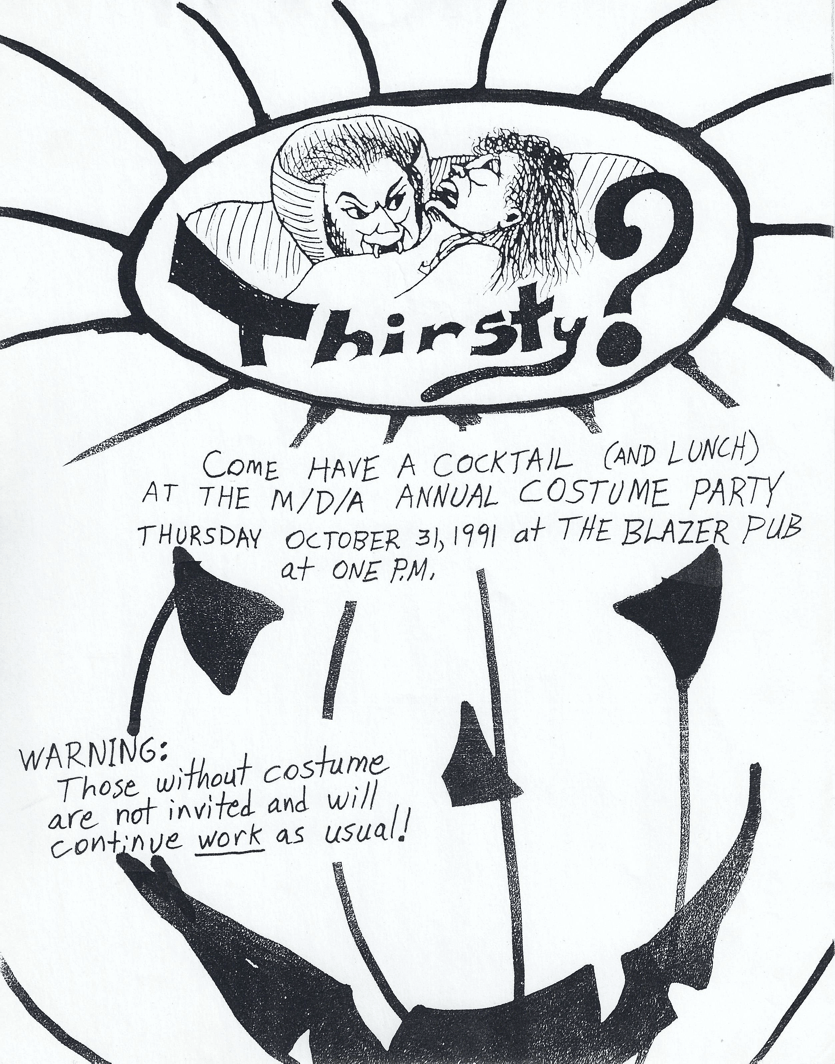
A note on the artwork: The eight drawings used in this post are scans of old drawings from back in my still-healthy-enough-to-draw-a-straight-line days. I had lost too much fine motor control to do fine art, but I could still do cartoons, flyers, and illustrations. Some of these are from the bittersweet final years of still hanging on to my job–so I’m nostalgic about them for two reasons.

Confusion About Violence   (2016Jun16)

Thursday, June 16, 2016                                          10:00 AM

Some motherfucker has commented on my YouTube post of one of Mendelssohn’s ‘Songs Without Words’ saying, “What a laugh! lol.” So I went to his YouTube channel to see what he was about—he had a post of the same piece, which he played very well, liked a trained pianist. My recording was definitely inferior—I don’t play very well—but I still didn’t understand why he felt the need to deride me—who made him the Internet Music Police, anyway?

Maybe he didn’t mean to be mean—I jump to conclusions about that, because he wouldn’t be the first troll on my YouTube channel and I’m kinda sensitive about my piano-playing. Maybe he’s just trying to make friends and he’s even more socially inept than I am—but that would be giving him a truckload of benefit of the doubt. A friendly comment would have made a point of laughing with me rather than at me.

But that leaves the question of ‘why would anyone bother?’ Who surfs YouTube looking for videos to make fun of—and how would a person’s life become so vacuous that being unpleasant to strangers would become a pastime? He may very well have been trying to upset me—but all such comments only confuse me—don’t people have anything better to do?


I’ve made many comments on other people’s YouTube posts—but I never bother unless I want them to know how much I enjoyed their music, or thank them, or encourage them to keep playing and posting. Here on WordPress I find myself sometimes trading barbs with someone who offends my sensibilities—but on YouTube? If I don’t like a YouTube post, I just stop listening—I don’t go out of my way to tell someone I don’t like their music. That’s like telling someone you don’t like their religion—or their face. It’s just rude.


I don’t like violence—I don’t understand how it keeps being such a big part of our lives. It never produces anything but more violence. Maybe I’m just lucky enough to live a life where violence doesn’t come up—but even in situations where violence is commonplace, I still don’t see it doing anyone any good.

And trolling seems to me much more an advertisement of loneliness than any kind of criticism I would take seriously.

Book Review: “The Sound of Time: A Novel” by Julian Barnes (2016Jun03)

Friday, June 03, 2016                                               11:37 PM

Friday’s here—and just as I often don’t get fully awake before noon, I feel like I’m just getting warmed up whenever the end of the week rolls around. Old and in poor health is no way to suck the marrow from life. But I find I have company, or rather, competition.

That is to say that I’ve just finished reading Julian Barnes’ excellent historical novel, “The Noise of Time: A Novel”, touching on the life of Dmitri Shostakovich—a Russian composer of the Soviet era, and a favorite of mine since my early teens. I clearly remember mentioning the name to my mother one day, mispronouncing it, and being surprised that she corrected my pronunciation of his name—firstly because I realized he was famous enough for my mother to know his name, and secondly because I had been enamored of his music for months, while saying his name wrong (I had been thinking of him as Shos-TOCK-ovich!)

The Russians take pride in their deep sadness—as an American, I’ll never get that, but I get it, kind of. Masochism, irony, and melancholy are tools I have used myself in defense against a dysfunctional reality. But my life, and my troubles, are of an American smallness, in comparison to Barnes’ description of the living hell Shostakovich found himself in. He was a sensitive composer trapped in Stalin’s Russia, forced to publicly denounce his own works, and the works of his hero, Stravinsky—and other close friends and respected musicians; in danger for years from ideologues and politicians trying to ferret out disloyalty, even in thoughts and feelings, especially among artists—and even more especially in composers who had achieved global fame.

The book reminded me of the stories I heard about Soviet Russians living in terror of anonymous squads who came and took them in the night, often never to be seen again—and about the ideological tyranny that deposed aesthetics as the yardstick against which their art was ‘measured’—and sometimes condemned, along with the artist’s life.

Stalin’s rule, up to 1953, was so bloody that upon his death and the ascension of Khrushchev, it was said that ‘the Soviet had become vegetarian’. Although it may be more proper to say that the Soviet ceased to be cannibalistic, since Stalin’s machine had been devouring his own people. And Shostakovich was apparently a pretty nervous fellow—at the height of the pseudo-ideological criticisms of his music, he spent every night, for weeks, waiting at the elevator to be taken away by the KGB so that they wouldn’t have to burst into his apartment and drag him away in front of his wife and child. Barnes writes that Dmitri was just one of many people who observed this nighttime ritual during the terror known as Stalin’s Cult of Personality. Shostakovich’s life was one horror show after another—and it didn’t help that he was fairly well-off, compared to the average Soviet Russian—that just gave him more to lose.

As a boy, my favorite of his works was the last movement of his fifth symphony—but as I matured, I learned to prefer the rest of the symphony. According to Barnes’ story, Shostakovich was forced to add the final ‘triumphal’ movement to the symphony because the foregoing movements were so unremittingly ‘pessimistic’—and so he composed the final movement ironically. To my callow ears, and to the politburo, it sounded glorious (which saved Shostakovich’s life, and career)—but as my tastes matured I came to find the last movement somehow brash and ugly, and prefer the music that comes before—and now I know why, I suppose. Much is made in the book of the fact that when confronted with brainless tyranny, the only safe rebellion is in irony—but that irony over time gets lost in itself.

This book is no happy story, but it is something perhaps better—a fascinating story about strange and awful truths, and the horrendous lies that hide them, for a time at least. I have long since given up hope of finding in great artists’ lives any kind of reflection or explanation of the exaltation of their creations—but this book actually matches up the bleakness heard in most of his music with the day-to-day life of its composer. I read it in one sitting—something I’m only pushed into nowadays by irresistibly good writing and an enthralling story.

Barnes quotes Shakespeare at one point, mentioning that his Sonnet LXVI resonated with the artists of Soviet Russia, particularly the line, “And art made tongue-tied by authority”. I had to go look at the whole poem and I am struck, not for the first time, by how apropos Shakespeare always is, no matter how modern we think we have become:

  Tired with all these, for restful death I cry,

  As to behold desert a beggar born,

  And needy nothing trimm’d in jollity,

  And purest faith unhappily forsworn,

  And gilded honour shamefully misplac’d,

  And maiden virtue rudely strumpeted,

  And right perfection wrongfully disgrac’d,

  And strength by limping sway disabled

  And art made tongue-tied by authority,

  And folly—doctor-like—controlling skill,

  And simple truth miscall’d simplicity,

  And captive good attending captain ill:

     Tir’d with all these, from these would I be gone,

     Save that, to die, I leave my love alone.

(Shakespeare, William (2011-03-24). Shakespeare’s Sonnets (p. 132).  . Kindle Edition.)

I love that line about “And folly—doctor-like—controlling skill,”—geniuses so often appear to fools as people who need to be ‘cured’, or at the very least, ‘corrected’. The poem as a whole is fitting for a Shostakovich biographical novel—he too was often tempted by thoughts of suicide, harried by the ubiquitous surplus of malevolent injustice crowding every aspect of his life.

That’s my take on the book—-lacking a segue, here’s two improvs from earlier today–hope you like them:


..


Memorial Day   (2016May30)

Monday, May 30, 2016                                            11:50 AM

Last night PBS aired the Memorial Day Concert from Washington DC—and all weekend long there have been war movies on TV—I just watched one of my favorites on TCM—“Sergeant York” (1941). An uncredited portion of the soundtrack contains “When the Roll Is Called Up Yonder” (by James Milton Black, 1892) sung in church at the beginning of the picture. Afterwards at the piano, I guess I mixed it up in my mind with (“Give Me That”) “Old-Time Religion”, another traditional gospel song from 1873.

ELD 064My dad is in this picture somewhere–he served in Korea after boot camp, and made it home safe.

Anyhow, I decided to improvise on that, since the soundtrack of the movie had those themes woven into the music. I began by trying to pick out the tune, but if you can get past that, I think it turned out alright in the end. I’m remembering the fallen today—have a safe and happy Memorial Day, everybody.

Higglety-Pigglety   (2016May25)

Wednesday, May 25, 2016                                               12:21 PM

Pete’s late—looks like no jam today. And I just got my microphone working! Oh, well. Oh, wait—maybe he comes at one, instead of noon? I can’t remember—maybe he does. Damn this swiss-cheese brain of mine.

Well, Jessy is expecting—which is great. Spencer is working on historical fiction for gamers (I’m not really sure—something like that) and he asked me for some medieval music examples recently, for research—he’s started up gardening and mowing, now that spring has sprung—which is also great. And Claire—well, as usual, Claire is unbelievable—life-drawing classes almost every day, a watercolor painting-tutorial day at the Botanical Gardens recently, and a drawing class in Katonah once a week. (She’s really becoming a phenomenally able graphic-artist). And that’s all beside the daily (at least) trips to the gym—and her ongoing work on her resume for her dream-job. Plus, she takes care of me, Spencer, and the house (with her other hand—ha ha).

So, let’s see—Claire was a prize pianist and music student in her youth, raised two toddlers as a young adult, got her Bachelor’s in computers and worked for an online-encyclopedia company during her programmer phase, then took care of her dying husband so well that the bastard never died, then went for her Master’s in occupational therapy, got in shape with pilates, yoga, and the gym, started drawing lessons—and is about to get a new job in her new OT career, at the same time as becoming a new grandmother. Lazy—that’s Claire—she’ll be sixty in a couple of years—and what will she have to show for it? Some people.

I used to have a life—boy, those were the days—but that was so long ago I can hardly remember what it was like. Okay, it’s one-twenty now—even if Pete was coming at one, he’s late now—looks like no jam today. Guess it’s time to go watch TV. Damn. Well, there were new movies on the menu yesterday—I hope one of them is worth watching.

Son of a bitch—Pete’s here!

Wednesday, May 25, 2016                                               6:20 PM

Okay, Pete came—we had a great session—then he had to go home—and I had a cheeseburger—now I’m just editing the video—and writing a blog about the political news of today.

Wednesday, May 25, 2016                                               8:41 PM

Okay, the best thing in the new movie listings is Zoolander II—hardly inspiring, although I’ll probably watch it. Ben Stiller really makes me laugh—when he isn’t making me puke—I think his masterpiece, “There’s Something About Mary”, redefined the boundaries of good taste in a comedy film—and it’s something of a genre these days. I can take that stuff, up to a point, but my gross-out limit is a very low bar.

I’ve gotten my rough cuts of the jam session edited—three improvs and a medley of eight Burton Lane tunes. The first improv sounded to Pete like calypso music, but I thought it sounded more like I was having a fit, so I call it ‘Calypsis’.

The other two improvs came out real nice—me in my best voice, I felt. You decide. One, “Either Way”, is three minutes, the other, “Twilight of the Gourds”, is a minute and a half—but still, all told we got about 32 minutes of video for the day—not too shabby.

Let’s talk about our Burton Lane songbook-covers video—first and foremost, none of this is Pete’s fault—he just puts up with my eccentricities. And, yes, this is some pretty sloppy piano-playing. But there are some moments of interest—and we did have fun joking around. If it were just me, I’d probably have second thoughts about posting this—but with Pete there, it’s still pretty entertaining, most of it. So, listen, don’t listen—either way, you’re right.

Thursday, May 26, 2016                                          11:38 AM

Afterword:

Last night I had my choice—sleepless, or sleep with nightmares. I finally got a few hours of shut-eye, but now that I’m up, my back is killing me. Which all goes to show that I had more excitement and fun yesterday than this old carcass is prepared to deal with. That’s a bad thing, kinda—but it’s also a pretty good thing, if you think about it. It’s not like I don’t get occasional nightmares and backaches—without having any excuse at all—and a good day is a good day, regardless of tomorrow.

Weekend Fun   (2016May22)

Saturday, May 21, 2016                                           6:58 PM

What a day—what a day.

Ah.

Sunday, May 22, 2016                                              12:23 PM

Yes, I know—it’s cheap and silly and stupid—but sometimes I just get desperate for a new sound. I thought, ‘maybe I could turn on the dishwasher or some other appliance—maybe a car engine idling—I don’t know—Oh wait—I know, I’ll play that ocean waves CD at a really high volume, so I sound like I’m playing piano on the beach.’  Yeah, right—no way it’ll sound like a cheap stereo playing ocean waves in another room. Hey, we do what we can—we work with the tools we have. And speaking of which—yes, I’m singing show tunes with a voice that sounds more like a torture victim’s than a vocalist’s—but I like the song, so deal with it.


…)


Closing In   (2016May17)

Tuesday, May 17, 2016                                            11:03 AM

SAM_2207I was always one of those too-enthusiastic people—teachers’ pet in schools, messing up on jobs by trying too hard when everyone else was happier skating along—you know, an unbearable eager-beaver—easy to trick, easy to tease, and otherwise—undesirable company. I’m the same way about learning and words and stuff—that’s why the first thing strangers and bartenders say to me is usually “So you went to college, huh?” This is funny in a sad way, since I never actually got a degree—in spite of several colleges and universities. When I was younger, still in school, it was “You talk funny.” or just “Speak English.”

SAM_2206

So, naturally, I get over-excited about the presidential election—a situation where rational judgement seems so obviously called for, and yet somehow precluded from the process. If the cable news shows keep repeating the word “Trump” a thousand times a day, every day, until November—we just might elect him—not because the man is fit for the office—or polite company, but because of the ubiquitous nature of his ‘brand’.

SAM_2205

I’m also tired of the cable news shows manufacturing their own reality for the sake of drama—no one ever mentions Hillary without including the words ‘disliked’ or ‘mistrusted’. But she just won another primary last night—if everyone hates her so much, why is she still the obvious favorite? The idea that this sensible, responsible civil servant might lose out to a nightmare-clown with delusions of grandeur makes me ill. But like I said, I’m too serious most of the time—some people seem to be enjoying the whole circus.

SAM_2204

I’d be one of them—it’s not as if the establishment doesn’t deserve a good kick in the teeth—if I weren’t certain that the GOP candidate is a greater threat to us than to the establishment. And Bernie’s no better—making a lot of rash promises without the first clue about the process of reaching those goals. Bernie is a wish-list come to life—he’s pointing out what’s wrong with capitalism—without any admission that we are capitalists, and that changing the system without wrecking the system is not something you can do overnight. I’m starting to wonder if Bernie Sanders isn’t just the second coming of Joe Lieberman—a Jewish Democratic presidential candidate who’s a closet Republican—and he’s just a spoiler for Hillary.

SAM_2202

Gandhi once pointed out that throughout history, in all the great struggles, good always emerged victorious in the end. And I can see how that might be—good makes for a stronger team than evil. But I fear that the opposite is also true—that in peacetime, behind closed doors, evil eventually and inevitably creeps in and builds a nest. Without any obvious call for self-sacrifice or any effort to act as a team, people have more opportunity to indulge themselves—and in time, self-indulgence becomes the norm.

SAM_2201

America has become so great, or to coin a phrase—‘huge’—that we can utilize a mere one percent of our people to wage global war—leaving the other ninety-nine percent free to quietly grub for money. It’s the worst of both worlds. I’m not a fan of wars or disasters—but it fascinates me that we are at our best in the midst of calamity. It’s such an intense heightening of spirit that if we try to act that way—in the middle of a quiet, peaceful day—we seem crazy.

SAM_2200

Just about 300 CDs—that’s a rough estimate of my total collection. I’m closing in on the last few piles to be ripped to the hard drive. After the months of ripping, I’m somewhat disappointed that there’s not more—the process seemed endless. But if you figure an average play-length of 60 minutes per CD, that comes to twelve-and-a-half days of continuous music—nearly two weeks of non-stop 24-7 sound—and roughly $2,400 worth of intellectual property.

Oddly enough, my first impulse—as I approach the completion of the ripping project—is to start thinking of how I’d like to burn new CDs of selected tracks! It’s a detail we rarely consider—to truly enjoy a large music collection, it needs to be ‘DJ-ed’ into interesting play-lists. Store-bought CDs have to be single-themed, whereas a listener prefers to hear a variety of tracks (and some are better than others, too). I like to hear a little classical, a little rock, and a little new age—sometimes I even throw in some of my own piano recordings. Thus, I have nearly as many CDs ‘burned’ as CDs store-bought—but since my home-made CDs are comprised of selected tracks from the store-bought, I didn’t have to rip the home-made ones.

When burning personally-DJ-ed CDs, it’s important to print a jewel-case playlist-insert—after ten or twenty CDs, if you don’t have what you’ve already burned clearly visible, you’ll go crazy—or you’ll end up with a few tracks that show up on several CDs—it’s better to keep track. Also, if you use a short label-name to handwrite on the CD itself, then use that ‘label’ as the title for your printed graphic, you don’t have to do a lot of hand-printing on the CD. Does anyone remember trying to print all the track titles onto that tiny square of cardboard in a cassette-tape case? I like having a printing press in my house—even if it is an HP.

SAM_2199

..

Nice Day   (2016May09)

Monday, May 09, 2016                                            3:19 PM

Gosh ain’t it great? Is there anything quite so delightful as a face full of sunshine after a week of rainy days? No, I don’t think so. And I don’t usually go outside, you know—bugs and mud and why would you, right? But today, oh yeah—today I went out and stuck my head up, like a flower, drinking in vitamin D like someone had added sugar.

I’ve been practicing some Brahms over the weekend, and earlier this morning—from the first volume, with the sonatas and all those variations, and just a few of the kind of pieces that make up my usual stomping grounds, volume two. I tell you, I spent about an hour just trying to play this one original theme—trying to ignore the forty pages of complex and challenging variations that only virtuosos bother with, that come after the Thema. Brahms isn’t happy unless you have to be Hercules to play the damned chord.

But today I’ve been enjoying Edward MacDowell’s “Sea Pieces”—there is one Song from that piano suite which is often included in Selected Easy Classical Piano books, but the rest of the pieces are quite challenging. I enjoy it after Brahms, because it seems easier after that monster’s sheet music—and I get a break in the middle, where that easy Song is. One of these days, I’ll be able to play most of it without stopping.

I’m feeling good today—things are going well—Claire’s finally over that awful cold that stalked her for over a week—Jessy’s in her last trimester and taking off from her job to take it easy. And I played a recital on Friday. Okay, now I’m gonna stop, because inventorying my memory for good stuff has just reminded me of some not good stuff. But I’ve felt worse, that’s all I’m saying.


I just found this new guy on YouTube, Bryan Schumann–ain’t he great?


The Yearly Recital   (2016May07)

Saturday, May 07, 2016                                           9:00 PM

Sherryl Marshall had her annual recital next door last night—I traditionally kick things off, since I’m shameless enough to do it—and it helps put the others at ease to see me mess things up (which I do) and not have the world come to an end. Everybody gets up and sings a song or three—I did “Masquerade”, “Maybe”, and “Marching Along Together”, all from the 1930s, and all (as Claire pointed out) from the ‘M’ section of my songbook. I’ve played my parents’ old songbook for decades, but still I had to rehearse these three for a few days beforehand, just to be comfortable performing them in front of other people (something I only do this one time each year, excepting Xmas-caroling sing-alongs).

Afterwards, when I got home, I was like an old car that keeps backfiring for a while after you turn off the ignition—spazzing and making involuntary exclamations—like the police were coming for me or something. I’m really not cut out for public performance. But then there is also a feeling of having made it through an ordeal, which is very satisfying. I spent most of today just basking in the fact that it was over with, and that I hadn’t screwed it up too badly.

I don’t get out of the house much. It’s wonderful of Sherryl to include me in these annual recitals—I’m not even one of her students. She says it makes the other students comfortable to see a neighbor there, that it makes it more casual—but I think she’s just being very kind to her shut-in, next-door neighbor. And these annual concerts help to remind me why I don’t try to perform more often on my own—it’s terrifying. I only do it that once each year—I don’t know how Sherryl has the courage to do it for a living. But then, she’s a real musician—a professional—and I imagine that gives a person more confidence when they stand up in front of a crowd.

I wish I could offer you some video from the concert, but I left my camera at home—I didn’t expect my singing to be worth recording. This re-enactment video will show you why—I guess I do better under pressure. Or maybe it was the setting—I don’t know.


Also, I want to wish all you mothers out there a very happy mother’s day!

G’night.


It’s The Little Things   (2016May02)

Monday, May 02, 2016                                            3:02 PM

When it comes to the fine arts, we are always prepared to follow the examples of those how have come before—in spite of also recognizing that past artists are of a greatness few can match. Thus we end up with grade-schoolers trying to emulate Mozart or Da Vinci, which is all well and good, especially if the youngster in question has a spark of talent that needs fanning into flame. But, as I have often put forward before, I believe the arts should not be a fenced-in preserve for the talented.

When we are in kindergarten, or even K-thru-3, we often sing songs together—this is both educational and fun, and little notice is paid to a lack of rhythm or tonal ear by any one child—though there is often material there for a critic, to be sure—and greatness is put to the side. Entire schools would gather for ‘auditorium’, which usually ended with a sing-along.

Later on, as early as high school, ‘choir’ becomes a class subject, weaning out those with little interest or ability. That’s fine—that’s understandable—it is school, after all, and they’re there to learn. But are all those other children meant to spend the rest of their lives without a song? That seems rather unlively to me. So I have been a one-man protest movement for music—aided these last ten years by YouTube, which allows my amateur efforts to reach far beyond the few people that walk past our house and sometimes hear tinkling inside.

Lately, I’ve had a few good improvs—but they’ve only lasted a minute or so. I have had to teach myself to sometimes be satisfied with that—there is a temptation to keep going, to create something of awesome architecture, like the musical greats of the past. But I am not a ‘musical great’—I’m not even a ‘musical so-so’—so if I record a mere minute of something nice, I try to accept that with good grace rather than try for something more traditional. And you would be surprised, as I have often been, by just how slowly the seconds tick by when you’re trying to be creative at the keyboard—a minute of decent improvisation is no small feat, not for me anyhow.

Also, while improvising, the longer one plays the more likely one will fall back on old tropes, familiar filler that one has used before—and one edges away from true improvisation and turns more towards rehearsal of the familiar. This is okay once in a while, but it should be recognized as such, or one’s improvs will come to sound like a familiar refrain. One’s personal musical style will make that problem enough without willingly pursuing the familiar. I’m proud that my daughter has told me that she can always tell it’s me at the piano—but I’d feel much differently if she had said I always sound the same.

Anyway, here are today’s selections—two very short improvs and one that is longer but is really three separate improvs (in different keys) in one video. Then there’s a long one that isn’t quite audience-ready—it’s a sample of the practicing of classical composers that I do to help keep my improvs changing and growing. One of my favorite songs is the old classic by Spanky McFarlane, “Sing Your Own Kind Of Music”—lyrics to live by, I’ve always thought.

Mommy, Where Do Republicans Come From?   (2016Apr29)

Friday, April 29, 2016                                              9:50 AM

Republicans are stupid. Republicans politicians are just smart enough to get paid by the rich and by corporations for advocating stupid legislature, but the Republican voter is unabashedly stupid, voting against his or her best interests, voting against science, voting against common sense. Republicans politicians cultivated stupidity in the party’s ranks for many years—‘teaching the controversy’ on many issues that sensible people considered settled, using ‘dog-whistles’ to attract certain ‘patriotic’-seeming hates, and persistently reassuring white Christian males that they were the apex of humanity (all that ‘equality’ nonsense aside).

So when twelve or so Republican presidential candidates took the field, way back when, they were all different flavors of stupid—you had conventional stupid (a la Bush Dubya, or rather, brother Jeb), religion-crazed stupid (a la Cruz), overtly corrupt stupid (a la Chris Christie), and just plain bat-shit crazy stupid, which appears to be the shoe-in for nomination. The Republicans wanted their voters good and stupid—but then were shocked to find that they supported the stupidest candidate that ever ran for the office. That’s pretty stupid.


Then they all got behind Ted Cruz, whom Boehner recently described as ‘the most miserable son-of-a-bitch I’ve ever worked with’—a man reviled by virtually all of his colleagues—merely because he was the only viable alternative to their front-runner, who they hate even more for his being an outsider, with his own brand of stupid. Any reasonable, intelligent group of people would have thrown up their hands at this point—but not the Republicans. Now that Trump has forced himself upon them, you can be sure that they will back his candidacy with the same wooden-headed stubbornness that they use to deny racism, climate change, or the nature of homosexuality.


The front page of the Times today has a story about how Trump is attacking Clinton with veiled sexism—and that the Democrats are ‘scrambling’ to find a way to counter this attack. I find that obtuse. And I’m upset that Republican stupidity has found legitimacy in the media, purely on the basis of its having become their political platform. I’m sorry, Republicans (and the NY Times) but stupid is stupid—it doesn’t need to be defended against, except when talking to Republicans. Trump’s appeal is confined to people angry enough to want conflict instead of compromise—even with the evidence of how conflict within the legislature paralyzes our government staring them in the face. These voters don’t want things done right, they want things done fast—thinking about whether it’s right or not is just more of that ‘political correctness’ that they blame for all their problems.

In fact, a vote for Trump is a way of quoting that old John Candy flic, “Canadian Bacon”, where a guy at the bar says, “There’s a time for thinking and a time for action—and this is no time for thinking.”  In the movie, it’s meant as a joke, a witty one-liner—but for Trump, it’s a campaign slogan that his adherents would unthinkingly agree with.

We have a two-party system, so naturally we think of them as equals—but there is no equivalence between Trump and Clinton. Clinton is a lifelong public servant with knowledge and experience far beyond the average citizen—Trump is an average citizen with a lot of money and a big mouth. And I think I’m being kind with the use of ‘average’—‘below average’ might be more correct.

Americans, by and large, are not fans of big thoughts or deep thinking—that’s nothing new. But we used to elect people to office who were smarter than us, just so they could do the thinking for us. This idea of electing someone just as stupid as the least of us, because he ‘represents’ us, is a new low. Apparently, even once every four years is too often to ask American voters to think.

Most people could have told you a year ago that Trump would be the Republican, and Clinton the Democratic nominee, and that Clinton would crush him in the general. We’ve all known this for some time. But the media persist in scaring us, creating dramatic tension (and ratings) by constantly asking the question, “Will America be stupid enough to vote in Trump?” Everyone knows the answer is a resounding ‘no’. But the media can’t accept that—there’s no excitement in a foregone conclusion—so they take a page from the Republicans, and ‘teach the controversy’.

Music Monday (2016Apr25)

Monday, April 25, 2016                                          12:34 PM

Earlier in Western history, composers did not become famous as pop stars do today. Music in general did not get broadcast by any media. You knew the nursery rhymes of your neighborhood, the work songs, the dances, lullabies, love songs—folk music—but it wasn’t ‘folk’ to you, it was all of music, as far as you knew. Musicians had to spread their works on foot, like Johnny Appleseed, and many of them were popularizers of music, as much for their careers as for their love of music.

That is why there is a national flavor to each Old World country’s music—there really wasn’t a great deal of interaction between musicians who lived hundreds of miles away. We see composers, and later on, virtuoso performers, travel farther and reach more people, causing more concert halls and opera houses to be built, as transportation improves—until the invention of the phonograph and the radio begin to act as distributors of music, separate from the musicians themselves.


We think of classical music striving towards a greater freedom of expression, from the confining rigors of Gregorian chant to the wild liberty of the expressionists and the modernists—but that freedom was as much forced on them as fought for. Religious, political, and technological revolutions all caused upheavals in the norm, creating spaces where composers worked without the confinements of a generation earlier. That’s why we call the great composers geniuses instead of revolutionaries—they didn’t battle their way into new music, they discovered it within their imaginations. The tawdry battle between conservative and progressive music critics always lagged behind, creating a sense of resistance to change—but the musicians always simply filled a vacuum and left it to others to sort it out.


I’m always aghast at the contrast between old and current music—all those centuries of seeking the magic formula, the series of sounds that would thrill the audience—finally adding syncopation, blues notes, and latin rhythms to drive the excitement-level ever upwards—until the electric guitar came along, with that electronic buzz that satisfies people in a way that an entire symphony orchestra or big band never could, regardless of the composition of notes. Amplification added something unnatural as well—and suddenly four boys from Liverpool could fill Shea Stadium with adoring listeners.

It’s not that I hold it against rock and roll—I love the Beatles as much as the next member of my generation—it’s just so easy, it seems like cheating. The greenest beginner on an electric guitar can enthrall a roomful of music lovers—meanwhile a hundred musicians have to study for a lifetime to play a Stravinsky ballet suite—and it doesn’t have the drawing power of a Jimi Hendrix solo. People just love the alien sound of electronics—they can’t get enough of it. I think the “Switched-On Bach” album is probably Bach’s biggest sales hit of all time—and it’s because it was all performed on a Moog synthesizer.


It’s not as if electrification was the first music tech—keyboards were invented—bellows-driven organs, steam-driven calliopes, cranked hurdy-gurdies, paper-roll pianos, and spring-driven music boxes. And there’s the subtle plumbing that turned a pan pipe into a modern flute, a bugle into a trumpet—and all the mysterious varnishes and the carpentry of resonance that goes into making a fine string instrument—those Stradivariuses aren’t worth a king’s ransom for nothing. The modern piano-forte—what we call a concert Steinway these days—was such a masterwork of technology that many people link its emergence with the greatness of Beethoven’s piano sonatas—he was the first composer to have access to the modern version of a keyboard. He certainly makes use of its dynamic possibilities—no one could’ve written all those triple fortes and triple pianos for a harpsichord—or, at least, no one could play any dynamics without a hammer-action to control the volume.

Even today, music drives tech innovation—no musician is satisfied with what has come before—they’re always searching for something new—both in the music and in how it is played.


Have a good week.

Sunshine Session   (2016Apr18)

Monday, April 18, 2016                                          5:05 PM

Pete and I went for two today—and came up with an extended session which I am pleased to share with you here—three improvs, six cover songs, and a piece by Domenico Scarlatti, no less—it was quite the take and I am now very tired—we don’t usually get so ambitious on these monthly get-togethers.

Now you can say that the covers—and certainly the Scarlatti—are terribly done and I can’t really argue with you. I post these more for the fun we had than for any great contribution to YouTube. But I stand by the improvs—they’re not so bad—and I don’t care what you think. Nothing inspires me more than to have a drummer play along with me—and Pete’s the greatest.

We start, as always, with an improv—today’s first improv was a warm-up, kinda Spanish-ey (I like to steal rhythms from Rodrigo) but not quite the greatest thing ever. That’s the trouble with improvisation—you can’t just ‘start’, you have to work your way into it—and I fear I lose listeners sometimes just because you have to give us a minute before we get anything going. Listeners don’t usually give that kind of slack to a YouTube video—but there’s no way around it, for me.

Here’s the chronology of today’s two part set:

Improv – When The Deep Purple Kush

Domenico Scarlatti‘s Sonata – Longo 23

Improv – Bluesome

Cover: “Crystal Blue Persuasion”

Cover: “All My Loving”

Cover: “Crimson and Clover”

[break]

Improv – Stone Soup

Two (2) 1960 Covers:  “Gee Whiz” & “Silence Is Golden”

Cover: “Sugar Sugar”

As you can see, the second round was shorter and less ambitious—but I’m still impressed that we had a second round at all. Only at the beginning of our sessions would I try something crazy like the Scarlatti—but I got that out of the way (and out of my system)—and trust me, you really haven’t played Scarlatti until you’ve had tympani backing you up—even if it is only bongo drums. There are many fine pianists (and harpsichordists) on YouTube, so you can hear the piece played properly (I gave you the Longo number) if you wish to do a search.

The second improv came out that way because Pete said, after the Scarlatti, “Hey, let’s try something more bluesey.” So I improvised using mostly seventh chords, which is my way of sounding bluesey. I’d play like Art Tatum if I could—but again, just search on “Art Tatum” if you want to hear some real blues piano.

I had a great time today—we played some of my favorite piano arrangements of cover songs from the sixties—and there was a third improv that we tried to be spacey with—like an acid trip on the piano—but I don’t know, I was pretty tired out by then. We had a great, sunny day to play in—so for today we bill ourselves as the Buds-Up Sunshine Band (with apologies to K.C., et. al.)

We talked a bit about a podcast—but as we discussed it, I realized that I always pick activities that can’t be rushed or scheduled. If I had to do an improv once a week on schedule—well, I couldn’t do it. It’s just like the poetry or the drawing—I can only do what I’m inspired to do; I can’t just decide it’s time to play an improv. Besides, I have my good days and bad days—getting together with Pete once a month is about as busy as I can manage—and even then, some months are better than others. Fortunately, today was kickass.


Th’th’that’s all, Folks!

Good Morning    (2016Apr16)

Friday, April 15, 2016                                                5:03 PM

Doggerel


“Auugh!”, as Charlie Brown used to say

—Though I prefer the traditional “Grrr!”

“Doh!” sez Homer Simpson—though I like a solid “Damn!”

On Firefly they say “Fracking” when they might as well say “Darn”.

I say “Golly-Gosh” a lot, ‘cause I know it won’t do no harm.

But if I’m really in a huff a give a loud “Harrumph!”

Just so you’ll know I’m pretty close to losing all my shit.

‘Cause when I get to swearing there’s no telling when I’ll quit.


Saturday, April 16, 2016                                          12:24 PM

Good Morning

Lately I’ve been getting a busy signal from my brain—‘temporarily out of order’, ‘please wait—maintenance in progress’—whatever it is that makes my brain useless for anything except self-preservation. But today I’ve awoken with the feeling of fresh canvas—as if my brain is saying ‘yes, of course you can be creative—what are you waiting for?’

It’s kinda like when my hands are too shaky—I can’t play the piano, no matter how much I want to or how hard I try—but in a larger sense, in that my head is the ‘shaky’ part and if I push it, only garbage comes out. But as I say, today—fresh canvas, clear sailing, blue skies—however one puts it. And I don’t know where to start—should I just relish this feeling of power and potential for a while or should I jump right in and start doing?

Creativity cuts both ways—I can revel in sumptuous daydreams, just privately enjoying my own imagination—or I can attempt to hitch my Pegasus to some earthly activity—a poem, a drawing, an improv—which is a greater adventure, but has its pitfalls. My head is signaling that my creative juices are once again flowing—but I’ve yet to hear from the body, which decides every day on a different amount of gas in the tank.

Some days the body fairly screams for activity—pushing me out the door for a walk around the block, or doing a little spring cleaning on some especially dusty part of my work area. This is rare, though. Most days I’m lucky if I have the wherewithal to do some CD-ripping while I sit here typing. I complain about having to do this but truthfully I’m grateful for a little busy-work that falls within my competency—and I kinda dread the day when I’m done with the ripping. There’s something reassuring about having some simple job to do whenever I feel idle—feeling totally useless is one of the great drawbacks to disability. It can really eat away at your self-image.

Posting a poem, picture, or recording can be very satisfying—it feels like an accomplishment. Getting responses, in the form of likes, shares, or comments, really adds to that feeling—but sometimes the total lack of response can undo all that good feeling. Often, in desperation, I’ll ask Claire to look at my post and give me an opinion—she usually reassures me that I haven’t wasted my time. I have to be careful—I want attention—to a point—but not so much attention that I feel obliged to return that attention to others—I want to be admired without the hassle of admiring someone else’s stuff. I’m self-involved—what can I say?

Most people see a lack of energy as the inability to get sweaty doing hard work—it’s so much more than that. The brain uses energy—a chess player burns more calories than a weight-lifter. And that energy goes into learning, into appreciating what others do, and in doing your own stuff. Without energy, I learn less and am less interested in what others are doing—so when I do my own stuff, it’s claustrophobic—I’m trying to weave new patterns by rearranging old memes. Back in my healthy days, my creativity was a response to the torrent of new input of ideas, images, and concepts found in the world around me—now I’m trying to squeeze creativity out of a vacuum of house-bound, isolated idleness. The law of diminishing returns stands as a specter, always at my elbow.

I wouldn’t dwell on it—but there really is an exclusion that comes with age. I can’t hang out at a college student union or a local bar or any of the places that I remember enjoying—I’ve outgrown them—and even if I don’t accept that, the young people there will let me know in no uncertain terms just how out of place they consider an old geezer at their haunts. In a private setting, good manners usually prevent anyone from rubbing it in—but out in public, the elderly stand out. I think the sight of old people makes the young uncomfortable—we are proof that their fantasy will someday metamorphose into something like us—and with us out of sight, they are protected from that unpleasantness.

People fear death and wonder why—since it comes to everyone. But age is the real boogeyman—just as inevitable, sooner arrived at, and visibly uncomfortable—death is a mysterious and sudden end to everything, but age is a lingering torture of diminishments—activity, freedom, and comfort all shrinking with each year. Sure, it builds character like nobody’s business—but once your character has finished building itself, what then? Like T. S. Eliot says, we acquire a perfect understanding of our lives, just when it has gotten past time for that understanding to do us any good.

One’s children are a temptation—how easy it would be to try to attach myself to their lives, to make a surrogate life for myself by intruding in theirs—there’s no end of excuses I could make—my experience, my knowledge of the world and of people, a lifetime of skill and wisdom. But by doing that, I’ll only delay the time when they begin to think for themselves—by ‘helping’ them forward, I’d really be pushing them somewhere I never got to, for my own reasons—it just wouldn’t do.

No, age is the ultimate hard lesson—there’s nothing you can do but learn it—if you struggle against it, it just makes you look foolish.


Sunday, April 17, 2016                                            5:32 PM

Scarlatti

I just finished a very difficult piece by Scarlatti—something I’ve practiced for decades and today was the best stab at it I ever took—so when I finished, I stood up and said, “Where’s my thunderous applause? Why don’t I hear thunderous applause? Something’s gone terribly wrong if I’m not hearing thunderous applause—and I’m not hearing thunderous applause—heads will roll.” In this way I comfort myself for doing well in an empty room. And of course I didn’t have the camera on—but that’s a funny story.


I recorded a quick trifle in the front room, and brought the camera into the living room, where the baby grand is, but then decided not to set it up and turn it on. I told myself, “You know, if you turn the camera on, somewhere there’ll be a noise—and you’ll get upset that the recording is ruined—and it’ll be a whole thing—so just leave the camera off.” So I did. And, boy, did I call it—the world’s most annoying dishwasher timer went off about twenty times before it finally quit—but I was able to just keep playing—because no one else was listening and I didn’t give a damn about the timer myself. I love it when I’m right. But that’s when I was comfortable enough to play the Scarlatti, to a marked lack of thunderous applause. You win, you lose, I always say.


Murder on 34th Street

This brings me to “Miracle on 34th Street”—the bane of atheists everywhere. I just caught the last half of it—the modern, Mara Wilson version. I prefer the original, Natalie Wood version—but this 1994 version is even more devastating to atheists. The trouble with “Miracle on 34th Street” is that it addresses the biggest problem for atheists—what about the children?

The central theme is encapsulated in this quote from the film: “If you can’t accept anything on faith, then you’re doomed for a life dominated by doubt.”  Or, even worse, this one: “If this court finds that Mr. Kringle is not who he says he is, that there is no Santa, I ask the court to judge which is worse: A lie that draws a smile or a truth that draws a tear.”  We can use a ‘get tough’ policy when we are speaking to adults—but what about children?

We parents want to give our children something to believe in—nothing has caused me more doubt and worry than to raise our children without any religion—not because I believe in one of them, but because it is Santa Claus on steroids—something to believe in with a vengeance, as it were. I yearned to offer my children this imaginary comfort—and if I could have offered them the magic without all the poison it contains, I would have. Yet in the final analysis religion’s darkness outweighs the sparkle of fairy dust—I couldn’t indoctrinate my children into one of those shams and still look at myself in a mirror.

I was often tempted to lie to my children while they were growing up—some of the questions they asked made me sick to answer truthfully—because people can get very ugly—and the ugliest of them seem to gravitate towards the money and the power, thus shaping our society far more than the wishes of the vast majority ever enter into it. We live in a world where the unethical is often legal and the ethical is always bad business. To prepare our children to meet that world we have to warn them of some of the worst humanity has to offer—not that I laid it on that thickly, but even the barest outlines of society can be unpleasant to explain to innocents. This is especially true when you live to see a smile on their faces.

So, as pleasant as it might have been to spin them a yarn about angels and doves and pearly gates, I gave them the truth as I saw it. I don’t regret it. There are some nasty people out there who profess a strong faith in god—and if you ask them they’ll tell you all about him—some of them even talk to him. I’d have been damned if I was going to raise my kids to be prey for those types of crazies.

Bushes   (2016Apr14)

Thursday, April 14, 2016                                                  8:11 PM

Hope you all got your taxes done—I didn’t. I just couldn’t get off the ground today. Some bad poetry, some bad writing, then some so-so piano. Maybe you did better.


On listening to a CD at my computer

Tinny trumpet echoes over bassoon

Bull fiddles thrust a basso tune at the moon

A symphony orchestra beams from my speakers

As I sit at my desk by myself I hear seekers

One hundred musicians from years ago

Play for me under the monitor’s glow

So I’m not really here—not while the note sounds

With music my transport, no trip’s out of bounds.


Dear Captain:

Be ready to cast off at first light. We mustn’t miss the tide.

The Harbormaster assures me that no pirate ships have been sighted within the Bay or its environs for several weeks. Nevertheless, be sure that we have sufficient gunpowder (and in water-tight barrels) should the need arise.

If you need me, I’m stopping at the Helm and Anchor. I’m looking forward to our voyage with more than a little excitement, as the map shows signs of great opportunity in Northern waters.


So I’m not really here—not while the note sounds

With music my transport, no trip’s out of bounds.


Dear General:

Please come at once. Our situation is more extreme than we realized. Supplies are short and the enemy has us tightly hemmed in—I pray this messenger can get through to you. I tell you our prospects are fading and without your help we will not last a fortnight. Avoid the high pass.


So I’m not really here—not while the note sounds

With music my transport, no trip’s out of bounds.


The MIDI-converter is playing with my head. I just noticed that its only labeled “MIDI” on the B channel, so I switched the piano cables to the B ports and plugged the USB back into the PC—and the darn thing is installing itself. I still don’t think it’s going to work. Piece of junk.

I was right. Still doesn’t record through SONY Music Studio. Piece of junk.

Journal Entry   (2016Apr12)

20160411XD-Flowers_05

Saturday, April 09, 2016                                          10:27 PM

In high school I wrote a term paper comparing T. S.Eliot’s “The Waste Land” with Lewis Carroll’s “Alice In Wonderland”—a spurious pairing based on both titles inferring the existence of a ‘land’ of some sort. On first reading I found T. S. Eliot rather opaque—so I was able to make a case that both works involved a lot of nonsense. My teacher was probably so glad that someone bothered to read Eliot that she forbore from destroying my facile interpretation of his poem—I think I got a high grade based solely on the ambition of my reading.

But having been introduced to Mr. Eliot, I was off and running. I read all his poems and most of his plays—then I read most of his essays—then I read critical analysis of Eliot’s life and works, seeking some explication of this rather difficult poet. In the process, I was led to read parts of the Bible, some Shakespeare plays, some poetry by Marvell and Donne, Jessie Weston’s “From Ritual To Romance”, and a good chunk of Fraser’s “The Golden Bough”. At one time I could recite “Burnt Norton” from memory—though at sixty now, and having read all the Four Quartets many times over, I think I understand the poem better now than I did when I could recite it.

Eliot is a strange influence on a young man—he was both after and before his time. He was after his time in the sense that Old World propriety meant more to this native of St. Louis than to the inhabitants of the modern-day London where he spent his adult life. He was before his time in many ways—not least of which being his rejection of religion in his youth and his return to it later in life—not unlike the born-again backlash against secularism that would sweep America a decade after his death.

20160411XD-Flowers_01

Eliot being as much a philosopher as a poet, studying his work as an adolescent may have made me old before my time, at least mentally. Looking back on it, I feel that studying Eliot made me old before my time in much the same way that being ill for so long, and even dying momentarily on the table during my eleventh-hour liver transplant, made me dead before my time. In my mind the two are similar in having made me an outsider among my contemporaries and robbing me, in a sense, of the innocence enjoyed by most people—both the carefree-ness of youth and the ignorance of death most adults maintain right up to the end. But there is room for doubt as to whether those things affected me or if I just have that sort of personality.

Because of this feeling I have a tendency to feel irritable whenever my thoughts turn to social ills, politics, or man’s inhumanity to man—I know that most people give these things only cursory attention now and then, rather than becoming obsessed with our immature behavior as a race. Most people cling to the assumption that humans shouldn’t be any better than they ought to be—but my ‘old geezer’ perspective rants and raves at our insistence on such ingenuousness. I look ahead so persistently that I never enjoy the present—it is a maturity shared by few. And that’s the way it should be—it is foolish to take the world’s troubles on one’s shoulders, when there is little to be done about it other than fret.

‘One day at a time’ is considered great wisdom by many—to me, it smacks of the grasshopper—wasting away the present, without a thought for tomorrow’s troubles. But then, I’m no big fan of ‘surrendering to a higher power’ either. So no twelve steps for me—I get along without them, but I’m glad they work for other people.

20160411XD-Flowers_06

Monday, April 11, 2016                                          11:53 AM

Yes, I know that Monday has a bad rep amongst the working—but for those of us who are unable to work, Monday has a sweetness to it that workers could never imagine. After being disabled it took me years to get over the vestigial thrill of the weekend. Every Friday night I would get that conditioned response—relief that the weekend was finally upon us—but what followed were two more days just like all the rest, if not less enjoyable.

Stores close early on the weekends—those that open on Sunday at all—and you can’t call any place of business to work out a billing or customer service problem. The weekend roadways, should I venture out, are crowded and slow. House-bound people tend to watch a lot of TV—and weekend TV sucks. (Okay, I’ll give you “Madame Secretary” and John Oliver on Sunday night, but that’s it.)

20160411XD-Flowers_02

All weekend long it’s mostly sports on TV—I could never acquire a taste for televised sporting events—believe me, I’ve tried. Even Turner Classic Movies (TCM) deserts me—Slip Mahoney and the Gang in the morning and silent films at night. The news channels (which I dislike enough on weekdays) run ‘caught on tape’ prison documentaries instead of live reporting—which is very apropos—weekends on TV are a lot like prison. All of this makes perfect sense—the vast majority of people have lives—and those lives are busiest on the weekend—why run top programming for an empty room?

I’ve learned to love Mondays. On Monday the New York Times crossword is as easy as it’s going to get—and Jeopardy is once again on at seven—those may seem like little things, but they loom large when one’s life has few other high-points. Weekend food is usually leftovers and take-out, so the food is better on Monday, too. Everyone else is starting their week and that excitement comes through a little, even if there’s a lot of tail-dragging that goes with it. When weekends involved a lot of partying, I used to have a terrible time on Monday morning—now that I can’t have that sort of fun, enjoying Mondays is my booby-prize, I guess.

20160411XD-Flowers_07

Tuesday, April 12, 2016                                          9:50 AM

There is so much music. I own so many CDs that a strong man couldn’t carry them all in one trip—stacks and stacks of them pile up as I continue re-ripping my collection to my new external hard drive—and all I can think about as I go through them is how much music is missing. My old LP collection was more complete, and I never lose that urge to buy enough CDs to equal that former glory—but that old collection was largely built up during my dad’s tenure as VP of Direct Mail at BBDO, back in the sixties. It included the Deutsche Gramophone recordings of the complete works of Beethoven (about twelve volumes of six records each) and the entire Time-Life classical music series (another pallet-full of records)—an avalanche of recordings he was given as free samples in the course of determining their mail-order ad campaigns. (We used to joke that he should talk Mercedes Benz into doing a Direct Mail campaign.)

I am one of five siblings, but neither my parents nor my siblings showed any interest in classical music back then—all the free records went to me and no one was jealous about it—in fact, I often fought over the living room hi-fi with my siblings—they much preferred Rock and R&B. I liked that music also—but I preferred variety—I wanted to listen to all music. The whole world was mesmerized by rock’n’roll back then—when I actually bought classical records  at Fox & Sutherland’s, they were going cheap—sometimes only a dollar or two, where Beatles albums were closer to ten bucks. The whole classical catalog was referred to as ‘loss-leaders’—records that were produced to enhance the reputation of the label, rather than to make a profit.

Having that in my early days, I would get huffy, later on, when some piece of classical music became popular—“Thus Spake Zarathustra” used in the soundtrack to “2001: A Space Odyssey” or “Bolero” used in the movie “10”—people would say, “You’ve got to hear this!” and in my mind I was always thinking, “Yeah, right—like I’ve never heard that before, you philistine.”

20160411XD-Flowers_04

When you listen to classical music and read classic literature at thirteen, you get used to being an outsider. But there is a way in which everyone will suddenly become an expert on something that found its way out of obscurity and into the spotlight for a time—and I find myself caught between my delight that others are finally sharing in the joy I get from these obscure sources—and resentment of my private preserve being trampled by the unwashed. But it’s not all my fault—I spent most of my time feeling outside of society and to do that day after day required that I build up some pride in being different—and there’s some unavoidable bitterness when that difference gets erased in a surge of popularity.

To make matters worse, there is so much music that even my obsession has gaps in knowledge. When ‘Classical Music’ appears as a Jeopardy category, I always assume I’ll know all the answers—but oftentimes I don’t—there’s just too much to know. Plus, ‘opera’ is the most popular form of classical music—and I’ve never much cared for opera—I don’t know much about it. Well, that’s not true—but I know less about opera than an opera buff.

It makes me laugh when Music Choice’s ‘Classical Masterpieces’ channel gives out with three factoids about the composer, that cycle on the screen while the piece is played on the audio. It’s ludicrous—they could be scrolling the composer’s complete entry from Grove’s Music Dictionary—or at the very least, the Wiki entry—in the time it takes some symphonies to play. Do they suppose that would make people less likely to watch? How information-phobic are people, anyway? They’d probably tell you that the factoids are meant to pique your interest so you’ll go google the composer yourself—but that’s just lazy.

Then again, I only turn to that channel when I’m reading—still, they could actually build up a viewership of music-geeks, if they put a little effort into it—maybe not—I don’t know. They make me irritable anyway, mis-titling and mis-crediting a surprising number of audio-tracks—so I know there’s nobody home at that company that gives a damn about classical music. I guess it’s still a loss-leader.


Here’s a song cover and an improv from yesterday:


It’s Getting Serious   (2016Apr08)

Friday, April 08, 2016                                              3:32 PM

We’ve reached an awkward point in the political process now—things are narrowing down. People begin speaking of candidates they formerly criticized as the solution to the problem of ‘the lesser of two evils’. Conversely, Bernie Sanders can no longer be unaggressive towards Hillary Clinton, and answered Charlie Rose’s question “Would you support her, if chosen?” by prefacing his ‘yes’ with “I’d consider a Trump or Cruz presidency an unmitigated disaster, so yes, I would support Hillary Clinton is she wins the nomination.” He couldn’t just say ‘yes’, like he would have a few months back—he’s got his gloves off and he’s got to keep them off.

20160407XD-BirdHearing (4)

The funniest part of this process is the simple truth that the very best possible next President of the United States would have to be dragged kicking and screaming into the Oval Office and be locked inside—sentenced, in his or her mind, to the jury duty from hell—and a hell of a way to reward years of selfless public service. Any sensible person can just look at the before and after hair-color of the last few presidents and be able to tell that the job redefines the word ‘difficult’. Only a spark of ambition would drive someone to the madness of seeking the post—and now that we’re getting down to it, that flaw is being brought to the forefront.

20160407XD-BirdHearing (1)

It’s attack time—and, hey, does anyone else get the impression that both Bernie and Hillary were more comfortable when it was still ‘gloves on’? I get the sense they are both sane enough to be uncomfortable with the egotistical sniping that the final days of a head-to-head must inevitably become. This is in marked contrast to the GOP—they’ve long since disqualified themselves from the list of respectable candidates. They are far too happy in their playpen, holding dick-measuring contests when they had an opportunity to discuss the issues for months—hell, years now. Their ambitions are front and center, completely overshadowing any sense of service or responsibility to the public—and while you may think it an old-fashioned attitude, in my view it disqualifies them from serious office, be their platforms whatever they may.

20160407XD-BirdHearing (2)

We forget sometimes that the election is not wholly a popularity contest—no matter how much we treat it as such, it remains a serious decision with mortal consequences. Sanders’ young supporters flock to him because young people don’t need convincing, they just need inspiring—and it is a good thing that they are being inspired to play a part in their own democracy—I hope it lasts beyond Hillary’s nomination. Because the problems Sanders talks about need more than a populist president to fix—those problems require a quantum-level rise in political engagement from coast-to-coast, over several election cycles, if we’re ever going to have a chance at taming the super-wealthy’s de facto march back to monarchism.

20160407XD-BirdHearing (5)

It’s daunting to think of—a quantum-level rise in political engagement, obtaining objective news sources, growing neighborhood bonds while our youth are ever more deeply seduced into the twitter-verse or VR-gaming helmets—the list of impossible things we need to do to fix the future goes on from there. We could just let the powers that be continue doing what they do—it might not be pretty, but who’s to say they won’t avoid destroying us all in the end, right? They know what they’re doing, don’t they? After all, they are in charge—even if they did grow up in an age when phones had busy-signals and cords—even if some of them don’t even understand how the world has changed—even if most of them see change as dangerous. They want the power? Let’em have it. At least, if it all goes to hell, we’ll have someone to blame. Why be so serious all the time?

20160407XD-BirdHearing (10)

Friday, April 08, 2016                                              4:15 PM

The Bird Hearing   (2016Apr08)

I went for a walk yesterday—the birds were so noisy, I went back inside and got my camera. I shot three minutes and change of bird cacophony—the video is pretty unwatchable—I was focusing on the sounds—but that didn’t stop me from making two improv videos with the same bird footage. The music is different in each, but the bird songs are the same. I suggest just listening to the audio—the video, in spite of all I did to stabilize it in post, is nauseating.

It’s kind of a shame I got so wrapped up in the birds singing—the music is pretty good on both of these—they would have been nice all by themselves, I think.


Oh, and here’s one more from the day before yesterday:


bu-bye now.

Piano   (2016Apr06)

SAM_2136

Wednesday, April 06, 2016                                              12:14 PM

I feel better about my piano-playing when I listen to some Erik Satie—but that’s a false equivalence—since his rebellious ‘ditties’ flew in the face of more than a century of standards and practices in Western music, whereas my plonking about comes long after Stravinsky, Schoenberg, Cage—not to mention Zappa. Still, there’s something similar there and it makes me feel better about myself and my playing. I’ve been practicing a lot of Chopin and Tchaikovsky lately—and those two are definitely not reassuring to later musicians but, rather, make one feel that music in general is far beyond mere mortals.

MORNING AND NIGHT


20160327XD-EasterSunday (18)

Mendelssohn, Chopin, and Tchaikovsky—it’s weird how most of my practicing boils down to these three nowadays—I used to be all about the Baroque—especially Bach, Handel, and Telemann. I still play them on occasion but in recent years I’ve developed a fondness for that intimate personal touch so prevalent in the Romantics. I’ve also progressed to where they have become more accessible—the Romantics can be more demanding of technique.

TELEMANN


20160327XD-EasterSunday (15)

I’ve been doing a lot of writing and a lot of piano-playing lately—but I haven’t had the presence of mind to include the piano recordings into the blog-posts, so this post will include several YouTube recordings I’ve neglected to share recently. Beyond that, there’s a great deal of piano-playing I won’t be sharing at all—sometimes I take a break from recording and just play—it gives me some elbow-room to take a break from being recorded. I’ve tried to learn to ignore the camera, but nothing I do seems to make me unaware of being observed—and that tightens up my playing in a way that makes playing without the camera a tremendous relief.

KLAVIERWERKE


I wrote a poem yesterday about Tchaikovsky—not a very good poem, but I can’t help that. Much has been made of Tchaikovsky being gay (true) and of his being pressured into committing suicide (false) so it’s difficult for me to imagine his life and times—however, it is true that in spite of his innovative compositions, his contemporaries sometimes criticized him for being too European and not Russian enough—kinda strange for the guy who wrote March Slav, huh?

20160327XD-EasterSunday (4)


Tuesday, April 05, 2016                                          3:16 PM


Pyotr Ilyich

My fingers plonk the keys—some Tchaikovsky

For beginners—full of Russian folk themes—

And the poor man’s life—under the thumb of

Entitled bullies and spoiled aristos.

Tchaikovsky is so delicate—so effeminate in some phrases,

Such fairy-like, walking-on-air-ish-ness—

His music is beloved—but for such a man

To live in the cold world—the horror.


I love Tchaikovsky—anyone, really, destroyed

By their own delicacy—to live is to die, and no matter

How long the course, among the many ways to die

What more glorious fate?

So many of us rail against the challenges of life.

We neglect to feel life—and our accomplishments,

Even those of grandeur, are as nothing if we fail

To build something inside us.

Pyotr Ilyich will live forever.


-© April 5th, MMXVI  by Xper Dunn

20160327XD-EasterSunday (1)

But evolving acceptance of gays has rendered the isolation and frustration of millions of gay people through the centuries a uselessly cruel tragedy—in a way, by channeling his struggles into his wonderful music, Tchaikovsky got more out of his social taboo than most gays of the past. That doesn’t lessen his suffering—but his legacy is a lot more than most gay people in his era were granted. I sometimes ponder the possibility that most of the fine arts were practiced by a predominance of gays—it being the only place where they could express themselves without being thrown in jail or burned at the stake. Then I remind myself that there’s plenty of misery available to the straight life, too—enough to evoke creative expression to equal the biblically damned.

TCHAIKOVSKY


20160327XD-EasterSunday (13)

I also played an improv to go along with my previous post about Grandma/First Lady/Senator/Secretary/Candidate Clinton—which I belatedly include herein:

GRANDMA CLINTON

20160327XD-EasterSunday (12)

Then there’s this business, which I couldn’t think up a title for, so I used a misspelled version of a current movie title:

SUM

And that brings me up to date with my YouTube postings. I hope you enjoy some or all of them….

20160327XD-EasterSunday (2)

Improv – Batty Batty Night   (2016Mar26)

Saturday, March 26, 2016                                        8:16 PM

Wearing my new ‘Dark Knight a la Van Gogh’ tee-shirt and my ‘Starry Starry Night’ socks, I felt inspired to play an impromptu novelette, “Batty Batty Night”:

A lone figure strolls Gotham’s streets unmolested—is that a fleeting swirl of black cape atop that building?—is that the bat-signal on the belly of the night’s clouds? ….

Aside from the political and satirical cartoonists of newspapers and The New Yorker, cartooning is a group effort. I don’t know how they’ve computerized it nowadays, but it used to be the original artists drew in pencil, other artists did the inking, others the lettering, and one more for the coloring. Even the creation of a comic book super-hero was collaborative—Jerry Siegel and Joe Schuster created Superman. In 1989, Bob Kane conceded that Bill Finger was a co-creator of Batman—it was unfortunate that Finger had passed away in 1974. Wonder Woman was created by William M. Marston, his wife Elizabeth H. Marston, and Olive Byrne.

But comic books, like rock-and-roll or politics, deals in high-brow ideals, virtues, and courage—as subject matter—while the business itself is as seamy as any other—dealing in promotion, property rights, and profit. It’s as if they found a way to make a buck off of telling kids, ‘Yes, there is a Santa Claus.” But I like comics—I’m not knocking comics—they’re fun. It’s just that the comics biz is a business, like any other. People will argue over credit, prestige, and audience recognition—or simply over money.

I always had half a mind to be a comic book artist, but anatomy was never my strong suit. You have to admire the forced perspective in some of those frames—that’s tricky stuff to draw. I guess I was never happy about the tiny boxes—I preferred a bigger piece of paper—and one per drawing. They do that now, in the more modern graphic novels—full page pictures—oh well. Besides, commercial artists have to draw fast—they need to crank that stuff out—I was always slow as molasses.

Old Songs   (2016Mar23)

Wednesday, March 23, 2016                                            2:07 PM

A fresh day in early spring—this is what we’ve earned by our patience through the long, dreary winter. The daffodils have a white pallor that suits them and belies the bright yellow they will eventually achieve. Here in the foyer the front door is ajar. A light breeze is clearing out the tobacco smoke and mixing in heady earth-tones of life stirring in the mud.

20160323XD-5OldPianoCovers_GRFC

My head is clear and my mood is solid—something I’ve learned to appreciate for its increasing rarity. I’m also thankful about many other things I took for granted, back when they were so plentiful and constant I mistook them for permanent fixtures rather than the glory of youth.

20160319XD-SupermanSocks (1)

My daughter’s gift for my sixtieth birthday was socks—Superman socks, Spiderman socks—an embarrassment of super-hero socks. She knows me too well. Not every adult is comfortable sporting Superman socks—I have no problem with wearing anything silly—red plaid pants with green plaid shirt and argyle socks—I don’t care. I never leave the house—and when I do, I assume everyone’s staring at me anyway because I’m kinda neurotic—so if they really stare at my socks, I don’t think anything of it. Life can’t have too much color in it, if you ask me. I could never be cool because cool people only wear black. I’ll wait for the funeral, thanks.

Okay, so—why play these creaky old tunes? Is it ironic? Well, maybe a little—but not entirely—some of them are fun, some are funny, some are just a great tune. Take, for example, “Paddlin’ Madelin’ Home”—now this song has got the silliest lyrics ever—and I’m not entirely sure the lyrics aren’t ingenuously sexual—they’re certainly suggestive. And “Yes! We Have No Bananas”—what kind of monster could fail to love that song? It makes no sense at all—I love things that make no sense at all. And I can’t sing “The Sheik of Araby” without picturing a mob of flappers swooning over Valentino wearing too much kohl around his eyes.


Old songs—the more I play them, the dearer they become to me. I think my favorite songs are still the ones I learned in grade-school assemblies and Boy Scout campfire sing-alongs. As a teen I was always eager for the latest hits—but I think people generally prefer songs they’ve heard over and over—it’s more fun when you don’t even have to think about it to sing along.

Today’s improv, “Extra-Sharp”, is passable–but you can skip the “Player Ade” improv from a few days ago–if it were anything special, I wouldn’t have waited so long to post it.


toodle-oo!

You’ve Got To Pay For The Lawyers   (2016Mar20)

Sunday, March 20, 2016                                          2:41 PM

Happy Vernal Equinox (1st day of Spring) everyone! It’s colder today than it was on Xmas, so of course they’ve forecast a little snow for the area.

I’ve been asked about copyright issues. First, let me disclaim any education, pre-law or otherwise—I don’t really know anything—I can only give what is my present understanding of how these things go. Firstly, aside from my downloadable e-CD, “Opus Eleven by XperDunn”, I don’t have anything profit-based online—my YouTube videos are downloadable and are all part of their Community-Usage pool of material, my blog is not subscription-based, and I have nothing for sale on E-Bay—I’m a non-profit user.

As I understand it, that doesn’t exempt me from copyright law, it just makes me a low-value target for the litigious—unlike successful artists, who it seems must spend a great deal of time and money fending off pretenders to their work, valid or spurious. Were anything of mine to go viral, or to show any revenue-earning potential, then I would have rich people’s problems—but don’t hold your breath.

As far as what you can post to YouTube, there aren’t any hard and fast rules—you can even post a favorite album of yours, if you go to the trouble of making a video out of it. But if you do that, and the band you posted doesn’t like it, YouTube’ll take it down. What I do is slightly different. I post covers of music—meaning I perform a piece of piano music on video and post that.

A lot of my stuff is classical or folk—and that stuff is in the Public Domain—which means it’s at least a hundred years old and no one can ‘own’ it. But I do a fair number of jazz and pop covers from songbooks—and in these cases both the original music belongs to someone else—and the piano arrangement rights belong to the publisher of whatever book I’m sight-reading. Here’s the weird part—I own the video of my own performance.

In the case of covers, YouTube will send you an email asking you to agree that the song doesn’t belong to you—but they leave the video posted online. I always include a ‘cover’ tag with any such post of mine, just so nobody can claim I was trying to pull something. When I’m not feeling lazy, I try to include the credits and copyright info for each cover-song in my description text as well. It may subsequently have a suggestion-link that uses your video to sell the original artists’ e-tracks—but even if they don’t use it as advertising, the cover post itself is free publicity. Unpopular YouTube channels like mine don’t get a lot of views—and if I post a really bad cover, even my channel subscribers don’t watch it—so it isn’t as if it hurts the composer—unless he or she listens to it.

Perhaps I hadn’t made it clear in my previous posts about copyright claim disputes—in my case, it’s all about the principle of the thing. My sole downloadable CD for sale hasn’t sold even once in two years, that I know of—and that’s pretty much what I expected. Only when an artist generates revenue does the issue of copyright become a serious legal matter—after all, you’ve got to pay for the lawyers. If you are a piano player, like me (or play any instrument, or if you sing) then you should feel free to post whatever you record—nobody is going to sue you. No one’s going to pay you either, but no one’ll sue you.


Enjoy your Sunday.

A Pretty Good Day   (2016Mar16)

Wednesday, March 16, 2016                                            9:22 PM

I’ve been having a pretty good day—my blood tests came back and I’m all good—and while that leaves my recent lack of pizzazz a mystery, it’s still excellent news. Claire and I are discussing that possibility of my return to anti-depressants—at least for a few months to see if it’s an important factor in my quality-of-headspace.


I wrote a poem this morning that I found funny—I like to be funny, even if I’m not funny to everyone. Then I wrote a blog-post about how science fiction could save the world—which is also kinda funny, but not really, since the world appears in need of a little saving, in spots. And here I’ve just finished getting a decent improv on record—which I’m about to edit and upload to YouTube. Plus, I’ve just been in a better-than-usual mood all day.

Maybe it’s politics—I’m for Hillary, and the only person she needs to beat, after last night, is that mess the Republicans are stuck with. I have high hopes that America’s voters still have more than 50% sane people to match against the frighteningly large number of maniacs who actually think she’s the problem, and that billionaire bully the solution. I was worried that Bernie might get her, but his popularity appears to have grown too little too late. Nothing against the idea of Bernie as President—but as Candidate, his extremism would only drive more fence-sitters over to that GOP megalomaniac. Anyway, I’m cautiously optimistic that Hillary will end up our new president, as she should be. The idea of the alternative has already sparked a new record-high number of searches on ‘moving to Canada’—but wouldn’t it be easier if we all stay here, and Trump moves on to his next TV show (where he can only destroy viewers’ minds)? Keep it simple.

My wife thinks it’s because I got a good night’s sleep—to quote her, “You should never get up before noon, Bozo.” I don’t know—maybe she’s right. But I fear that getting up at noon one day is more a symptom of an irregular sleeping pattern than a reproducible result. Perhaps she just wants me to stay in bed (and out of her hair) ‘til noon—asleep or otherwise—ha ha. Can you blame her?

Today’s music has me first down in the dumps then up in the clouds, so I named them accordingly. I’ve been getting a great deal of sheet-music on video, but it’s all so bad I can’t watch the replay—I don’t know what the problem’s been lately—I can’t post any of it. But I still get a decent improv here and there.


Good night.


YouTube and CD Baby are Ripping Me Off   (2016Mar13)

Sunday, March 13, 2016                                                    1:20 PM

I’ve complained previously about how YouTube will try to snatch my videos’ copyrights away just because my classical-piano-music posts have the same title as some label-signed virtuoso, even though the recordings are my own performance of a centuries-old piece of music, long passed into public domain.

Now I’m confronted by a new wrinkle—CD Baby is a service through which I uploaded a CD’s worth of digital tracks [now available for sale on CD Baby, Amazon, and I-Tunes: “Opus Eleven” by Xper Dunn]. Suddenly, today I’ve received multiple Copyright Notices from YouTube telling me that CD Baby is claiming the rights to all my videos of the same mp3 tracks on the album.

So far, I’ve been notified of four specific tracks:

Video title: Improv – On The ‘A’ Line (2014Oct28) – Copyrighted song: On the ‘A’ Line – Claimed by: CD Baby

Video title: Piano Cover: “When I Fall In Love” (plus “Improv- When In Love With Shakespeare”) (2014Oct21) – Copyrighted song: When in Love With Shakespeare – Claimed by: CD Baby

Video title: Improv – The Starfish-Annointed (2014Oct15) – Copyrighted song: The Starfish-Annointed – Claimed by: CD Baby

Video title: Improv – Noble Gaseous (2014Nov03) – Copyrighted song: Noble Gaseous – Claimed by: CD Baby

I assume that CD Baby will eventually make claims on all the tracks from the CD I so naively clicked on the EULA approval box for. Now, even if the law allows CD Baby to rip me off for the audio rights, that still doesn’t give them any claim on the videos—or so it seems to me.

I would appreciate it if YouTube would respond to this reprehensible attack on my ownership of original content created, performed, and recorded by no one but myself. Please advise.

[This is the text of my claim dispute submitted to YouTube.]

Old Books   (2016Mar13)

Sunday, March 13, 2016                                          3:13 AM

I used to burrow through the complete works of old authors—it was so comfortable in the worlds they created—a slower, more intimate and more gentle place than the present.

Just take a look at this:

“THE FOURTH CHAPTER

A MESSAGE FROM AFRICA

THAT Winter was a very cold one. And one night in December, when they were all sitting round the warm fire in the kitchen, and the Doctor was reading aloud to them out of books he had written himself in animal-language, the owl, Too-Too, suddenly said, “Sh! What’s that noise outside?”

They all listened; and presently they heard the sound of some one running. Then the door flew open and the monkey, Chee-Chee, ran in, badly out of breath.

“Doctor!” he cried, “I’ve just had a message from a cousin of mine in Africa. There is a terrible sickness among the monkeys out there. They are all catching it—and they are dying in hundreds. They have heard of you, and beg you to come to Africa to stop the sickness.”

“Who brought the message?” asked the Doctor, taking off his spectacles and laying down his book.

“A swallow,” said Chee-Chee. “She is outside on the rain-butt.”

“Bring her in by the fire,” said the Doctor. “She must be perished with the cold. The swallows flew South six weeks ago!”

So the swallow was brought in, all huddled and shivering; and although she was a little afraid at first, she soon got warmed up and sat on the edge of the mantelpiece and began to talk.”

– from: “The Story of Doctor Dolittle” by Hugh Lofting

Isn’t that delightful? Could you imagine a cozier scene? There were many things I didn’t care for in the Doctor Dolittle books—but I was hooked on the sense of contentment that radiated from each tale’s beginning and end—there were adventures—sure—but they were always bracketed by scenes of tea or a pipe-smoke, in an easy chair by a warm fireplace. It speaks perhaps more to my need for quiet and contentment than to any great skill of Mr Lofting as an author.

Or how about this fragment from an introduction to another great children’s book:

“This country is not Fairyland. What is it? ‘Tis the land of Fancy, and is of that pleasant kind that, when you tire of it—whisk!—you clap the leaves of this book together and ’tis gone, and you are ready for everyday life, with no harm done.

And now I lift the curtain that hangs between here and No-man’s-land. Will you come with me, sweet Reader? I thank you. Give me your hand.”

– from the introduction to: “The Merry Adventures of Robin Hood” by Howard Pyle

It seemed to me that no one could read such a preface without settling more deeply into their armchair and opening their mind to the verdant clearings about olde Nottingham Wood, busy with bold yeomen, rubicund friars, and good fellows who robbed from the rich and gave to the poor.

Or try this—from the introduction to a book so bound up in chivalry and honor and nobility that even the words have straight backs and stiff upper lips:

“Then to proceed forth in this said book, the which I direct unto all noble princes, lords and ladies, gentlemen or gentlewomen, that desire to read or hear read of the noble and joyous history of the great conqueror and excellent king, King Arthur, sometime king of this noble realm, then called Britain; I, William Caxton, simple person, present this book following,”

– from Will Caxton’s preface to: “Le Morte D’Arthur” (Sir Thomas Malory’s Book of King Arthur and of his Noble Knights of the Round Table)

How happy I was to find, later on, that even the adult fare of long ago was couched in intimate, trusting honesty:

“This little work was finished in the year 1803, and intended for immediate publication. It was disposed of to a bookseller, it was even advertised, and why the business proceeded no farther, the author has never been able to learn. That any bookseller should think it worth-while to purchase what he did not think it worth-while to publish seems extraordinary. But with this, neither the author nor the public have any other concern than as some observation is necessary upon those parts of the work which thirteen years have made comparatively obsolete. The public are entreated to bear in mind that thirteen years have passed since it was finished, many more since it was begun, and that during that period, places, manners, books, and opinions have undergone considerable changes.”

– Advertisement by the Authoress, To “Northanger Abbey” [by Jane Austen]

One of my favorite features of these older writers was their complete lack of concern with the length of their sentences—or with how long they took to make a point:

“Chapter I.

Treats of a Place Where Oliver Twist was born, and of the Circumstances Attending his Birth.

Among other public buildings in a certain town which for many reasons it will be prudent to refrain from mentioning, and to which I will assign no fictitious name, it boasts of one which is common to most towns, great or small, to wit, a workhouse; and in this workhouse was born, on a day and date which I need not take upon myself to repeat, inasmuch as it can be of no possible consequence to the reader, in this stage of the business at all events, the item of mortality whose name is prefixed to the head of this chapter.”

– from:  “Oliver Twist” by Charles Dickens

Even in sophistication, we find cynicism and the weight of experience translated into the subtlest of sentiments:

“The Memoires of Barry Lyndon, Esq.

Chapter I. My Pedigree and Family–Undergo the Influence of the Tender Passion

Since the days of Adam, there has been hardly a mischief done in this world but a woman has been at the bottom of it. Ever since ours was a family (and that must be very NEAR Adam’s time,—so old, noble, and illustrious are the Barrys, as everybody knows) women have played a mighty part with the destinies of our race.

I presume that there is no gentleman in Europe that has not heard of the house of Barry of Barryogue, of the kingdom of Ireland, than which a more famous name is not to be found in Gwillim or D’Hozier; and though, as a man of the world, I have learned to despise heartily the claims of some PRETENDERS to high birth who have no more genealogy than the lacquey who cleans my boots, and though I laugh to utter scorn the boasting of many of my countrymen, who are all for descending from kings of Ireland, and talk of a domain no bigger than would feed a pig as if it were a principality; yet truth compels me to assert that my family was the noblest of the island, and, perhaps, of the universal world; while their possessions, now insignificant and torn from us by war, by treachery, by the loss of time, by ancestral extravagance, by adhesion to the old faith and monarch, were formerly prodigious, and embraced many counties, at a time when Ireland was vastly more prosperous than now. I would assume the Irish crown over my coat-of-arms, but that there are so many silly pretenders to that distinction who bear it and render it common.”

– from: “Barry Lyndon” By William Makepeace Thackeray

I could read this syrup all day—it often made me despair of having been born too late—into a world that has no time or patience for such graceful effusion.

And I couldn’t just pick up such books and start reading them, like a magazine or a newspaper—these books were fine wines—they had to be set up for, settled in for, and my mind had to be quiet enough for their delicate traceries to take hold of my imagination—they were too quiet to break through to a mind caught up in 20th century busyness.

However, once well started, great books became another world, so distinct and real that I would hurry through whatever obstacles stood between me and a return to those pages—and once back there, I was not easily drawn back into consciousness of the world around me. I didn’t study these works as ‘classic literature’—I didn’t attend to the structure, plot, or characterizations—I simply consumed the story, swept up in a vicarious universe. I couldn’t even remember what I’d read—not in the way of a student—they were movies that played in my mind—my involvement was total.

Well, things aren’t quite like that anymore. Like many of my former pursuits, my reading has been rendered difficult, brief, and harder to get lost in. Plus, there isn’t much left, unless I start re-reading those same books (not a terrible idea). But reading remains my favorite thing to do—I’m a bookworm, tried and true. Give me a choice between a good book and a good time in real life—and I’ll retire to find my reading glasses and a comfortable chair.

All that being said, I made two videos today—the first is a brief improv, but the second is an interesting collection of seven short works by the baroque German composer, Georg Philipp Telemann (1681-1767), who was self-taught and became a musician against his parents’ wishes—two things I admire in any person.


Goodnight for now…

A Fine Friday   (2016Mar11)

Friday, March 11, 2016                                            6:51 PM

Pete came by today, after a long illness, but was still willing to play along—even after I tired him out with too much Chopin. I’ll spare you all the Chopin mazurkas—but here’s the jam session:


ta-da!


Super Leap Week   (2016Mar01)

20121002XD-WIKI-Bernini-LaocoonNSons

Tuesday, March 01, 2016                                                  5:18 PM

I know what would fix our economy—raises. Nobody’s been given a raise since the 1980s. You could double the salary of any working person today, and they’d still be underpaid if calculated by the same increases the wealthy have enjoyed these last few decades. But no—the wealthy fret about how the world would end if we had a $15/hour minimum wage. Are you kidding me? Who could live on $15/hour? And if you can’t run your business without paying a living wage—then you can’t run your business—you’re incompetent. Since when does a business plan include victimizing your employees? Well, I take that back—literally all business plans do that, and always have.

20121002XD-Rodin-TheKiss(Detail)

It seems strange to me that employers make half their money short-changing their customers—and the other half from short-changing their employees. Shouldn’t we just shoo these people away? We haven’t converted to an ‘office-free’ economy—we’ve converted to a ‘security-free’ economy—at least to employees.

MadonnaInCloudsNegtv

And a business is not a person. Until a business can feel pain, it will never be a person—and it will never deserve the rights and considerations of a person. That’s just legal mumbo-jumbo being promulgated by the rich. Let’s shoo all them off too.

bacchus2

I’m serious—terrorists at least have the decency to chop your head off and make a clean end to it—American employers want to enslave us and abuse us until the end of time—who’s really worse? Capitalism has gotten out of hand—and the only way to restore the balance is to make the streets our workplace, dismissing all CEOs, lawyers, entrepreneurs, and HR personnel. Shoo’em off, that’s what I say. Their mismanagement is going to let our infrastructure rot away and be buried beneath the waves of global warming, anyway—dismissing these entitled fops wouldn’t cause any less disruption than their continued oversight will produce. We’ll just feed them the same line they feed everyone else—‘Hey, it’s not personal—it’s just business’. It is unfortunate that wealth confers power, without conferring one whit of good judgement. It that sense, it greatly resembles violence.

caravaggio6

Harumph! Anyway—let’s talk about something important—how’s Hillary doing? It is Super Tuesday, and the sun’s getting low in the sky—though, if you ask me, Leap Day is pretty special—making ‘super’ Tuesday something of an anticlimax. It’s just a bunch of primaries. Still, if I imagine myself in Hillary’s shoes (and yes that does feel uncomfortable) it must be a thrilling day.

botticelli3

I’ve gone from sight-reading through Chopin’s book of mazurkas to his book of nocturnes—I have hours of recordings I’ve spared my listeners—I enjoy sight-reading through good music like that—but I don’t keep to tempo—and I go back and correct myself when I flub a passage—it’s a lot more like actual reading than it is performance—it’s quite unlistenable. I just do it for myself—it’s really fun. And after I find favorites, and do them over and over, I eventually get to play them better. I used to post some of the work—nowadays I only post the finished product—when I’ve gotten it as far as I’m going to get it. But that’s a tough call—take today’s nocturnes—they’re not great, but they’re a lot better than the other four that I’m not posting.

The improvs are a poser as well. I try to make them all different and, technically speaking, they are all different. But inasmuch as they’re all ‘me’, they’re pretty much all the same, too. So I post them all, even knowing that some judicious editing would make my YouTube channel far more attractive. But when you post nearly every day, it gets to be like writing a journal—you’re too busy writing it to ever read it back to yourself. Same with this blog—sometimes I go look at a post from a year or two ago, and I think to myself, ‘Huh! Did I write that?’

Okay then.

botticelli5

Music and Death   (2016Feb28)

Sunday, February 28, 2016                                               1:34 PM

I’ve just been listening to a bootleg CD, a gift from my friend, Chris, of a live concert of Peter Blegved at St. Ann’s in Brooklyn. It filled me with the sense of music being both powerful and personal—you pick your own words, you tell your own story, you make up your own tune. What could be more empowering? What could be more intimate?

I appreciate all that from a distance, though. You won’t catch me onstage in Brooklyn singing to a crowd of people (like they’d have me). There has to be a motive force to get a person onstage—I have nothing I wish to share that urgently with other people—typical of someone who’s always had trouble communicating. To me, it’s a struggle. It’s so easy to be misunderstood—and that’s when people are paying attention to begin with. All it would take is one heckler and I’d be outta there. I think of entertainment as show business, emphasis on the ‘business’—music, itself, is another thing entirely.

I guess that’s what I’m trying to say by posting thousands of piano videos on YouTube—I love music, but I’m no entertainer. I don’t really invite people to listen to my playing—more that I’m asking people to share my love for the music I’m struggling to recreate (in the case of the classical and other sheet music covers). I put the improvs out there because I don’t mind people listening to them, not because I think I’m the second coming of Tchaikovsky or something. Perhaps an illustration would help clarify—sometimes I listen to one of my better improvs and I think to myself, “Hey! That almost sounds like real music.”

It might help my self-esteem if I didn’t have such a deep appreciation of music—I’ve always been a fan of classical music, first and foremost. I like all the other kinds, but if I had to pick just one—classical. I like rag, swing, jazz, rock, blues, funk, folk, and show-tunes, too. Between the great composers and the great performers, the virtuosi and the rock-stars, Glenn Gould to Jimi Hendrix to the Bulgarian Soviet Female Vocal Choir, my mind is awash in the glory and the diversity and the ecstasy of centuries of great music. So when I plonk away on my Mason-Hamlin baby grand, it’s unlikely that I’ll get a swelled head.

Conversely, I never have to worry that I’ll run out of things to do—there’s always more music to learn, there’s always more music to invent, there’s always room for improvement in my technique—it’s an infinite hobby that offers nothing like an endgame—perfect for someone who’s feeling his years.

My illness has been serious enough to offer ample opportunities to contemplate death. I consider it unhealthy to dwell upon, but only when it remains in some distant sometime—when you hear it knocking, it’s only natural to give it some thought. Funny that my one great fear, it turns out, is the embarrassment—‘He was right in the middle of something—he actually thought he was going to keep on living—what a schmuck!’  I imagine the dirty clothes I hadn’t got around to putting in the hamper—all the loose ends that a person assumes they’ll ‘get to’ eventually. I could almost spend the rest of my life making sure I leave a neat room behind me, with no unfinished projects lying around. How sad for my family to have to tidy up after what I presumed would be the rest of my life—you know?

I don’t think anyone fears the actual dying itself—it’s the absence of the life that’s impossible to get my head around. What good’s a universe without me in it, right? At some point, I will no longer have a vote on what constitutes reality—I’ll be completely non-participating. That just doesn’t seem right—it’s eerie.

And it is unhealthy to dwell on—I’ve found that being sick enough to feel compelled to face death is a horrible curse—we’re not meant to face the infinite. Our lives are meant to be lived as if they are open-ended—admitting death’s inevitability spoils that. So I really shouldn’t even be writing about it—it’s not fair to you, dear reader. Forget I said anything.

Drunks Tussling   (2016Feb27)

Saturday, February 27, 2016                                             4:33 PM

In a reasonable world, Hillary Clinton would win the presidential race in a walk—and if I’m living in an unreasonable world, I’d just as soon not have my face rubbed in it. If, god forbid, a Republican did win, that would be a tragic-enough disaster, without making me listen to these people—as I have already for more than a year—for the rest of this year. I’ve listened to them ad nauseam—and in their case, that’s about three minutes in—do I really have to bear the sound of Trump’s voice until November? Hasn’t he said enough idiotic things?

I remember our last Republican president—do you? He was an idiot—he got us in a war by mistake—he destroyed our economy—he didn’t speak in complete sentences—and what sentences he managed to get out had made-up words in them. Cruz or Rubio would be just as bad—maybe worse—and the nightmare scenario of a Trump presidency conjures up the movie-title-to-be: “The Return Of Fascism” or maybe “The Rise Of American Fascism”.

We are all aware that there is a contest between these three Republicans—it’s all the news, all the time—but to me it resembles a bunch of drunks tussling on the sidewalk just outside a bar-room—my concern for who wins is nothing compared to my concern that a cop will come along and get them off the street before a passer-by gets hurt. But there are no cops on CNN, or in journalism generally. News shows can keep airing this stuff—but I’ve got better ways to spend my time than watching a stupidest-man contest.

Likewise, while I appreciate Bernie forcing Hillary to add a focus on income inequality to her platform—I don’t want to hear any more about how he’s going to make college, health-care, and whatever else, free for everyone—yes that’s the way it should be—there are a lot of things that aren’t the way they should be in this country—but nothing happens on inauguration day—and Hillary is better prepared for the day after inauguration—both domestically and internationally. I don’t think Bernie supporters understand what a president actually does—I think they think he or she’s a wizard who makes a decree, and changes things all by himself or herself.

So that’s it between me and the news—I’ll wait to hear from other people about anything important. Hillary should win—and even if she doesn’t—that’s just more reason not to spend until November listening to all of this back-and-forth BS. Seeing as how our government is already broken, I think it’s a pretty sweet gig—getting a free pass on all the work our government should be doing while we all have a two-year long conversation about the Donald. I’m sure the folks in Flint, MI or Hoosick Falls, NY are glued to their sets. If I ran CNN, I’m pretty sure I could find more interesting stuff to report on—but fans of ‘The Apprentice’ might tune out the news—and that’s a huge demographic. I can hear it now: “Mr. Dunn, you’re fired.”

Ah, America—I hardly knew ye.

Enough. Here’s today’s improv:

Disruptive Presence   (2016Feb26)

Friday, February 26, 2016                                       11:34 AM

It’s a wistful day—thoughts of long ago, dreams of the future, a strange contentment with the familiar troubles of the present—a day when happiness asserts itself, without any need for reasons. The specter of bad news is forgotten, still possible, but unlikely on such a day.

I played my electronic piano yesterday. I’ve been trying for years to figure out how to hook up the Yamaha and my PC—for many reasons—a MIDI recording has no ambient background noise—and a MIDI recording can be digitally transcribed into sheet music—and it would be easier to do multi-track recordings. Yesterday I attempted to hook up my latest effort—the M-Audio MIDI-to-USB converter—but whatever I did, I still couldn’t get it to record to my PC—so frustrating!

So, as a reaction to my frustration, I made one of my usual recordings, with my camera on a tripod. I did not name it ‘Disruptive Presence’ because my family takes turns walking through the room while I’m playing—I actually like it when someone walks by as I’m playing. The phrase just came to me—I’ve been described as a ‘disruptive presence’ myself in the past, and looking back, I’m proud of most of those incidents. Most people who might call you or me a ‘disruptive presence’ are pompous assholes who need to be disrupted—bad teachers, entitled middle managers, and other smug bullies. Thus I think of it as a badge of honor.

Another excuse for the title could be the sound-selections—this recording comes to over 15 minutes long—because for each instrument (piano, organ, strings, etc.) I played a little improv that suits the timbre of the sound I’m playing with. I play at least a little something using every voicing the Yamaha DP-95 has to offer. So it’s really ten improvs, ‘disrupted’ by changing sounds.

Anyway—enough excuses—here’s the video:


please enjoy.

Ode To Delirium   (2016Feb22)

Monday, February 22, 2016                                    1:11 PM


Ode To Delirium

Shoo-bob-she-bop. Fini-finito.

Don’t finish up before you had a good start.

Ram-a-lama-bam-a-lama.

Don’t act stupid when you’re trying to be smart.

Hipster-flipster. Bang-a-flippin-gong.

You can’t start weak if you wanna finish strong.

Hi-dee-hi-dee-ho. Gimme-gooey-glow.

You can’t get there if you don’t know where to go.

La-la-la-la. Shimmy-shimmy-bang-bang.

Gimme a light and I’ll give her goose the gun.

There’s yer ‘periphrastic study in a worn-out poetical fashion’.

Wangey-langey-blangey-stangey-stick-stop-stah-doodle.


Wednesday, February 24, 2016                                       1:09 AM

That was a poem (if you can call it that) I wrote yesterday—don’t ask me to explain it—I think the title does that, if anything can.

Had some strange recordings today—well, it’s yesterday now—and the day before was pretty awesome also. That day I played a slow but nearly accurate ‘Arabesque’ by Debussy—and then, after listening to Sibelius’s Second Symphony in e minor, I tried to pick out the finale theme on the piano—and that one I call ‘Playing with Sibelius’—I really shouldn’t use his name, since I made quite a mess of his music (which is really beautiful—check out the YouTube of Leonard Bernstein conducting it) but I couldn’t pretend that his theme, even as jacked-up as I played it, was my own creation.


Then today, or yesterday rather, our good neighbor, Harlan, came over to repair our plumbing—you can hear some handiwork clunking about and such—while I was making a video of the snow falling outside our window—and I played some song covers that came out good enough to post. The camera was pointed towards Harlan’s house (even though you can’t see it in the video) and you can hear Harlan, at the end of the recording, asking why we’re filming his house (ha ha).


The two improvs I played after everyone else left, so they have no interesting stories to them—but I kinda like the way they turned out anyhow. February has been a big recording month for me—this makes twenty-six recordings for February and it’s not even over yet…. But the biggest thrill for today is—the toilet flushes again! Yayyy. (You never appreciate stuff until it goes away, do you?)


farewell until next time…

VOD Movie Reviews: “Trumbo” and “Steve Jobs”   (2016Feb18)

Thursday, February 18, 2016                                           3:43 PM

I watched two movies – “Trumbo” and “Steve Jobs” –both bio-pics, obviously, but truth is stranger than fiction and Hollywood has done as much with non-fiction drama as it has with plain old movies—and I use the phrase ‘plain old movies’ advisedly, since the most impressive movies of recent days have either been historical (“Selma”, “Straight Outta Compton”) or biographical (“The Imitation Game”, “Unbroken”) or both (“Jersey Boys”, “Race”) and, since the first blush of CGI’s thrill has long since worn off, block-bluster fictional movies like “Spectre” or “The Force Awakens” (or any Marvel or DC movie) just seem that much more formulaic. Movie-making embraced childhood with its abject surrender to science fiction, sword and sorcery fantasy, and especially comic books—all the things that leant themselves to the new SFX tech’s possibilities. Now that such whiz-bang-ery is a given, these themes are poised to return to the children’s entertainment from which they came.

Don’t get me wrong—good science fiction (and yes, I’ll admit it, for Tolkien’s sake—fantasy) can still be great entertainment, suitable for grown-ups—but science fiction encompasses both sweeping visions and ‘space opera’ (i.e., soap operas with spaceships in them, like the Star Wars franchise) and for every Kubrick’s “2001: A Space Odyssey” there are a thousand “Transformers”. So I’m glad that science fiction has been taken out of the kiddy-corner—now all we need is a little judicious bifurcation between age-levels, and everything will be fine.

Maybe it’s my age—or maybe it’s my lifelong interest in history—that makes me lean towards the ‘based on actual events’ movies. Or maybe I just like the challenge—everyone knows that a movie is a movie first, and a historical archive last—and my favorite thing to do is watch a historically-based movie, especially one based on a serious non-fiction book, like “Unbroken” or “The Imitation Game”, and compare in my mind what I read with what I see. I have discussions with myself about why they cut this interesting fact or added that spurious made-up scene. It’s like a review quiz for those of us who read the book first. And it’s a reminder that all history, written included, has to be taken with a grain of salt—we can never know the whole story, because even the people who lived it never know the whole story—the whole idea of ‘knowing’ history is a misunderstanding of what history’s limits are.

We see it on the news—especially now, during campaign season—the call and response ritual of two people trading ‘That’s not what I said’s back and forth—illustrating that even in a single conversation, the ‘truth’ is a combination of context, syntax, attitude, and intent—all whipped together with the vagaries of language and the pitfalls of hasty assumptions. To imagine that a student of history from a century or two back would reach any more than a vague abstraction of what really happened is, well, silly.

Those abstractions, however, are dead serious—they are the paradigms of our present. Our ideals, our ideas of what our country is, of what we are—are all bound up in the history that led to this present. Thus the desire for history to be something we can nail down and dissect—but all we can ever really do is postulate—to suggest that this is the way it might have gone. To me, this is one of the great reasons for the need for pluralism—disagreement is a given, within groups as often as between groups—and so we should see groups of any kind as a superficial distinction that is always overridden by our commonalities.

20160218XD-Trumbo_TheMovie

But I was talking about movies. Okay, first off, I read “Johnny Get Your Gun”, Dalton Trumbo’s historic novel, when I was a teenager. Being a bookworm, I just came across it—no one warned me what it was about, or suggested it—I just opened to the first page and started reading. Oh my fucking God!—this book was meant to be an ‘anti-war’ novel—it starts with a disembodied person talking to himself, wondering why he’s blind, and deaf, and can’t move. It turns out, as you read along, that you are reading the thoughts of a wounded veteran who is lying in a hospital bed, covered in bandages and missing an appendage or two. I can’t remember specifics—just the horror of Trumbo’s description of what it’s like to be blind, deaf, helpless, and alone. The book turned my stomach—I recommend it to anyone who’s considering enlisting, just for a second opinion.

But I didn’t hate it—I was enthralled by what I was reading—disagreeable as it was, it pulled me in. And I think that is what made Dalton Trumbo both a martyr of the Blacklist, and its vanquisher—he not only wouldn’t look away from the unpleasant or the inconvenient, he was bound and determined to get you to look at it too—but in a way that made it impossible to look away.

As for the movie—it was great. I’m a big fan of Bryan Cranston and Diane Lane and Louis CK and John Goodman and Helen Mirren—jeez, if they’d made a bad movie, hell would’ve froze over. I watched the movie, then I hit the replay button on my remote and watched it again.

20160218XD-SteveJobs_TheMovie

As for “Steve Jobs”, I vaguely remember writing a blog not too long ago where I defended Aaron Sorkin from reviewers who shrugged at his latest effort—even though I hadn’t yet seen the movie. Well, I’ve seen the movie now—and I was right. It’s fantastic—it tells so many stories in the interstices between the obvious stories—to call it multi-layered is to damn it with faint praise.

Again, big fan of Fassbender, Winslet, and Rogen—and Sorkin, of course—so I expected great things. But the ‘frame’ everyone made so much of—the movie being set in the minutes before three major product launches, separated in reality over many years of actual time, is very fitting for a historical precis—each launch was a nexus of time, pulling together all that went before and all that would follow, and the combination of personal, business, and technical conflicts in the moments before—well, it gives a lot of depth and texture without trying to nail down exactly who said what when, and that sort of thing.

I said something in yesterday’s post about my favorite artists’ biographies invariably disappointing me by revealing that they had feet of clay—Jobs is certainly in that category—but every movie needs a bad guy—even if he’s the hero.

*-*-*

Okay, here are three new improvs:


Ta Ta For Now…

Roarin’ Piano Covers   (2016Feb16)

Tuesday, February 16, 2016                                             3:23 PM

Billie Holiday’s discography includes some beautiful old standards—one of my favorites is “I Can’t Believe That You’re In Love With Me” written by Jimmy McHugh & Clarence Gaskill in 1926. I find the sheet music demanding and if I can’t play the thing properly, I certainly can’t give you the slightest idea of how exquisitely simply beautiful it is on the Billie Holiday recording. Those early recordings of Billy Holiday with the Teddy Wilson Orchestra are, in many ways, the apotheosis of musicality—so weirdly perfect and so perfectly weird. (Apotheosis means “the highest point in the development of something; culmination or climax.”—I looked it up to make sure I wasn’t being stupid.) Here’s another favorite Holiday recording:

https://www.youtube.com/watch?v=69CS90p-s80


Besides Billie Holiday, I’ve owned a few albums of Art Tatum, Joe Williams, Sarah Vaughan, and of early blues singers—this sort of wonderfulness:

https://www.youtube.com/watch?v=4q7nYEDzljE


And that’s the context in which I first heard performed “Everybody Loves My Baby (But My Baby Don’t Love Nobody But Me)” written by Jack Palmer & Spencer Williams in 1924. Again, I struggle too much with getting this sheet music played to give it the easy bounce that it should have.

The middle piece from today’s video is by Vincent Youmans—a real class act—influenced in later years by Jerome Kern—but this early song is more of a jazz take on a revival-tent choir—“Hallelujah” written by Vincent Youmans, with words by Clifford Grey & Leo Robin in 1927. Here’s another from 1927, “I Know That You Know”:

https://www.youtube.com/watch?v=NF6cZJIsTgc


“Hallelujah” is a tricky piece, included today because I’m not likely to get a better take of it. So there you go, caveats included—my piano cover video for today:


And here are a couple of not-too-bad improvs:


(a short one:)


Th-th-th-that’s all, folks!

Vigor (2016Feb12)

20160212XD-Indoors (3)

Thursday, February 11, 2016                                           5:23 PM

We rely on the Brownian motion of personal relationships—we don’t acknowledge it outright, though—instead, we tend, when things are going well, to say ‘uh-oh, I just know something bad’s gonna happen’—or when things are going badly, to say ‘oh well, things will get better’. We don’t assume our lives will always get better—but we like to assume they’ll always change. And I suppose one of my biggest fears is that I would someday find myself in a situation that never changed—I can take the bad with the good, but I can’t take the nothing. That wouldn’t work for me.

20160212XD-Indoors (4)

I think that’s the horror of poverty—looking at the situation and seeing no possibility that it will ever change. Even the American Dream has something of that—the pursuit of happiness doesn’t guarantee happiness, but it implies change of some kind—the possibility of it, at least—and that is why President Obama’s call for hope and change resonated so deeply for Americans—change is the American Dream. The financial inequality and the shrinking of the middle class frighten us—because they signal an end to mobility. America is becoming set in its ways—and that’s exactly what people yearn to escape when they dream of coming here. It’s the curse of ancient roots—to lose even the dream of change—and America, at a mere two centuries, is already getting as stagnant as the rest of the world.

20160212XD-Indoors (6)

Americans used to travel more—we used to relocate more—we were restless—‘cruisin’ was the national pastime. Growing job markets used to attract relocated workers looking for new opportunities—now growing industries hide inside our computers—we don’t even go outside anymore—except to go to the gym. When did fresh air and new sights become the enemy? The person who figures out how to reinvigorate the millennials is going to make a revolution—and a butt-load of money. But what kind of app gets people outdoors?

I recorded a lot today—a whole bunch of Chopin mazurkas (only three made it onto YouTube) and a bunch of scraps of improvising that I threw together into one video—it isn’t nearly as bad as I thought it would be—it’s really kind of a nice change for me.


If I don’t post before then–have a good Valentines Day!

Join The Debate   (2016Feb11)

Wednesday, February 10, 2016                                       6:25 PM

I’m working on backups—I’ve had it in the back of my mind ever since the new year turned—and when the PC crashed yesterday, I was worried about how much writing, music, scans, and who-knows-what-else I might have lost—so—backups, right away—before I forget. And I have it in mind to try and think of a way to do intermediate, frequent backups of work-in-progress—just to keep this sort of thing from covering too broad a time period.

Thursday, February 11, 2016                                           11:05 AM

The pain is obscene—I’m having a bad day. God, I could scream. I’m not usually Mr. Comfortable—but I’m used to that. It’s when the pain is just so severe and so constant that I can’t think straight—that’s when I get a little bitchy about it.

I resisted the strong urge to respond to all the political posts on my Facebook wall—thankfully—there’s nothing to be gained by venting my ‘old crabby guy’ sentiments all over Facebook, just so some trollish meathead can engage me with what he or she is sure is ‘cogent reasoning’, but which in the end only proves how superficial, emotional, and peer-pressured their thinking is. The trouble with Facebook is that an educated, intelligent person can find himself or herself put on the same level as the dumbest ass in the country—and I recoil at the waste of time represented by arguing with someone who can’t even use the English language (or, at least, spell-check).

Also, there’s a mountain of difference between someone with fifty years of engagement in history, politics, and current events—and someone whose political involvement began when they decided to jump on Bernie’s bandwagon two months ago. I won’t even go into the depths of stupidity, and lack of self-preservation, represented by favoring the GOP. I could face standing in front of a classroom, trying to teach people what they don’t know—but I’ll be damned if I’m going to face them as equals, trading quips, while I try to educate them—and while they pretend to an equal understanding. That’s too hard for me—and much too easy on them.

And it is too easy to be a troll—they can just keep spewing bullshit until someone calls them on it—I, on the other hand, feel a responsibility to know what I’m talking about before I argue a point. I could twist the truth eight ways from Sunday—but I call myself on that stuff before it even leaves my lips—I don’t just throw it out there and dare someone else to refute it, just because it wins my argument for me. That’s debate-team bullshit—and everyone knows it—even the people who habitually use it in place of verisimilitude. Debate and argument are like government—none of it works properly without good will on both sides.

Not that I intend to leave the battlefield to the morons—I’ll post political comments on Facebook again someday—but using the cold logic of reason—not out of this pit of bitterness and pain.

Here’s some piano music from before the recent computer crash:


lll

New Piano Music   (2016Feb08)

Monday, February 08, 2016                                             10:47 AM

Well, let’s see, lately I’ve watched “Bridge Of Spies”, which was fantastic, “Suffragette”, which was beautifully made, and some other movie that escapes me at the moment—no reflection on the movie—I just have a swiss-cheese brain. I did a nice post the other day, “Lachrymosa Regina”, which is about as good as my writing gets—and a new improv, “Suffragette” (which I named in honor of the film) which is about as good as my piano-playing gets—so I’ve had a banner post-birthday few days. Claire and I watched the last hour of the Super Bowl last night, waiting for Stephen Colbert—but the game ran long and Claire had to give up and go to sleep—I only saw Tina Fey, his first guest—I fell asleep before Will Ferrell came on.

That’s my autobiography of the last few days—pretty insular stuff—I did take at least one walk up and down the street outside my house during that time—not much, but I did see the sun. And I just recorded another decent improv (I think—I still have to listen to the playback).  Okay—I just listened to the playback—I’d forgotten that, about one minute in, I’m trying to figure out Tom Wait’s “Jersey Girl” (I just heard it during the credits of the eponymous Kevin Smith film)—I only get a few chords from the chorus before I give up and start improvising, but it does kinda drag down the whole recording—which is, otherwise, as good as I’d hoped it was while I played it.

I also recorded a cover of the old Association hit, “Cherish” (by Terry Kirkman)—which I bang on quite wildly—like the piano owed me money or something—but that’s how I play when I think I’m being expressive—maybe I should take anger-management—but I think the problem goes too deep for group therapy to fix.


hope you like’em


Happy Birthday To Me!   (2016Feb03)

Wednesday, February 03, 2016                                       10:13 AM

20160203XD-SurpriseParty (1)

I am sixty years old today. I was born in 1956. Television is only a few years older than I am—but I’m a few years older than NASA. Some of my sharpest childhood memories are of watching NASA on Television—in between Civil Rights protests, Vietnam War news-reports, the assassinations of Martin and John and Bobbie, the Flintstones, Mary Poppins, and Star Trek. Computers used to be building-sized machines—cars used to have curves—and so many things used to be ‘shocking’—I miss ‘shocking’.

20160203XD-SurpriseParty (2)

There was shocking art, shocking music, shocking language, shocking nudity (remember “Hair”?) and shocking space flights—orbiting the earth (Mercury), docking in orbit—and space-walking (Gemini), and landing on the moon (Apollo). I am not the only thing that has gotten old—‘shocking’ is showing some gray hairs as well—here in the future of wrist-computers, gay marriage, black presidents, and robots on Mars. I like it—I’m happy that we’ve matured to the point of accepting these new normalities—but I do miss ‘shocking’.

20160203XD-SurpriseParty (4)

I miss kids outside, too. That used to be where you found kids—outside playing. I’m too old for kick-the-can—but it’s sad that no one plays kick-the-can anymore. I play Candy Crush now—and, yes, I’m too old for that as well, but I enjoy it—still, it’s no kick-the-can. As a kid, I was often chided for staying indoors all day, reading books—but even then, I spent more time playing outside than the heartiest of today’s kids.

My parents took us five kids camping in the summertime—Taconic State Park was a wilderness to a kid from Bethpage, Long Island—but we also hit Maine, Pennsylvania, Virginia—hiking in the woods, building a campfire, sleeping in a tent—I’m often disappointed with myself that I didn’t do the same with my kids. Being the son of a Scout Troopmaster, I certainly had the skills—I guess it’s just one of those things where you have to grow up to appreciate it—and my kids grew up before I did.

20160203XD-SurpriseParty (3)

My dad taught me carpentry, too. I knew how to use power tools before I had a shop class—my dad had a workshop in the cellar—and I used to have a small workshop of my own—I could build furniture and fix parts of our house—but it’s a library now and most of my tools are gone. My son is familiar with basic tools, but I never taught him as much as I should have—he’s like me—more a reader than a builder.

I find myself thinking about time—the past, the present, the future—and while my head is whirling with thoughts, I have nothing to write down here—I suspect I’ve blogged for so long that I’ve already told most of my life story—and I hate to repeat myself.

20160203XD-SurpriseParty (5)

Claire has put flowers all over the house to mark the day for me—and with the rain pattering down outside the open front door it’s very spring-like for my birthday—how bizarre—I remember one early Long Island birthday party when my father had to shovel a tunnel from the front door to the street—not a path—a tunnel—to allow my party-goers into the house after a blizzard. While blizzards are not the standard, either, it is true that a February-third birthday has always been snow-covered—whether Long Island or Westchester, February’s coming is well into winter—and a lack of snow is unnatural—though these easily-chilled bones have trouble complaining about warm winters.

20160203XD-SurpriseParty (6)

I feel sorry for my contemporaries—hitting sixty has traditionally been the beginning of a slow, comfortable slide towards the sunset—but for us, it’s more like someone has hit a reset button—saying, “All that you have known is no more—and all that is new is strange to you”. Between climate change and technology change and social change I don’t know which is more disorienting. I wish I could come at all of this brave new world with a young heart and a young body—that I could face with some relish. But to have things go whirling off into the unknown, now, when I’m no longer a real part of it—that’s disheartening.

20160203XD-SurpriseParty (7)

Still, I cheer the good changes—and there have been many—the world is undoubtedly a better place than it was in 1956—all our present troubles notwithstanding. You learn that progress changes for good and for bad—the people with bad agendas and self-serving goals adapt and overcome obstacles just like the good people—computers and rockets can be used for good or ill. The fight for the soul of humanity abides—and always will—no progress can change that.

20160203XD-SurpriseParty (10)

Have you ever heard the fourth movement of Sibelius’ 2nd Symphony? It’s the greatest—I mean the whole symphony is nice, but that last movement—OMG. It’s like the Beatles—you can hear the same tune a million times, but it stays exciting and new, year after year. The difference, with classical music, is that you get something that lasts a half hour or more—instead of a four minute tune—that alone makes classical music great—to me, at least—I like something that hangs around for a while. And the conductor can alter the tempo and phrasing so much—I swear, I’ve heard Tchaikovsky’s Fifth by at least five different conductors and it’s like they’re five different pieces of music—it’s really something. Even a piano solo—look at the difference between Bach played by Wanda Landowska and Bach played by Glenn Gould—you’d swear it was a different composer.

Anyways, here’s some of my piano-playing:


Wednesday, February 03, 2016                                       10:21 PM

Surprise Party!

Okay—talk about a contrast of moods—this morning I was all contemplative—I played a thoughtful improv—I got sentimental with my blog post. I assumed I’d have a quiet day—I had asked Claire specifically not to have any party plans for my birthday—and Pete had called and said we’d get together to jam today. But as soon as we set up to record—Claire threw me a surprise birthday party—Pete was there as a decoy—to make sure I was up and dressed when people arrived, and Harlan and Sherryl came, and Marie and Evan—Claire and Spencer, of course—and Greg came along eventually. It was a lovely time—there was Swedish meatballs and mac’n’cheese and angel-food cake with strawberry icing—and I got nice presents (mostly colored socks—my specialty)—and I had a captive audience while I played the piano. Jessy called by I-phone from California—so we got to see her baby-bump and her pregnancy ‘glow’—she’s so beautiful as a mother to be—even more beautiful than usual. But maybe I’m biased. I gave the camera to Spencer and asked him to take pictures of everyone.

Groundhog Day   (2016Feb02)

20150302XD-LikeALion (38)

Tuesday, February 02, 2016                                             6:32 PM

I had “Groundhog Day” playing in the background for part of the day—Comedy Central ran it on a loop, in honor of the day. And for those of you following at home, Puxatawney Phil did not see his shadow this morning—which legends tells us betokens an early spring—as if global warming wasn’t threatening to bewilder the spring bulbs out of the lawn right here in early February. I have a special fondness for Groundhog Day because it has always been the day before my birthday—which I share with Horace Greeley, among others. And the eponymous film is one of my favorites because lots of people say they don’t care for science fiction—but everybody loves “Groundhog Day”, and if that’s not science fiction, nothing is.

20150625XD-BigTree (1)

My CD-library-designated external hard-drive died, and today I purchased a new one-terrabyte Passport by Western Digital to replace it. I’ve started ripping my CDs to the new drive—but I have hundreds of CDs, so it’s going to take a few days. I hope I didn’t lose anything irreplaceable—but I’m not going to spend $500 to find out (that’s the average cost of a data-retrieval service to restore a broken hard-drive’s data). I’m enjoying the review of my CD collection, anyway—so I’m just going to relax and enjoy rebuilding my digital music library. I was fortunate in using my C: drive for the downloaded music files delivered by Amazon or I-Tunes—I don’t know where I’d begin to restore that part of my music collection. Do I re-order it? Do I have to pay for it twice? What’s the deal? Here’s hoping I never have to find out.

20150514XD-Rijk-RiverViewInFrance_JohanBJongkind_1855

Hillary won (just barely) and Trump lost in last night’s Iowa Caucuses, so I’m cautiously optimistic. I think people forget that Hillary Clinton would be our first woman president—and that’s aside from being the best candidate, regardless of gender. We’ve been so excited and proud, most of us, to have elected Barrack Obama—and now we have a chance for another first—but somehow, the fact that we’ve had our first non-white president takes some of the luster off of the idea of our first woman president—which is weird. I guess, emotionally, people can get too much of a good thing.

CA152CA

Ms./First Lady/Senator/Secretary Clinton has done a lot of the downplaying herself—I guess she doesn’t want to make her gender the focus of her candidacy—and I can see why she’d think that—but I’m excited. Female heads of state may be rare—but guess what’s rarer? Female heads of state who commit war crimes, or get caught in corruption, or do the many bad things that male heads of state get up to when they get the chance—that’s what (or should I say who?). Not that women are always good—perhaps they get less chances to ruin the world—but that still leaves them with pretty good track records.

20141107XD-WalkPix (40)

Good old Bernie is a nice guy—but he’s promising the moon to college kids—and those young people have enough school-loan-debt and unemployment to make them hungry for change—even hungry enough to vote. But let’s get serious about a Socialist running in the national election—the Democratic primary is one thing, but getting the whole country behind him is altogether different. And that’s just getting him elected. Look at Bernie Sanders’ voting record in office and ask yourself how much bi-partisan support his programs are liable to generate—even an elected Bernie could never deliver on his promises unless those same people vote in progressive Democrats to the Congressional and Senate seats.

20150504XD-SuchABeauty (43)

Anyway, I continue to watch the race with interest. Now here are some videos I posted recently—I hope you like them:


And, finally, this is a post originally from my Amazon Customer Reviews:

Monday, February 01, 2016                                             3:58 PM

Book Report: “This Long Vigil” by Rhett Bruno   (2016Feb01)

This would be more properly titled ‘Short Story Report’ but I often fall into the pit of convention—and in this case I am helped along by my Kindle, which renders the purchase and consumption of all fiction into the same seamless ‘buy-with-one-click’ stream—with the exception of the length of time for which we will be beguiled by the author. In this case—blink and you’ll miss it.

I found ‘This Long Vigil’ entertaining, well-written, and engrossing—but far too short. In the case of such snippets, one is more likely to feel the resonance of what’s missing than the paucity of what’s not. In this particularly case, I was left wondering how the premise came to be—what devilish organization would decide to put humans into the situation which the protagonist of this story finds himself? A solitary life leavened only by the voice of a parental computer, but surrounded by a thousand sleeping bodies who will never wake—this story leaves a lot unexplored—particularly how someone could survive such a life without succumbing to emotional imbalance or outright insanity. The protagonist’s final option skirts the issue, but couches it as a hero’s choice—not the ultimate desperation of a tortured guinea pig.

In programming we have the ‘reality check’—we look at a program’s results and, rather than check the calculations, we’d ask ourselves ‘does the output make any sense in general?’ If the ‘number of orders shipped’ equals negative two, or twenty million—you know you have a program bug—that’s a ‘reality check’. Story’s like “This Long Vigil” can be haunting and evocative—but the lack of a ‘reality check’ in the premise always breaks my vicarious concentration. Fortunately, this story is over before you have too long to dwell on it—the doubts come after. I look forward to reading something of Rhett Bruno that is longer and less darkly-toned—and I must stop here lest my review outstrip the story.

Caregiving   (2016Jan30)

20151106XD-Rijk_Allegory_of_the_science

Saturday, January 30, 2016                                               12:32 PM

Caregivers are the big growth sector in the jobs market—as the population skews toward seniors, which all developed countries’ populations do, the need for people to assist the aged, infirm, or confused mushrooms with places, buildings, groups, and the individual caregivers around which such systems form. For as the need for caregiving expands, the reaction of capitalist free-marketry is to create an ‘industry’. Suppliers of equipment, materials, and medications form one sector while organizers/suppliers of the caregivers themselves form another—and they accrue protocols and regimens that conform to existing gatekeepers, such as the FDA and the AMA—and regiment themselves in such a way as to conform with business expectations. It’s a growth industry.

20151106XD-Rijk_Invention_of_the_compass

Meanwhile, for the less well-to-do, caregiving is more of a homegrown thing—people like me end up being cared for by our spouses, our parents, or (as with most seniors) our own offspring. In my case, my wife went back to school for her bachelor’s degree in computer science, went to work for Scholastic’s online encyclopedia, left to get her master’s degree in occupational therapy, and became an accredited occupational therapist—all while shepherding me through a decade of HepC, liver failure, three cycles of treatment with Interferon and Ribavirin, liver cancer, a liver transplant—and another decade of recuperation and infirmity while the HepC attacked my new liver—only to be stopped last year by the new cure for HepC.

20151106XD-Rijk_Portrait_of_Dr_Gachet

I was one of the lucky ones—many people I knew with HepC are long gone—but I can’t help thinking that my wife may be one of the unlucky ones—having to subsume her own drives and ambitions to account for an ailing dependent. She is looking forward to a new career in occupational therapy, one which I presume will remit commensurate with the need for a master’s degree and passing an accreditation exam—but for over twenty years she has already worked as an unpaid caregiver. The millions like her will see only a handful reach the same success—most unpaid family caregivers find themselves hobbled by the constant needs of a dependent, finding it difficult to make ends meet, much less get ahead.

Wedg 008

Caregiving can be, all familial sentiment aside, a form of involuntary servitude—and in this country, where we question even a mother’s need to care for her children over the demands of capitalism, we give little thought to the efforts imposed on those who care for the aged and infirm. Neither do we consider, as we are still embroiled in the debate over giving equal health care insurance to rich and poor, how caregiving takes on its double aspect—paid servants caring for the rich while indentured family members care for the poor.

FlowersOnTheWindowsill

Medical-related care and technology is unnatural—the Christian Scientists recognize this—whenever we delay the natural course of a life, we enter a somewhat science-fiction-y world. Not that there’s anything wrong with that, as Seinfeld would say—I’m no Christian Scientist, but it is fitting that the religion with ‘science’ in its name has some logical basis for its eccentricities. But caregiving really reaches into the outer limits of this question. In the case of seniors, for example, how long is it a good thing to prolong the life of someone with ever-decreasing mobility and awareness? When do we ever reach the point where life is too much a readout on a medical monitor—and too little actual living?

20120221XD-BP21-Pg01-Gfx

I find myself questioning whether my own quality of life justifies the ongoing expense and effort—and that’s without even beginning to consider whether my needs justify my wife’s sacrifices. But of one thing there is no question—respect must be paid. When people give of themselves, whether it’s the raising of children or the caring for the old or the sick—they transcend the earthly plain of profit and survival and make of their lives an expression of humanity. We glorify those who express their creative passion, but we fail to marvel at those who express an even more transcendent quality—mercy.

FightingFolks(SMALLER)

Caregiving gives us a window into capitalism—for the rich, caregiving becomes something they pay money for, in lieu of gratitude—while they overlook the importance (and expense) of the same service among the less fortunate. For the rest of us, caregiving remains a sacrifice worthy of our respect and gratitude—and sometimes, a job for which no payment is sufficient.

I had much more to say, but the gas-tank in my brain is empty for now. Here are two piano doodlings from yesterday:


Talking Movies   (2016Jan27)

Goosebumps

Wednesday, January 27, 2016                                          12:55 PM

I saw “Goosebumps” last night—I doubt I enjoyed it as much as a fan of the book series might have, but I enjoy Jack Black in anything and I enjoy any story where horror gets a light touch—the paranormal is usually treated with such darkness in films. I also saw the re-boot of “Fantastic Four”—I wondered at a re-make of such a recent film, but then I remembered the original had Chris Evans playing Johnny Storm and he’s now obliged to play Captain America in the whole tapestry of Marvel movies. The good news is that this new cast allows for a meeting of Fantastic Four and the Avengers in some future ‘free-for-all’ Marvel movie—wouldn’t that be cool?

FantasticFour

DC Comics is making up for lost time with their new WB series “Legends of Tomorrow” and the upcoming film “Batman vs. Superman: Dawn of Justice”. Marvel has done a great job of translating their comics library into films, but DC has made more inroads into the television-series-adaptation and the animated films (I also watched an excellent animated “Wonder Woman” yesterday)—in a way, DC is more true-to-form in that comic books are for kids, and TV series on ‘the WB’ and animated films are more kid-centric, where Marvel sticks to live-action cinematic realizations meant to cover all age demographics.

DCsLegendsOfTomorrow

I preferred DC Comics as a kid in the sixties—but now that I’m sixty myself, I lean towards the Marvel efforts. I can see how “Legends of Tomorrow” would appeal to the young—it has as many characters as Pokemon and it plays with time-lines and time-travel, creating a wealth of niggling details that appeal to obsessed kids, but are a turn-off for grown-ups. The WB already had Green Arrow and Flash series (and Supergirl is on CBS) which provide a steady stream of villains, co-heroes, and sidekicks—meat for endless discussions over ‘who can beat who’. The ultimate ‘who can beat who’ is, of course, “Batman vs. Superman: Dawn of Justice” But I’ve never seen the fascination—Superman is Superman—Batman could spend his life in a gym and it wouldn’t help much—besides, who wants to see to good-guys fight each other? Aren’t there any villains, for crying out loud?

BatmanVsSuperman

Anyhow, my VOD menu is pretty empty now—I’m trying to psych myself up to watch Spike Lee’s “Chi-raq”, but I expect it’ll be fairly heavy sledding. Greek Tragedy and Inner City Violence—not a light-hearted combo—but Spike Lee is a great filmmaker, so I’m going to watch it—I just need to steel myself first.

My biggest problem is the passage of time—I’ve watched a lot of movies. As a fan of the classics, I’ve seen silent films, black and white films, the classics, the not-so-classics, and ‘the essentials’ (as TCM calls them). I’ve seen many movies in drive-ins, in old movie palaces in NYC, and in local theaters—and since my illness, I’ve had ample opportunity to watch films on TV—some of them multiple times. With the exception of a few genres, like straight horror, I’ve seen every movie there is. I’ve thought about their stories, their plotlines, the process of movie-making, the work of acting, and the possibilities and the confines of dramatic tension—if I were any more involved with movies, I’d have to get a job in Hollywood.

This is a problem because I have acquired some pretty high standards—and originality is pretty hard to come by, after a century of creative people racking their brains for new angles, unexpected twists, and engaging serendipities. It’s been said that there are only a few stories—and that all stories are variations of these few ‘wireframe’ concepts—but I don’t know about that. There are a lot of stories out there—and while many of them are ‘road trips’ or ‘buddy’ films, ‘quests’ or ‘comings of age’, there are also a lot of unique stories that have no variations or spin-offs—modern-day fairy tales, and fantasies of myth, romance, or science that are unique in both plot and setting. Still, while there may be more than a handful of basic story ideas there are still not enough of them to fill sixty years of movie-watching with unending surprise. I’m in danger of outgrowing movies entirely—though I’m sure there are those who might think I should have done so long ago.

After all, movies are meant to be diversions from real life—and when illness took away my ‘real life’, I leaned heavily on diversion as an anchor for my sanity. Unfortunately, diversions are not meant to be the whole of a person’s life—so I’ve come to ask of movies rather more than they can possibly provide.

And now for the musical portion of our presentation—two improvs from last night that I share with you now. I’ve recently begun to question whether I should bother to post my improvs—their uniqueness is questionable and while they may each be technically unique, their style and sound is deathly familiar. I’m only one person playing one piano—the same person playing the same piano—and I’ve been posting improvs for years now. That’s my excuse, but it still makes me wonder some days why I bother. By my calculations, a person could listen to my YouTube improvs for a solid week-and-a-half—that’s hundreds of two-to-six minute improvs—and even Beethoven and the Beatles would get tiring in such large doses, never mind that I’m no Beethoven.

Still, here are two more. The first one, “In The Old Town” is followed, at the end, by a rendition of “A Hot Time In The Old Town Tonight”—a song old enough to be in the public domain, so I don’t give it ‘cover’ status on YouTube, even though, officially, I should. The second improv is so weird that I had to call it “Spaghetti Fingers”. I hope you like them.


Happiness Is   (2016Jan24)

20160123XD-TheBigSnow (7)

Sunday, January 24, 2016                                        11:51 AM

Unhappiness can seem like a deep pit from which there is no escape—but then something happens and happiness dawns—we look back and see that the shadows that surrounded our thoughts have all dispersed, that nothing is quite so bad as it seemed—that life is, in fact, good. And this happens to us whether we are rich or poor, lonesome or crowded, silly or distinguished.

20160123XD-TheBigSnow (6)

The difference is that unhappiness has reasons—ask anyone who is down and they’ll tell you the many reasons for their dismay. Ask someone why they’re happy, however, and they’ll tell you they don’t know—they just are. Is happiness merely an escape from reason? That’s entirely possible—there are plenty of reasons for worry—happiness may be simply the ability to transcend the knowledge that all life ends, that all things must pass, that human beings are not always nice people.

Consider intoxication-it’s got ‘toxic’ right there in the word—we poison ourselves with alcohol, etc. to escape from reason, to become happy. Consider the song lyric: “Forget your troubles, come on, get happy.”—we are not told to solve our problems, just to forget them. Happiness isn’t the absence of trouble, it’s the ignoring of trouble.

This brings us to the somewhat insane conclusion that happiness is not about conditions, it’s about attitude—we can be miserable in total comfort, and we can be happy in a snake pit—how we feel doesn’t necessarily match what we feel. So be happy—nothing can stop you. Just don’t go to your friends’ funerals that way—sometimes we are obligated to be unhappy. On the other hand, don’t be unhappy at a party—nobody likes a wet blanket.

To some degree, happiness comes from being busy—being busy is like being intoxicated—things happen, we get distracted from our thoughts, and happiness can spring out of any corner of our minds. That’s why being idle is so depressing—our unhappiness is uninterrupted and we need to be interrupted to remind us that happiness is an option. Loneliness and idleness are dangerous because they form pools of uninterrupted unhappiness—no distractions.

Charity and charitable works, likewise, do not make us happy because we are being ‘good’, they make us happy because they keep us busy thinking about someone else. But nothing makes us happier than danger—life is never so sweet as when death has been recently avoided. Life is so friggin weird.

20160123XD-TheBigSnow (4)

The Sanders Surge   (2016Jan17)

Sunday, January 17, 2016                                        6:47 PM

Well, don’t expect much, because it’s been a rough few days and it is Sunday after all. I’ve been thinking about Bernie Sanders and his surge in the early states’s polls—and while that doesn’t mean a change in the overall Democratic nomination process—it does feed into my worry that I’ve been so set on Hillary Clinton for so long that I might be overlooking something in her number one rival for the Democratic nomination. However, now that I’ve taken some time to think on it—this is why I’m ‘still for Hil’:

A couple of things—first, Sanders supporters might not be taking into account that Bernie’s message, while attractive to the Democrats themselves, may fall on deaf ears in the nationwide election. Secondly, while I applaud all of Bernie’s most thrilling reforms, I question whether any person could deliver on any big, sudden financial reform—there’s a lot of headwind in that process—and while Hillary may be promising to do less, she has more chance of getting it done.

Hillary Clinton, because of Bernie’s rhetoric, is becoming the ‘bird in the hand’ candidate. You can take what she offers and be fairly certain she’ll win the election (and, as importantly, work better with a probable GOP-majority congress) or you can reach for what Bernie is offering, even though the realpolitik of his succeeding in both the election, and in working with a GOP-led congress, are less than promising.

I kind of think of Bernie Sanders as an Elizabeth Warren without the wisdom to see that such reforms will require a longer game—and greater influence—than a presidential term or two. In fact, Liz Warren, continuing her struggle in the Senate, has more chance of getting these kinds of reforms passed than a President Sanders ever would.

The chaos of the Republican campaign has caused the Democratic race to be shrunk down into a cartoon of itself, with little room in the meager coverage—between Trump sound-bites—to get the subtle nuances of why Hillary Clinton is still far and away our best bet, in spite of Bernie’s pyrotechnics in live performance (who’d a thunk it, huh?) And I admit that my fear that one of those Republican clowns could possibly ‘slip through’ is another factor in my favoring Hillary Clinton. Bernie supporters should recognize that his appeal stems from the very things that will make him beatable by a Republican—‘Socialist’ isn’t a dirty word to Democrats—but to the rest of the country? Please. Not that I have any objection to Bernie Sanders—wonderful guy—great ideas—total champion of the little people—but as presidential candidate in lieu of Hillary? No.

So, that’s my two cents on the Sanders surge.

I played some music the other day, right after several days of practicing nothing but my book of Chopin’s Mazurkas—so I’ve entitled it ‘Mazurkoid’—not because it sounds like Chopin, but because it has harmonies and rhythms I’ve never have thought of, had I not immersed myself in his genius—and I like to give credit where credit is due. All my improvising, honestly, is informed by constant practice, sight-reading through the great composers, the great song-writers, and any sheet music I can find, really—so while I don’t know where my fingers will go next, I know that their paths have been shaped by others—and all I’m adding is my personality.


Today I played from my Jazz Standards book—these are songs that I may have posted previously but if so I guarantee that these are better versions than I’ve ever recorded before, so I want to post my progress, if nothing else. They’re even kind of listenable, if not professional grade, renditions—so please feel free to give them a listen. I also ended with a tiny improv that I call ‘Moving On’, because it sounded so bright and sunny—like a fresh start. Wish it was longer, but I was pretty tired from all that jazz. I had just failed to play a decent rendition of Gerry Mulligan’s “Five Brothers” which was so bad it’s not on the recording—and you can hear me mumble, “I ain’t no Gerry Mulligan.” as I begin to play the improv….


Xper Dunn plays Piano – January 17th, 2016

Nine Jazz Standards:

Wrap Your Troubles In Dreams
Cute – by Neal Hefti
Don’t Get Around Much Anymore
Moonlight In Vermont
Imagination
Bernie’s Tune – by Bernie Miller
Let’s Get Away From It All
Fly Me To The Moon
Moonglow

Obama’s Paean   (2016Jan12)

Tuesday, January 12, 2016                                                10:35 PM

Eight years and many a fine speech—but perhaps more impressively, never a stupid remark—take that, Republicans. We used to handicap poor Dubya whenever he made a speech. Bill had a good run—until the end when he started debating the definition of ‘is’—and lying some, which is its own kind of stupid. Before Bill we had Reagan and Bush—theirs was a kind of dazed-bully kind of stupid. But President Obama is an intellectual—he’s used to having to talk down to people without ‘talking down’ to them—but he’s always been more the knowledgeable guy you look up to than the guy you want to drink beer with. I’ll never understand the ‘drink beer with’ BS.

You may want to feel good towards your candidate for president—but you have to feel that they are more knowledgeable than Joe Schmoe from the local bar. I mean—even Dubya was a college grad—he wasn’t stupid stupid, just stupid for a president. It’s a hard job—you can’t have no idiot at the switch in there.

Which brings me to my favorite part of Obama’s final State of the Union Address—when he called out Trump and Cruz for their anti-American rhetoric of hate and division, saying we should reject all politics that target people by race or religion. That was good. I also enjoyed when he pointed out that America is too strong to be threatened in any real way by ISIL or Al-Qaeda—that citizens may be under threat from random craziness, but the country as a whole should deal with that without jumping the shark about national security. It’s refreshing to hear a politician tell us not to be afraid, isn’t it?

I’ll tell you why the healots have gotten out of hand—progressives have progressed—they learned that progressive programs are more subtle than a catch-phrase. The world’s complexity demands thought and patience—and we have to be sturdy in our grasp of change. Change without thought breeds chaos—catch-phrases work on the emotions, not on governance. The divide between good politics and good governance widens every day—it has always created a paradox, but now the ubiquity of media makes a monster of campaigning, completely overshadowing the whole idea of good government. So, while thoughtful politicians must be ever more careful of statements they know will be picked apart by nitpickers, the hucksters can shout their vitriol to the rafters without fear of an answering shout from their more serious rivals—people handicapped by their insistence on thinking before speaking.

I understand that people like Trump have to be covered by the media while they are running for president—but I hope we can enjoy a moratorium on idiots after the election is over (assuming we don’t elect one). I’ve heard enough from Trump to last me—and if I never hear him again it’ll be too soon. On the other hand, President Obama’s cool will be sorely missed—it’s hard being an egghead—and there’s something reassuring about having one in office. I felt like, even if the rest of the country is going crazy, at least the president gets it—I’ll miss that—I truly believe it’s better to have some brains in the executive office.

Anyway, here’s today’s improv:


Bowie’s Requiem   (2016Jan12)

Tuesday, January 12, 2016                                               12:51 PM

Yesterday when I heard that Bowie had died, my sadness was mixed with intrigue—the newspeople put it as “…died just days after the release of his last album, ‘Blackstar’”. That seemed the result of either overly-coincidental providence or macabre planning on David Bowie’s part—more likely the latter, I figured, when I also learned he had battled cancer for eighteen months prior to his end. But that begs the question—what was the plan, exactly? Was Bowie’s creative spirit so intense that he had to give us one more offering—or was he writing his own funeral score?

Bowie once said in an interview something to the affect that he was lucky to have been permitted to reach middle age without ever having to stop being a twenty-year-old. Artistry demands self-involvement—ego always threatens to overwhelm ability—but giving up ego, even for something worthwhile, like a satisfying but settled-down sort of life, leaves an artist creatively paralyzed. Self-expression requires a surplus of self-respect—enough to make one get up on stage before a mob to share one’s inner self. As we mature, we learn to respect cooperation, responsibility, and patience—and so much respect for all these things other than ourselves leaves us wondering if we ‘dare to eat a peach’. Bowie gorged on them.

But he wasn’t lost in his ego—he was fully aware of it—in fact, he ‘rode’ it in a way few people have the confidence to do. And, as an ‘ego-rider’, it would have been strange had he not left us with his own requiem. For someone like me, it would seem infinitely overweening—but for Bowie, it must have seemed virtually obligatory. Over and out, Major Tom—you Peter Pan of Glam—this is Ground Control ceasing transmission.

NOTE: Later on today, I sat at the piano and, with the above musings in mind, decided to try to be completely unconcerned with anything but my own experiences—not wondering if it was real music, not wondering how others might hear it—it was a liberating thought and, whether for that reason or not, today’s recording came out satisfactory to me.

Tuesday, January 12, 2016                                                1:20 PM

I have an embarrassment of riches today: $100 credit on my Amazon account, just waiting for me to spend on whatever my heart desires; Three new movies of promising qualifications on my VOD menu—“A Walk in The Woods” with Robert Redford and Nick Nolte, Woody Allen’s latest, “Irrational Man”, and Matt Damon in “The Martian” ( I read the book—fantastic book!); and I’ve made a breakthrough with my Android tablet—I’ve figured out how to use it as a Kindle while my Kindle is charging –and- I’ve figured out how to use OneDrive to move photos, docs, etc. from the tablet to my PC. I also found the button that changes its built-in camera from the front lens to the back lens (so now I can photograph something other than my own ugly face). It’s a small victory—but important to us old folks, who sometimes feel overwhelmed with all the new tech.

But now I’m just confused—I do better with one thing at a time—a bunch of stuff all at once—even good stuff—tends to push my ‘tilt’ button. So now I’m just sitting here, a little dazed, talking about movies I haven’t watched yet. I’ll be back, much later, writing reviews of the movies—I’ve started to enjoy reviewing movies (a bad sign) so I’m probably enjoying the anticipation right now more than I’ll enjoy the actual watching of the movies—we’ll see.

I turn sixty in three weeks—which is a problem for my Amazon shopping—I mean, who gets to sixty and doesn’t already own pretty much whatever they really need to own? I’ll probably end up looking at stuff that I can’t afford—I’ll almost certain spend more than the $100, so it’s really just unnecessary expense, in the end. I miss the early days of the Sharper Image catalogs—remember them? Page after page of strange new gadgets and devices—it all seems a little tawdry now—now that we’ve seen many new gadgets break, or not work as advertised, or become forgotten on a shelf after the first blush of interest in something, ultimately, useless. We’re still waiting for the real thing—jet packs and immersive-VR harnesses and hot-coffee spigots in every room.

Tuesday, January 12, 2016                                                7:43 PM

Well, there’s another day gone and nothing much got done by me—I’m not concerned—I have to take the long view of ‘getting stuff done’ these days. I’ll be off to watch President Obama’s final State of the Union Address in an hour or so—typically, the GOP spent the day front-loading their pooh-poohing, claiming the speech will be crap, that Obama’s last year will be crap—hey, if these guys could predict the future, our political landscape would look a whole lot different—but that doesn’t stop’em. I spent half the day playing Candy Crush and I feel more mature than those—oh, words escape me, profanity fails me—I yearn to insult them because they insult my mind—and they insult the whole country. The Childish Party? Isn’t that more representative than the enigmatic ‘Tea Party’? Come to think of it, GOP—Grand Old Party—is a pretty childish monicker—kind of like The He-Man Woman-Hater’s Club.

Topsy-Turvy Turnabout   (2016Jan09)

Saturday, January 09, 2016                                               10:47 AM

How has the world changed? Maybe it’s just me, but I think we’ve lost shock value and fashion. All those years of movie-makers trying to top Hitchcock at fear and horror, to top DeMille at sin and sensuality—we have no limits in film any longer—only tightening demographics and a rating system that affects ticket sales projections. Censorship has only taught us to hear dirty words as ‘bleep’, where even suggesting profanity was once forbidden.

Over those same years we’ve had so many career comebacks, period fads, ‘I Love the [decade]s’ TV shows, and retro fashions that no haircut, no pair of shoes, no ensemble is truly out of fashion—that monolith doesn’t exist anymore. We only see shadows of it in boardroom meetings and comic-cons—where participation requires a costume. But I remember a time when you weren’t allowed in a restaurant without a tie—when girls couldn’t wear jeans to school—when you could actually be judged by the clothes you wore or the length of your hair—nobody cares anymore. Are there exceptions? Sure. But where a man with long hair was once the exception, now the exception is those few people who still think such things important.

And good riddance, I say—both shocking our morals and dictating our appearances were based on a rigidity of mind that we are well rid of. It was the main target of the sixties counter-culture—a generation that saw JFK put an end to men’s obligation to wear a hat when outdoors was made afraid of authority. And authority gave them plenty to fear—a pointless war, destruction of our ecosystem by industry, persecution of women and minorities—protest and rebellion were the order of the day. Conformity for its own sake finally became visible as an enemy of our collective pursuit of happiness.

But conformity goes hand in hand with authority—accepting authority is conformity. The emperor’s-new-clothes of politicians and business leaders has been revealed as naked power and corruption—Nixon wasn’t our first bad president, he was just the first bad president to be publicly shamed—the tobacco industry wasn’t the first bad industry—they were just the first industry to be proven, in court, to be liars and their products killers.

Back then the good guys, the champions of justice, were the grass-roots, behind-the-scenes influence, fighting against publicly recognized authority. After the truth had won one too many battles, we now have the rich and powerful generating non-truths through grass-roots, whisper campaigns—fighting against publicly recognized humane ideals—like clean air or abortion rights. They have developed tricks of public debate, ways to twist the truth around, which we refer to as ‘teaching the controversy’, but are simply the latest methods of bullshitting the disaffected.

The fat cats love that crap—until ISIL does it—then we call it radicalization. But ISIL is just another organization funded by rich people, selling their bullshit through modern methods—they may be more bloodthirsty than the climate-denying industrialists or the profiteers of arms manufacture, drugs, or GMO crops—but in the long run, they are far less dangerous—ISIL only kills people the old-fashioned way, by hand, one at a time. Not that I’m a fan of those dickwads.

It’s a topsy-turvy place in time, the present—the tough-guy bullies whose favorite phrase used to be ‘Be a Man’ are now urging all of us to run and hide under the bed—from everything and everyone—cowardice is the new American way. Cops aren’t ashamed to panic at the sight of tween minorities—they proudly declare they emptied their service piece into a pre-pubescent because they were afraid of a little boy. People aren’t ashamed to be terrorized by the sight of a turban on an airplane. Politicians are stealing material from Hitler, advertising their fear of a religious group that has been around since before they were born—since before America was born. Then there’s my favorite—immigrants—this nation of immigrants has decided to be afraid of immigrants—what the actual fuck?

What’s my problem with being afraid—I’ll tell you—it’s unproductive. Being prepared is productive—I’m not saying I don’t protect myself. But I don’t own a gun. I live in a place where guns are bad news—and I want that—I want to be surprised when someone shows a gun—I want to say ‘what the hell, man—where’s the invasion?’ I know there are places, like Syria and downtown Chicago, where that is not the case—and I feel for the people that live there—but the answer is not for all of us to start living as if Syria has come to our town. We pay a shitload of money for the United States Military—if they need my help, they’ll let me frickin know. I wasn’t afraid last year or the year before—I ain’t going to be afraid today. The News is messed up—it’s their business to get us excited about stuff—and we have to kick that monkey off our backs.

The worst of fear is that scared people aren’t nice—it takes courage to be nice. That’s why the fat cats like fear-mongering—it keeps us from caring about each other, from coming together as a community. I’ll wait until I meet some Syrian refugees before I decide whether to be afraid of them or not—that’s just common sense.

I’d like to take this moment to thank my foreign readers—I just checked my stats for this blog—and today, so far, this is xperdunn.com’s international reach:

20160109XD-xperdunnCountryStats4Today

I don’t want to brag, but I’m being read around the world (in droves of one, mostly, but still). It’s exciting. Even my online poetry book, bearlybliss.com, six years on, is still getting traffic:

Now for a special treat—Pete has returned. Fighting off a holiday shoulder injury (he fell out of his attic getting Christmas ornaments) he joined me yesterday to re-form the Buds Up Restoration Project. We had a special guest star drop in—the fabulous Sherryl Marshall—and join us for a cover of “Norwegian Wood” that was lots of fun. I can’t post that until I ask Sherryl about permission—but afterwards, Pete and I had an exceptional improv jam that I’m happy to present herewith:


Nothing To Be Afraid Of (2016Jan06)

Wednesday, January 06, 2016                                          12:41 PM

Suicides are up; random violence is rising; Europe is turning away from its march towards unity—back towards nationalism; borders are being walled off; and worst of all, stupidity is on the ascendant. I don’t think even Hillary can handle all of America’s problems—and I don’t think even America can handle all the world’s problems. Yet population continues to grow—meaning there’s less of everything for everyone. And our planet is hurting, which means we can’t use as much of it as we used to.

20130325XD-Goog-Imag-Marc_Chagall_0280

We’ve been told that racism is over—but it isn’t. We’ve been told that population growth is no longer a problem—but it is. We’ve been told that capitalism is good for us—but it isn’t good for all of us. People will be what people have always been—talking a good game, but walking the walk of self-centered-ness. Problems that can be solved are not—and problems that make money for somebody are lied about—their existence denied outright.

20130811XD-GooglImag-827ea

It looks pretty hopeless, doesn’t it? How do we solve one problem when that one problem is enmeshed with a hundred others? How do we discuss our problems when the kibitzers get all the air-time—and the words of wise men and wise women get bumped for Bieber updates? As I look over this post I see nothing but bummed-out despair in my words—but am I lying? No. Am I focusing on the bad and ignoring the good? No—the good’s ‘all good’ but it doesn’t solve the problems of the bad. Sunshine and laughter would make far better material for a post—I know that. But our problems abide.

botticelli3

What do we do? I don’t know. All I know is what we shouldn’t do—we shouldn’t turn to demagogues like Trump—he’s just a 21st century Hitler waiting to happen. And we shouldn’t throw up our hands, just because there are too many problems. We should care about each other—that’s the only answer. Pass all the laws you like—if we don’t care about each other, it’s all just wasted paper.

20130603XD-WinslowHomer-TheBirdCatcherse

Trump’s recent call to register Muslims reminds me of a story I heard—about Sweden during the Nazis—when they were told to have all their Jews wear Stars of David on their clothes, the entire population put stars of David on their clothes. They found an answer to Hitler—through the simple expedient of caring about each other. And they did something else—they put their fear aside. Americans used to think of themselves as that kind of people—people that put their fear aside.

20150711XD-Wiki_Ingres_NapoleonSurLeTrone

Today America is the world’s largest producer of fear—we have become a nation of cowards. We cower before black teens, we cower before people who wear headdresses, we run to the gun store to stock up on firearms, as if our neighborhoods are different than they were last year, or the year before—fear is in fashion.

FlowersNearArles detail

We have to stop being afraid of our neighbors and start caring about them. And we have to act on that caring—and stop acting on our fears. People will never be sensible—it’s not in our nature. We cannot ‘formulate solutions’ to all the threats our imaginations can conjure—we have to care about each other and embrace the courage that made this country great.

Hopper15

Personally, I’d prefer to take all the super-wealthy out back and shoot’em—but Iraq taught us that evil is a snake without a head—destruction without caring about what comes after just makes things worse. We are quick to listen to the shouters, the bullies, the hecklers—as if there was no wisdom in silence, no good in quiet reason, and no point in patience. We can’t help it—people are like that. But if we care about each other—and if we act on that care—we might start voting for people who care about people, too. We might start voting for people who aren’t rich or pretty—like Berny. But he’s just one guy—electing him wouldn’t do nearly as much good as emulating him. Better we should all become him than expect him to change the world all by himself.

20150711XD-Wiki_Ingres_Odalisque_a_l_esclave

A phrase from T. S. Eliot’s “Ash Wednesday” has always stuck in my head:

“Teach us to care and not to care

Teach us to sit still.”

I think it means that we need to learn what to care about—and we have to have the courage to sit still—to not flinch at every worry that flies past our heads—and to have the patience to work things out the hard way—instead of going with ‘Hulk smash!’

So, anyway, my two improvs for today are titled “Teach Us To Care” and “To Sit Still”.


The camera didn’t work today, so I’ve substituted video of photos randomly selected from my hard drive–if you are a relative or friend of mine, you’re probably in the video–then I ran out of material and used illustrations from my book of Bear Poems to fill up the rest of the video. For the classical recital’s video, I used some of the great art from my library of images.

I also played from my “Classics To Moderns” piano book today—the stuff towards the end of the book. Run down to Stanton’s Sheet Music to get your own copy—there’s a whole series of easy-to-middling piano works for the amateur (like me) that are nonetheless very beautiful and satisfying to play—I’m sure with a little practice, you could play them much better yourselves in a surprisingly short time.


Xper Dunn plays Piano, January 6th, 2016

12 Works from ‘Classics To Moderns’ :

Romance –Reinhold Gliere (1876-1958)

Brisk Game, Novelette, & The Horseman –Dmitri Kabalevsky (1904-1987)

Chanson Sans Paroles (Op. 40, No. 2) –Jan Sibelius (1865-1957)

Prelude No. 4 (Op. 11) –Alexander Scriabine (1872-1915)

Sea Piece & To A Wild Rose –Edward MacDowell (1861-1908)

Valses Poeticos –Enrique Granados (1867-1916)

Elfin Dance, Song of the North, (‘Saebygga’) & The Cowherd’s Song (Op.17) –Edvard Grieg (1843-1907)

botticelli1

On Paper   (2016Jan01)

Friday, January 01, 2016                                          6:49 PM

The major American wars were over legislation—the Revolution and the Civil War were both ultimately fought over pieces of paper. Granted, slaughtering the indigenous people—that original sin, the century-long continental sweep of genocide—that was pretty bloody. But given that, the subsequent Americans traditionally never fought over territory—we prefer to fight over the rules. We elect officials to office—but we are led by a piece of paper—it’s a doozy, but it’s still just words written on paper.

The words represent ideas, perhaps even ideals—but they’re not perfect words—they prescribe three branches: two places to argue over the words—and one place for a tie-breaker. It’s a prescription for an imperfect world—thus it breathes, it morphs, it accommodates us, as the changing times alter our problems and our perceptions. But I didn’t start out to write an Ode to the Constitution—I just can’t help myself—Hi, my name is Chris and I am a Yankee-Doodle Dandy.

But we do argue over the rules—we recognize that our rights and our voices are more valuable than property or privilege. Americans are a litigious bunch—and we’ve always been quick to expose corruption and malfeasance. Perhaps that is why gun violence is on the rise—now that the printed word is digitized, it’s lost some of its weight—not to mention the competition for attention from screens. Politicians and corporations play fast and loose with words now—words are branded rather than defined. Hard science is denied. Fear is popularized. The pen has lost its power—and we revert to pointless violence—something we’re used to seeing elsewhere in the world, but not here, in the land of the free.

An educated, literate constituency is so important to the proper function of America—our once-leading position in the world on Public Education was a major factor in all that we have become. And now our educational system seems to be broken—how can that be? How is it possible that we knew how to educate our kids in the 1950s, the 1960s, and the 1970s—but we don’t know how now? How the hell did that happen? That’s our present government’s major malfunction—lack of education bleeds into the economy, human rights, our international status—into government itself. It is the foundation—the fountainhead—our most valuable natural resource. Do we act that way? Do we fund it that way? No and no. That’s messed up.

Higher education has been made into a profit center—it now produces more debtors than scholars—score another victory for capitalism free of reason and restraint. How’s that ‘trickle-down’ feel on the back of your neck?

And that is what enrages me when I hear a Republican advocate persecution of Muslims—not that it’s Hitlerian (which it is) not that it gives aid and comfort to ISIL (which it does) but because it is crap like this that keeps our eye off the ball. Education and Infrastructure—and fuck the rest. Or rather—take care of the rest without performing Wagner’s Ring-Cycle over every goddamned affront to your God-given bigotry. And focus on Education and Infrastructure—that’s your job. People elect you—you work for them.

See, this is the trouble with turning politics into a popularity contest—in a democracy, you vote for the best person to do the job—not the one you like the most. That is, if voters have the sense to understand that government is work—it’s not a debate society—it’s supposed to be a bunch of adults who work out their differences and come up with compromises. It’s not a show. They make it one on TV, but government is not a show. It’s hard enough to get a good effort out of a bunch of politicians without giving them all the wriggle-room that mass-media and the dumbing of America affords them.

Polls are a thriving business these days—if we’re not careful we’ll end up spending more money learning how we feel than we spend on teaching our kids how to think. Congratulations, America—you’ve invented religion-free dogma. Better yet—someone’s making a good buck off it—and all you have to do is put up with the unwanted phone-calls at dinner-time and the spam in your email. It’s a great business model, really—the owner of the business pays minimum wage for the telemarketers who call and question you —and pays you, the callee, nothing—and makes a bundle selling the metadata—ka-ching.

Anyway, I’ve lost the thread of what I was saying. Here are two videos from last year that I forgot to post before now:


O—and Happy New Year!


Year-to-Date   (2015Dec31)

Thursday, December 31, 2015                                         1:14 PM

Happy New Year’s Eve, everyone! I feel a lot better than I did yesterday—yesterday, I was just gnawing away at my own insides for some reason—I get like that sometimes—temporary insanity—I’d be more comfortable with full-time work, as far as that goes—but we don’t get to pick and choose our personal brain chemistries, so what can you do, right? I’ll append my unposted rant from yesterday below—but don’t take it too seriously—it represents a mood more than a state of mind.

But before I get to all the screaming and shouting, let me talk about today which, as I say, finds me in a far more temperate state of mind. I was just watching “A Night At The Opera”, starring the Marx Brothers and Kitty Carlisle—the shipboard music number, to be precise, when first Chico plays piano, then Harpo goes from piano to harp, with the male lead (I forget his name) singing “Cosi Cosa”. The Marx Brothers make music seem so simple and easy, like they’re not even paying attention to what they’re doing. It inspired me to the point of muting the TV and going to play some piano myself.

Today’s improv is me trying to emulate the breezy, simple music they always played as a feature in each of their films. Can I play the piano as if I’m shooting the keys with my forefinger, like Chico? No, sadly, I can’t. Can I add that soupcon of old-world classical style, with a hint of angelic despair, like Harpo? I wish. But I can play in the same spirit—and that is what I’ve tried to do with today’s offering.

As much as I admire the Marx Brothers, I must admit I’m glad it’s New Year’s Eve—weeks of movie marathons, Hallmark movies, holiday specials, and Top-10-retrospectives of the year—with commercials promising to resume first-run programming, airing fantastic new stuff—has me wishing that at least the late-night hosts would come back from holiday re-run hiatus. Why interrupt a re-run to tell people that good TV will be shown next week—are TV execs just frustrated torturers that missed out on the Inquisition?

I depend too heavily on TV as pastime to be comfortable with half-a-month without oxygen. I’ve started checking the year-of-release of all the cable movies—I say to myself, “1992—let’s see, that came out twenty-three years ago.” I wonder how many times I’ve wasted two hours re-watching this movie on cable over the decades. It’s a sad exercise—one I would gladly give up to watch a new release—but even the VOD-movie-releases dry up during the holidays—as if the whole world had ‘things to do’ during the holidays.

Some genius should start a new cable channel for TV addicts—no commercials and nothing is ever shown twice. I’d watch that, no matter what they put on. No, I take that back—the so-called Science Fiction Channel (or Syfy) taught me that TV can ruin anything. There’s very little sci-fi on Syfy—it’s mostly horror and paranormal garbage. There’s little science on Science—and scant history on History (unless you’re obsessed with Hitler—what’s with that?) TV can be so disappointing.

Here’s wishing everyone a Happy New Year, with lots of good TV to watch. Now as promised, I append yesterday’s horrible writing, by turns deathly boring and insanely spiteful—enjoy:


Wednesday, December 30, 2015                                               8:52 AM

Those NASA photos get to me after awhile—they’re pictures of things so immense that if the entire planet Earth was in the picture, it wouldn’t be big enough to make out against the backdrop of nebular clouds and lenticular galaxies. Then there’s the ‘pretty picture’ issue—when astronomers take pictures using radio-waves or x-rays, the pictures are the color of radio and x-ray, i.e. invisible—and so are displayed using false colors—which is fine. I mean, a picture that can’t be seen by the human eye is of limited use—using false-color hues to indicate depth and shadow is mandatory—but when you give someone a box of Crayolas, you have to expect a little creativity in the result. And while the resulting NASA photos are spectacular, they bear little resemblance to what I see when I go outside at night.

Not that I want NASA to be boring—I find the whole subject fascinating—humans spent centuries puzzling over the nature of light—which can exhibit the characteristics of both particle and wave—before we realized that light is simply that range of electromagnetic radiation which our optic nerves respond to. That is just wild, to me—imagine—radio waves with wavelengths longer than a grown man, and microwaves of (naturally) microscopic wavelength, are also electromagnetic radiation, but too big or too small to be sensed by human eyes.

There is nothing special about visible light—except to humans, which have evolved eyeballs to see green—that’s why green is smack in the middle of the visible spectrum—because human eyes evolved to better find food (green vegetation). The other colors are just extra, a way for our brains to separate out the green. Electromagnetic radiation in the infra-red range—now that’s special—infra-red is what we call heat—small enough to be invisible, but big enough to excite molecules (which is where the heat comes in). Infra-red’s wavelength is so close to that of visible light that we can make goggles that display infra-red imaging as visible—though I couldn’t say how they do it.

I get confused by the idea of imaging non-visible electromagnetic radiation—I know that the original discovery of x-ray photography was based on the reaction of photographic plates to x-rays—but how in the world do they do that digitally? Mysteries abound. How does a magnet know which end is positive? How does a circular magnet know where the ends are? What is the difference between electric current in a wire and electromagnetic radiation moving through space? I love physics, but it’s very confusing.

Wednesday, December 30, 2015                                               1:08 PM

I don’t know why I’m so full of frustrated rage today—maybe I’m coming down with a cold or something—I have no patience, no mercy, and no interest in being polite. It’s probably best if I stay off of social media today—I was just cursing at the News on TV—just sitting by myself, watching the news, and cursing a blue streak at high volume, directed towards the subjects of the news, the interviewees, and the talking heads themselves, each in their turn. No one meets my apparently-too-demanding standards of common sense and objectivity—but I usually just turn the channel—not stay there, screaming at my TV. I need a change of scenery or something—I’m really starting to lose it altogether.

Wednesday, December 30, 2015                                               9:26 PM

Trumpelstiltskin   (2015Dec30)

Donald Trump is a pompous dick. He says he’s a successful businessman but he’s really just a successful greedy person—there are lots of ways to get rich off of strategic bankruptcy filings, which let principle officers walk away with all the cash and leave the creditors, suppliers, and employees with nothing—but that’s not ‘good business’—that’s just being good at unethical, yet still technically legal, dealings. Trump, in his Mussolini-esque way, would insist that that’s still business—which says a lot about his take on ethics.

He’s never held office or won an election—how do we size him up? Maybe we should ask the people he has done business with—or maybe ask the people who work for him. He does a lot of talking—but we don’t hear a peep out of the people that know him. He’s pretty good at publicity—how is it he’s never been able to introduce us to his friends and colleagues? What is he afraid they might say?

Does he need ethics for a career in politics? Sadly, no. Politics is a cesspool and always has been—but the Republican solution—to elect incompetents and delusional morons to the legislature—is actually making things worse. This last hurrah of the Tea Party—a bid to elect the most incompetent moron to the highest office in the land—has been side-tracked. There are so many candidates with equally empty skulls—Cruz, Rubio, Bush, Christie—that they should by all rights be spoiled for choice. But that has all been swept aside by a reality-TV personality who has years of experience playing to the mouth-breathers. The Tea Party constituency has forgotten this is an election—they think it’s a game show—and they want their hero to win.

The GOP has only itself to blame—they’ve trained these knee-jerk reactionaries to run counter to common sense—and the party faithful have learned their lesson all too well. The Republicans wanted stupid voters and they’ve got’em—and they’re all gonna vote for the bully who’s ‘on their side’—how little they suspect what an elected Trump would truly mean for them and their families, and their day-to-day reality.

President Obama has been notably focused on positive results—so much so that, even with all the push-back, he has almost undone all the damage Bush did—but that still leaves us sixteen years behind where we should be. Imagine what would happen with Trump in that office, knowing nothing except how to bitch and blame and criticize other people. As an atheist, I can only say, ‘God help us’ if that happens. On the other hand, Trump actually making policy, making decisions about America—is an even more terrifying prospect. Bush showed us how dangerous a simple idiot president can be (the fucking ‘decider’—what a tool)—and we don’t want to find out what a reckless idiot president entails.

Doesn’t this smarmy, entitled prick have enough? Does his ego truly require the destruction of the greatest nation in the world? Why doesn’t he go back to ripping off anyone stupid enough to trust him, and building surprisingly ugly buildings with his name plastered over the door? Fucking asshole.

I call this election the last hurrah of the Tea Party because it can only end one of two ways. Either they’ll lose, proving that the electorate is too smart to fall for another Bush, or worse, a Trumpelstiltskin—or they’ll win, which will mean the doom of America—either way, the Tea Party will die. Republicans will have to go back to pretending they believe in science and pluralism and all those things they hate—they will have to accept that voters are people, with all the horrible variety that implies. Sorry, right-wingers—the world is just too serious for your childish tantrums; too complex for your simplistic pretenses.

In a world where change is so frighteningly fast that nobody can keep up, the conservatives are bound to take a beating—and ever since the digital revolution, they have had to rely on misdirection and dirty tricks to maintain any kind of influence. In fact, for people who want to live in the past, they are surprisingly adept at absorbing new technology to enhance all the misdirection and dirty tricks. The fat cats love the right because nothing panics a fat cat like the prospect of change—or fairness—and Americans, historically, have a bad habit of changing things for the better, making things fairer—so conservatism is the only safety afforded the wealthy and powerful—it’s been that way since we kicked out the British.

We let ourselves be fooled by leaders like FDR and Kennedy—men raised in wealth who still had more concern for the people than for the ruling class they came from—and boy, did their peers hate them for it. But they were special men—great men. Outside of such rare exceptions, we should never be voting for rich people—rich people suck. I submit that Trumpelstiltskin sucks big red hairy ones—he’s special, alright—just not in a good way. If he wasn’t so afraid of political correctness, he’d probably ask for a wheel-chair ramp for his brain. Then again, he’s very sly and nasty—that’s almost like being intelligent, if you don’t look too close.

Improv with Drawings No. 1 (2015Dec18)

Friday, December 18, 2015                                               9:37 PM

I’ve had an exciting notion that I hope will lead to new possibilities in future—when I was younger I would sometimes draw a crowd looking over my shoulder while I drew in my sketch-pad (back then I was well-practiced, drawing everywhere I went—so the drawings were more impressive than what I can manage today). Still, as I tried to think of a video to front for my audio track of piano music—it occurred to me that even watching me draw a so-so picture was light-years ahead of yet another one-shot of my ugly mug at the old eighty-eight—so I figured ‘Use the kitchen—there’s plenty of light there—and just draw whatever—it’ll be better than still photos or my usual wind-in-the-trees video from the front yard’.

We shall see. Let me just create the video—one second….

Okay, it’s processing now—it looks like it’ll be more interesting than my usual video—but this was just a trial run—I’ll have to come up with better subject matter in future—and I’ll have to try and put just a little more artistry into my drawing, if possible—I’m practically drawing cartoons in this first video. I’m helped by the fact that the drawings took me ten minutes—so I used the video at double speed to match the five minutes of music I needed to cover—and that makes my drawing look more deft that it actually is—I’m not complaining.

Now my head is whirling with all the possible videos I can do using the drawing as the visual part and my piano (or, as in this first one, my electronic piano) for the audio—and it makes me yearn even more for the days when I could fill a piece of oak tag with a very detailed ink drawing. Maybe this will give me the impetus to get back to drawing more seriously—who knows. I’m excited.

Trump’s Fascist Hate-Speech   (2051Dec07)

Monday, December 07, 2015                                           5:48 PM

Here I was earlier—quite proud to be an American as I watched all the Pearl-Harbor-themed movies on TV this morning. The America of the 1940s, a unified gargantuan force, dead-set on vengeance against would-be tyrants—ah, in amongst all that desolation and blood, it was a magnificent sight—the greatest generation, etc. Then I hear that Donald Trump has called for the banning of Muslims from entering the United States. And all that pride melts away, replaced by shame.

I’m unsure what embarrasses me most–it could be the childishly ignorant hate-speech itself; it could be the TV reporters calling it ‘politics’ instead of plain villainy; or it could be the string of Republican presidential candidates who echo his sentiments—proving that stupidity is now a sellable brand within that party. When I think of how Muslim-Americans must feel when they hear this—as if America and all it stands for can be chucked out whenever these overfed oafs get a little nervous—I want to rush door-to-door, upstairs and down, all through the town, yelling, “Don’t worry—America is not represented by these idiots—they just get too much air time!”

I’m sick and tired of these people giving a pass to all the Christian nut-jobs without pausing for breath—and then conflating 1.6 billion Muslims with a pack of nut-jobs that live in another country. Excluding 22% percent of the world’s population might be problematical, especially since ‘being Muslim’ doesn’t show—did Trump forget the part where they all have to wear little cloth crescent-moons on their lapels? What about Muslim-Americans who’ve left the country on business or on vacation—can they come back in? Can their relatives ever see them again—or will Muslim-Americans have to leave our shores to be allowed to see their native families from now on? I feel that the 74th anniversary of Pearl Harbor is a bad day for a presidential candidate to do his Hitler impression for the cameras. Donald, you’re not funny anymore.


I’m loathe to include my latest piano music with this post about an evil clown with delusions of awareness, but here they are (I’m damned if I’m going to do two posts just because Trump’s a galactic-class asshole):

That Christmas Thing   (2015Dec03)

Thursday, December 03, 2015                                         4:42 PM

Well, it wouldn’t be the holidays if friends didn’t get together and sing some Christmas songs—and that’s what me and Pete did today. We also managed a couple of brief improvs. It was grand and glorious.


Holiday Music (2015Dec02)

Wednesday, December 02, 2015                                               11:15 AM

It’s a long way from sheet music to video—I started this holiday season with the idea that I could video myself performing an entire book of Christmas songs and carols. I play them cover-to-cover every December, and most of the songs in the different songbooks are the same—there’s only so many traditional holiday songs that remain popular over the years. Carols and such have to be good songs, but they also have to be accessible to the untrained voice, and catchy, without being too challenging for the average kid to sing.

It’s its own genre of music—but don’t be fooled—some of these babies are just as demanding to play on the piano as your average piece of classical music—it may be for the kids, but it’s not kid-stuff to play. There are pared-down versions, of course—but it took me some years to be able to play the intermediate versions—and I don’t like to backslide.

Also, I pretty much have to sing along. It’s more difficult to sing while I play, but I know most of the words—and what’s a Christmas song without the words, after all? Anyway, the thing is—I start to record the songs—and I find that the recordings are not as good as they felt like, while I played them. So then I try again—and by playing the songs more than once, I hope to get a useable recording of each—but then the camera’s battery died just as I was getting warmed up—and an hour of playing goes unrecorded. The next day, I try again, but now my back hurts and my fingers are stumble-y.

I consider backing off, taking a day or two off from playing piano—but then I realize that if I don’t keep going, I’ll forget what I was doing (this is a common problem for me). So I keep pushing when I should be resting—suffice to say I won’t be publishing ‘recordings of entire songbooks’ on YouTube anytime soon. But I got a few done.

Sunday, November 29, 2015                                            9:55 AM

Okay, Christmas carols—Now, I’ve made no secret of my atheism so someone might reasonably ask why I’m so crazy about the holiday music. Well, firstly, I love music—and the holidays provide the only real opportunity to suggest a sing-along, outside of a boy-scout campfire, without hearing a chorus of moans in reply. Besides that, there’s also the matter of childhood memories—when I was a kid, we not only sang Christmas carols around the piano, we still went to midnight mass.

The carols are fun to sing and play, but they lose a bit of luster when you no longer ‘feel’ the lyrics the way a young, Catholic-indoctrinated boy does. Nowadays, I am comfortable enough in my atheism to allow some nostalgia for faith—to allow myself to pretend to still believe while I’m singing—and the thrill is back, to a certain small degree. For me, there’s no smidgen of cognitive dislocation involved at Christmastime—what with the irony of Santa Claus being a belief we grow out of, and Christ being a belief we’re supposed to maintain. But it is just that irony that now allows me to pretend that Christmas is what it once was—at least while I’m singing.

I would, if I could figure out how, prefer to make videos of a crowd of carolers—a video of just me, singing and playing carols, lacks something in the holiday-cheer department—but I have to work with what I have available.

Saturday, November 28, 2015                                          11:25 AM

Treacly Ever After   (2015Nov28)

Have a holly-jolly…. Oh, hello there! And welcome to the dreamy snowflake happy kids express—yes, it’s that time of year again—and if you share my sickness, you’re once again binge-watching the Hallmark Channel’s offerings of Christmas-themed TV movies—partly because it’s crack for the romantics and partly because it’s a fascinating infinite loop of wishes coming true and impossible dreams coming true and fantasy—and while that may not be, as Hallmark claims, ‘the heart of Christmas’, it is certainly the heart of good TV.

Last night was an especially rich vein of fantasy—two movies which both combined Christmas miracles with becoming a princess: “A Crown For Christmas” and “A Princess For Christmas”. It got me thinking about how royalty is an old-fashioned type of myth that no one believes in anymore—and how Santa Claus is an old-fashioned type of myth that no one believes in after grade school—and how Christianity is an old-fashioned type of myth that many people still believe in. I think it’s odd how these Hallmark Channel movies focus so much on fantasies and miracles and dreams coming true—it’s as if theism has a market value, and this holiday-centric company is willing to intermingle Christianity with other, admittedly-pretend ideas—just for the entertainment value—in spite of how it lumps Faith in with childhood imagination and wishful thinking.

It’s like they’re admitting that Christianity is more of a ‘feel-good’ idea than a fact—something we keep as a tradition more for the sake of innocents and children rather than as a core belief—it’s quite undermining, if you think about it. There are so many of their Santa-based plot-lines that end with the kids being right all along—there is a Santa Claus—and that seems a dangerous concept to mix in with Christianity, which expects followers to keep believing into adulthood. Are they trying to say that real Christians believe in Santa Claus, too—even though the grown-ups are buying their kids the presents, and know full well that if they don’t, there’ll be nothing under the tree?

Or are they saying that Christianity is just an idea—and you have to do all the work yourself? Because, I’m sorry, but that’s Humanism—atheism with a smiley face. Now, if Christianity is just a thing for the kids, like Santa Claus, and all us grown-ups are supposed to play along, both for the kids’ sake and because it’s just a nice thing—that’s cool—I can get on board with that. It’s just when some very serious grown-up, like a politician, starts talking about how we should sprinkle magic-dust on public policy—that’s what I can’t deal with. If we could keep religion at the Santa Claus level, where we only talk seriously about it when we talk to kids, but laugh about it amongst ourselves, that would be fine with me. Maybe that’s why I like the Hallmark Channel.


In Which The Hero Has A Narrow Escape   (2015Nov24)

Tuesday, November 24, 2015                                           8:00 PM

We got new chairs—they’re classy, made out of unpainted wood—not folding chairs, which have been our go-to chairs, mostly. It’s good to have chairs—that way you can have company—uh-oh! Company? Wait a minute….

I started to write a post today, then about three pages in, I realized I was mistaken in my facts. I had to walk away—I hate when I realize I’m wrong about something—it’s not like it happens every day (more like every other, but never mind).

But I walked away with a cigarette burning in the ashtray. I came back just now, hours later, and the smoke-eater ashtray is still on, wasting its batteries, and there’s a butt that’s gone out on the newspaper that I use for a mouse-pad, with a little burned-out circle in the paper. I almost burned my house down because I got upset about being wrong.

It’s partly the chairs’ fault—you don’t usually get a parade of new chairs coming through the front door, which I’m sitting next to. So, stunned by being wrong and confused by a shower of furniture, I walked away from a lit cigarette—but I was lucky. The house abides.

Then I misspelled “Haydn” on my video graphics, and had to go back and correct all that—it’s just my day for screwing up, I guess. Day after tomorrow is Thanksgiving—there’s a pressure (for me at least) building from the approaching holidays—opening ourselves to feelings, in the tradition of the season, makes the thought of trouble more intimidating. When things go wrong during the holidays, they don’t just go wrong—they ruin the holiday. Not that I expect things to go wrong—but bustling shoppers and stressed-out parents and heavy store traffic, all together, just need a little complication, like bad weather for example, and the whole thing becomes a nail-biter. I kinda feel like ducking, until January 2nd makes it all go away—I love January 2nd—it’s like that day you come home from vacation—the good times are over, but it’s nice to just settle in again.

Well, next blogpost, I hope to know what I’m talking about—if that was ever the case.

I’m Lucky That Way   (2015Nov23)

Monday, November 23, 2015                                           12:44 AM

I noticed that today’s YouTube-posted improv was exactly one week after the last one—I used to post almost once a day—am I now going to post only once a week? Am I slowing down because my sixtieth birthday is only three months away? I think it’s more likely that I’ve finally accepted that I’m my own biggest fan and other listeners are not eagerly awaiting my next post.

It’s true that I like my own music—it’d be a pretty sad state of affairs if I didn’t, I guess. And I am one of those few people that enjoyed classical music right from childhood, without being told it was important or impressive—or without having to be taught to ‘appreciate music’ in school—though I did enjoy those classes. So I’m used to liking music that doesn’t interest a lot of other people—music that is more (and less) than just something to dance to. So, for a long time I figured that I might just be ‘inaccessible’, like classical music—but now I think I have to give that up—I am not going to draw a crowd—ever.

My big ‘idols’ are Glenn Gould, George Winston, and Keith Jarrett—and since I’ve never surpassed any of them in any way, I can’t really call them ‘influences’. I think I’d have to go past them in some way before I could relegate them to ‘influence’ status—they remain my idols, people far more talented than I. So, if recorded musicians of forty or fifty years ago are still unreached targets—if I still think of myself in terms of someone who’s trying to get started in music—then I take it as given that my dreams of being notable in music will never be more than dreams.

Not that they were ever very promising dreams—I never received the slightest encouragement from parents, teachers, friends or loved ones—more like discouragement, in many cases. I stuck with music through plain stubbornness—I wasn’t about to let myself be excluded from something that great. And if I had to be a lousy musician, then so be it—I was not about to spend my entire life just listening to other people have all the fun.

Anyway, I stuck to it for a long, long time and now I’m liking my own recordings—some more than others, but that’s how that goes—a few I’m quite pleased with. I have the luxury of having my own music—other people aren’t interested in listening to it, but that doesn’t change the fact that very few people have their own personal music soundtrack they can switch on whenever they get tired of pop music. Just another luxury—did I tell you I have my own library? I am so rich—and on so little money—I must be pretty clever.

I used to make a decent wage—we had very big bills back then, but we didn’t have half so comfortable a lifestyle. Sometimes mo’ money is mo’ problems. Sometimes being able to indulge your whims isn’t healthy. I’ll never be wealthy but I’ll always be rich. I’m lucky that way.

There, that’s better–two days in a row….

Time Passes Slowly   (2015Nov15)

Sunday, November 15, 2015                                            12:12 PM

“Time Passes Slowly” was one of my favorite Judy Collins songs when I was a teenager—I only wish I could still sense that stillness of time. Here in my aged future, time passes far too quickly—and with less happening in it, to boot. At the moment, it seems last spring was only a few weeks back, that last summer was yesterday, that Halloween came and went while I was glancing at something else—and Thanksgiving is only seconds away, to be followed an hour later by Christmas. That’s what being old feels like (in between the groans and the wheezing, of course) a maelstrom of time that gives not a moment’s rest.

As promised, I purchased Amazon’s only listed biography of Joseph Henry, the American discoverer of electromagnetic induction (Michael Faraday is given the historical credit, in the cliff-notes version). If you remember, I wanted to discover why his name is so unknown today, when he was so revered by scientists for over a century. While that project is still under weigh, I have come up with one thought to share.

Joseph Henry was born in 1797—George Washington was still alive. Henry lived in Albany, New York—recently made the new capital city of New York State. Sloops made regular trips up and down the Hudson River to New York City though by 1807, Fulton’s “Clermont” was steaming over the same route—to be followed by numerous other steam-powered vessels throughout Henry’s youth. As a young teacher-to-be, he made a trip down to West Point to attend a teacher’s conference and learned there of a new invention for the classroom—a black board, which could be written on with chalk, then wiped down and used again—it was a breakthrough in classroom demonstration—the i-pad of its day, if you will.

Henry would continue his experiments with magnetism while teaching Chemistry—Physics would not be recognized as a separate study for some time. And native Americans still lived in the Albany area when he was young—many pioneers passed through Albany on their way west—the North American interior was still very much a separate world. Both the United States and science would grow, slowly but surely, over the years.

It occurred to me that science progresses quite slowly. Euclid’s geometry was written down in the third century BC. Alchemists would work with metalworking, refining, colored dyes, pigments, and other useful materials for centuries, providing the foundation for the Chemistry to come, while being hunted as Satanists. Medical science and astronomy would work through similar resistance from religious institutions to reach understandings of basic human anatomy or the course of the planets through the heavens. Men like Ben Franklin, Alessandro Volta, and Luigi Galvani would spend lifetimes studying electricity without even connecting it with magnetism.

Likewise, it would be almost a century before Henry’s own discovery of induction would produce practical devices such as Morse’s telegraph, Bell’s telephone, or Edison’s dynamo. All of science and technology would crawl along, taking years, or even centuries, to take a single step.

But here’s the thing—as a student in the 1960s and 1970s, I was taught all of these wonders in the space of a handful of semesters. They were not presented as a ‘story of us’—rather as a mere list of rules and functions. It would take me years more to discover the story of humankind implied behind the bare bones of chemistry, calculus, and physics as taught in school.

As I read history, I learned of the life stories of these men and women, of how they lived and died, of the cultures they inhabited while ferreting out these secrets of the universe. I saw the steps taken, one person standing on the shoulders of all who came before—and becoming a foundation for those who would come after. I imagined the changing lives of people who went from caves to indoor plumbing, from horses to steam engines, from papyrus to Gutenberg’s printing-press, from leeches to open-heart surgery.

But I also realized that these giants of human knowledge were all geniuses of some degree—that the principles, the formulas, the mathematics that make up the education of modern children take time to teach because they are all gems of perfect understanding, insights that only our greatest minds could reveal. Their greatness is obvious in the sheer effort required by mortal minds such as my own to grasp what they saw—what they had the genius to recognize and to communicate to the rest of the world (no small feat of its own).

So, yes, it takes time to acquire a good education—because we are climbing on the shoulders of a crowd of intellectual giants. Even so, we are only learning the barest highlights of what they did—without even the names of the people who mined this treasure, much less their stories, or the story of how this knowledge percolated through civilization to yield the wonders of our modern age—no wonder children ask why they need to know these things—they are never told of the richness of humanity’s struggle to wrest understanding from an opaque existence. It’s as if we are loading their knapsacks with gold bars—and never telling them of its value.

So, to begin with, the story of Joseph Henry’s invisibility is the same as the story of the death of a liberal arts education—many people don’t appreciate the context of information as being of equal value to the information itself. We used to teach scholars ancient Greek and Latin—dead languages with no apparent face-value—but when using these old terms, by knowing their origins, we are reminded that some things are as old as ancient Athens or Rome, and that the people of that time were no different from ourselves. Context is its own wisdom—its own information.

Now we are inclined to pare down education even further, by renouncing the creative arts—a sure sign that we don’t appreciate the connection between music and mathematics, painting and chemistry, or dance and physics. We are educating ourselves as if we are machines being prepared to be slotted into a job after our training is over—not as if we want to raise humans with hearts and minds that find fulfilment and wonder in the world around them. Context is everything. I will continue reading Joseph Henry’s biography and I’ll keep you all informed of what I find.

Had a windy day yesterday:

Failure of Leadership / Veterans Day  (2015Nov11)

Wednesday, November 11, 2015                                              12:37 PM

Every war we talk about the bravery, the gallantry, of our side’s soldiers—and the perfidy and inhumanity of the other side. And no one with a heart could fail to feel the tragedy of young heroes going to their deaths with honor—or fail to feel disgust at war crimes. But to me, the failure is always on those who allow things to get to the point of war.

The anti-war movement that arose during the Vietnam War was begun by activists—but it attracted many parents of draft-age children, and of children who were currently serving, and of the fallen. They recognized a failure of leadership in a government that cared more for their Cold War ‘chessboard’ than for the men and women being sent into harm’s way. Had they known that Nixon’s advisors had told him the war was unwinnable, they would have had too much ammunition—so they were lied to.

Being the first time that a citizenry had actually opposed its own government’s war plans, the peaceniks made a few mistakes. Their biggest mistake was in demonizing the soldiers, along with their leaders—the horrors of Vietnam were laid at the feet of the grunts on the ground—young boys, mostly, trying their best to survive in a situation that their leaders sent them into without any hope of winning. Whatever savagery was reported as having been committed by US troops in Vietnam (and there was far too much of that, sadly) it was a consequence of boys being sent into hell without any leadership—and that was reflected in the top brass, all the way up to the C-in-C.

Nevertheless, today’s GOP cliché, that liberals don’t ‘support our troops’ was a valid charge in 1972. But the liberals have seen, along with the rest of the country, that our military reflects our leadership—those young people will respond to whatever training and discipline the USA gives them. And with world leaders—and military leaders—that can’t be bothered to think things through, to discuss alternatives, or to make plans before they start shooting—we can’t really expect those leaders to produce an army that won’t immediately descend into bloodlust—the whole idea of war is to suspend civilized behavior for the duration—exceptionally convenient for leaders—not so good for the GIs.

I watched the Iwo Jima Reunion of Honor documentary last night—and I was struck by the refrain of survivors of both sides—that they had nothing against any individual—that they fought only because their country told them to—and because they expected to be killed if they didn’t kill first. I remember the shock I felt, after a Cold War childhood of indoctrination into hating the commies, when I first confronted the truth that most citizens of the USSR were just like us, getting up every morning, going to work, raising a family, trying to live their lives—that they were an ocean away and, outside of a few Politburo members, no more interested in our neighborhood than we were in theirs.

The Cold War was two governments, riddled with fear and ambition, insisting that we citizens share those failings. It was give substance by the nuclear arms race and MAD—but those policies were also confined to our governments—in fact, most information concerning that science was kept secret—we were only supposed to share the fear and hatred, none of the understanding.

I’m disgusted by the fact that humankind is so tantalizingly close to a civilized society in some parts of the world—and our leaders, our military, and our media focus on the trouble spots—trying to treat war as if it were an inevitability. War isn’t inevitable—it is, and always has been, a failure of leadership—we should rename Veteran’s Day to Leaders Should Do Better Day.

Hawks will say this is naïve—that the world is full of evil and it must be fought. Well, evil is everywhere—when it happens here, we call the cops—we don’t declare the neighborhood a war zone—a profit center for arms merchants and black-marketeers. There is a balance to most things—war signifies those places where the powers-that-be have decided ‘balance be damned’. And they don’t do this because they have to—they do it because they’re too damned stupid and lazy to find a better way. Worse, there are those like Dick Cheney, who sees war as good business—how do we forgive ourselves for voting for madmen like him?

Americans have matured—we no longer blame soldiers for the horrors of the wars they are sent into. But when are we going to start blaming the governmental and business leaders whose responsibility those horrors are? When will the ‘Leader of the Free World’ evoke the image of a diplomat, instead of a sniper?

Improv – Two Etudes   (2015Oct29)

Thursday, October 29, 2015                                             3:38 PM

When I listen to other music, I am open-minded and forgiving—if something doesn’t catch my ear at once, I’m willing to give it a chance. When I am feeling very hard-headed and down-to-earth, I can’t enjoy music as much as I otherwise do—engaging one’s critical faculties too completely puts one in the position of ‘finding fault’—and no creative impulse can survive such a negative onslaught.

It only now occurs to me that I always turn my criticism on ‘high’ whenever I judge my own efforts—and in doing so I’m being less fair to myself than I would be to a long-dead stranger—so today I’m having a moratorium on self-doubt and self-criticism. I enjoyed playing this improv on my piano and that’s all there is to that.

Pixels_2015

Speaking of being open-minded and forgiving—I just watched Chris Columbus’s “Pixels” on VOD. Liberals doses of ‘willing suspension of disbelief’ are required (and a little THC doesn’t hurt either) but if, like me, you are a fan of Adam Sandler, Kevin James, Josh Gad, Peter Dinklage, and video arcade games—then “Pixels” is funny, and a lot of fun.

First of all—I love movies where the characters start as children and then, through the magic of “30 Years Later…”, we begin the real story of the characters in the present day. It’s a great way to give a story depth, especially something as goofy as “Pixels”. Secondly, I love a movie where no one is inherently evil—childishly stupid, yes—misguided, greedy, not thinking things through, … whatever—yes—and I think this is closer to real life. Reality never seems to have a positive villain—for every issue there are just a lot of sides, a lot of needs, and a lot of pigheadedness—but rarely pure evil.

The good guys win and the guy gets the girl—other features I’m always in favor of. No lengthy wrong-turns into gloom and despair—another plus. Factoid hunters on IMDb point out that many game characters used were derived from post-1982 video games, which belies the film’s premise—but if that was the most unbelievable part of this movie, the world would be a very strange place.

What I enjoyed noticing was all the kid actors’ credits—many of the smaller roles were played by children with last names like Sandler, James, and Covert (one of the producers of the film) and I can only assume that the film’s set was very much a family affair. And if you look closely, you’ll catch a glimpse of the actual Professor Toru Iwatani, inventor of Pac-Man, doing a cameo as a game repairman in an early scene, at the Electric Dream Factory arcade. Good times.

In my walk earlier, I felt a strong regret that I hadn’t brought my camera, so I shot a few snaps out the window to use for today’s video:

20151029XD-AutumnInOurYard (7)

20151029XD-AutumnInOurYard (6)

20151029XD-AutumnInOurYard (5)

20151029XD-AutumnInOurYard (4)

20151029XD-AutumnInOurYard (1)

Lyric (2015Oct27)

20151026XD-POEM_Lyric_01P

Lyric

Void unimaginable, an ocean without a floor or shore

Floating there I wait and see only distance and space

No company to joke with—no more after or before

Floating where eternity dances yet hides its face

With feet that never find a place

And I am small amid the vastness

And I am lost among the stars

And I am never going to see again the green

And I am stuck forever in between

And if I died no one would know it

And if there’s hope no one will show it

I swim

In this vastness

The power of nothingness overwhelming my mind

No chink in the every of everywhere always

No feature or landmark remaining to find

Come speak to me love—(I don’t care what she says)—

Say what you will but please say Yes.

20151026XD-Pastels_01b_Z

Face and Bubbles – Collage

Tuesday, October 27, 2015                                               12:10 AM

Post (2015Oct27)

Well, I may have gone a little too dark on this poem—I tried to pull the nose up, at the end—but maybe too little too late. Anyway, the point is that too much solitude is as mentally unhealthy as too little sunlight is physically unhealthy. Love is necessary, or friendship—even simple companionship which, while not as profound, may be easier to come by—I’ll take anything to break that recursive loneliness loop that eventually drives one insane.

The new pictures are made with my new oil pastels—I haven’t quite got the hang of them yet. I’ve always had a problem with color—I tend to use them all. I like prisms and rainbows—I’m very democratic, even inclusive, when it comes to color.

The piano cover of “Autumn In New York” goes well with all the gold and orange leaves outside my window—my voice—maybe not so much. I threw in the other three covers just because. I’m struggling with my improvs lately—I have been trying to make them better for decades, but I feel like I can’t find anything new anymore—we’ll see—maybe I’ll have an epiphany or something. In the meantime, I’m just trying to sound entertaining.

20151026XD-Pastels_02_Collage

Bubbles

Tuesday, October 27, 2015                                               10:38 AM

Real Progress   (2015Oct27)

In just a few days, we will have reached the one-year mark on our presidential campaign—I can’t help wondering what the previous twelve months of back and forth were supposed to accomplish, other than to fill air time on cable-news shows and politics-based social media threads. It’s hard to stomach all the focus on ‘who it will be’ without any concern about ‘what will they do’. Yet, with the right-wing, those are the same question—a tea-party candidate will do nothing—except try to keep others from doing anything—that’s their whole agenda.

Likewise, a moderate Republican will do nothing—not for lack of trying, but because of their tea-party brethren. And even a Democrat will get done only as much as the executive office allows—because the House and Senate are still firmly in the hands of the GOP. The only real hope for governmental or legislative action is if the Democrats can find a way to win back those Congressional seats, as well as win the White House. So this presidential campaign obsession is just the usual media focus on the inconsequential. Ben Carson (not to mention Trump) is a scary possibility—but the odds of anyone but white males voting for either one is so low as to make their chances in a general election ‘slim to none’.

The same can be said of Bernie Sanders—he’s got the far-left tied up, but he could never get the majority of the nation’s voters either. That leaves Hillary, whom everyone has assumed will win all along—only she’ll be hobbled by the same GOP congress that bedeviled Obama. Again, the real story—the story that’s being ignored—is whether the Democrats can elect local support, outside of the presidency.

Of course, I could be wrong—we may get a Republican president, if voters are stupid enough—what a hell on earth that would be. Despite Obama’s heroic efforts, we still haven’t dug ourselves out of the hole the last GOP president buried us in. The only good that came out of Bush’s two terms was getting Democrats out to vote—Obama began his terms with a friendly Congress and I’m still confused as to how we managed to screw that up.

Well, not really—the answer is horribly simple. The Democrats, while they have an edge on common sense and American values, are just as dumb, lazy, spineless, and corrupt as the Republicans—both our candidates and we voters. Intellect and transparency can find a place in the Democratic party—which, as I say, gives them something of an edge—but we’re still people, just like the GOP folks. And people are human—with all the failings that implies.

When I look back on all the changes in society, I’m dumbstruck by the incredible progress we’ve made. While we still struggle with racism, at least it has lost its legitimacy in the laws of our land. While we still lack gender equality, we have seen women get access to birth-control, jobs, and inclusion far beyond the Suzy Homemaker mindset of my childhood. While we still have issues with LGBT equality, we have at least progressed beyond the point of considering homosexuality as a crime, or a mental disease. To me, this is the real progress of our country—I could care less about laptops, cellphones, smart-cars, and DNA sequencing, if it doesn’t have the open-minded humanity that an enlightened, modern culture deserves.

Lost In A Space   (2015Oct21)

Monday, October 19, 2015                                               1:42 PM

Lost In A Space

Warm by the woodstove your just-bathed

Body borne on flannel quilt—

Droplets in the cleft above your lip,

Starry-eyed and blushed over,

I bring two steaming mugs

Of hot chocolate and we sip

Around the marshmallows,

Gazing into one another’s eyes.

Outside the other, darker world hurries on.

We hear only crackling from splits of apple wood

In the quiet closeness of our snug little keep.

I kneel and you raise your soft lips to mine

The glow of your bath still softening your arms

And I am lost forever amid the comforts of home.

Monday, July 13, 2015                                             2:39 PM

I don’t know. I have a lot going on inside me—it makes me feel like I have something to write—but there’s just chaos in there, virtually screaming a million things at once, none of it coherent. So, no, not really anything to write.

My body seems to be slowly bouncing back from its long decline—enough so that I begin to feel restless about spending all day every day inside this tiny house. Not that we don’t love our cozy little cabin—but hell, sometimes you have to go out. Now, that wasn’t true—hasn’t been true for many years—I’d focus more on having the energy to get out of bed or make myself a sandwich or take a shower. But before I got sick, it was pretty common—I get bored and frustrated very quickly when I’m in touch with my full capacity.

And I’m sick and tired of retracing my words just to explicate that ‘full capacity’ now does not mean back to my original 35-year-old, healthy, rambunctious self. Take it as given that if I’m talking about a resurgence of my vitality or a sharpening of my senses, I’m only talking relative to my near-death experience and decades-long infirmity. I’ll never be young again. I’ll never have twenty-twenty vision again. My hands will never be steady again. And most of all I’ll never have the ability to get lost in my own thoughts again.

I used to think of that zoned-out state I’d get into while programming code or drawing a picture as a kind of wandering—but it wasn’t. I was taking for granted something that came easily to me—but now I can see it for the very strenuous hacking through the mental jungle that it was. I can feel the effort of thought now—if I heard about effort of thinking in those young days, I refused to believe it. I couldn’t perceive any effort—even though my mind was functioning like gang-busters. I miss that a lot—in the way you can only miss something that you lost without ever having known how valuable it was.

Of course, I also miss it because it was my meal ticket. I used to think that I was lucky to find a job in programming and systems—now it is clear to me that I was never good at anything else, not professionally. My mind started to weaken from illness at about the same time I was considering looking for more challenging coding work. It was very frustrating to lose my super-power, slowly, mysteriously, just as I was trying to move on to even more difficult puzzles. Now I can’t program my way out of a paper bag—which leaves me with a large past life that was headed towards something I can never go back to. So, yeah, I miss that a lot.

My old self is dead. I am alive. It’s a quandary.

Wednesday, October 21, 2015                                         10:29 AM

Fall proceeds apace—others have posted some striking photos of the leaves changing, so I’m gonna pass on taking my own photos of the yard and environs. The urge to photograph things is always there, but I’d rather conserve my energy on the off-chance that I’ll get antsy enough to draw a picture instead.

The endless drone of leaf-blowers gives the Fall a sour strangeness—these people want their mess cleaned up and their lawns bare, and they don’t care how much racket they make getting it done. Who could have imagined that getting an artificial wind to blow would be best accomplished with tiny engines that make a deafening whine and emit grey clouds of diesel soot?

But enough of my seasonal peeves—no more. What matters is the doing—and what am I doing?

Monday, October 19, 2015                                               6:04 PM

Joseph Henry was an American physicist who discovered the principle of electromagnetic induction nearly simultaneously with Michael Faraday, the Englishman who, through the vagaries of history, is known as its sole discoverer. But such quibbles about ‘first-places’ abound in the history of science—Morse was not the first man to send a signal by electrified wire, Edison was not the first man to create a moving picture (or a light-bulb, for that matter)—there are often two stories. One is the closely researched story of who did which step and when, and how it all ‘worked out’ to what we’re familiar with today—and the other story is what we call ‘popular history’, where Ford ‘invented’ the car and Italians ‘invented’ pasta.

It is a little odd that in trying to tell some of the detailed, accurate story, an historian has to set up and knock down several widely-held misapprehensions common in the popular understanding of history. Serious historians must tell the true story while ‘untelling’ the false ones. This can lead to great interest amongst the populace—and some will argue with any history based on the archived records simply because they love the popular version so much better. And some details are just too bothersome to retain—Columbus’s voyage west to the Indies involved five ships—this is well-documented, and even taught in school—but the image of the Nina, the Pinta, and the Santa Maria endures.

The only book offered on Amazon.com has a blurb which extols the great achievements and the seminal place that Joseph Henry held in the formation of the United States as a scientific world leader, but such importance is belied by the fact that there is only the one book—a biography. I placed an order for a used copy—I want to see if I can find out why we care so little about a man who was Edison’s Edison.

I’ve also downloaded Cervantes’ “Don Quixote” from the Gutenburg Project’s digital library—I’m thinking of doing a video that combines my readings of passages, my illustrations of the story as images, and my music as soundtrack. The book is enormous—the idea of illustrating every passage, even in rough sketches, would take a younger man than myself—and completing such an audio/video chapter-book is that much more unlikely. But it will give me a project that never ends—and in my mind, they are the only ones worth starting.

The Woman Herself   (2015Oct10)

Saturday, October 10, 2015                                              8:36 AM

I’ve never been good at music—I don’t have rhythm—I can’t keep a beat—not the way a musician can. That’s why I always say I play the piano—I never ‘perform’. Performances are for people who are sharing their talent—I play piano for my own satisfaction, but I know that I’m not good enough to entertain an audience. Don’t get me wrong—I would love to be a musician—but I was born with a gift for drawing—and people are rarely blessed with multiple talents (even if they prefer music to art).

Nowadays, the rule of thumb is: Rhythm is everything—if you can’t dance to it, it ain’t gonna fly. Exceptions include extended pauses, rubato, and caesurae—these are times when music sacrifices rhythm for theatricality, for dramatic or emotional effect. Nonetheless, there is no music without rhythm—I can’t disagree—but we weren’t always so enlightened. In early medieval times, plainchant was the music of the church—it was ponderously slow and entirely monophonic. Plainchant, even Gregorian chant, was meant to be solemn and reverent—it was a tool of the service, not an entertainment. If you wanted entertaining music, you had to go to a tavern, a wedding party, or a country dance—where one could hear jigs, hornpipes, and reels—the folk music that sprang from work songs, lullabies, and marching tunes.

With the advent of polyphony, especially counter-point, church music began to acquire texture, depth—and tempo. People loved it, but conservative types put it down as ‘rough’ music—that’s what Baroque means—Rough. When Vivaldi toured the continent with his Four Seasons, performed by his all-girl orchestra (he was a music teacher at a home for daughters of unwed mothers) it combined youth with rough music—kind of like medieval rock-and-roll—and they caused a sensation everywhere. People went mad for the new music. The young Bach, as a boy, was fascinated with Vivaldi’s music—and Bach was lucky not to have been born decades earlier, when his style of sacred compositions would have been considered sacrilegious.

The disapproving oldsters that deemed early baroque music ‘rough’ were concerned with maintaining the dignity of the church service—good music was not their lookout. But baroque music was good—it was downright irresistible—and we saw a split between those who wanted music confined to the reverence of plainchant and those who liked to listen to good music. Bach split the difference, believing that his compositions were offerings to God—prayers, if you will. This was in keeping with German Protestant views, moving away from merely worshipping God on their knees—and towards glorifying God with their good works.

Detractors of early baroque had the same success as detractors of early Elvis or early Beatles—history tells us that good music always wins the argument. Those old naysayers weren’t speaking out of concern for the music, they were simply trying to enforce a dogmatic conservatism that saw change as something to be feared—something wrong, even evil.

I see similar blindness in the behavior of so-called Pro-Life activists. Abortion used to be illegal because it was birth control—nobody in the pre-modern era gave a damn about fetuses—or new-born babies, or children in general for that matter. In the times before modern medicine, miscarriages and infant mortality were all too common—mothers of a large brood were lucky to see half their children survive to adulthood. Birth control was forbidden by religious dogma—and still is, for Catholics and many others—whether it took the form of abortion, a condom, or even the unreliable ‘rhythm method’.

The modern concern over ‘the rights of the unborn’ is a modern adaption—conservatives lost the fight over the legality of birth control in general, but they weren’t going to give up on abortion without a fight. Hence Pro-Lifers have a new dogma to push back against the struggle for women’s right to control their reproductive systems.

Let me add here that even progressives like myself don’t approve of late-term abortions—if a woman knows she’s pregnant, and doesn’t want to be—fine—but if she can’t make up her mind after a month or two—well, that’s just irresponsible. In the progress from fertilized egg, to fetus, to infant, it’s hard to say where the line is, since premature births are not uncommon—so putting it off will bring one to a time when it’s hard to say whether you’re performing an abortion or infanticide. Medical professionals use the term ‘viable’ to divide a fetus from a preemie—but in terms of conscience, it’s best not to let it even reach that question.

That question aside, abortions don’t appear to have any significant difference from the countless manipulations of nature that modern medical oversight of our lives entails. Doesn’t a vasectomy, or a tubal ligation, prevent numerous potential lives? Don’t incubators and other advances save more wanted babies than are lost to unwanted fertilized eggs and early fetuses of abortion patients? Pro-Lifers can be very insistent in their protests but they are very capricious in the reasoning behind it. Their furious insistence that a woman complete any and every pregnancy is never combined with an offer to foster the unwanted children.

Plus there’s the very important point that no woman is eager to have an abortion—they simply want to avoid becoming a mother when they are not prepared to do it properly. How nice it would be if anti-feminists were mobilized against neglectful parenting, instead of attacking those who see it coming and try to avoid it.

Conservatives insist that an abortion is the same as killing a baby—very picturesque, very dramatic—but hypocritically simplistic. Their own preachers will tell them that the body is nothing—the soul is everything. Being an atheist, I prefer the term conscience, or consciousness, but it’s all the same thing in different terms. The body is just equipment—the mind is the person. You can’t ‘murder’ something that lacks awareness—you can’t be guilty for ending something that is only potential, not yet extant.

Of course, arguments can be made on both sides, ad infinitum. Since it is such a fine point, I believe the question should be decided by the person most intimately involved—the woman herself. If anyone else has an opinion, let them back it up with an offer of involvement in the raising of the child, or mind their own damn business.

Journal Entry   (2015Oct08)

20120221XD-(Cover Art)BP29-Pg01-Gfx

Thursday, October 08, 2015                                             4:04 PM

Huzzah! I am once again a licensed driver of automobiles. My faithful compendium, Spencer, went out early this morning to top off his gas tank in anticipation of my noon Road Test in Carmel—and he reminded me to bring all my paperwork, which was a good thing. I’m not used to his car, but I’m actually an old hand at driving, so different cars don’t really throw me that badly—and he has a really nice car, too—a Chevy Impala. I forgot to look over my shoulder before pulling out; and I didn’t signal before beginning my parallel parking; but I passed, and that’s the important thing.

20120221XD-BP01-Pg01-Gfx

More important, to me, was the fact that I was able to use the bathroom this morning for the first time in several days—it’s quite a relief. I’m on my second day of heavy antibiotics for diverticulitis—things are finally becoming bearable. I’m able to think again, relatively speaking—and for what my usual thinking is worth—so I’m going to share some of the hell I’ve gone through recently.

20120221XD-BP02-Pg01-Gfx

I’m tempted to comment on the Republicans in Congress and the Russians in Syria—but this is a journal entry, so no politics today.

Wednesday, October 07, 2015                                         7:16 AM

Pain, And More Pain   (2015Oct07)

For days I felt pain in my abdomen—then yesterday I couldn’t stand it any longer and Claire drove me to the ER in Mt. Kisco. Turns out I have diverticulitis. That may sound bad, but they were talking about ‘blockages’ and ‘surgery’, so it’s actually good news—plus, they didn’t have to admit me—bonus!

20120221XD-BP03-Pg01-Gfx

So they put me on a massive antibiotics regimen and liquid diet. It still hurts this morning but at least I’m not wondering if I’m about to die—it’s really quite painful. It reminded me of the ‘good old days’ when I had six months of forty surgical-staples in my abdomen, after my transplant operation.

20120221XD-BP04-Pg01-Gfx

People who’ve been sick or in pain can be very dull—for instance, I have no plans today other than to lay around and be glad I’m not having surgery (knock wood). Whenever the antibiotics get my inflammation to die down, I plan to spend that day just enjoying the absence of pain (I should be so lucky). With any luck, I may move my bowels someday soon—it’s a friggin carnival, here at the Dunn house.

20120221XD-BP05-Pg01-Gfx

In the meantime, I’m wondering if having something new to write about is all that great—seeing as how it’s all about dysfunction in my ass—not your traditional crowd-pleaser as literary subjects go. Still, being a shut-in makes you crazy for anything to happen, anything to break the stultifying circularity—and if I only counted the positive incidents, I’d have a long wait for that break.

20120221XD-BP05-Pg02-Gfx

There was positivity, however—my lovely Bear drove me to the hospital and stayed with me the whole time and drove me home again around midnight, when she had to get up early today, to serve jury-duty in lower Manhattan. It’s times like these that I marvel at how lucky I am to have a wonderful Bear. She’s the greatest. But anyone who has met her knows that.

BTW, All these drawings are my illustrations for my Bear Poems

BTW, All these drawings are my illustrations for my Bear Poems

So much pain over the last week or so—it made it hard for me to think—I have trouble thinking under pressure. I’m posting the improvs, but only as examples of how messed up in the head I was when I played them. I have enough trouble with the piano when I’m feeling myself.

Before I knew about the diverticulitis, I had a bad week—I wrote several posts that I never posted—they were very dark. But since I now know what was going on, I’ll share one of them with you—this was from five days ago:

Friday, October 02, 2015                                         11:32 AM

Pain   (2015Oct02)

After a certain point, you realize that aches and pains have just become a part of your daily life—that each twinge is not a signal that you’re dying, or that you ate poison, or that you need to go to the ER. You reach the conclusion that if you’re not actually sweating in pain, then it doesn’t hurt that bad. And even when it’s sweating-bad, you give it a few minutes—just to make sure it isn’t gas—or a cramp. Pain signals help the body respond to threats and intrusions—but as we age, tiny threats and intrusions become the norm—and the aches and pains stay turned-on pretty much from the time you get out of bed.

20120221XD-BP08-Pg01-Gfx

Analgesics are wonderful things—by reducing inflammation of tissue, it reduces pain—and it also reduces the amount of damage, since the longer tissue is inflamed, the worse the damage. I occasionally use ice packs, or heating pads, for my back aches or neck aches. The only pain I have trouble dealing with is headaches—to me, it’s like static on the radio—it makes it hard to think, to read—even watching TV is difficult with a headache. So I use aspirin.

20120221XD-BP09-Pg01-Gfx

As a teenager, I was addicted to aspirin for a while—now, if I use aspirin too much, it just makes the headache worse. For years, I used Tylenol and Advil instead—but then my liver doctor told me that was suicidal, so now I’m back to aspirin—and only one at a time—and not every day. Still, I sometimes get unbearable headaches—and I break down and take two aspirin and two Advil. That works most of the time—but it also guarantees that the headache will come back the next day, a kind of boomerang effect. So I do my best to avoid that vicious cycle.

20120221XD-BP10-Pg01-Gfx

It’s so different for children—as a child, I didn’t understand what a headache actually was—I almost never got sick, and when I did I’d be so delirious from fever that I hallucinated. Pain is virtually unknown to the young—their bodies work like well-oiled machines, their bones are elastic, and they hardly weigh anything when they fall down. When pain does arrive in a young person’s life, it’s momentous—it can overpower their reason. That’s very different from someone like me, who thinks of pain as a normal part of breathing. It’s another aspect of life that makes it hard for young and old to understand each other.

20120221XD-BP19-Pg03-Gfx

If you ask a young person if they want to live forever, they’ll say ‘of course’—but if you ask an old person, they’ll have to think it over. Living forever is nothing unless it includes eternal youth—otherwise, you’re just extending your retirement—and what’s the point of that? I don’t want to live a long time—I want to live healthy for as long as I can. In my case, that’s already a moot point. I’ve been living on the edges of health for years now—and it’s nothing but hard work, fighting off the spells of frustration, rage, and despair that inevitably follow when life has no object beyond breathing.

20120221XD-BP17-Pg02-Gfx

In normal life, the bottom line is always a goal—you’re trying to accomplish something—hopefully, maybe even achieve greatness at something. Without access to a job, a career, a car, or a social group—as in my case—without the ability to work or create or achieve, life becomes a battle against oneself. Even staying alive isn’t my job—it’s my doctors’. My only real job is not to kill myself and waste all their hard work. In the meantime, I suffer from an incurable case of ‘idle hands’.

20120221XD-BP19-Pg05-Gfx

At the same time, the emptiness of normal lives is revealed to me—nine to five, working for some office manager, getting paid a salary—these thing may allow me to support my family, but what do I get out of it, besides a life of modern slavery? What right do the wealthy owners have to enslave the other 99% in pursuit of manufacturing plastics, selling magazine subscriptions, organizing vacation itineraries, or selling burial insurance? How is it different from Medieval times, when the wealthy owners enslaved everyone to grow food that wasn’t even their own?

20120221XD-BP24-Pg02-Gfx

Statistics show that democracy doesn’t respond to the majority of people in the country—it responds to the majority of rich people. Statistically, there’s as much chance of the most-wanted legislation being voted on as the least-wanted legislation—among the whole population. Among the wealthy, democracy does what it’s supposed to do—it enacts what they want most and avoids what they most don’t want—but if it only works for the 1%, then it’s not really democracy, is it?

20120221XD-BP14-Pg01-Gfx

Likewise with ‘progress’. The new I-Phone 6s is a wonder—if you have a thousand bucks up front, and hundreds a month to spare. The new Tesla model S is a wonder—if you have $100,000 to spare. Meanwhile, the rest of us get to work nine to five for the privilege of worrying about bills and driving a junker. And that’s if we’re not starving, or homeless, or sending our kids to schools that don’t teach them to read. The United States, in its origin, began a fight with the rich and powerful—I think, here in 2015, we can all agree that we’ve lost that fight. The poor are always with us—and so are the rich. Anyone see a connection there?

20120221XD-BP20-Pg01-Gfx

In our war against the rich, we are constantly being diverted with little nothings—molehills built up into mountains for the media to get excited about. They spend all day talking about whether Trump should be president, when it’s so obvious that that asshole belongs in jail, at best. The Koch brothers hold seminars to decide which candidate to pay for, when they should be huddled in their mansions with a torch-lit angry mob outside their windows.

20120221XD-BP25-Pg01-Gfx

It’s the old problem—you can’t fix a car while you’re driving it down the highway. We can protest Occupy Wall Street all weekend, but we have to leave and go work for those pigs on Monday morning. We can vote for any candidate we like, but the candidates get pre-selected by those pigs. And the most able among us are not working to beat those pigs, but to join them. And people wonder why I’m so depressed all the time. What a crock.

[Afterword: So, that’s how I’ve been feeling lately. Nothing was easy or comfortable. But I’m on the mend now—and I have a drivers license again (motorists beware!) so I’m a happy man. Have a good day, everybody.]

20120221XD-BP26-Pg01-Gfx

The Music Of Love   (2015Oct04)

Sunday, October 04, 2015                                       10:39 PM

The Music Of Love

By sweet columbine and punky woodbine lolls my baby,

Lounges my tiger, languishes my odalisque—she

Wouldn’t stay long but here she is now.

Oh, ripple of water over stones behind the purr—her

Throaty laughter at her own foolishness—she

Makes all nerve ends tingle, every single, ringa-dingle.

Scent of attar of roses and melon-musk sweet

As caramel with sea-salt sauce on vanilla bean ice-cream—her

Eyes have lips have tongue—all light and red and curly sweet—so

Sweet, so sweet—Oh, can I have some? Oh please?

Oh baby.

My sweeting, my darling one—come to me baby.

Wrap your warm soft arms about my neck—don’t

Withhold your sensuous, sinuous charms.

Run with me over the hay and the heather grasses

Your bare feet whisper among the blades

Your hair flies in the wind

Your eyes flash and your laughter rings off the hillsides—so

Sweet, so sweet—Oh, can I have some? Oh please?

Oh baby.

Brahms Day   (2015Sep26)

Saturday, September 26, 2015                                          12:34 PM

Finally, I’ve reached the point where I’m willing to share my progress on the Brahms Opus 117. Here are some details about this special trio of piano intermezzi I’ve pieced together (mostly from Wikipedia.org):

Johannes Brahms

Three Intermezzi

Op. 117

(first published in 1892)

20150809XD-Sketch_010001

The book is originally Claire’s (she’ll still play a bit now and then—still better than me—oh, well) so you can see I had the benefit of practice notes left in her margins by the great piano teacher and performer, Muriel Brooks, who taught Claire for years—and even gave me the only ten lessons I ever had. Old Ms. Brooks is notable for the host of young Westchester piano students she helped shepherd towards musical enlightenment—most of us not so cooperative, as you may imagine. Some of Claire’s fingering is also marked in pencil which made things much easier for me.

  1. in Eb major – Andante moderato


“Schlaf sanft mein Kind, schlaf sanft und schön!

Mich dauert’s sehr, dich weinen sehn.”

—(Schottisch. Aus Herders Volksliedern)

20150809XD-Sketch_010003

[Schlaf sanft mein Kind, schlaf sanft und schön!

Mich dauert’s sehr, dich weinen sehn.]

[(Sleep softly, my child, sleep softly and well!

It breaks my heart to see you weep.)]

20150925XD-Brahms_Opus117_IntermezzoNo01_GRFC

This first intermezzo, so like a lullaby, has such sonorous harmonies, such profound base lines, and so soaring and angelic a recapitulation in the finale that I find it almost too exciting to play. While this is considered a fairly simple piece to perform, as you can hear—even a single wrong note can mar the entire work.

20150925XD-Brahms_Opus117_IntermezzoNo02_GRFC

  1. in Bb minor – Andante non troppo e con molto espressione

20150809XD-Sketch_010004

This second piece, my favorite, demands the most of what I lack—an alacrity with the keyboard—though I’ve tried many times, I can never give it the lilting simplicity it requires. This is as close as I can get, so far.

20150925XD-Brahms_Opus117_IntermezzoNo03_GRFC

  1. in C# minor – Andante con moto

20150809XD-Sketch_010005

This last, longest, and most difficult of the three is something of a voyage—there are changes of mood, of key, and of texture—it begins with a troll-like dirge but the middle section is the most gymnastic and fragile keyboard sheet-music I’ve ever seen.

I first heard this work on an LP included in a Time-Life boxed set entitled “The Romantic Era” back in the early 1970s. Something about these three intermezzi has led me to listen to this piece again and again—I am haunted by its beauty. In some sense, each of the three is a variation on an old Scotch lullaby. In some papers there is also a tantalizing utterance of Brahms about “cradle songs of my sorrows”, which has often been associated with the set. I always found these pieces too dramatic to be lullabies, with the exception of the first, which does share tones of the famous Brahms’ Lullaby—but who am I to argue with music historians?

20150925XD-BrahmsCartton_01

And now, a note in defense of my posting these to the public:

Music belongs to us all. Sure, there are those who excel at performance or composition—and I’m the last person who’d ever disrespect their tremendous talent and skill—but again, music is for everybody. As Judy Garland once sang, “If you feel like singing, sing. (If you can’t sing good, sing soft).” And my version of ‘singing soft’ is to post my piano-playing recordings on YouTube, where other people can listen to them, ignore them, or even complain about them—and I don’t disagree with the complainers. I’m not a gifted musician—I never will be—but I’m in love with music, with the piano, with the music of the great composers.

20150925XD-BrahmsAtThePiano_01

And aren’t we all on different levels of ability or skill in just about every endeavor? Isn’t there always someone better, or smarter, or quicker? Even if that isn’t always true, it is true for all of us except one—and that one only in one area of expertise. But we don’t sit about, waiting for only the best to do the things we are not ‘best’ at—we all do what we can, as best we can, at whatever moves us.

Classical music seems exotic to us—so we think of virtuosi as almost sacred (which in some ways they are) and exempt ourselves from attempting what they have already done, better than we ever could. I say no—I say music is for everyone. Listen to the greats—but let yourself sing as well—or play an instrument, or write a song—you have every right—in some ways, you even have a responsibility to have creativity and self-expression be a part of your life.

20150925XD-BrahmsInTheStudio_01

When we absent ourselves from the arts we atrophy the most aspirational aspects of our personalities—we are less than we can be, when we eschew the arts—just as we are ignorant when we eschew the sciences, for lack of being ‘geniuses’. In practicing piano, I have always heeded an early piece of advice: Always work on the parts that are the most difficult for you. And I’ve broadened this to include my whole life—for those of us with slender talents, it is just as important, perhaps more so, to make an effort towards creativity; for those of us with trouble learning, it is just as important to read something new, to learn, however slowly, new things. I don’t see adulthood as an end-point, but as a higher level of development towards a better self, an advanced stage of the learning and growing that we sometimes assume is the role of schoolchildren—and ends with childhood.

Plus, I like to share my stuff with my friends and relations who love me and support my meager efforts—just because I made them. And YouTube is free. So there it is—the great Brahms Project—but understand that I hope to post a much better performance next year, or the year after that.

Years ago, I often named my improvs ‘post-Bach’, ‘post-Haydn’, etc.—because I felt that the composers whom I had just sight-read had inspired me somewhat in the improv immediately afterward. But that naming convention led to too many duplicate titles, so I began making up names instead, for mnemonic purposes. Today, however, I return to this convention, in honor of Brahms.

Piano Work   (2015Sep20)

Sunday, September 20, 2015                                            4:15 PM

I played the piano for forty-five minutes today—I’m getting so active that I’m letting a bunch of recordings go—I can’t make a video out of everything I play these days—life is too short.

But I did stitch together all the improvising I did between the Brahms and the MacDowell—it came to just over eleven minutes, but it’s actually three different improvs ‘smushed’ together. The final segment has a break where the camera ends one file and starts another—my camera does that every twenty minutes. If I want to be sure of no interruptions, I have to jump up and restart the recording every time I play a separate piece of music.

The MacDowell is very fragile stuff—I tried to keep the phrasing intact while I let the tempo lag, trying to get my shaky hands to settle in to the proper configuration of each chord to be played. He’s such a romantic, he even added little phrases and poems to the titles of his works:

Xper Dunn plays Piano

September 20th, 2015

Three (3) Pieces by Edward MacDowell

from “New England Idyls”, Op. 62

  1. An Old Garden

“Sweet alyssum,

   Moss grown stair,

Rows of Roses,

   Larkspur fair.


All old posies,

   Tokens rare

Of love undying

   Linger there.”

from “Sea Pieces”, Op. 55

  1. Nautilus

“A fairy sail and a fairy boat”

from “New England Idyls”, Op. 62

  1. With Sweet Lavender

“From days of yore,

Of lover’s lore,

A faded bow

Of one no more.


A treasured store

Of lover’s lore,

Unmeasured woe

For one no more.”

I also played the Brahms Opus 117 again, all three intermezzos, like I do every day—I almost posted today’s, but it still isn’t quite ‘there’ yet.

VOD Movie Review: “Love And Mercy”

Saturday, September 12, 2015                                                   10:47 AM

20150913XD-LOVE_AND_MERCY_Poster

I just watched “Love and Mercy” (Director: Bill Pohlad, 2014) a Brian Wilson biopic, starring Paul Dano as his ‘past self’ and John Cusack as his ‘future self’. It was beautifully made—not just the photography, which was stunning—but Atticus Ross’s musical collages, made for the soundtrack using samples from the Beach Boys’ oeuvre, had a way of (very appropriately) making Brian Wilson’s inner nightmare sound like a cyclone of Beach Boys tunes. And John’s sister, Joan, isn’t fooling anyone with her uncredited cameo as one of the back-up dancers in the scene that recreates the “Fun, Fun, Fun” televised performance—she’s only in the background for an instant, but there’s no mistaking that toothy grin.

The Beach Boys were a guilty pleasure of my youth—much like Anthony Edwards’ character in “Downtown” (Director: Richard Benjamin, 1990) who meets with disgust from Forest Whitaker’s character when he claims the Beach Boys as his ‘jam’. (It gave me inordinate pleasure to see Whitaker’s character’s ‘family’ become Beach Boys fans by the end of the film.) While the politics and social agendas of other song-writers’ lyrics of the time made many dismiss the Beach Boys as insubstantial party music, Brian Wilson’s musical genius shone through for people like me who cared more for the sound than the ‘meaning’.

Also, there is great yearning and loneliness in songs like “In My Room” and “Wouldn’t It Be Nice” that was audible to those of us who shared Wilson’s suffering under draconian parenting or his isolation from less-sensitive, less-artistic family and friends. So often, people condescend to Beach Boys music as fluff—while overlooking Wilson’s subtle but profound reflections of domestic abuse and teen angst—perhaps it takes a ‘fellow traveler’ to hear that subtext.

“Love and Mercy”, like other Beach Boys biopics, made my skin crawl with the depiction of his horrendous father—and then added an even creepier note to Wilson’s life by depicting his twisted therapist. Both nightmare scenarios resonate strongly for me—too strongly to enjoy the story, in spite of the incredible cinematic skill brought to this effort. But I gloried in the deconstruction of their classic hits as we are shown recreations of the production process Brian Wilson goes through, experimenting and fine-tuning every instrument, every beat—to create the overall sound that we find so familiar. I especially enjoyed the evolution of the passage that combined Theremin and cello within “Good Vibrations”—so hard core, yet so outside the box of ‘rock’—an ineluctable sound if there ever was one.

I also wanted to cheer when Melinda Ledbetter (played by Elizabeth Banks) throws open her office door to confront the monster therapist (played with Oscar-worthy monstrosity by Paul Giamatti)—what a moment! Though difficult for me to bear, the movie was overall a tremendous experience—a true masterwork of film in many ways—and a welcome further examination of the life behind some of the twentieth century’s finest music.

Here’s a YouTube playlist that shows my ongoing struggle to mind-meld with Brian Wilson:

Daily Doings   (2015Sep05)

Saturday, September 05, 2015                                          6:19 PM

My last few posts are not of the type I admire or enjoy—I don’t know why I post them. They feel right at the time—but in the rearview, they always seem kinda mean-spirited—as if I catch the meanness from the meanies I rail against. But time will take care of them—time makes everything seem less urgent, less dire—and it doesn’t need me to do that.

I’ve been too distracted lately to interweave my posts with anything other than my anger. Today I present a recital, warts and all—fairly representative of my usual morning’s doings. There are works by Mendelssohn, Bach, and Brahms—unedited, with all my slip-ups, and a nice little two-minute improv at the end. I would have preferred to edit the page-turns and the garbled notes—for the sake of you, dear listener—but today you get the real deal, just by way of full disclosure. I have also appended some videos which I left out of recent postings. No pressure—watch’em when you want the musical equivalent of ‘peace and quiet’ and you won’t go far wrong.

Morning Recital (Mendelssohn, Bach, Brahms)   (2015Sep05)

Improv – Delicatito   (2015Sep02)

Improv – Family Time   (2015Sep03)

Improv – Weavers Dance (2015Sep02)

You Tread On My Dreams   (2015Aug31)

Monday, August 31, 2015                                       1:54 PM

William Butler Yeats (1865 – 1939) is an interesting guy. Considered one of the pillars of twentieth-century poetry, he was born in 1865—much like our twenty-first-century pop stars who were all born in the 1980s—centuries can be a weirdly illogical dividing line. Yeats’ life was a full one—he excelled early on, and it is said that he is one of the few writers who wrote their best work after winning the Nobel Prize for Literature. His poetry is like walking through a dream—he really had a knack.

It always surprises me that a great artist and creator can have such subtleties of expression and nuance of feeling—yet their relations with women are always as confused and complicated as any moron’s. It’s as if women are men’s blind spot—and if you look at the present-day struggle simply to recognize women as equal, you may consider the theory proved. What is our problem?

His poem, “Aedh Wishes for the Cloths of Heaven” is a strikingly beautiful bit of writing—it has been quoted in books, movies, and songs galore. One of the most famous musical-setting versions is “Yeats Songs”, for baritone & piano, by Richard Bunger Evans—I’m not crazy about ‘modern’ atonal stuff, but you may enjoy it:

Yeats Songs, for baritone & piano:

The poem also inspires its share of artwork, as well—for example:

http://lacewoodshelties.blogspot.com/2009/03/aedh-wishes-for-clothes-of-heaven.html

Here are the words:

The Cloths of Heaven

Had I the heaven’s embroidered cloths,

Enwrought with golden and silver light,

The blue and the dim and the dark cloths

Of night and light and the half-light;

I would spread the cloths under your feet:

But I, being poor, have only my dreams;

I have spread my dreams under your feet;

Tread softly because you tread on my dreams.

-W. B. Yeats

Gorgeous imagery, isn’t it? But isn’t Aedh being a little passive-aggressive? Aedh is one of Yeats’ three mythic characters—the others are the Artistic one and the Rational one, but Aedh is a pale, lovelorn victim of La belle dame sans merci—a passive-aggressive take on love if there ever was one. It’s not too far off from a rapist blaming his behavior on the woman’s attractive attire—as if, when men find women attractive, it’s their fault that we suffer when they fail to reciprocate our feelings. It’s as romantic as misogyny gets.

Still, it is romantic, much like when Elton John can’t remember what color eyes a girl has but still ‘loves’ her enough to write her “Your Song” (I won’t get into the details of Bernie Taupin being the lyricist—or of John being gay, for that matter). Much of our romantic-themed media is layered with latent misogyny—perhaps indicative of the confusion men feel when women want to be equals in public but still prefer a more brutish, or brutish-seeming, mate—that this is just the flip side of men’s feelings about the same things never seems to occur to us.

And speaking of gay—I think it’s possible that our emotional problems with the LGBT community are largely based on our tendencies to separate the female from the male—and when we’re struggling to meet public standards of political correctness concerning the ‘weaker sex’, gays make it all just too confusing—like an added complication that breaks our mental backs. It’s just a theory.

Anyway, I feel like I’ve wandered too far from any one topic to ever make a coherent post out of this mess, so why don’t I just offer today’s musical ‘sermon’:

You Tread On My Dreams:

O—and here’s something even weirder from yesterday:

Insecten: