One-Way Finger-Pointing (2013Nov15)

So, I can’t understand this ‘instant disaster’—or maybe I just don’t want to—a few days ago, everyone was very happy with the President, even though there were problems with the Healthcare.gov website, and then the Insurance industry sends out blanket cancellations, specifically blaming the Affordable Healthcare Act for the cancelling of these policies.

First off, they followed this specious accusation with a sales pitch for a ridiculously overpriced ‘replacement’ policy they offer—and held back any emphasis on the new insurance ‘marketplace’ the AHA laws had created—sometimes failing to even mention that option in their ‘cancellation notices’. And there’s something else they conveniently overlook—that the Insurance moguls were cancelling existing policies because they failed to meet the new minimum requirements for Health Insurance!

So, did Obama really lie about keeping our policy? Or did he just conveniently overlook that Insurance Companies were definitely going to have to cancel those policies, because  the new law made them sub-standard. Now, I heard a lot of cherry-picking: some middle-aged woman made a big deal about not needing maternity coverage, because she was done having children. She didn’t understand, apparently, that the point is no health insurance policy be considered legitimate if it doesn’t cover all medical needs.

Lots of people don’t need every single, itemized bit of coverage in their plan—that’s called a ‘minimum standard’—the Insurance company offers a policy that protects you from unforeseen medical costs—if it doesn’t include maternity, that’s not a ‘savings’ for post-menopausal women, it’s merely a refusal of decent coverage for all the rest of the women capable of bearing children.

In all this ‘Tea Party’ madness, we sometimes lose sight of whose side we are on. Health Care Reform has been a major issue for decades—and for all that time, between our insurers and our employers deciding what our health coverage and cost should be, legislators have tried to curb the excesses and depredation that system was stuck in.

It is the Health Insurance Industry that is our enemy, not the President of the United States—how hard is that to understand? Insurers and Big Pharma have their economic sights set on all of us, just as any employers will. They want to get the most they can out of us, and give us back the least they can get away with. If our government can protect us from that, why are there so many politicians railing against the Affordable Healthcare Act?

I suspect their agendas lean towards other priorities than our well-being. The really sad part is they are tricking us into helping them help the Insurance lobby.

And in the process, they are demonizing our President for trying to curb the excessive rip-offs of these money-grubbers and make things better for the rest of us. They try to defame Obama just to help the Insurance industry maintain their ‘freedom’ to screw us over—and the Talking Heads rush on the air and say, “O No, the world is ending for Obama” – the real headline is: “Insurance Companies Close to Eluding Regulation”.

Back In The USSR Days

20131114XD-Googl-USSR-_06_soviet-space-program-propaganda-poster-28

When the Cold War ended and people started tearing down the Berlin Wall in 1989, it wasn’t just the end of a war, it was the end of a way of life. And those of us who were born near its beginning were cut adrift in a world that no longer made sense.

In my day, we knew who the enemy was—it was the United Soviet Socialist Republics, the USSR, the place that is known today as about ten different countries, including Russia, Poland, Bulgaria, Czechoslovakia (or whatever, and however many, new countries Czechoslovakia is now), and most of Eastern Europe. We thought of them as the Commies.

20131114XD-Googl-USSR-_09_images

Boy, did we hate the Commies! They outlawed religion. They kept the few Jews that survived WWII from leaving the Soviet Union, so they couldn’t go live in the new Israel. (Or NYC, which had a larger Jewish population than Israel—and still does, for all I know.). They outlawed any literature and music from the West (we used to be ‘the West’—that is, the NATO countries and their satellite nations). Trade with ‘The Free World’ was prohibited. Free speech and free assembly were prohibited. The only reason we went to the Moon was because the Russkies (another word for Commies) put a satellite in Earth orbit first—and scared us to death with visions of them raining nuclear missiles down from the sky. Then VP Lyndon Johnson was quoted saying ‘we cannot allow the communists to take the high ground of space’.

20131114XD-Googl-USSR-_03_ku-xlarge

We had our favorite Soviet artists, like Solzhenitsyn the writer and Shostakovich the composer—and we admired them not just for their talents or artistry, but for the harassment they endured under the Soviet’s cultural restrictions. We ridiculed the Russkies in our media—Boris and Natasha (of ‘The Rocky and Bullwinkle Show’ fame) were generic caricatures of inept Soviet spies who couldn’t even catch “moose and squirrel”. As a child, I also went through atom bomb defense drills at school—they had all us kids go into the hallway, huddle down facing the walls and cover our heads with our hands. I remember also being informed that I should never look directly at an atomic blast because it would cause permanent blindness. No one said anything about how blindness would be the least of a person’s problems if they were close enough to look directly at a nuclear explosion.

20131114XD-Googl-USSR-_02_ku-xlarge

But, there were upsides to the Cold War, too. Companies’ employment practices couldn’t be made too draconian without being accused of the same kind of autocratic invasion of human rights that the Commies were guilty of. Our freedoms of speech and of assembly were more jealously guarded because it was one of the things that made us the ‘good guys’.

Religion was kept in perspective as well—we could see that no hand of God was destroying the Godless Commies, so we couldn’t say religion was fact, as some evangelists try to do today—but we also recognized it as an important personal freedom. It was relegated to the background in practical terms—no one took seriously the fission between science and the Bible—science was science and religion was religion.

20131114XD-Googl-USSR-_08_love18

And civil rights got a huge boost from the Cold War—as soon as the Commies began to deride our ‘Free Country’ for being racist and quite unequal, the civil rights groups, the feminist groups, they all had to be taken seriously—they had become part of the Cold War, not as an enemy but as a necessity.

Information was free then—as it had always been. Scientists took collaboration to be such a serious mandate for scientific progress that the idea of owning information had a Commie feel to it. And that was leading edge scientific research—nowadays we can accept the idea of information ownership because our ‘information’ consists of reality-show-videos, music-videos, online gaming shortcuts—and other such frippery. The sharing of information between two scientists, in today’s terms, would be up against a mountain of Non-Disclosure Agreements and a mob of lawyers. The people who own things have gathered information unto themselves—and now the great scientific minds of the World are kept locked away by these Fat Cats so that they may profit from whatever genius those thinkers possess.

20131114XD-Googl-USSR-_07_tumblr_mlaknq4ash1qgvzl4o1_500

I admit, it was a simpler time. Back then, the idea of riding in a jumbo jet was new and modern—steering them into the WTC Towers wasn’t something anyone thought about until much later—and even then, in 2001, most of us were shocked by that particular idea. I read the “Tom Swift, Jr.” adventure series when I was little—that was science fiction about jumbo planes and undersea construction, all dumbed down to the level of grade school reading. But I loved them.

20131114XD-Googl-USSR-_05_PartyPoster

Later on, I began to read the late Tom Clancy—along with several million other people—his novels were very satisfying. The only evil in the world was the Communist Bloc—and U.S. soldiers never did anything wrong. As long as Jack Ryan defused the bomb in time, the world remained free from the threat of Soviet Dominion! In Clancy’s last real best-selling thriller, “Executive Orders”, he has cobbled together enough serendipity to land Jack Ryan in the White House (Someone steers a jetliner into the Capitol Building during a State of the Union address.) yet still leaves his character enough running room to fight bad guys hand-to-hand before it’s all over. And when it was over, it was over—that book was published in 1996.

20131114XD-Googl-USSR-_011_soviet-space-program-propaganda-poster-22-small

Clancy would write several other popular novels that would concentrate on the technology of modern warfare, mostly starring the sons (and daughters) of the main characters used throughout the books of his glory days. Many movies were made of his books–and his later post-Cold War writings were almost as prodigious, inspiring the TV series “Tom Clancy’s Net Force” and video-games from “Red Storm Entertainment”. He died in October of this year, 2013.

20131114XD-Googl-USSR-_014_image_hero_0024

Not only had we become used to the two-dimensional configuration of our civilization, us vs. them, but at its farthest, most extreme remnants, it became codified in entertainments, from “The Russians are Coming, The Russians are Coming” (1966) until the movie version of “The Hunt for Red October” (1990)—we enjoyed the melancholy status quo of two peoples separated by ideologies, who were always seen by each other as far too human when encountered face-to-face.

20131114XD-Googl-USSR-_04_soviet-space-program-propaganda-poster-29

We had yet to encounter a world in which terrorism was the new paradigm—I’ve always been very upset about our country’s reaction to 9/11—the fear that we allowed into our life-styles and our laws—was by far the greater attack—and we fell before it. Nowadays I could start a riot simply by walking away from a backpack in a crowded place. And yet we have more fatalities accounted for by random shootings this past decade, not to mention the home-grown terrorist Americans that bombed Oklahoma City. We have more fatalities accounted for by soldiers’ suicides than those who have fallen in action!

20131114XD-Googl-USSR-_012_DonaldDuck-propaganda-poster

Clearly, something’s amiss. We must put away our fear. And we must put away our pride. We have to take stock of ourselves, individually, and as a society, and we have to start figuring out sensible plans for moving forward.

The biggest storm in recorded history hit the Philippines a few days ago—and the consensus is that climate change is about as ‘real’ as it gets. The lying bastards who have knowingly obfuscated this issue for decades to get their almighty, god-damned dollar are not pooh-poohing Global Warming anymore—the smart ones are investing in the ocean-walling business—every big city in the world is near the shore of some ocean, and that’s a lot of massive berms and boundary wetlands.

The Chinese are learning what we learned—go overboard on the cheap, dirty energy, and the cities become murky fogbanks of lung-glue, and cancers break out all over. The Chinese will be easier to reason with—their advisors need only point out their windows, or at American newspaper headlines—the results of fifty years of greedy, sloppy energy-production are manifesting globally, in historically bad weather and bad crops. The planet is physically changing—and not in a good way. Between resource-rape and over-population, we’re headed for a bumpy ride these next ten, twenty years.

Tea-partiers trumpeting their petulant ignorance are not to be blamed—no journalist with any wits would waste time on Sarah Palin and that bunch. It is the Koch brothers, a notably personal aberration comprised of twin nut-jobs, who deserve the blame for inciting the stupidest demographic we have, and more than them—it is the cold, shark-like predations of all corporations, in their present configuration. The laws governing corporations in the USA read like an instruction manual for destroying the human race—and they must be changed.

We can never go back to the fairy-tale of “Moose and Squirrel” vs. “Boris and Natasha”—we know all too well now that our greatest dangers lie within ourselves and within our society. As a people, we don’t take enough responsibility—we don’t have more than a quarter of eligible voters voting in any election—and you can imagine how many informed voters that comes to. Not a lot. You know who comes out—the yahoos. They may be dumb, but they’re smart enough to win elections—simply by showing up.

I don’t know—I’m not expecting to see too many more decades—I ain’t dying, but I ain’t young, neither. My only concern is the kids, trying to make a good life for themselves in this junk-heap of a civilization we’ve become. Whenever I try to imagine a lifetime starting from now, I just get very tired. Can you imagine? It was hard enough starting in the 1950s—starting in the twenty-first century seems like something I wouldn’t enjoy—luckily, my opinion isn’t what matters.

There are some things I’m sure of. Money is a problem. Ignorance is a problem. Fertility is a problem. And, of course, Peace is a problem. There are organizations which, no matter how fine someone slices it, exist for the sole purpose of keeping the truth from being shared. Likewise, there are PR firms and propaganda departments that exist for the sole purpose of telling us lies, or at least, well-spun truths. Education will never work well until we recognize it as an ongoing thing—most especially now, when technology changes the marketplace, and the jobs market, so quickly.

20131114XD-Googl-USSR-_013_ku-xlarge

Public schools that don’t graduate literate students are not acceptable—how is that even possible? It’s possible because even very good, dedicated people are powerless against politics—and politics is rife in public education now. Maybe that’s because parents started trying to get their kids educated ‘with conditions’. The differently-abled are well-deserving of any assistance that can be devised. But the differently-‘faithed’ are a different story—we need to tell those parents to cowboy up and teach that junk at home, where it belongs.

20131114XD-Googl-USSR-_012_soviet-space-program-propaganda-poster-16-small

We can see the way the debate is formed by the media—what’s important is pre-decided—all that’s left is the arguing, which the media facilitate the best they can. And we all have fun, arguing over stuff, discussing stuff, criticizing stuff. We can see that many important things are left out of modern news reporting—things that don’t have high visibility yet have immense importance—these issues are ignored entirely. Think to yourself—aren’t there things you think about, that you never hear about in the news? And aren’t some of those things kinda important?

20131114XD-Googl-USSR-_01_Poster010

Ahh, like The Beatles, I miss being “Back In The USSR”.

This Is One Of Those

Monday, November 11, 2013              5:58 PM

Marconi at his desk

WIKI: [“They All Laughed” is a song composed by George Gershwin, with lyrics by Ira Gershwin, written for the 1937 film Shall We Dance where it was introduced by Ginger Rogers as part of a song and dance routine with Fred Astaire.]

Lyrics Excerpt:

“They all laughed at Christopher Columbus /When he said the world was round

They all laughed when Edison recorded sound

They all laughed at Wilbur and his brother/ When they said that man could fly

They told Marconi, wireless was a phony / It’s the same old cry

They all laughed at Rockefeller Center / Now they’re fighting to get in

They all laughed at Whitney and his cotton gin

They all laughed at Fulton and his steamboat

Hershey and his chocolate bar

Ford and his Lizzie kept the laughers busy

That’s how people are…”

True that, as the kids might say. That’s how people are. Why is doing something new such a big deal? Why is it that people go crazy whenever a person tries to stop an old mistake, or make something new that makes things better?

You’d think we’d have gotten over it by now—or at least learned not to be panicked by the new.  When astronomers said the Sun didn’t go around the Earth, I could see why some of them could have been burned at the stake—it was a long time ago, and who really knew anything, right? But then they used that information, along with telling time, and a compass, to navigate out of sight of shore.

Did the big bosses at the Vatican say sorry? Well, yes, they did. But it was just a year or two ago—like, six centuries too late for those crispy scientists-on-a-stick—o, well! Then there was slavery. It’s eerie how the Spielberg film, “Lincoln”, showed legislators in Congress debating whether slavery should be forbidden—very similar to the same scenes in old movies, and in modern movies and now on CSPAN (et.al.) right up to the latest news-cycle—like recently, when the government shut down for two weeks because they were against something new, I was watching CNN, CSPAN, and the PBS-related news-programs. At times, these days when I have too much time all the time, I’ll have to sometimes check myself, and differentiate the ‘current events’—extended TV show and any of the fictional entertainment I might be channel-surfing past.

We watch “Lincoln” and we think to ourselves, well, of course they’re going to prohibit owning people—but that’s only because we know how it ends. At the time, those conservative yahoos truly argued, with straight faces, against the criminalization of their presumption of superiority. The more frightened they were at the thought of changing the status of the African-Americans from chattel to citizenry, the harder they argued to keep things as they were. One might speculate that having a vehement opponent—which righteousness is prone to be—the conservatives’ fear of the unknown may have been brought to the level of panic by the addition of the sense that they were being rushed into something. Either way, there is neither any change in a conservative’s feeling of being rushed nor in his, or her, belief that all change is a bad thing.

I was young enough to be surprised about the male uproar over women’s lib, as it was labeled in my day—I thought, here we’re well into the fight for racial equality—most intelligent people have come to feel uncomfortable with showing themselves to be bigots in public—and yet the simple commutative principal that I’d used to equate accepting the equality of African-Americans with our own mothers and sisters—and daughters—being given that same equality before the law—and, rightfully, in our hearts—this ‘elephant in the room’ of mine was invisible to many men. And it was easy to see why—they were terrified—they’d seen too much Donna Reed as children—and someone was trying to shut down all the Stepford Wives, leaving them with a bunch of chores they didn’t know how to do—and that part was just scratching the surface.

Shunning had thrived in the later centuries, under its new guise of ‘propriety’. The World Wars that take up the first half of the twentieth century kept everyone’s face in the dirt. But once we woke up to the 1950s, women had both served in an official capacity—nurses and WACS and WAFS, etc.—and in bomber-manufacturing, etc., at home—the majority of them weren’t about to object to the dream of keeping a nice big house while the man did all the paid work. But indoor plumbing, a modern range-oven, washer-dryer, vacuum, station wagon to the market—all such activities had reached a tipping point.

We had reached a civilization milestone—a woman no longer required the full twenty-four hours of each day to do the once-gargantuan task of doing all that stuff without appliances, or hot and cold running water. It passed by with little fanfare—no doubt most men suspected their ‘homemakers’ weren’t really ‘working’, you know, like they were—and saw no great change being implied. Big mistake. Women work very hard—in my experience most women work harder than most men. Once they could reach the end of the work before the end of the day, they didn’t stop working. The just started working on new things, new ideas—and you know, I’m sure, how that kind of nonsense ends up, right? Yeah, next thing you know, they’re saying, “Hey, we didn’t care when we were too busy to listen to your bull, but now that we have the leisure to consider your verbal nonsense, you’re starting to piss us off.”

Now, I saw this coming a mile away—I just couldn’t believe the conservative line on women’s lib—bunch of Bible stuff and a dash of reductionist sociology, et Voila! Nothing. What can one say? Am I going to walk up to my mother and tell her she doesn’t deserve as much respect as I do? In what universe?

It’s a constant drum-beat throughout history—Monotheism is an abomination—kill the Pharaoh! Christianity is wrong—kill the Christians! The Christians are in charge—kill the non-Christians! Alchemy is witchcraft—kill the chemists! Astronomy is sacrilege—kill the mathematicians! And—you know—I just wanted to pause here, and consider that there has been a major change—we don’t just kill people in bunches any more—well, most of us, most of the time, anyway.

And so the new fashion is to ridicule discoverers and inventors and explorers or scientists in general. We’d still kill you for some atrocities—like if you were gay or transvestite or Jewish or Gypsy… ..well, anyway, a lot of murders go unsolved, even today when every drama show is a training tape for the police academy—so you can imagine how easy it was for the sociopaths to prey on the outcasts in earlier times, up to say, the 1950s and 60s.

After that, the FBI started using new evidence collected through science—and now it’s like a science fiction movie what the police go through at, say, a murder scene. But we still haven’t changed anything about our prisons—there was a time of optimism, when Robert Redford played a new prison warden (with a heart, of course) and they took to re-naming prisons as ‘rehabilitation centers’, but there is no significant change in the way we punish criminals—except they have to do their time without a cigarette nowadays.

I don’t know nothing about criminology—all I know is no one changes anything about prisons—and I’m pretty sure we have found better ways to deal with criminals by, what’s it today? –2013, yeah—well into the twenty-first century and we still put people in cages—that’s just wrong. We’re not even trying, on that one.

But aside from prison and the grave, ridicule can still do harm to people that are only trying to make things better. Those germ guys—Lister and Pasteur, the established medical community gave them both a very hard time. Did they spend years afterwards, giving speeches of apologies—no, that doesn’t happen. The ridicule—always—the sincere retraction and apology—only spoken of, never witnessed, to my knowledge.

Who else—O, yeah—the whole electricity crowd—people refused to believe Bell when he first demonstrated it in public—not everybody, just the you-know-whos. And Marconi’s wireless radio, O—and I almost left out the big dog, T.A. Edison—let’s tick’em off, shall we? 1st Electrical Turbine, 1st Light Bulb, 1st to offer Electricity to Homes as a Public Utility, 1st Audio Recording, 1st Record-Player, 1st Motion Picture—and those are just the highlights—and  that’s not mentioning the many developments of these basic inventions throughout his many years of experimentation. Now Edison, as you may imagine, was found to be difficult to laugh off—sure, one could grumble about ‘new-fangled’-this and high-falutin’-that—but at the same time, you can see where you’re going, indoors, in the dead of night; there was no open flame in every room any longer—and no need for candles and oil lamps. And one could listen to a symphony play Beethoven, right in their own parlor—it sounded a little more professional than the family’s traditional caterwaul. Edison was like Euclid that way—like him or not, he’s hard to argue with.

So I’m learning all this stuff in elementary school, and even then I noticed that any big advance in civilization involved someone being given a very hard time, ranging from laughed-out-of-town to burnt-at-the-stake. And I see it on TV—African-Americans in the southern states standing up to people that would do anything to keep those protestors relegated to second-class citizenship. And I thought to myself, hey, it’s Galileo and Louis Pasteur all over again—can’t they see they’re trying to hold back civilization’s natural impetus towards making us a better people, a fairer people, a kinder people? And after the race riots, the news showed the Viet Nam war—people killing and dying—I think that must be a bad scene in real life—I didn’t even like seeing it on TV.

Conservatives—are they the natural result of an evolutionary process that makes most of the herd dislike change, while only a few will go rogue and strike out after something different? Is that why they’re so politically powerful—because at heart most people don’t want change of any kind? Is that why rabble-rousers have to do so much rousing? Is that why every great person will eventually find themselves wondering if they’re crazy? And, if so, is that the corollary to all crazy people thinking they make perfect sense?

All good questions, but I digress. I had a point to make here—I’m almost certain of it. ‘sfunny how you get an idea about something big-ish like ‘social progress’ and no matter where you turn, you’re always getting caught up in details that don’t even make sense after a while? Well, this is one of those—sorry.

I really enjoyed that PBS part 1 of 2 Kennedy; American Experience—hope I remember to watch the end tomorrow night. O, and here’s a video of just me and another video of me playing some Bach:

Drawings on Request

Saturday, November 09, 2013             7:15 PM

_*+*_X P E R _*+*_ D U N N _*+*_*+*_X P E R _*+*_ D U N N _*+*__*+*_X P E R _*+*_ D U N N _*+*_*+*_X P E R _*+*_

Start of commercial announcement:

Artistic Drawings on Request – 15 Bucks Each


(No Payment until Fully Satisfied – Free Gift with Purchase)

The world-renowned artiste, Xper. Dunn,

is open to all comers


Your drawing may be something specifically commissioned—

-OR

You may say, “Surprise me.” –in which case a suitable drawing will be committed at the draughtsman’s discretion.


Either way, it’s still only $15—

Don’t miss this limited time offer !

email now: xperdunn@optonline.net


{And tell your friends.}

:End of commercial announcement

_*+*_X P E R _*+*_ D U N N _*+*_*+*_X P E R _*+*_ D U N N _*+*__*+*_X P E R _*+*_ D U N N _*+*_*+*_X P E R _*+*_

The above is a potential posting to generate revenue.

I liked ‘five bucks each’ because that was my first sidewalk art festival price, back when I was fourteen, in Bedford Hills, 1970. But it presents a conundrum –packing and shipping are gonna run me darn near $5—and that’s only domestic—my international friends may be loss-leaders—no, not may, they’ll definitely go over $5. So I should make it $10—that way I’d end up with about five bucks net apiece.

So, now my whole idea is screwed—if I have to charge over five bucks, the question becomes, ‘What are my drawings worth to the average consumer?’ the answer to which is, ‘Nothing, if not sentiment or curiosity’—which begs the question, ‘How would ten bucks, paid by a FB friend, be any different from pan-handling?’ Having reached that cul-de-sac, I’m forced to ask myself if I really believe my drawings are worth money?

I never really have. They’ve always seemed both more and less than any price—something I did for people, as a favor or a gift. But I want to build some kind of mental scaffolding that will make the drawings seem worth the effort, outside of my own ambitions (which I long ago fulfilled—as anyone who has found happiness in life can say) thus I’m left with the problem of how much would be a seeming pittance for my hoped-for customers and still pay its own freight, as it were.

Ten dollars is the best figure from that point of view—but there’s a funny thing you learn in advertising—if you only charge a fraction of what the thing usually sells for, no one will buy it because they’ll assume it’s no good! This actually happened to me once, when I created a marketing-demographic-by-zip-code program for back-end analysis (go ahead, make your jokes). At the time, inferior programs from specialty companies went for $15,000 to $30,000 a pop. We offered ours at $500 and no one bought it. We persuaded a client to do parallel mailings, to match us against the two top alternative products—and the results showed that our product worked better. And even with that proof included in our sales pitch to clients, they still stayed away in droves. We raised the price to $5,000 and people started buying it—sweardagod.

So, now the question becomes, ‘If I’m asking ten bucks for a decent work of art, aren’t I kind of guaranteeing that only the pitying will buy it?’ I mean, where’s my sense of self-worth? I almost have to ask more than ten bucks, or I’d be insulting myself, in public, for no good reason. So what, twenty, twenty-five?

Yeah, but then it’s no longer a pittance. If I still had a steady hand, I’d offer to do portraits—but I found likenesses difficult enough when I was in full health—trying to do them now would most likely result in a caricature—and few people appreciate having to pay to be insulted.

Which reminds me—I need to somehow say that I don’t do requests in the specific sense, only in subject matter—again, I’d need better physical self-control to realize someone else’s visions on paper. But I can do landscapes, or a picture from tales or myths, general stuff—the more general the better. And heck, why commission a picture when it’s something you can already see in your mind, anyhow?

So, that settles that, ten bucks it is. I’m not going to be pushed around by control freaks who want me to draw their pictures instead of mine. Wow, I’m starting to remember why I stopped drawing—it’s not the work so much as the worry. Better make it $15.

Okay, my fellow bloggers and bloggettes, any comments, criticisms, suggestions, warnings—all are gratefully welcomed—please help me design a nice little poster for me to post. Some sample drawings are included below for your perusal.

Monkeys On The Bed:

Snowmen Finger Puppets:

Bird In Sky:

The Magic Kite-Tail:

Pumpkin Carving:

Tree-Dragon:

Nightmare:

Flower:

Rhino-Forte:

The Day The Planets Came Home:


Three Sweets to the Wind (2013Nov08)

Hello, you lucky people.

I finally have some postable Bach (not that it’s great–or even good) that is about as good as I get.

Please don’t feel bad if you don’t watch the whole thing–I get tired as I go along, so the mistakes and flubs become worse and more frequent as the video goes on….

I’m also very pleased with my Improv today–I didn’t really play the whole thing straight through as shown here–it was all in one recording, but there were three places where I played freestyle–and I didn’t have the patience for separate videos, so they’re all bunched into this one video. As always, I hope you enjoy it…

[Improv – Sweets to the Suites   (2013Nov08)]

[J.S. Bach – selections from three (3) French Suites   (2013Nov08)]


Sweets for the Suite

These recordings began as mixtures–I would play some of Bach’s French Suites 1-6 and intersperse that with my usual improvs.

The Bach is very challenging and it is rare that I get a good recording of me playing any of it–this time was not rare at all, so I’ve spared my listeners (who am I kidding? nobody listens…) the Bach and present here only the improvs I played in between the Bach massacres. Frustrated at my inability to post any Bach, I named these improvs in tribute ‘French Sweetys’ No 1 & 2.

I hope they are enjoyable.   By the way… this time I didn’t download any single graphic image from Google Image Search–instead, I took a screen capture (control-shft-PrtScr) and pasted that whole array of pictures (the search term was ‘Painting Queen’). I post the original screen-capture below as a link to the playlist of both improvs–and then below that, I put the two separate improv links…

20131107XD-FrenchSwettys_QueensMontage_01(TitlesCARD)


Backlog

I’ve just been catching up to myself–all recordings from the past eight days have now been processed:


Hope you enjoy….

Strawberry Hill (2013Oct28)

Wrote another poem today:


Poem (?)

Argffth! Spttoo-o-o-o-o-o-o! Yaughck!

Augh, I can’t.. Hack-Hack-spurtle..I can’t Breath! cough

cough

cough

Where’re the others?

O my god (cough)

What happened?!


                 -by XD

And then my lovely Claire came home (with a whopper jr w/cheese–the bestest) and I played for her–It came out kinda romantic, so I named it after those Spanish-language soap-operas they call ‘Novelos’:

Improv - Novelo

Improv – Novelo

…As you can see, today’s graphics theme is ‘Strawberry Hill Gothic’, a old, brief fad in architecture. I couldn’t say what connection to the Beatles’ “Strawberry Fields” there is, if any–I always figured the Beatles did Strawberry Fields for the same reason the Kinks did “Ducks On The Wall”–because it was something their parents liked, and they hated.

All these pictures are examples–I guy named Walpole got rich from writing Halloween stories, and this was his dream house style–I read about in a post I shared earlier today (You can go on my Facebook page and find the one called simply ‘Halloween’) and I Googled images of the style…

so, here’s a few more:

Graphics Explosion

Okay, two new improvs and a look at some of the artwork contained in my video uploads:

GRAPHICS:

Back in the I-beginning, museum sites had no restrictions on downloading graphics of their paintings, sculpture, etc.

Back then, it took minutes for a hi-res graphic to download off a phone jack ISP, but I knew that someday the doors would all be locked–so I downloaded graphics like an obsession. Nowadays, security on graphic image files is pretty tight. It’s all ‘information’ now, and information is ‘owned’ now, too.  But I don’t commercialize my sites, so nobody looks too closely. Also, there are special programs like that of the Rejksmuseum in Netherlands, which allows a user to download graphics of their masterworks for non-commercial use. I still grab stuff off the Google-Image search, but I have to be more careful about snagging something off of those new ‘graphics by fee’ sites–one of them threatened me with legal action a few weeks ago!

Anyhow–here’s some of my latest ‘artwork’ in service to my YouTube channel uploads, and the original files I used for graphics backgrounds. You’ll notice that I over-lighten or over-darken these paintings to make my Text stand out and be legible.

20131019XD-Improv-GYup_01_Art-HorseLexington-1968-Good

20131019XD-Improv-GYup_02_200_Currier_&_Ives_Ready_For_The_Signal

20131019XD-Improv-GYup_03_No_Known_Restrictions_Horse_Racing,_Currier_&_Ives_Lithograph_1890

20131019XD-Improv-GYup_04_Trotting_Cracks_on_the_snow

20131019XD-Improv-GYup_05_english_hunt_fence

20131019XD-Improv-GYup_06_Hunter

20131019XD-Improv-GYup_(CreditsCARD)

20131019XD-Improv-GYup_(TitlesCARD)

20131019XD-Improv-HYup_(CreditsCARD)

20131019XD-Improv-HYup_(TitlesCARD)

20131022XD-FitzWllmVrgnlBk_XV_Robin(TitlesCARD)

20131022XD-FitzWllmVrgnlBk_XVIII_BarafostusDream(TitlesCARD)

20131022XD-FzwlmVrgnl_17thCenturyEnglishMusic_01

20131022XD-FzwlmVrgnl_17thCenturyEnglishMusic_02

20131022XD-FzwlmVrgnl_17thCenturyEnglishMusic_Barfastus_s_Dream_01

20131022XD-FzwlmVrgnl_17thCenturyEnglishMusic_Barfastus_s_Dream_02_Baschenis_Musical_Instruments

20131024XD-Improv-Factory(TitlesCARD)

20131024XD-Improv-PrototypeX(CreditsCARD)

20131024XD-Improv-PrototypeX(TitlesCARD)

20131026XD-Improv-AdAstra(CreditsCARD)

20131026XD-Improv-AdAstra(TitlesCARD)

20131026XD-Improv-Aspere(CreditsCARD)

20131026XD-Improv-Aspere(TitlesCARD)

20131026XD-Rijksmuseum_MyStud_Art-Nouveau_interieur_anoniem_1890-1910

20131026XD-Rijksmuseum_MyStud_Delftsche Slaolie-Jan_Toorop_1894

20131026XD-Rijksmuseum_MyStud_Het_stadhuis_op_de_Dam_in_Amsterdam-Gerrit_Adriaensz-Berckheyde_1672

20131026XD-Rijksmuseum_MyStud_Portret_van_een_vrouw_tussen_bloemen-Eva_Watson-Schütze_ca_1910

20131026XD-Rijksmuseum_MyStud_Seated Cupid-Etienne-Maurice_Falconet_1757

201320811XD-PreRaphWomen_GoldenTrio

20131026XD-Rijksmuseum_MyStud_Mantelpiece_w_relief_of_Paris_n_Oenone-Jan_Baptist_Xavery_1739

A Pretty Good Day…

I got two decent improvs out of today:


‘nocturnal’ 17th Century keyboard works

The Fitzwilliam Virginal Book was published in England in the 17th Century.

The virginal was a small clavier, so quiet it could only be heard in a small parlor in absolute silence. I guess it was of a piece with the way gentleladies were expected to behave in the old days. The music, which has much more life to it than I’ve been able to express herein, is nonetheless very sleep-friendly. One can only imagine what those people would have made of a heavy metal concert….

Robin, etc.

Robin, etc.

20131022XD-FitzWllmVrgnlBk_XVIII_BarafostusDream(TitlesCARD)

You Are Everything And Everything Is You

Siren-UofVTc036

I feel like I must have done something wrong. It just came to me that I’ve hardly ever cared about anything but music. I used to draw and paint to pass the time—I was good at it and I liked being able to impress people—but in the end, it wasn’t something I had to do. Same with reading and writing—a fantastic way to spend time—and it always took me away from the most unbearable environments—in the same house with an arguing family, being a brat on a bus full of brats, being stuck on a long line, and others. So I draw, read, and write here and there—but there’s only one thing I have to do—listen to, and play, music.

Ulysses-sirens-Draper

From that perspective, I can visualize my whole life, my jobs, my social interactions, my buying habits—as one big structure whose purpose is the perpetual availability of music to listen to, and a piano to practice and play on, and a stack of songbooks to sing from. Don’t get me wrong—many of my hardest efforts were in service to my Claire and my Jessy and my Spence. But anything I do for myself is unfailingly music-related. Nothing else has that feeling of obsession that I just can’t shake.

SirensBoutibonne

Unfortunately, I was not blessed with any talent for music—in general, I’m pretty awkward—and at piano, I’m markedly so. Any slight ability I display now, at the age of fifty-seven, is due to daily practice since the age of fifteen. And whatever ability that may be, it is easily out-shined by any toddler with musical talent and a few weeks of lessons. Do I have a great knowledge of music? Yes, indeed. And do I have a familiarity with music history that goes beyond that of nearly everyone? I do. But I’ll never be a musician, in the normal sense—I must eternally satisfy myself with my own puny capacity, and my improvisations (in which I attempt to make strengths of my weaknesses).

pygmalionNgalatea

Thus, there is a Zen aspect to my music-making—I must see my music as one thing and ‘real’ music as another. Otherwise, I’d have to give up the piano. It makes for a unique situation—there aren’t many pianists who practice every day, but never perform in public, never collaborate with other musicians, and are still waiting, forty years later, to get ‘good at it’. But that it exactly my case.

odsirens

The one thing that remains invisible to everyone else is the satisfaction I feel when I’m playing improvisationally—every day, I imagine that today’s improv is tremendous. Most days, I have a camcorder running and when I see the playback or burn a CD to listen to it, I hear something that is not at all tremendous—in fact, it stubbornly sounds like me playing badly—it’s mystifying.

persephone

I’m lucky, I guess—when I was young, I was very bright—I got used to being sure of the right answer, even when everyone else thought differently—it is a very good attitude—I wish I could share it with people who didn’t do well in school, who became averse to non-conformity and repelled by new data. I always feel sorry for people who disqualify themselves from learning, reading, listening to classical music—someday they’ll run schools so that the slower kids will have as much respect for their own viewpoint as they do for the teacher’s—but I won’t hold my breath.

herculesL

So much of my life is a hot-house flower—it can only survive because the conditions are perfect for it. I don’t have to spend the majority of my time at an eight-hour job every day, because of Disability. I have a very fine baby grand in a living room that really only rates an upright. I have the advantage of having been mentored by Matt Glaser in junior high, and Gil Freeman in high school. I was raised to sing Christmas carols and Boy Scout campfire songs, and to sing along with the AM radio pop tunes of my day. As the cherry on top, listening to records of both Keith Jarrett and George Winston taught me, at an early age, that playing the piano can be as much a cathartic experience as a performance.

Godessette

When I was a teenager, in the heat of a summer day, I could put LPs on the record-player—Glenn Gould playing the Well-Tempered Clavier, Books I and II, by Bach—and it would have nearly the same effect as an air conditioner—the cool, geometrical perfection of Gould’s Bach affected me in a physical way. Tchaikovsky’s 1812 Overture would make my blood hot and ready for battle. Silly little pop tunes could make me feel like my heart was breaking (and I loved having my heart broken) or that I was ‘king of the world’.

A-Sirens-Berlin

My sincerest sympathy I reserve for the people that see music as one thing—as rap, or as Bob Dylan, or as Theophilus Monk. Even confining oneself to a single genre is, to me, a tragic waste of potential experiences. I like medieval music, Bulgarian folk choirs, baroque recorder music, the Beatles, the Beach Boys, Enya, Michael Hedges, Carol King, Randy Newman, Leroy Anderson, John Williams (the composer and the guitar player who made the name famous first). I like the Archies, the Partridge Family, the Monkees, Air Supply, Bread, Kris Kristofferson, Andrew Lloyd Weber, Barbra Streisand, Harry Nilsson, Artie Shaw, Glenn Miller, John Philip Sousa, the Roach Sisters, both Guthrie’s (Woody and Arlo), Judy Collins, Burt Bacharach, and just about every other ‘bad’ musician overlooked by ‘serious musicians’.

CombWBattle

I’ve seen every musical movie ever, I watched Bernstein’s TV programs on music appreciation when I was little, I listened to every Nonesuch record in the library, back when Nonesuch produced LPs from ‘Bulgarian Folk Music’ to the ‘Koto Music of Japan’. Music is so much a part of my life that if it was excised from my history, my biography would read: “I am born. I get married. I have a family. I die.”

fantasy-fairy-sirens

And that being the case, it seems rather unfair that I should be without even a hint of musical talent—but nobody expects life to be fair, and for good reason. I think it has been good for my character, such as it is—overcoming failure every day is character-building, if nothing else. My dreams of being a great musician would probably lack their zest if I had the slightest idea of what being one is really like. Isn’t that strange? On the plus side (and I say this all the time) it’s good to have a life-long pursuit that can never be completed. I know that Yitzhak Perlman could say the same thing—but being the world’s greatest living violinist, he doesn’t have to focus on that particular fact the way I do.

Boreas_s1

Horsey Rides – 10¢


Saddle Up, Cowboys and Cowgirls!  Yee-Haaaw!


Improv -  G'yup  (2013Oct19)

Improv – G’yup (2013Oct19)


Improv -  H'yup  (2013Oct19)

Improv – H’yup (2013Oct19)

Louie-Louay

Haydn's Sonata No. 25 in E-flat

Haydn’s Sonata No. 25 in E-flat


Improv - Fun for Friday

Improv – Fun for Friday

Good News

Thursday, October 17, 2013                5:52 PM

Aaah! What a difference a day makes. The happy couple, off in Cancun, are not here anymore and, while we miss them, it sure is quiet around here with just Spencer and the Wonder Dog (and Bear and I). Politically, the fiscal disaster has been averted but perhaps more importantly, the Tea Partiers’ disastrous tactics have been roundly condemned in poll after poll. You won’t be able to tell from listening to them because one of their hallmarks is to talk ‘through’ realities and ‘preach’ their crazy gospel at the same time. Then there’s the great time I had recording videos yesterday (please feel free to give’em a listen on YouTube) and the fact that I thought I was out of tobacco, but then found a whole tin I’d forgotten about—so my ‘next day rush’ order for more will not be a marathon nic-fit. Add a hot cup of coffee and the day couldn’t be better.

The greatest new thing (as Rachel Maddow would say) is Peapod. It may not be available in your area, but they have me for a new customer. Peapod is a website that lets you shop in the Shop&Go online and have your groceries delivered the next day! I’ve just tried it out, I ordered cookies and cheese and cereal and lots of other stuff and the next day, Poof!, there it was at the door. This may seem silly to a lot of people, but I no longer have a car. And even if I had a car, it’s difficult for me to go and drive and shop and bag and lift and load and carry and put away.

Up until now I’ve been relying on Claire to do all the shopping—but now I can have anything I want, no muss, no fuss. It’s so luxurious I haven’t gone on Peapod a second time yet—I’m still enjoying the pleasure of having stuff delivered. It always bothered me—I mean, a lot of places deliver stuff—pizza, Chinese food, UPS, Amazon-dot-com—but nobody ever delivers what I want most—food and drinks, fresh produce, bread, and sundries.

And they used to. I remember our old house in Katonah had a boarded up rectangle in the kitchen wall—and the same on the outside wall of the house. Someone explained that that was once the ‘grocer’s pantry’. The delivery boy would deliver groceries to this over-sized cupboard without having to ring the bell or be let inside. Likewise, the cook could then unload the grocer’s pantry from inside the kitchen. Back before the Model T, delivery boys and messenger boys were everywhere—better for them to run back and forth than the customers.

But it’s been decades now since the internet first started casting about for a cost-effective technique for online grocery shopping and delivery—and Peapod is the first successful prototype of this concept. I’m very excited.

When I was a boy, one of my favorite books was “My Big Ball Of String”, written and illustrated by Marion Holland, 1958. A boy gets a cold and has to stay in bed. To satisfy his needs without getting out of bed, he begins to tie a string to the light switch, and then the doorknob, and pretty soon he’s got zip-lines and pulleys and his room looks like a giant spider web. I was enchanted by this vision of remote control.

Ever since the Internet arrived, I’ve been searching for new ways to do anything I want from inside my home. And Peapod is my newest ‘string’.

Yay!

p.s. check out my movie reviews at StreetArticles.com

Seven (7) Solid 60's Covers (click here)

Seven (7) Solid 60’s Covers
(click here)


Peapod Comes (Click here)

Peapod Comes
(Click here)


Tip The Driver (Click here)

Tip The Driver
(Click here)


Keep Trucking On (Click here)

Keep Trucking On
(Click here)


In Which I Make a Spectacle of Myself

What town was I in? Nelsonville, aka Cold Springs, NY. Where? On Main Street.

Jessy’s dog, Tuesday (the ring-bearer) and our son, Spencer, and myself had just been driven there by Karen, Claire’s Mom. My Mom, Ethel, had already arrived at a nearby hotel, where she shared rooms with my niece, Danielle, Kathy’s eldest, and Danielle’s daughter, Boston (the flower girl). Our neighbors, Harlan and Sherryl, were there. The rest of the forty-odd wedding party were Burrs from South California.

They had excused me from the rehearsal dinner so that I would be fit for the wedding—and Claire had gotten a sudden case of shingles, so she stayed home, too. If my Mom hadn’t made it, Jessy would have had no family there! I felt bad for Claire—between her work and her courses and helping Jessica with wedding arrangements, she’s been busier than a one-armed paper-hanger. So, I figure the shingles were stress-induced. Now that it’s all over, I hope she can find a little ‘me-time’ again.

So there I was, walking down Main Street on a busy Saturday afternoon in a tuxedo with bow-tie and two-toned (black and white) shiny dress shoes. People were shouting at me, “Hey, nice suit” and “Looking dapper, there” and so forth—I had never felt so exposed in my life—and I wasn’t quite sure where I was going. I wandered into a bed and breakfast and asked if Jessy was there and, for a miracle, the lady said, “Yes, she is. Come on in.” So I stood there in the foyer and I guess I was a little winded—she looked at me solicitously and asked if I’d like to sit down—which I suddenly realized I very much wanted to do—and asked me if I wanted a cup of tea or some water—which I suddenly realized I needed almost as badly.

So she disappeared upstairs to the girl’s party that brides-getting-dressed always seem to become. I sat in an armchair sipping ice water and dreading the long walk up the street to the library where the wedding would take place. I didn’t want to walk that far, but as father of the bride I felt obliged to escort her wherever she went in her bridal gown—and she was walking up Main Street, so I was too. In the event, it was five of us, including the beribboned dog, walking through town and causing quite a stir.

At the library I ignored all the stairways and what-not, focused on being the ‘arm’ Jessy was ‘on’. The service was surprisingly long (considering it was secular—I would’ve expected it from a Catholic wedding service) and then it was back down the hill, but it was dark, I was no longer obligated to escort anyone—so Claire and I walked down rather slowly. I was running on fumes at this point.

We got to the reception, an illegal storefront with no liquor license. As soon as I walked in, the sonic assault made me dizzy—O, do I hate loud music in a small place when I’m expected to make small talk with strangers—OMG, as the kids say. I soon retreated to the sidewalk again, had a smoke, and steeled myself to re-enter. Before too long it was time to eat, and then they danced. I had to do the traditional Father-Daughter dance—but I can’t dance, of course, so I just went from side to side, trying to lift my feet off the floor a few times just to make it officially ‘dancing’.

But Jessy was so happy and so loved and really enjoying her own wedding—something much rarer than you might think—it was a pleasure just to hold her in my arms, regardless of my awkwardness. And she had told me, days before, that the father-daughter dance would be my last mandated activity, so I was relieved to be close to the ‘finish line’, if I can call it that. I would miss the bulk of the reception, including the cutting of the cake, and the after-party—which I assume only the young people had the energy for.

Today, if I remember correctly, they are on their way to Cancun for their honeymoon. Jessy had been married once before, alone in Vegas, to an army recruit who spent most of their married years in Iraq—and this ceremony had much more of an air of permanency about it. I hope that remains the case—they are wonderful people, the now Mr. and Mrs. Burr, and life is so much nicer when you have someone to share it with!

And me? Well, I have a renewed appreciation for lying in bed and watching TV all day. And something about this wedding made me feel that Jessy was taken care of, parentally speaking—and that’s a great feeling. Now, all we need to do is find a girl smart enough to see Spencer as the beautiful man he is…

A Dish with Added Spice

This Improv, “Chili Con Carne”, was originally recorded on July 20th, 2013.

Phil Robertson of E-Studio Drummer was kind enough to record a drum track and mix it in.

For this revised video, I’ve chosen a sampling of my title-cards for listeners to watch as the music plays–please don’t be confused by the succession of titles.

I hope you like this:


XperDunn plays Piano Improv
“Chili Con Carne” (Originally recorded July 20, 2013)
(NEW!)
(with an added Drum Track
recorded and mixed by Phil Robertson
of E-Studio Drummer)

The Bitch

Thursday, September 26, 2013            1:58 PM

Everybody loves a bitch. The Stones had a big hit in “Bitch” (Sticky Fingers 1971) I think, in large part, because we kids loved to sing along. And it’s just a fun word to say—“bitch, bitch, bitch.” We love them. We go crazy over them—especially the mega-bitch. A mega-bitch is a completely evil, incredibly hot woman, such as Shannon Doherty’s role as Brenda Walsh in the series “Beverly Hills, 90210” (1990). Women are drawn to a bitchy character because she is self-determined and adversarial; men are fascinated by a bitchy character because no matter how evil her mind, heart, or voice—she’s still a woman, and men, by and large, want women.

I’d venture a guess that the proliferation of old witches and crones in our folk stories were a product of male story-tellers who were more comfortable with a bitchy character bereft of any hint of fecundity—but I’m no archeological psychologist, I just know myself.

I’ve just had a rather embarrassing email exchange with a writer friend, whose first serialized on-line novel I’d found instantly engaging and compelling. Some poor schlub’s horror-of-a-girlfriend character was a constant spur to my interest. But when she debuted her new novel’s first chapter, set in a sort of antebellum Edwardian atmosphere, I instantly attacked her for it, saying the whole thing was worthless, a pile of junk. (Jumping the gun is a favorite hobby of mine.)

But when, at her urging, I went back and re-read the chapter, I suddenly found, by focusing on it better, that it was a well-paced, tightly written piece of fiction—so, feeling like a jackass, I sent her my apologies. I was confused—it was well written, yet it repelled me at first—and even having found that it was good, I still lacked any inclination to read more.

But this morning it came to me. There was no bitch. Moreover, there wasn’t a bad-guy or an evil influence in sight. When I had my health, and was a terrible bookworm, I would casually allow myself (and the author) the first 150 pages as a ‘gimme’. I’d had plenty of experience with writers with a slow burn—and they were often the best, if I could ride out the slow start.

Now I have a more modern sensibility—I need a quick fix. I need coercion, I need conflict, I need me a bitch. I truly miss those good old days when I could re-read Robin Hood in that wonderfully drowsy ‘dear reader’ kind of style; I could re-read the Iliad and be charmed by the interplay of human drama and Jovian fate and the symbolism and the repeated phrases that made it as much a chant as a story. I read everything and anything—and fast—I averaged 1.3 books a day—unless they were little things of 300 pages or less. Before I lost my health, I got to where I preferred only 700+ page-books, like King, Follett, Clancy, and Ian Banks. Anything less than that frustrated me—I would hardly get comfortable in the writer’s world when I would find myself reading the exit sign: “The End”.

But today, I mostly do TV. When I do commit to a book, I start reading like I always used to—but then I quickly find my neck aching, or my eyesight blurring, or just a mental inability to follow along as I read. I put it down, wait an hour, try again. In the last half of the book I will become transfixed, and I’ll wonder why I don’t still do this all the time. But the next day, after I finish the book, I’ll have blurry vision most of the day, and little aches and pains and spasms from holding open the heavy book and from focusing my eyesight (through magnifying glasses) on the page for hours at a time.

So, long story short, I don’t read much anymore. When I do, I get impatient of any settling-in type beginnings and intolerant of any slack in a storyline. I prefer to be left wondering to being given more than I need. I’m become the same audience as the illiterate—just show me eye-candy with music, please.

And the end result is a media with a narrow range, stories that introduce conflict from the first sentence and keep it hot right until the big car crash (with explosion) at the end. All the best told stories are the opposite, they build and build a world around you, inserting conflicts at strategic points, adding detail and suspense and character development with the tidal flow of their story’s pace—only with such subtle storytelling can an artist ever build up to a tidal wave far more awesome than a mere car crash—but without the leeway to do this, merely good writers can outperform the great writers, making wam-bam-thank you-ma’am plotlines the industry’s default quality.

Fortunately, the treasure house of the past is still easily accessible to anyone with a library card. But be careful to read the book before you see the movie. I had read “The Lord Of The Rings” three times before Peter Jackson got his green light—so the freeze-dried husk of the CGI version will never mar my memories of the happiness I felt marching along with the Fellowship through Tolkien’s worlds. Or stalking Clancy’s cold-war villains from one end of the Earth to another. Or shivering from my immersion in the horror of King’s nightmare town, Kerry, Maine. How I wish I could still spend whole days there, day after day.

But this isn’t about me. My writer friend has brought into focus a dilemma that all modern writers face—subtle writing is to small audiences as simple writing is to big audiences (and big money). And I’m not suggesting that today’s writer has to ‘dumb-down’ their writing to be popular—I’m saying that the leeway enjoyed by earlier writers has contracted to a fine point—a tightrope that must be walked. Mass audiences actually require intelligence in their entertainment—but it must be a carefully monitored dose, administered with precise timing and dosage, from moment to moment in their favorite tales.

Stephen Spielberg cracked this code, creating movies that blew us away, while not insulting our intelligence. The use of levity is essential is his formula, but he also kept the mayhem and the fear going at all times.

And perhaps most restrictive of all, today’s popular stories must start with high drama—either dread, rage, sublime ecstasy, or just plain explosions. My writer friend, in beginning with a busy, happy family scene, had failed to grasp me by the throat—but was that her failing, or mine?

Four (4) Fall Flings

Well, the heat is working, the air is crisp, and TV showing signs of new programming–guess that means it’s back-to-school time.

Saw the DC shootings on CNN–can’t think what to say–can an reservist be a terrorist? Can the armed forces protect themselves against their own -and- should they have to? I’m clueless–just sad.

Anywho, here are my last four stabs at musicality– I think Arioso and ‘O Happy Day’ are the best, but the other two aren’t too bad, either (I hope).:

Improv - Arioso   (2013Sep13)

Improv – Arioso (2013Sep13)

Improv - Capitalization  (2013Sep14)

Improv – Capitalization (2013Sep14)

Improv - Cursive  (2013Sep14)

Improv – Cursive (2013Sep14)

Oh Happy Day (Gospel Cover)

(Cover) Improv on Gospel Song “O Happy Day” (2013Sep16)

That’s all for now–enjoy the crispiness, everybody!

Manifesto

Bear2007May5 024

Monday, September 02, 2013              7:28 PM

Bear2007May 002

I write in a mind frame wherein I take certain precepts as given—my written thoughts and comments all come from, and are processed through, the filter of these central tenets. They aren’t world-shattering—I doubt that I am in some special category of philosophy—I believe that my perspective is shared by many educated and fair-minded people, simple because ‘reality’ is as it has been observed to be—a reality of mystery and enigma, of emotions and facts and cold steel and breastmilk.

Bear2007May 003

Still, just in case some clown decides to be clever and twist my words into other than intended directions, I hereby state the obvious:

The universe is infinite—in the sense that any cosmological theorist speculating upon a closed, looped model would still be talking about the thing with our planet going around our sun which is only one solar system in the galaxy we call the Milky Way—and that galaxy is only one of billions of visible galaxies that crowd the sky when viewed with a wide swathe of the electromagnetic spectrum, instead of the narrow band designated ‘visible light’, i.e. only what can be perceived by the human eye. This virtually infinite space, of a volume no human mind is able to truly apprehend, is our universe—as far as we can tell, so far.

Bear2007May 004

Advanced physics gives us Einstein’s provable formula, that matter is compacted energy and that energy is unraveled matter, which shows us that all atoms are concatenations of energy, in the form of nucleic particles and the orbiting electrons—in short, an atom is a ‘knot’ of energy, full of empty space and containing certain attributes which are the determining characteristics of each of the elements on Mendeleev’s chart—and that their three (or four, if you count ‘plasma’) states: gas, liquid, and solid, are mostly a matter of compression, but that certain elements only acquire certain of their attributes when in one particular state.

Bear2007May 005

For example, the original superconductors do not super-conduct at room temperature—only at near zero degrees Kelvin—a fact that came up only in the twentieth century, after those elemental alloys already had a long-standing definition as just plain old ‘conductors’. So, in the case of the most common superconductor material, niobium-titanium alloy, the nature of the elements Niobium and Titanium were redefined, along with the discovery of the superconductor phenomenon itself.

Bear2007May 006

Long story short—the universe is a limitless pool of energy, some pieces of it solidified as matter, some characteristics, such as charge, spin, and charm, are only displays of quantum effects for one, particular iota of the infinite.

Bear2007May 007

Then comes the humanity effect—we see flat ground, so we tend to think the ground is flat. We see bright colors, but colors are a tool our minds created to give things definition—green is in the middle of our visible spectrum for a reason—green means food, and what we need most, we try hardest to see (speaking in evolutionary terms). The actual facts, that the way we ‘see an object’ is really the way we ‘see light being bounced off an object’, are ignored by us—we see the color as something coming out of an object. We see gravity as a constant (well, except for the Apollo teams) even though our ‘gravity’ is only a constant when standing on the surface of the Earth.

Bear2007May 008

Gravity, like Electro-Magnetic Radiation, is invisible—if it weren’t for light, even mass would be invisible! Most of the universe is invisible to our eyes. Not only that, but theoretical physicists are pretty sure we’re only perceiving four of the twelve dimension—we understand width, height, depth, and time passing—those are the only four dimensions we know. But these guys (and they’re pretty smart, some of them) say that that’s less than half of all the dimensions our Universe possesses.
Bear2007May 009

In other words, the humanity effect is that, in some sense, we are misled by our senses—and we are blind to the many other sensations there are to sense. Which leads me, at least, to the conclusion that we don’t know much, and what we do know is probably, mostly wrong.

Bear2007May 015

And this is where the atheism comes from—ancient prophets and priests claim to have received word, direct from the Supreme Being and Creator of the Universe. My having such a complex knowledge of our ‘ignorance’, in the technological world we live in, now, makes it very hard for me to imagine that such messiahs had anything more to offer than good advice—of which they offer plenty, such as the Golden Rule—a perfectly sensible, useful idea that improves the lives of all who live that way.

Bear2007May 016

But aside from some great advice on how we can live better, happier lives, I choose to discount any and all of religions’ mythological components as anything other than great illustrative symbology. Freud named his neuroses after characters in ancient Greek plays—because those particular myths gave a strong sense of the concept he named them with. We can learn a lot from bible stories—but I think it is a mistake to teach our children that any of those ‘sacred’ scriptures can be looked to for historical facts, or natural laws (or astrophysics, archaeology, and medicine).

Bear2007May 017

Physicists theorize that matter and energy can be neither created nor destroyed. In that sense, I believe in the possibility of post-death transmutation. I do not mean that to include hocus-pocus, ghosts, or heaven and hell—I just mean that we don’t know much about much, so why jump to the conclusion?

Bear2007May 018

So, let’s tally me up—existentialist, atheist, somewhat asocial in my attitudes, but very pro-people in general. In the words of Charles Schulz (in the form of Lucy Van Pelt) “I love humanity. It’s people I can’t stand!”

Bear2007May 021

I feel that we understand the universe better when we recognize the difference between our natural attitudes and our scientific research—and I’m always very uncomfortable when anyone tries to muddy those waters. For instance, politics—this always gets my back hair up—you’d think that a candidate for a civil service job would be all about how good a job he or she is going to do. But that isn’t ever touched on. On the contrary, it would be bad politics to point out that one did better in school than one’s opponent—even though it is hard to imagine why one’s education would not have relevance.

Bear2007May 026

But aside from all those clowns thinking they should be ‘all about the argument’ and to hell with getting any work done, my still worst revulsion is for the politicians that want to court both the vast numbers of Christian voters and the smaller, but still important, numbers of educated-person voters.

Bear2007May 027

In a nation with a venerated tradition of religious freedom, to fail to be up-front about one’s belief (or one’s atheism) is a dishonorable deception performed by a person who, whatever their faith in God, has no faith in their country and the people who live here. In this sense only, I consider being without faith to be a crime. And we voters are also complicit in accepting such ignorance in a candidate for an important office.

Bear2007May 028

So, that’s the basics of where I’m coming from. Beyond that, I’m a liberal. For me, equality extends to every gender, physique, sex-orienting, race, religion, net worth (or lack of same), health, country of origin, and age. I can’t think of any one of those labels that doesn’t have a spectrum of humanity within it—like you and me, they come in smart, dumb, strong, weak, mean, nice, and funny—which makes it impossible to categorize any such grouping as being ‘different’.

Bear2007May 032

I believe that Social services, generously dispensed, will always cost less, over time, than saving money by letting others suffer want and hunger. Plus, it feels right.

Bear2007May 030

I believe that Capitalism has become a millstone around civilization’s neck and that it’s well past time for a new paradigm, or at the very least, a drastic overhauling of the rules of business. I think the USA will fade and die if we don’t bring our education stats back to ‘best in the world’ levels—and while I have no solution for that problem, I’m pretty sure that’s the meat of the argument against allowing ‘the sequester’ and ‘trimming’ social services.

Bear2007May 034

I believe that the entertainment business is making it harder and harder for people to express themselves freely—at some point we will have to choose between the importance of our quality-of-life and the importance of copyright protection.

Bear2007May 035

I think we should be spending the majority of our defense budget on software security and advanced programming—our enemies could empty our bank accounts overnight, right now, and we wouldn’t have a clue as to in which direction to start shooting.

Bear2007May 038

There it is—hereafter, please keep these basic axioms in the back of your mind when reading my posts—they are the starting point for everything else I write.

Bear2007May 040

Of course, I have my personal peculiarities—like saying ‘of course’ too much. I love Science Fiction, Physics, Comic Books, Books in general, TV, Movies, and Music. My musical tastes include folk music, show tunes, popular songs, and classical music—and I love the piano more than any other instrument. I like to draw, but I’m no longer very good at it. I like to write poems, I’m very poetic—but I ain’t much of a poet. And I get a lot of satisfaction from typing out the stuff in my head and posting it on my blog.

Bear2007May5 004

Does having an active blog make me a jerk? Possibly—I’m sure a lot of people would find me unbearably egotistic. But there are a small group of people who seem to think I’m readable—and I’ll take that. I don’t need to be famous, I just need to imagine that anyone could read my stuff, if they wanted to. It gives some purpose to the obsessive writing and helps me convince myself that I’m still a part of the great big world.

Bear2007May5 005


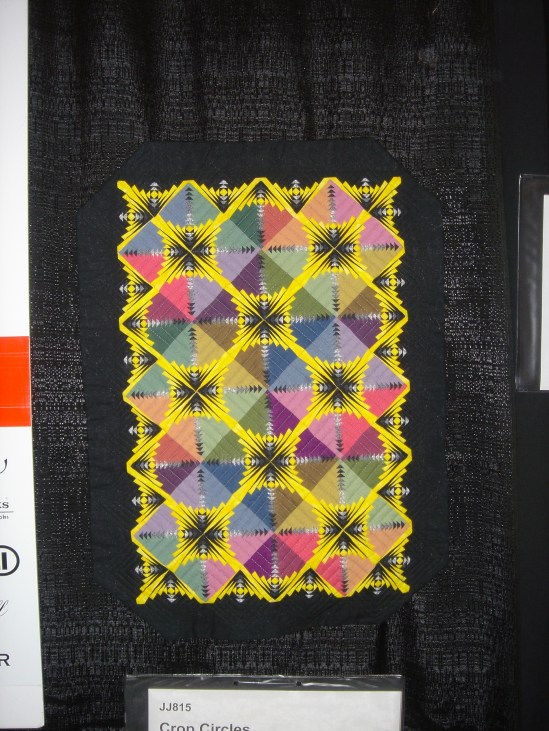
[Illustration Note: back when Claire had the time to quilt, she would attend the annual quilter’s bee in Lancaster PA–these pics are from their 2007 exhibition…]