Absurdities and Fragments (2015Dec13)

Friday, December 11, 2015                                               11:26 AM

Absurdities

Like a waterfall in the ocean, or a cloud beneath the ground

Or if toes could type like fingers, or the flowers sniff themselves

Like rain all night in weather dry, or songs without a sound

Or heaven without angel wings, or Santa without elves—

If I could only fly aloft by lying in my bed

Or make a universe exist with a logarithmic word

I’d think up all the great ideas with nothing in my head

And make a world of common sense seem patently absurd.

Friday, December 11, 2015                                                        2:10 PM

Fragments   (2015Dec12)

I was struck today by the image of a waterfall in the ocean—see, you can’t have a waterfall in the ocean—you need solid ground to make a waterfall—isn’t that weird? Stoner thinking—I know. But while we stoners seem pretty silly, ceaselessly marveling at the simplest things—I can’t help wondering if a penchant for being blasé about the universe is such a great alternative. The ability to see things anew, with a fresh appreciation, isn’t a distortion—it’s a gift beyond price. Being bullheaded about everything is just as foolish—and I see people do that all the time—without benefit of any self-medication.

I’ve decided to back away from politics—not that it doesn’t matter—it matters plenty—it’s just that I see now that politics is just a bunch of people fighting over the steering wheel while no one is looking out the windshield. In the end, people run politics as much as politics run people—if the politicians go too far wrong, they’ll always get corrected by public pressure. Look at Trump—front-runner for prez one day, shunned by the entire globe the next. While politics is important, my giving myself a stroke watching it on TV doesn’t do anyone any good—especially nowadays, when TV anchors report both sides of the news—the sensible and the idiotic. They used to report on different sides of the sensible and simply discount the idiots—and I miss that—but that may have been my youthful ignorance and there’s been idiots all along—whatever.

Feelings are so confusing. Sometimes I feel that I’m on the cusp of a great notion—something new, an exciting idea, a fresh insight—then a gear slips and my mind is blank—nothing left but a vague notion that I had an idea. I’m confused about which part of my mind is malfunctioning—is it my memory that collapses every time I get inspired—or am I just delusional and never had an inspiration to begin with, just the notion of one? Given the result, it hardly matters which—I guess I just want to know which to grieve over.

Today’s post is a great illustration of my mindset—every paragraph is about a different subject—nothing coheres. I used to wield my mind like a chainsaw—buzzing through any obstacle—focused on one job at a time—but now my mind is more like a river that I sit alongside of and watch go by. The thoughts and ideas drift into view—then drift away—and while new ones come after, none of them can be held tight and examined closely. People think that intelligence and memory are separate things but I’m here to tell you—you can’t have one without the other.

And one could say that my near-lifetime of TV-watching during my infirmity is much like watching a river go by—a stream of media, if you will—yet I can’t do anything useful, like fishing if I was watching a real river. But I am struck often by the archival footage of old conservatives, espousing hatred of all the different groups—at every distinction they can find, really—and how one can match them up with people speaking today, on CNN, yet no one seems to see the direct line-of-descent of this changeless ignorance.

It’s holiday time—lots of Christmas carols on the piano (prepping for caroling parties) and watching lots of Hallmark’s latest seasonal TV films, but not enough buying of trees or presents—I’m better at celebrating in my head than actually celebrating. Christmas is a wonderful time of year, but it’s also pretty confusing and emotion-laden to the point of stress—even more so for us atheists who don’t let our disbelief ruin a good holiday.

And as if there weren’t enough stress to the season, we’re experiencing a record-breakingly warm December here in New York—far from a white Christmas, we’ll be lucky if it even rains. With our climate, a white Christmas is never guaranteed—but in the past at least it managed to be cold! Pacific island nations may be in danger of disappearing beneath the waves, but a warm Christmas will probably do more to promote climate-consciousness in New Englanders than any other weather phenomenon—so perhaps it’s a good thing.


The Culture Novels of Iain M. Banks   (2015Dec12)

Saturday, December 12, 2015                                           5:57 PM

Technically (at least with regard to Amazon.com) there are only ten ‘Culture Novels’ listed in their website’s ‘Kindle department’—but there are, to my knowledge, twelve Culture Books to date. Amazon’s Kindle-publishing didn’t offer “Against A Dark Background” [1993] on Kindle until just recently—and it still doesn’t offer “Transition” [2009] (or “Inversions” [1996], though they list it as one of the ten—go figure). There are debates about whether something is distinctly a Culture novel or not—but as far as I’m concerned, they’re all written from a Culture frame of mind and are set in the same ‘universe’ (though vastly extended over both time and space) and are thus all Culture novels—but that’s just me.

In the course of my choice to re-read all the Culture Novels in chronological order, this and other details led me to create a table—and for anyone with a yen to do the same, I hereby save you the trouble:

20151212XD-Banks_CultureNovels_GRFC_02

I’m presently on ‘book 6’—which means that I’m reading “Against A Dark Background” on my Kindle—with plans to read “Inversions”, which I luckily have a printed copy of, the next time Kindle interrupts my reading for a charging of its battery—take that, Kindle! Truth is, I have them all in print somewhere—but there’s a lot of rooting-around implied in that phrase ‘somewhere’, so I’m just biting the bullet and paying for the Kindle versions (where available). I’ve become spoiled by reading a lit screen—and I really can’t read print by lamplight for very long nowadays, anyhow.

“Fans of the Culture novels by Iain M Banks” is a Public Group on Facebook that I just joined. Iain M. Banks is the ‘science-fiction-name-version’ of Iain Banks, a Scottish author whose initial renown springs from his gruesomely violent “The Wasp Factory” published in 1984. “The Quarry” and “The Bridge” are subsequent non-sci-fi novels—and the Iain Banks without the middle initial is thus a bestselling novelist. Still, ‘Wiki sez’ that he began as a sci-fi writer and couldn’t get published—and further, that there are aspects of “The Wasp Factory” that are sci-fi in disguise, so to speak.

I find this odd, but not that odd—science fiction should have its own publishers and editors—how can we expect a ‘regular person’ with no interest in science fiction to recognize what makes great sci-fi reading? Iain Banks, by manipulating his own talents in a more commercially-acceptable genre, gained acceptance as a writer first. Then he was able to slingshot around the imagination-opaque editors and get his sci-fi published. Being a logical kinda guy, he used his middle ‘M.’ to keep up the Chinese Wall between his two audiences.

I first read “Consider Phlebas” in the 1980s—I was its dead-center demographic—a sci-fi reader with a hard-on for anything T.S. Eliot—my favorite poet. Banks uses Eliot quotes for book-titles, sometimes—my kind of guy. I was pleasantly surprised by ‘Phlebas’—many writers throw in some T.S. Eliot for legitimacy—and who doesn’t want to quote the greatest poet of the last century—especially back in the last century? Most do it out of a well-founded sense of inadequacy—but Banks’ writing makes it clear that his affinity for Eliot comes from an affinity for the same kind of ‘big picture’ concepts dealt with in the great man’s poetry—and no small amount of literary talent. Banks’ fiction is exceptionally good reading—an even rarer prize in the sci-fi genre than in fiction generally.

Banks is also amongst those writers whose envelope-pushing in their own medium make them difficult fodder for the cinematic-conversion that so many writers envision as the end-game to success—he succeeds in his writing perhaps too well to succeed as the germinator of movie adaptations. His writings’ best features are also almost a list of things that are hard to adapt from the literary—though great screenwriters have adapted some wild stuff from past writers, so I wouldn’t go so far as to say the Culture novels will never be adapted for mass media in some way. Still, I can almost guarantee they will lose something in the process.

When I was ill for many years, I read very little—I had such poor memory that I could only read a Banks novel by keeping a few index cards between its pages—on which I would write the names of the many humanoids and ship-minds that filled the story. Ship-mind names proliferate—and any reader with a poor memory will have difficulty keeping them all straight—I noticed this particularly last week, while re-reading “Excession” [1996]. I do enjoy the serendipity of the naming of the mind-ships, though—and I enjoy the concept of super-AI minds being housed in starships whose size and power match their imagined mental capacity.

Fiction takes us to another world, another time or place, and allows the vicarious experience of other characters—when it’s done well, it’s transportive. In the case of science fiction, that escape is heightened by the absence of any boundaries of place or time—it can let us be not just different people in different places, but things that don’t exist in worlds that are different from Earth—even with physics that differ from our observed reality. What a trip. Iain M. Banks is one of those rare sci-fi writers that can comfortably, confidently take us on such limitless journeys and I recommend his books to anyone who has hitherto been missing out.

[Blogger’s Postscript: I wrote this post yesterday under the assumption that Iain Banks was still living and that he would bring us more books in future. I’m saddened to learn that Mr. Banks passed away in 2013 of cancer–and I hope no one feels I have disrespected him by writing about him as if he was still with us.]

VOD Movie Review: “Ant Man”   (2015Dec08)

Tuesday, December 08, 2015                                           5:06 PM

Ant Man is a strange choice for a superpower—to get very tiny hardly seems like an advantage aside from crawling through key holes to get into locked rooms. But Ant Man’s power is that he retains his inertial mass—Dr. Pym, played by Michael Douglas, explains it as ‘making the space between atoms smaller’ which makes tiny Ant Man capable of punching with all the force of his full-sized self—but it is, of course, all nonsense.

Like Superman’s power of flight, which has no connection to any notion of propulsive force, Ant Man’s inertia is very convenient in its manifestation. It doesn’t make Ant Man leave behind man-sized-deep footprints or make him weigh as much—but it works when he’s punching the bad guys. But one doesn’t watch superhero movies for the logical train of physics—that just spoils the fun.

AntMan

Insouciance was a favorite feature with the old-school superheroes—but it has lost cool points here in the twenty-first century. Paul Rudd, thankfully, has managed an updated, Portlandia-ish style of insouciance that is fun to watch. And the supporting cast of bumbling petty crooks tilts the movie towards farce, but not too much. As with all the Marvel movies, there was a business-like hand at the directorial helm—so the movie didn’t push any envelopes, other than casting Rudd in the first place. And there was the obligatory tie-in sequence that only die-hards get to see after all the credits have rolled.

The tie-in got me to thinking—when they’re done, these Marvel movies are going to be a ‘Sistine Chapel’ of movies—a panoply of stories, each with their own features, but each a part of a whole—I can imagine 24-hour viewings of chronologically ordered Marvel movies—just an immersive group-journey into the mind of Marvel. Only the Star Wars series and the Tolkien movie series can match it for single-themed sequential run-time. Actually, the Tolkien movies top out at six and the Star Wars, while (I assume) unfinished, is only at episode seven—while the Marvel movies—well, let’s see: there’s the Iron Mans (are there three or four?—I can’t remember.) there’s the Hulk movie (take your pick) two Captain Americas, two Thors—they’ve already exceeded both franchises and they’re just getting started over there, it seems to me. Comic books have been selling for decades—why should they ever stop making movies of them?

DC Comics, you say? Sorry—yes, there are plenty of movies of DC heroes, but they’re not themed—they’re not centrally coordinated by a far-sighted team that treats them as a single brand, as Marvel does. Don’t ask me why. Then again, if we look at the younger graphic novel scene—there are far more movies based on Dark Horse comics and the like than even Marvel can match, so it’s not as if they’ve cornered any market but their own—still, they’ve done a better job than DC. And I appreciate the glimmer of grandeur they give their whole enterprise (not an easy thing for me to say, since I’ve always preferred DC, as far as comic books go) by tying together all their movies, giving it the resonance of a cinematic tapestry. It counterbalances the simplicity of the stories themselves because let’s face it superhero movies have a pretty narrow scope for story-telling, by the time you’ve gotten past the origin story, the intro of the villain, and all the frippery of human-interest plot-points.

Ant Man is a case in point—the storyline is packed with exposition and development—there’s hardly time for the big action sequence at the end. Paul Rudd and buddies (played by Michael Peña, David Dastmalchian, and T.I.) add all the humor they can fit into the script—but the rest of the cast are straight-faced enough to more than balance it out. It’s hard to say whether a longer movie might have allowed some more breathing room into this story—or whether that would have destroyed that balance. I enjoyed it—but you can’t go by me—I have the critical faculties of a ten-year-old. All I can say is, they promise a sequel and I’m looking forward to it.

Trump’s Fascist Hate-Speech   (2051Dec07)

Monday, December 07, 2015                                           5:48 PM

Here I was earlier—quite proud to be an American as I watched all the Pearl-Harbor-themed movies on TV this morning. The America of the 1940s, a unified gargantuan force, dead-set on vengeance against would-be tyrants—ah, in amongst all that desolation and blood, it was a magnificent sight—the greatest generation, etc. Then I hear that Donald Trump has called for the banning of Muslims from entering the United States. And all that pride melts away, replaced by shame.

I’m unsure what embarrasses me most–it could be the childishly ignorant hate-speech itself; it could be the TV reporters calling it ‘politics’ instead of plain villainy; or it could be the string of Republican presidential candidates who echo his sentiments—proving that stupidity is now a sellable brand within that party. When I think of how Muslim-Americans must feel when they hear this—as if America and all it stands for can be chucked out whenever these overfed oafs get a little nervous—I want to rush door-to-door, upstairs and down, all through the town, yelling, “Don’t worry—America is not represented by these idiots—they just get too much air time!”

I’m sick and tired of these people giving a pass to all the Christian nut-jobs without pausing for breath—and then conflating 1.6 billion Muslims with a pack of nut-jobs that live in another country. Excluding 22% percent of the world’s population might be problematical, especially since ‘being Muslim’ doesn’t show—did Trump forget the part where they all have to wear little cloth crescent-moons on their lapels? What about Muslim-Americans who’ve left the country on business or on vacation—can they come back in? Can their relatives ever see them again—or will Muslim-Americans have to leave our shores to be allowed to see their native families from now on? I feel that the 74th anniversary of Pearl Harbor is a bad day for a presidential candidate to do his Hitler impression for the cameras. Donald, you’re not funny anymore.


I’m loathe to include my latest piano music with this post about an evil clown with delusions of awareness, but here they are (I’m damned if I’m going to do two posts just because Trump’s a galactic-class asshole):

Undeclared News   (2015Dec04)

Friday, December 04, 2015                                               12:54 PM

We must fight for liberty—freedom isn’t free. That makes us a fighting kind of people even though our present military is less than 1% of our population—and civilian-military engagement, like all social interaction, is less today than it was during the Big One, or even during Nam. No, today’s young whippersnapper doesn’t spring up to drive to the recruitment office and prove his manhood (or, as of today, her womanhood).

delightZ

But we do express our combativeness by buying guns—we’re not going down without a fight. And, yes, there is crime—and certainly more crime in certain places than others—but, by and large, the suburbs are designed to be lived in without gunfire. In most cases, everybody is too busy with other things. Putting aside the far greater, so-called white-collar crimes, we find that crime stats follow poverty stats. That seems clear to me—what do you think? You end crime by ending income inequality—by giving a hand to the underserved, by making the whole place rich and not just your patch of it.

I’m troubled by the undeclared aspects of recent news—the unadmitted connections between things we favor and things we disapprove of. The Senate just passed a bill to defund Planned Parenthood (which won’t pass but plays well to the base, I guess?) but the GOP are bending over backwards to deny that there’s anything wrong with the 2nd Amendment. You can’t revere the sanctity of life for the unborn if you don’t care about tens of thousands of annual gun-related killings.

delightr_Detail_01

There’s something else notable about mass-shootings and gun violence in general—there’s always wounded as well as killed. In San Bernardino 14 people died—and 17 were wounded. I’ve never been wounded by a bullet and gone to the hospital—for anything from a Band-Aid to a wheelchair for my paralyzed body—but I imagine that pretty well ruins your whole day. And on top of all the death that day seventeen people had that experience. There’s always more wounded than killed (maybe the same mind that goes to trigger-pulling isn’t that keen on the whole aiming thing) and with gun-shot wounds, you have to go on living with whatever havoc a hunk of metal has wreaked on your poor, baby-soft skin.

The truth is these right-wingers don’t revere the sanctity of life—not nearly as much as they fear being disarmed. They only want to revere their God above women’s reproductive rights—and opposing legal abortion is the only way they can do it without revealing how backward they are. But they should try it—I’ve got my sixtieth birthday coming up in a month or so, and I’ve never owned a gun or handled a firearm—and I’ve never been in a situation where that made a bit of difference. I’ve almost died from disease, fire, traffic, and bad-living—but I’ve never been shot at. Am I just lucky—or does not being a part of the gun culture make me lucky?

delightS

Anyway, there’s a far stickier wicket in the unacknowledged issues department—religion. We make the distinction between ISIL terrorists and average Muslims who have no truck with violence—and we have this right-wing nonsense about grouping everyone together—terrorist and Muslims, terrorists and Syrian refugees. But what we don’t address is the part being played by religion, both in the Planned Parenthood shootings and in the San Bernardino shootings—these people imagine themselves in some kind of battle between good and evil—a battle where dogma outweighs human life.

delightc

I don’t blame religion for what these people did—if they didn’t have a religion to turn to, they would have made up one of their own—crazy is crazy. I’m just saying that there is an association between religion and crazy—cult-leaders are an embarrassment—as are pedophile priests—yet no one sees an obvious connection between a strong fundamentalism and mental imbalance. If you think about it, Al Queda and ISIL are really just cult-leaders gone pro, and gone global. Reality won’t be obscured, though—there are communities now that purposely isolate themselves to lessen the cognitive dissonance between their overblown zealotry and the run-of-the-mill Protestant. It is far more difficult for such nut-jobs to maintain their self-importance when they are individual oddballs sprinkled throughout our average communities.

delightW

The original pilgrims’ decision to separate church and state was the first time that a society put practicality above its supernatural beliefs—at least publicly. You have to remember, back then, they still believed in a monarch’s ‘divine right’ to a throne—entire governments were based as much on religious dogma as on bloodlines. And the colonists still accepted that—they would remain loyal to the crown—even if they couldn’t decide on exactly which divinity was granting the right. That whole Revolutionary War stuff would come a hundred years later—America has always been more about getting on with life without letting religious nonsense cause trouble, than it has ever been about freedom or democracy. Indeed, you can’t have either of those things until you chuck religion, anyway.

delightr

Religion is okay for kids, and it’s okay for people to believe something in their hearts—but our important decisions should never concern themselves with anything other than justice and fairness and kindness, no matter how many people believe in stuff they can’t see. That’s what separation of church and state is all about. Those Christians who wish to drive a religious wedge into American politics and government are just as dangerous as ISIL—perhaps more so, in the long run. And right-wingers who wish to lay off all gun violence on the mentally ill should take a look at ISIL’s behavior—and ask themselves, “Are these Muslims, or are these just sociopaths using religion to cover their troublemaking?”

delightX

Millions of people live their lives, going to church on Sunday, but not basing their lifestyle on their afterlife—they accept religion in its rightful place and leave the rest until they have more evidence—a sensible approach. But some would have us all join them in their conviction that all life is just a journey towards an afterlife, with very specific rules—some will even go further, convinced that the world will end on a specific date—then the afterlife, as if the end of the world is just a feature. And religion doesn’t have to worry about charges of false advertising, because no one comes back to complain—of any religion, by the way—so we can assume that all are satisfied customers, regardless of faith. End-of-Days people have had their embarrassments, it’s true—but it is the nature of religion that most of these people just pick a new date and carry on.

delightd

Now these beliefs are beautiful and strange—I would never resent anyone investing their interior life with such exoticism—but there is a bullying quality to evangelism, to caliphate-building, to confessions and shaming, to exclusion, regimentation and dogma—these are the signs of someone using religion for self-aggrandizement—and I really don’t see how people fail to see through their bullshit. So—religion—good stuff—but keep it to yourself, please—and don’t go terrorist, whatever your faith.

delightU

A final question—since it was reported yesterday that this year’s mass shootings outnumber the days in the year, giving an average of more than one mass shooting per day. Where are all the stories of the brave, armed-for-self-defense Americans that fired back at these crazed gunmen? If we need guns for self-defense, why are none of these victims defending themselves? Is it because only the nut-jobs feel the need to carry weapons? Is it because we don’t live in the Wild Goddamned West anymore—and the average American prefers not to carry a gun?

delightT

Hieronymus Bosch did all these religious paintings, by the way–anyone want to debate me on that point about the connection between fundamentalism and mental imbalance?

That Christmas Thing   (2015Dec03)

Thursday, December 03, 2015                                         4:42 PM

Well, it wouldn’t be the holidays if friends didn’t get together and sing some Christmas songs—and that’s what me and Pete did today. We also managed a couple of brief improvs. It was grand and glorious.


Holiday Music (2015Dec02)

Wednesday, December 02, 2015                                               11:15 AM

It’s a long way from sheet music to video—I started this holiday season with the idea that I could video myself performing an entire book of Christmas songs and carols. I play them cover-to-cover every December, and most of the songs in the different songbooks are the same—there’s only so many traditional holiday songs that remain popular over the years. Carols and such have to be good songs, but they also have to be accessible to the untrained voice, and catchy, without being too challenging for the average kid to sing.

It’s its own genre of music—but don’t be fooled—some of these babies are just as demanding to play on the piano as your average piece of classical music—it may be for the kids, but it’s not kid-stuff to play. There are pared-down versions, of course—but it took me some years to be able to play the intermediate versions—and I don’t like to backslide.

Also, I pretty much have to sing along. It’s more difficult to sing while I play, but I know most of the words—and what’s a Christmas song without the words, after all? Anyway, the thing is—I start to record the songs—and I find that the recordings are not as good as they felt like, while I played them. So then I try again—and by playing the songs more than once, I hope to get a useable recording of each—but then the camera’s battery died just as I was getting warmed up—and an hour of playing goes unrecorded. The next day, I try again, but now my back hurts and my fingers are stumble-y.

I consider backing off, taking a day or two off from playing piano—but then I realize that if I don’t keep going, I’ll forget what I was doing (this is a common problem for me). So I keep pushing when I should be resting—suffice to say I won’t be publishing ‘recordings of entire songbooks’ on YouTube anytime soon. But I got a few done.

Sunday, November 29, 2015                                            9:55 AM

Okay, Christmas carols—Now, I’ve made no secret of my atheism so someone might reasonably ask why I’m so crazy about the holiday music. Well, firstly, I love music—and the holidays provide the only real opportunity to suggest a sing-along, outside of a boy-scout campfire, without hearing a chorus of moans in reply. Besides that, there’s also the matter of childhood memories—when I was a kid, we not only sang Christmas carols around the piano, we still went to midnight mass.

The carols are fun to sing and play, but they lose a bit of luster when you no longer ‘feel’ the lyrics the way a young, Catholic-indoctrinated boy does. Nowadays, I am comfortable enough in my atheism to allow some nostalgia for faith—to allow myself to pretend to still believe while I’m singing—and the thrill is back, to a certain small degree. For me, there’s no smidgen of cognitive dislocation involved at Christmastime—what with the irony of Santa Claus being a belief we grow out of, and Christ being a belief we’re supposed to maintain. But it is just that irony that now allows me to pretend that Christmas is what it once was—at least while I’m singing.

I would, if I could figure out how, prefer to make videos of a crowd of carolers—a video of just me, singing and playing carols, lacks something in the holiday-cheer department—but I have to work with what I have available.

Saturday, November 28, 2015                                          11:25 AM

Treacly Ever After   (2015Nov28)

Have a holly-jolly…. Oh, hello there! And welcome to the dreamy snowflake happy kids express—yes, it’s that time of year again—and if you share my sickness, you’re once again binge-watching the Hallmark Channel’s offerings of Christmas-themed TV movies—partly because it’s crack for the romantics and partly because it’s a fascinating infinite loop of wishes coming true and impossible dreams coming true and fantasy—and while that may not be, as Hallmark claims, ‘the heart of Christmas’, it is certainly the heart of good TV.

Last night was an especially rich vein of fantasy—two movies which both combined Christmas miracles with becoming a princess: “A Crown For Christmas” and “A Princess For Christmas”. It got me thinking about how royalty is an old-fashioned type of myth that no one believes in anymore—and how Santa Claus is an old-fashioned type of myth that no one believes in after grade school—and how Christianity is an old-fashioned type of myth that many people still believe in. I think it’s odd how these Hallmark Channel movies focus so much on fantasies and miracles and dreams coming true—it’s as if theism has a market value, and this holiday-centric company is willing to intermingle Christianity with other, admittedly-pretend ideas—just for the entertainment value—in spite of how it lumps Faith in with childhood imagination and wishful thinking.

It’s like they’re admitting that Christianity is more of a ‘feel-good’ idea than a fact—something we keep as a tradition more for the sake of innocents and children rather than as a core belief—it’s quite undermining, if you think about it. There are so many of their Santa-based plot-lines that end with the kids being right all along—there is a Santa Claus—and that seems a dangerous concept to mix in with Christianity, which expects followers to keep believing into adulthood. Are they trying to say that real Christians believe in Santa Claus, too—even though the grown-ups are buying their kids the presents, and know full well that if they don’t, there’ll be nothing under the tree?

Or are they saying that Christianity is just an idea—and you have to do all the work yourself? Because, I’m sorry, but that’s Humanism—atheism with a smiley face. Now, if Christianity is just a thing for the kids, like Santa Claus, and all us grown-ups are supposed to play along, both for the kids’ sake and because it’s just a nice thing—that’s cool—I can get on board with that. It’s just when some very serious grown-up, like a politician, starts talking about how we should sprinkle magic-dust on public policy—that’s what I can’t deal with. If we could keep religion at the Santa Claus level, where we only talk seriously about it when we talk to kids, but laugh about it amongst ourselves, that would be fine with me. Maybe that’s why I like the Hallmark Channel.


In Which The Hero Has A Narrow Escape   (2015Nov24)

Tuesday, November 24, 2015                                           8:00 PM

We got new chairs—they’re classy, made out of unpainted wood—not folding chairs, which have been our go-to chairs, mostly. It’s good to have chairs—that way you can have company—uh-oh! Company? Wait a minute….

I started to write a post today, then about three pages in, I realized I was mistaken in my facts. I had to walk away—I hate when I realize I’m wrong about something—it’s not like it happens every day (more like every other, but never mind).

But I walked away with a cigarette burning in the ashtray. I came back just now, hours later, and the smoke-eater ashtray is still on, wasting its batteries, and there’s a butt that’s gone out on the newspaper that I use for a mouse-pad, with a little burned-out circle in the paper. I almost burned my house down because I got upset about being wrong.

It’s partly the chairs’ fault—you don’t usually get a parade of new chairs coming through the front door, which I’m sitting next to. So, stunned by being wrong and confused by a shower of furniture, I walked away from a lit cigarette—but I was lucky. The house abides.

Then I misspelled “Haydn” on my video graphics, and had to go back and correct all that—it’s just my day for screwing up, I guess. Day after tomorrow is Thanksgiving—there’s a pressure (for me at least) building from the approaching holidays—opening ourselves to feelings, in the tradition of the season, makes the thought of trouble more intimidating. When things go wrong during the holidays, they don’t just go wrong—they ruin the holiday. Not that I expect things to go wrong—but bustling shoppers and stressed-out parents and heavy store traffic, all together, just need a little complication, like bad weather for example, and the whole thing becomes a nail-biter. I kinda feel like ducking, until January 2nd makes it all go away—I love January 2nd—it’s like that day you come home from vacation—the good times are over, but it’s nice to just settle in again.

Well, next blogpost, I hope to know what I’m talking about—if that was ever the case.

I’m Lucky That Way   (2015Nov23)

Monday, November 23, 2015                                           12:44 AM

I noticed that today’s YouTube-posted improv was exactly one week after the last one—I used to post almost once a day—am I now going to post only once a week? Am I slowing down because my sixtieth birthday is only three months away? I think it’s more likely that I’ve finally accepted that I’m my own biggest fan and other listeners are not eagerly awaiting my next post.

It’s true that I like my own music—it’d be a pretty sad state of affairs if I didn’t, I guess. And I am one of those few people that enjoyed classical music right from childhood, without being told it was important or impressive—or without having to be taught to ‘appreciate music’ in school—though I did enjoy those classes. So I’m used to liking music that doesn’t interest a lot of other people—music that is more (and less) than just something to dance to. So, for a long time I figured that I might just be ‘inaccessible’, like classical music—but now I think I have to give that up—I am not going to draw a crowd—ever.

My big ‘idols’ are Glenn Gould, George Winston, and Keith Jarrett—and since I’ve never surpassed any of them in any way, I can’t really call them ‘influences’. I think I’d have to go past them in some way before I could relegate them to ‘influence’ status—they remain my idols, people far more talented than I. So, if recorded musicians of forty or fifty years ago are still unreached targets—if I still think of myself in terms of someone who’s trying to get started in music—then I take it as given that my dreams of being notable in music will never be more than dreams.

Not that they were ever very promising dreams—I never received the slightest encouragement from parents, teachers, friends or loved ones—more like discouragement, in many cases. I stuck with music through plain stubbornness—I wasn’t about to let myself be excluded from something that great. And if I had to be a lousy musician, then so be it—I was not about to spend my entire life just listening to other people have all the fun.

Anyway, I stuck to it for a long, long time and now I’m liking my own recordings—some more than others, but that’s how that goes—a few I’m quite pleased with. I have the luxury of having my own music—other people aren’t interested in listening to it, but that doesn’t change the fact that very few people have their own personal music soundtrack they can switch on whenever they get tired of pop music. Just another luxury—did I tell you I have my own library? I am so rich—and on so little money—I must be pretty clever.

I used to make a decent wage—we had very big bills back then, but we didn’t have half so comfortable a lifestyle. Sometimes mo’ money is mo’ problems. Sometimes being able to indulge your whims isn’t healthy. I’ll never be wealthy but I’ll always be rich. I’m lucky that way.

There, that’s better–two days in a row….

Paul Ryan – What A Jackass   (2015Nov17)

Tuesday, November 17, 2015                       10:50 AM

I’m so mad I could spit. Obama spoke at the G20 yesterday, making several sensible points about dealing with Daesh. Among those points was his conviction that humanitarian concern for the refugees was not only a responsibility of the world’s governments, including the USA—but that caring for these helpless victims, without questions about their faiths, is what separates us from Daesh.

In response, a crowd of jackass GOP governors have announced that they will not accept refugees from Syria in their states. That they have no authority to do that is something they choose to ignore—apparently, the political effect of announcing their cowardice and prejudice is enough to satisfy their ostrich-like followers.

Then this morning Paul Ryan was on CNN talking about being ‘prudent’—about how, in the case of Syrian refugees, it is “better to be safe than sorry”. What a cowardly, un-American, xenophobic jackass. He spoke about halting the flow of refugees until we can verify that they are safe to accept into our homeland—ignoring the fact that America’s vetting of refugees is lightyears more involved than any other country’s—that it could not possibly be any more thorough. He just wants to halt the flow—and the rest is all BS excuses.

Is he really afraid of a bunch of dazed, victimized, mostly women and children refugees—or is he simply another GOP knee-jerk, anti-whatever-Obama-wants idiot? Either way, he’s no American. Not the kind of American who leaps, unarmed, to defend a train-full of people from a gun-toting terrorist. Not the kind of American that says, “Give me…the wretched refuse of your teeming shore. Send these, the homeless, tempest-tossed to me…”. Paul Ryan is an elitist, anti-American coward.

And if he and his band of mouse-panicked elephants weren’t bad enough, we have CNN and all the other news outlets making hay out of terror, digging their heels in on the terror aspect of all this and blocking out all the defiance that real men and women feel, far more than any intimidation these thugs wish to engender. I’d rather deal with a suicide bomber than these mealy-mouthed, chicken-hearted, entitled scaredy-cats—they make me sick. And Paul Ryan—you should be ashamed of yourself, you dick.

Time Passes Slowly   (2015Nov15)

Sunday, November 15, 2015                                            12:12 PM

“Time Passes Slowly” was one of my favorite Judy Collins songs when I was a teenager—I only wish I could still sense that stillness of time. Here in my aged future, time passes far too quickly—and with less happening in it, to boot. At the moment, it seems last spring was only a few weeks back, that last summer was yesterday, that Halloween came and went while I was glancing at something else—and Thanksgiving is only seconds away, to be followed an hour later by Christmas. That’s what being old feels like (in between the groans and the wheezing, of course) a maelstrom of time that gives not a moment’s rest.

As promised, I purchased Amazon’s only listed biography of Joseph Henry, the American discoverer of electromagnetic induction (Michael Faraday is given the historical credit, in the cliff-notes version). If you remember, I wanted to discover why his name is so unknown today, when he was so revered by scientists for over a century. While that project is still under weigh, I have come up with one thought to share.

Joseph Henry was born in 1797—George Washington was still alive. Henry lived in Albany, New York—recently made the new capital city of New York State. Sloops made regular trips up and down the Hudson River to New York City though by 1807, Fulton’s “Clermont” was steaming over the same route—to be followed by numerous other steam-powered vessels throughout Henry’s youth. As a young teacher-to-be, he made a trip down to West Point to attend a teacher’s conference and learned there of a new invention for the classroom—a black board, which could be written on with chalk, then wiped down and used again—it was a breakthrough in classroom demonstration—the i-pad of its day, if you will.

Henry would continue his experiments with magnetism while teaching Chemistry—Physics would not be recognized as a separate study for some time. And native Americans still lived in the Albany area when he was young—many pioneers passed through Albany on their way west—the North American interior was still very much a separate world. Both the United States and science would grow, slowly but surely, over the years.

It occurred to me that science progresses quite slowly. Euclid’s geometry was written down in the third century BC. Alchemists would work with metalworking, refining, colored dyes, pigments, and other useful materials for centuries, providing the foundation for the Chemistry to come, while being hunted as Satanists. Medical science and astronomy would work through similar resistance from religious institutions to reach understandings of basic human anatomy or the course of the planets through the heavens. Men like Ben Franklin, Alessandro Volta, and Luigi Galvani would spend lifetimes studying electricity without even connecting it with magnetism.

Likewise, it would be almost a century before Henry’s own discovery of induction would produce practical devices such as Morse’s telegraph, Bell’s telephone, or Edison’s dynamo. All of science and technology would crawl along, taking years, or even centuries, to take a single step.

But here’s the thing—as a student in the 1960s and 1970s, I was taught all of these wonders in the space of a handful of semesters. They were not presented as a ‘story of us’—rather as a mere list of rules and functions. It would take me years more to discover the story of humankind implied behind the bare bones of chemistry, calculus, and physics as taught in school.

As I read history, I learned of the life stories of these men and women, of how they lived and died, of the cultures they inhabited while ferreting out these secrets of the universe. I saw the steps taken, one person standing on the shoulders of all who came before—and becoming a foundation for those who would come after. I imagined the changing lives of people who went from caves to indoor plumbing, from horses to steam engines, from papyrus to Gutenberg’s printing-press, from leeches to open-heart surgery.

But I also realized that these giants of human knowledge were all geniuses of some degree—that the principles, the formulas, the mathematics that make up the education of modern children take time to teach because they are all gems of perfect understanding, insights that only our greatest minds could reveal. Their greatness is obvious in the sheer effort required by mortal minds such as my own to grasp what they saw—what they had the genius to recognize and to communicate to the rest of the world (no small feat of its own).

So, yes, it takes time to acquire a good education—because we are climbing on the shoulders of a crowd of intellectual giants. Even so, we are only learning the barest highlights of what they did—without even the names of the people who mined this treasure, much less their stories, or the story of how this knowledge percolated through civilization to yield the wonders of our modern age—no wonder children ask why they need to know these things—they are never told of the richness of humanity’s struggle to wrest understanding from an opaque existence. It’s as if we are loading their knapsacks with gold bars—and never telling them of its value.

So, to begin with, the story of Joseph Henry’s invisibility is the same as the story of the death of a liberal arts education—many people don’t appreciate the context of information as being of equal value to the information itself. We used to teach scholars ancient Greek and Latin—dead languages with no apparent face-value—but when using these old terms, by knowing their origins, we are reminded that some things are as old as ancient Athens or Rome, and that the people of that time were no different from ourselves. Context is its own wisdom—its own information.

Now we are inclined to pare down education even further, by renouncing the creative arts—a sure sign that we don’t appreciate the connection between music and mathematics, painting and chemistry, or dance and physics. We are educating ourselves as if we are machines being prepared to be slotted into a job after our training is over—not as if we want to raise humans with hearts and minds that find fulfilment and wonder in the world around them. Context is everything. I will continue reading Joseph Henry’s biography and I’ll keep you all informed of what I find.

Had a windy day yesterday:

Four Political Thoughts (2015Nov06)

20151106XD-Rijk_LArbre_de_science

Thursday, November 05, 2015                                         3:41 PM

Can You Feel The Warming Now?   (2015Nov05)

Oil and Coal interests have been denying climate change for so long that they are now being investigated by the New York attorney general Eric T. Schneiderman. Since the world outside our borders has accepted climate change as real, there are a mounting number of international agreements on limiting carbon emissions. As the writing on the wall becomes more legible, a new legal strategy presents itself—by obfuscating the unstoppable tide of repression that fossil fuels face in the near future, Schneiderman posits, energy companies have been misleading their investors as to the value of energy stocks—in other words, financial fraud.20151106XD-Rijk_Lectern-Felix_Meritis_Society

Big Energy has been questioning scientists’ concerns over greenhouse gasses since the 1970s—and has been successful, domestically, in carrying the day, partly due to confusion raised by conflicting research—which they paid for. This was a successful strategy insofar as it focused on doubting the details and expanding the questions—difficulties with ‘absolute proof’ are inherent in scientific research, especially in a field as new as climate science. That is the whole point of ‘doubt factory’ lawyering.

20151106XD-Rijk_Mantle_clock

But we have reached a point where doubting climate science only works now in a court of law—finer points aside, only an idiot would question climate change as visible, and worsening. Plus, even if climate change is unprovable, in a legal sense, there is no question that people and businesses are now behaving as if it is true—and this changes the future potential value of energy stocks. In short, economic pressures pushed the energy companies to fight the inevitable—and now economic pressures are going to oppose their interests.

There is sometimes a subtle poetry to politics—if efforts like this new lawsuit can enhance America’s too-slow response to this issue, we may yet have a hope of retaining the polar ice-caps and avoiding sending most of the globe’s coastal real estate where Atlantis went. Of course, there’s still overfishing and rising acidity in the oceans, habitat-loss and species-loss on land, and plenty of other disasters-in-waiting to worry about—but clean-energy conversion would still be something we could all be proud of.

20151106XD-Rijk_Allegory_of_the_science

Some Kind Of Crazy

What is the difference between Trump crazy and Ben Carson crazy? Trump’s brand of crazy comes from ego and avarice—a businessman who feels that defeating the competition is as valuable as succeeding, a boardroom warrior who would rather burn down the building than lose his standing, a financier who would gladly bankrupt his company to protect his personal fortune, regardless of the losses suffered by others. He respects strength and strategy—which is understandably attractive to Republicans, yet Trump doesn’t discard practical knowledge, math, or science because they are too useful—and far more common in business than they ever are in politics.

Ben Carson’s crazy is a whole other animal—Rachel Maddow recently described it as a war on epistemology, or the ‘theory of knowledge’. According to recent quotes, it appears that Carson’s ‘American History’ (as well as his personal history) are simply stories he makes up as he goes along. His fundamentalism makes for some outlandishly screwy quotes that would place most people firmly in the ‘crank’ category—but he is a GOP presidential candidate, so at least during the primary he gets a pass on that particular line of nutcake.

20151106XD-Rijk_Portrait_of_Dr_Gachet

Ben Carson is an iconoclast, i.e. ‘a person who attacks cherished beliefs or institutions’—but where traditional usage refers to those who attack religion and the establishment, Carson is an iconoclast who attacks the cherished ideas of humanism and science. More than that, he attacks many ideals that most of us consider core principles of the American spirit. His statements about barring Muslims from elected office are a direct contradiction of our Constitution. Moreover, I find any kind of fundamentalism or evangelical zealotry to be vaguely un-American—to accept pluralism requires us to be hard-headed about which of our faiths’ finer points should be debated as public policy.

On the surface, it would appear that anyone can believe anything—our thoughts don’t show, our religion doesn’t imprint on our foreheads. Our freedom of religion recognizes that fact—but it also implies that we have to be circumspect in any real-world manifestations of our chosen faith, particularly in public—especially in politics. There is a world of difference between believing that the Earth is only 6,000 years old—and deciding policy based on that belief. If your faith tells you that women have less status than men, you still have to recognize that, in the real world, the rest of us—and the law—don’t agree.

Today’s far-right has embraced the evangelical, ignoring the fact that theocracy by any other name is still anti-American. There are many faiths in this country—and there always will be. To pick just one, and incorporate it into a political platform, should by all rights be political suicide—that this is not true for the GOP is just one of its many dysfunctions. And it is also what makes a delusional nut-job like Ben Carson a viable candidate for their party.

20151106XD-Rijk_Invention_of_the_compass

Why We (Choose To) Fight

I was shocked the other night watching “The Brain with David Eagleman” on PBS—it was the episode about how we make choices. Towards the end, he shows an experiment that measures a person’s ‘disgust’ threshold—that is, how easily they are grossed out. Then he follows that up with another experiment that measures a person’s political bent—conservative or liberal. What was shocking about this was his statement that the tests showed a virtually unanimous correlation between a low ‘disgust’ threshold and a preference for conservatism. Neuroscientist David Eagleman said that he could look at the results of just the first test—and tell a person’s political leanings without giving them the second test.

If you think about it, it makes a lot of sense. What are the things conservatives often deride about liberals?—Gooey things, like long hair, quiche, yogurt, or tofu—just the kinds of things that, at first glance, are somewhat repulsive. There is a ‘disgust’ barrier around these things—and only certain kinds of people will push back long enough to give these things a try. Not all liberals enjoy yogurt, you understand—but liberals are more likely to give it a try.

20151106XD-Rijk_Mécanique_de_Vaisseau-volant

Being hawkish is a conservative trait—perhaps the male ego feels disgust for the idea of not fighting—even when fighting may be a bad idea. Poor people can be kind of gross—and women’s health certainly makes men squeamish—health issues in general can get pretty slimy, repulsing both men and women. Wouldn’t it be funny if conservatism turned out to be regressive—a sign of emotional childishness? Like kids who won’t even try their broccoli. Xenophobia is a form of disgust—perhaps that is what makes liberals more inclusive—they more easily look past the surface strangeness to the human being underneath.

I say we stop considering conservatism as merely another point of view—I say we start calling liberalism what it really is—intellectual maturity. Then again, I don’t need a scientist to convince me that conservatives are often childish—and being childish, nothing anyone says will convince them to change their minds. Only voting them out of office will do that.

20151106XD-Rijk_Lectern-Felix_Meritis_Society(Detail)

Suggestion Box

I have a couple of suggestions. First, we should consider the millions of Syrian refugees as a potential resource. European countries are already seeing the potential benefit of an influx of younger, more energetic citizens. But what about giving Syrians a chance to do something about their own country?

What say the UN offers all young adult Syrian refugees the opportunity for military training—we gear up a few divisions of native sons and daughters, give them the arms and equipment and support they’d need to retake their country, and point them at Assad and ISIL? That way, outsiders like the US don’t have to send troops into a foreign country. Young displaced Syrians have an opportunity to do something other than depend on the charity of the world—and they wouldn’t go anywhere after the fighting is over—they’ll set up a responsive government—maybe they’ll even send for their relatives, old and young, to rejoin them in their native land— a Syria finally free of endless fighting. It’s just a thought.
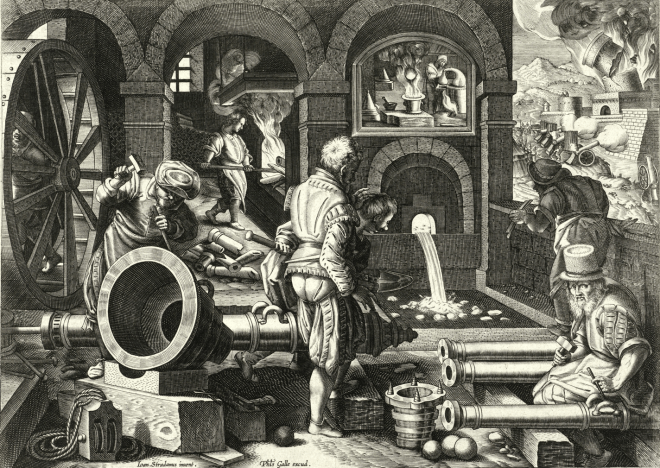
20151106XD-Rijk_Artilleriewerkplaats

My second suggestion is for Hillary Clinton’s campaign—hey, why don’t you guys rise above the media’s narrative and focus your platform entirely on infrastructure? You could come up with specific projects for most of the fifty states—smart highways, clean energy, bullet trains, wilderness bridges, dam tunnel, bridge and highway refurbishing, underground fiber-optic networks,–hell, I could go on and on—and I’m just one person. I’m sure a room full of people could produce quite a list.

And every one of those projects would make jobs, stimulate our economy, and put America’s infrastructure back to its former place as leader of the world. One of the most telling aspects of a developed country is its ease of transportation and communication—and these are the greatest lacks of underdeveloped countries. Lack of roads and barriers to communication contribute to poverty, hunger, and despotism in all the most bedeviled parts of the world—and those with a plethora of such resources are too busy doing business to have uprisings, insurgents, or to invite the chaos we find in the world’s worst trouble-spots.

20151106XD-Rijk_Book_Printing

Eisenhower’s great post-war push to grow America’s highways was an essential element in our rise to wealth and power in the latter half of the twentieth century—but now we are losing roads, bridges and other key features through neglect and an assumed entitlement that often precedes a great empire’s slide into decline. This stuff won’t fix itself.

We spend a lot of time and money on what we call Defense—it’s more than half the federal budget. Shouldn’t we consider taking some defensive measures against the passage of time? If we don’t have the will, or the spirit, to improve our infrastructure, we should at least defend against the loss of what our forebears have already provided.

20151106XD-Rijk_Windmolen

All images are property of the Rijksmuseum—to whom all thanks are due:

Gazette du Bon Ton 1914, No. 8, Pl. 80: L’Arbre de science /Robe du soir de Doeuillet, Anonymous, George Doeuillet, Lucien Vogel, 1914

Mantle clock (pendule), Anonymous, Benjamin Lewis Vulliamy, c. 1802 – c. 1803

Allegory of the science, Jeremias of Chess, Henry Crown Velt, 1696

Portrait of Dr Gachet, Vincent van Gogh, Paul Ferdinand Gachet, 1890

Invention of the compass, Philips Galle, c. 1589 – c. 1593

Mécanique de Vaisseau-volant, Anonymous, c. 1781 – c. 1784

Lectern of the Felix Meritis Society, Anonymous, c. 1778 – c. 1779

Artilleriewerkplaats, Philips Galle, c. 1589 – c. 1593

Book Printing, Philips Galle, c. 1589 – c. 1593

Windmolen, Philips Galle, c. 1598 – c. 1593

On VOD, Reviewed: Three Films (2015Nov05)

Tuesday, November 03, 2015                                           12:40 PM

Pre-Reviews   (2015Nov03)

Okay, I’m an old fuddy-duddy—I added these movies to my “Cart” from the “Just In” menu of my Cable VOD listings: “Best Of Enemies”, a documentary about the 1968 debates between William F. Buckley Jr. and Gore Vidal, the then-champion intellectuals of America’s political right- and left-wings, respectively; “The End Of The Tour”, a re-enactment of Rolling Stone reporter David Lipsky’s road-trip/interview with the late novelist David Foster Wallace during his 1996 book tour promoting his masterpiece, “Infinite Jest”; and “Inside Out”, the animated Disney feature about the inside of a young lady’s head, populated by characters that represent emotions—Joy, Anger, Fear, etc.—as she experiences the trials of childhood.

As a twelve–year-old, I remember finding the Buckley/Vidal debates excruciatingly boring—they talked of issues I knew nothing about, using words I couldn’t understand—I hope, forty-seven years later, I can understand them a bit better. I’m actually looking forward to watching “Best Of Enemies”—even though my memories of those talks are vague, I still miss their obvious insistence on clarity and correctness—something so absent from the politics of our new millennium. Ironically, it was most likely the entertainment value of their last exchanges, which devolved into anger and name-calling, which brought forth the kind of nonsense we see in modern debates.

I’m not sure whether I’ll enjoy watching “The End of The Tour”. David Foster Wallace’s writing is a beautiful stream-of-consciousness cornucopia of vocabulary and images unmatched by other living writers—but his subject matter was unfailingly dark, disgusting, and full of despair. Add to that the unpleasant highlights of his blurb-biography—and the fact that he committed suicide in 2008—and I’m left with the suspicion that I won’t have much fun watching the film, no matter how well-made. Having plowed through “The Broom Of The System” and “Infinite Jest”, and having read the first few stories of “Oblivion: Stories”, I’m afraid to read any more of his stuff, especially now that he’s killed himself—I have my own struggles with depression and I don’t need my leisure pursuits to reinforce my worst impulses. I think I want to watch the movie just to get close to his beautiful mind again, without having to actually join him there by reading his works.

“Inside Out” should be fun for me—as a kid, I used to run cross-country—and I’d pretend my body was a mechanism, and I was a controller sitting inside my brain, behind my eyes, ‘flying’ myself around the track, or through the paths in the woods behind our school. Besides, I don’t think I’ll ever outgrow Disney animated films—they’re the best—and if the reviews and box-office are anything to go by, this is one of their better efforts.

20151105XD-BestOfEnemies_Movie

Wednesday, November 04, 2015                                              9:51 AM

Post Review   (2015Nov04)

“Best Of Enemies”  is an enjoyable documentary and I found it especially so because it gives impressions of the two-party mind-set just as that paradigm was coming to the surface. Prior to World War II, social friction was between Rich and Poor—easy-peasy, simple as that. During that War, America put on its best overalls and pretended we were ‘all in this together’. Immediately post-war we busied ourselves fighting against ‘Red propaganda’, touting liberty, democracy, freedom of speech, and freedom of religion. Having gone from competing armies to competing ideologies, America’s entitled found themselves in a quandary—many of the free world’s ‘good features’ were populist and inclusive. Unions were acceptable, racial integration had begun in the military, and women were fresh from the workforce—pushed out by returning servicemen and the closing of war factories, but still cognizant of what they had achieved during those years spent in so-called ‘men’s jobs’.

To me, religion is the most elusive aspect of those times—we were claiming that religious freedom was a touchstone of modern civilization, but there were many Americans who assumed that Protestant Christianity was the default American faith. This allowed the establishment (an old term for the rich and powerful) to take exception to some freedoms as ‘sinful’—particularly when talking about women’s roles and rights. As we had seen during the war, women were legally accepted as equal—able to work in factories, offices—even serve in the military as ‘support’—but the Bible gave chauvinists the ammunition to reverse that acceptance. The invention of the Pill brought birth control into the equation—and we were off to the races. Women’s equality saw such a backlash that it would be the 1970s before any pushback from women was heard. Still, theocratic mores had permanently embedded themselves into the toolkit of the rich and powerful.

Law and order was another meme adopted by the establishment—but it was used as code for white supremacy. Any public outcry or demonstration in favor of racial justice was characterized as lawlessness—urban rioting was blamed on the rioters, not on the issues that got them rioting. This double-talk would appear legitimate until the Civil Rights Act and the Voting Rights Act were adopted—afterward it became increasingly difficult to characterize social progress as ‘troublemaking’. And to this day, police brutality is rationalized by the rich and powerful as ‘maintaining the peace’.

Our half-century of ‘war on drugs’ was also a thinly-veiled attempt to persecute African-Americans. The criminalization of marijuana as a Schedule I drug, the CIA’s involvement in flooding American cities with crack cocaine, our present-day swollen prison population—mostly non-violent drug offenders—are all examples of how drugs (which are a legal, billion-dollar industry) are still being used to persecute minorities. The establishment remains rabidly anti-drug, in spite of evidence that the War on Drugs created an underworld market—a subculture that makes it easier for their own children to get ensnared by addictive drugs than if they were legally sold over the counter, like cigarettes or booze.

Post-war Americans retained many wartime attitudes—‘get it done, no matter what’ was a common phrase while fighting to save the world from Fascism—but after the war, we still felt that a good person would just ‘get it done’. Those who couldn’t ‘get it done’ were useless, rather than helpless—they deserved our derision, not our sympathy. The old, the sick, the poor, the unemployed—these people were useless—they didn’t deserve help—that was the establishment line. Buckley habitually described the poor as ‘lazy’—as if poverty was a choice.

So we see the kernel of modern conservatism in Buckley’s battle of wits with Gore Vidal—biblical fundamentalism, thinly-disguised racism and sexism, and blaming the victims in lieu of social support programs. Buckley’s early work in stymying social progress and maintaining white male supremacy can seem silly to us today—but his fatuous reasonings were acceptable to the staid, close-minded majority of Americans of his time. Today’s conservatism has become far more sophisticated—it has had to, since the majority of Americans today see things more from Vidal’s point of view. We are, by and large, far more open-minded and inclusive about race, sex, and sexuality—and we have documentation proving that social support programs help the whole society, not just those who need them. Yet the philosophical battle rages on—proof, to my mind, that it is what it has always been—rich versus poor, those in power versus those without a voice.

20151105XD-TheEndOfTheTour_Movie

Thursday, November 05, 2015                                         7:39 AM

Post-Review   (2015Nov05)

“The End of The Tour” is well-acted, beautifully photographed, mysterious, engrossing—a surprisingly powerful movie, given the scope of the action—and most importantly, it is not a documentary. We aren’t led through a delving into the details of David Foster Wallace’s life and work—in fact, much of the dialogue displays Wallace’s fear of being detailed and analyzed.

David Lipsky, author and journalist, had just published his own novel when Wallace’s “Infinite Jest” exploded onto the cultural scene—and we see that he is appalled by the rave reviews for Wallace, and then more appalled by reading “Infinite Jest”. I can attest to the impression made by that experience—Wallace’s writing is unbelievably good and can’t help but evince a touch of despair in anyone with pretensions of writing. Rather than being repulsed by such overbearing competition, Lipsky becomes fascinated and cajoles his Rolling Stone editor into letting him interview Wallace as he completes his book tour.

Thus begins a short road trip, an awkward bro-mance between two equally neurotic intellectuals who couldn’t be more different. Lipsky is torn between admiration and envy. Wallace is torn by his sudden celebrity, which represents a sort of pinnacle of all the failings of American culture so deftly deconstructed and demonized in his writing. Few films make such an open-and-shut case for the theory that all great art is the product of suffering—or the irony that subsequent success only adds to the suffering.

Adapted from David Lipsky’s “Although of Course You End Up Becoming Yourself : A Road Trip with David Foster Wallace”, a book which expands on the original magazine article, this film has a quiet beauty that belies the ugly struggle of creative expression and its practical side-effects. It has a camaraderie that belies the intense rivalry endemic to artists—and it has a peacefulness that belies the internal struggles of extreme, self-conscious intellectualism. For a film that is the opposite of an ‘action’ movie, it is a terribly exciting adventure.

20151105XD-InsideOut_Movie

Thursday, November 05, 2015                                         2:29 PM

Post-Review   (2015Nov05)

“Inside Out” is excellent family fare, as we’ve come to expect from Disney/Pixar. It is packed with humor yet isn’t a comedy—a special formula that had served Disney well for decades. Drama, with all the fear and confusion that is the subtext of childhood, is what elevates their product above the pabulum Hollywood often offers to children. I’m reminded of my own childhood reaction to Mary Poppins—which, for the 1960s, was pretty mature fare for a family film—there is no greater satisfaction for a kid than to be entertained without being condescended to.

The story has complexities that one usually associates with adult drama—there is an interior story—the characters inside the girl, Riley’s, mind—and an exterior story—Riley’s family moves to California. The interior story involves anthropomorphized emotions and other details of the mind’s inner workings that are simplified, but correct, as evidenced by the credit roll’s expression of gratitude to the Mortimer B. Zuckerman Mind Brain Behavior Institute of Columbia University. One learns through the course of the film some fascinating elements of brain function and memory.

As a story, the most telling effects are the back and forth between the inner emotions of Riley and her exterior words and actions—the two stories are not overwhelming in themselves, but the interplay of the two brings a richness to the vicarious environment. There are also hints at the same ‘committee of feelings’ inside the mind of Riley’s mother—and indeed, by the movie’s end, we get a peek inside all the characters’ minds.

As a story-telling ‘frame’ it is a rich vein of original situations that bodes well for an ongoing franchise of ‘Inside Out’ sequels. However, this first movie’s central theme—the necessity, in maturing children, for their joy to accommodate their sadness—will be hard to replace with an equally stout tent-pole in subsequent stories. Still, this cleverly wrought mechanism of interior dialogues will add spice to any tale—and I’ll probably watch as many sequels as they can produce.

If the movie has a valuable message for young viewers, I’d say it was the distinction made between disaffection, or the loss of joy—and sadness, a necessary emotion in life. One hopes that children will see this film and have a better sense of their own emotional states—and be better able to withstand the pot-holes of bad days and rough times. Let’s hope so.

Well, that’s it—three films in three days cost me $16, over and above our monthly cable fee—so don’t expect regular installments of movie reviews—I ain’t got that kinda cash. I admit, though, that if next week’s New Listings on VOD has three equally attractive titles, I’ll probably do it again—it’s not like I’m a Zen-master of self-control or anything.

Improv – Two Etudes   (2015Oct29)

Thursday, October 29, 2015                                             3:38 PM

When I listen to other music, I am open-minded and forgiving—if something doesn’t catch my ear at once, I’m willing to give it a chance. When I am feeling very hard-headed and down-to-earth, I can’t enjoy music as much as I otherwise do—engaging one’s critical faculties too completely puts one in the position of ‘finding fault’—and no creative impulse can survive such a negative onslaught.

It only now occurs to me that I always turn my criticism on ‘high’ whenever I judge my own efforts—and in doing so I’m being less fair to myself than I would be to a long-dead stranger—so today I’m having a moratorium on self-doubt and self-criticism. I enjoyed playing this improv on my piano and that’s all there is to that.

Pixels_2015

Speaking of being open-minded and forgiving—I just watched Chris Columbus’s “Pixels” on VOD. Liberals doses of ‘willing suspension of disbelief’ are required (and a little THC doesn’t hurt either) but if, like me, you are a fan of Adam Sandler, Kevin James, Josh Gad, Peter Dinklage, and video arcade games—then “Pixels” is funny, and a lot of fun.

First of all—I love movies where the characters start as children and then, through the magic of “30 Years Later…”, we begin the real story of the characters in the present day. It’s a great way to give a story depth, especially something as goofy as “Pixels”. Secondly, I love a movie where no one is inherently evil—childishly stupid, yes—misguided, greedy, not thinking things through, … whatever—yes—and I think this is closer to real life. Reality never seems to have a positive villain—for every issue there are just a lot of sides, a lot of needs, and a lot of pigheadedness—but rarely pure evil.

The good guys win and the guy gets the girl—other features I’m always in favor of. No lengthy wrong-turns into gloom and despair—another plus. Factoid hunters on IMDb point out that many game characters used were derived from post-1982 video games, which belies the film’s premise—but if that was the most unbelievable part of this movie, the world would be a very strange place.

What I enjoyed noticing was all the kid actors’ credits—many of the smaller roles were played by children with last names like Sandler, James, and Covert (one of the producers of the film) and I can only assume that the film’s set was very much a family affair. And if you look closely, you’ll catch a glimpse of the actual Professor Toru Iwatani, inventor of Pac-Man, doing a cameo as a game repairman in an early scene, at the Electric Dream Factory arcade. Good times.

In my walk earlier, I felt a strong regret that I hadn’t brought my camera, so I shot a few snaps out the window to use for today’s video:

20151029XD-AutumnInOurYard (7)

20151029XD-AutumnInOurYard (6)

20151029XD-AutumnInOurYard (5)

20151029XD-AutumnInOurYard (4)

20151029XD-AutumnInOurYard (1)

Morning Walk   (2015Oct28)

Wednesday, October 28, 2015                                         12:49 PM

Walking outside in the drizzle this late in October (Halloween is Saturday) I feel a chill yet I don’t need a jacket—it’s a short walk—just long enough to see the thick golden blanket of leaves on the lawn, the swirl of leaves falling through the breeze in the trees, and hear the whispered rustle of so much paper-like shuffling it becomes its own white noise. All summer long the trees had been uniformly green—now they each display their true natures—dark crimson, golden yellow, or faded sunset orange—and the leaves leave the trees, filling the air and carpeting the ground, gathering in wind-blown piles.

All yesterday the neighborhood ached with the high groans of leaf-blowers—today’s light rain leaves me the joy of autumn’s delicate hiss, unsullied. I know I am old because I no longer sense the aroma of mimeograph ink in the smell of fall’s foliage and moldering breath—even a passing school bus makes me ponder the driver’s sobriety rather than its sweat-stanky back seats—that’s how old and parental I’ve become.

Neither do I obsess over my costume or dream of pillowcases filled with candy—instead I dread the monotonous getting up to answer the door and sitting back down only to hear the bell again. But Trick-or-Treating has fallen out of favor in our modern age—so now the wearying chore becomes instead a long wait between rare interruptions—almost a relief as well as an annoyance. Where are the crowds of kids that wandered the local streets of yesteryear? Why do I feel my own age so sharply as the year itself comes to a close?

Lyric (2015Oct27)

20151026XD-POEM_Lyric_01P

Lyric

Void unimaginable, an ocean without a floor or shore

Floating there I wait and see only distance and space

No company to joke with—no more after or before

Floating where eternity dances yet hides its face

With feet that never find a place

And I am small amid the vastness

And I am lost among the stars

And I am never going to see again the green

And I am stuck forever in between

And if I died no one would know it

And if there’s hope no one will show it

I swim

In this vastness

The power of nothingness overwhelming my mind

No chink in the every of everywhere always

No feature or landmark remaining to find

Come speak to me love—(I don’t care what she says)—

Say what you will but please say Yes.

20151026XD-Pastels_01b_Z

Face and Bubbles – Collage

Tuesday, October 27, 2015                                               12:10 AM

Post (2015Oct27)

Well, I may have gone a little too dark on this poem—I tried to pull the nose up, at the end—but maybe too little too late. Anyway, the point is that too much solitude is as mentally unhealthy as too little sunlight is physically unhealthy. Love is necessary, or friendship—even simple companionship which, while not as profound, may be easier to come by—I’ll take anything to break that recursive loneliness loop that eventually drives one insane.

The new pictures are made with my new oil pastels—I haven’t quite got the hang of them yet. I’ve always had a problem with color—I tend to use them all. I like prisms and rainbows—I’m very democratic, even inclusive, when it comes to color.

The piano cover of “Autumn In New York” goes well with all the gold and orange leaves outside my window—my voice—maybe not so much. I threw in the other three covers just because. I’m struggling with my improvs lately—I have been trying to make them better for decades, but I feel like I can’t find anything new anymore—we’ll see—maybe I’ll have an epiphany or something. In the meantime, I’m just trying to sound entertaining.

20151026XD-Pastels_02_Collage

Bubbles

Tuesday, October 27, 2015                                               10:38 AM

Real Progress   (2015Oct27)

In just a few days, we will have reached the one-year mark on our presidential campaign—I can’t help wondering what the previous twelve months of back and forth were supposed to accomplish, other than to fill air time on cable-news shows and politics-based social media threads. It’s hard to stomach all the focus on ‘who it will be’ without any concern about ‘what will they do’. Yet, with the right-wing, those are the same question—a tea-party candidate will do nothing—except try to keep others from doing anything—that’s their whole agenda.

Likewise, a moderate Republican will do nothing—not for lack of trying, but because of their tea-party brethren. And even a Democrat will get done only as much as the executive office allows—because the House and Senate are still firmly in the hands of the GOP. The only real hope for governmental or legislative action is if the Democrats can find a way to win back those Congressional seats, as well as win the White House. So this presidential campaign obsession is just the usual media focus on the inconsequential. Ben Carson (not to mention Trump) is a scary possibility—but the odds of anyone but white males voting for either one is so low as to make their chances in a general election ‘slim to none’.

The same can be said of Bernie Sanders—he’s got the far-left tied up, but he could never get the majority of the nation’s voters either. That leaves Hillary, whom everyone has assumed will win all along—only she’ll be hobbled by the same GOP congress that bedeviled Obama. Again, the real story—the story that’s being ignored—is whether the Democrats can elect local support, outside of the presidency.

Of course, I could be wrong—we may get a Republican president, if voters are stupid enough—what a hell on earth that would be. Despite Obama’s heroic efforts, we still haven’t dug ourselves out of the hole the last GOP president buried us in. The only good that came out of Bush’s two terms was getting Democrats out to vote—Obama began his terms with a friendly Congress and I’m still confused as to how we managed to screw that up.

Well, not really—the answer is horribly simple. The Democrats, while they have an edge on common sense and American values, are just as dumb, lazy, spineless, and corrupt as the Republicans—both our candidates and we voters. Intellect and transparency can find a place in the Democratic party—which, as I say, gives them something of an edge—but we’re still people, just like the GOP folks. And people are human—with all the failings that implies.

When I look back on all the changes in society, I’m dumbstruck by the incredible progress we’ve made. While we still struggle with racism, at least it has lost its legitimacy in the laws of our land. While we still lack gender equality, we have seen women get access to birth-control, jobs, and inclusion far beyond the Suzy Homemaker mindset of my childhood. While we still have issues with LGBT equality, we have at least progressed beyond the point of considering homosexuality as a crime, or a mental disease. To me, this is the real progress of our country—I could care less about laptops, cellphones, smart-cars, and DNA sequencing, if it doesn’t have the open-minded humanity that an enlightened, modern culture deserves.

Ben Carson, The Simple Scientist   (2015Oct25)

Sunday, October 25, 2015                                       9:23 AM

Ben Carson seems unusually ignorant for a respected brain surgeon—how can that be? It is a signal victory of fundamentalism that it has the flexibility to accept technical training and scientific rigor within the confines of the purely mechanical—and yet maintains its insistence on magical thinking within selected contexts. The Amish are the exception, as they eschew even geared wheels and electric current—a mystery, yet more sensible in its absolutism than the pick-and-choose fundamentalism of run-of-the-mill bible-thumpers like Ben.

Modern Christians usually accept that current science replaces the ‘factual’ tautology and cosmology of the Bible without doing any great harm to the spiritual content of that Good Book. Orthodox Christian Scientists are the exception, as they eschew the medical science and practices that Ben is so known for. Oddly, the Christian Scientists will drive a car—and the Amish will take medicine—yet it is accepted that both groups worship the same God as the less stringent, more casual believers of mainstream Protestantism.

Catholics have their specialty too, but it lies in the more ethereal realm of ‘morality’—their focus is often on birth-control and gender-bias (and gender ‘purity’, i.e. LGBT hatred). This is a hangover from the days when the Catholic Church made a business out of selling forgiveness—and business was good, while it lasted. But there is always a boomerang effect—young Amish are most tempted by muscle cars; young Christian Scientists are most tempted by medical relief—but Catholics, being focused on sex and gender, are most tempted by sexuality.

Religious ‘specialty features’ become a window into human nature—whatever is most feared becomes that which is most fascinating. Certain ‘tools’ are used to limit this gravitational attraction to the forbidden. The Amish use the wanderjahr, or Rumspringa, as a way of allowing their young adults to experience the wider world—knowing that some will choose to remain in that world, rather than return to the Amish culture. Of those who choose an Amish life, there is also the practice of ‘shunning’, which cuts all ties to any member of the community who breaks faith with their rules. Being such a backward culture, the Amish community requires these cut-offs to prevent their ranks from swelling with rebellious members willing to allow changes into their way of life. Ignoring two centuries of change across the rest of the globe is no easy task.

The Catholics have absolution, which makes it possible to break their rules and still have a place in the community—but they also have excommunication, which is a paradoxical process by which they exempt the worst offenders from absolution, and of acceptance in their community. Forgiveness is their watchword—unless one goes too far, for which is there is no forgiveness—like I said—paradoxical.

Protestants have only propriety—which in its way is even more insidious. A staunch protestant can invent more rules and strictures than other faiths could imagine—and these inventions can become part of the societal conventions of a community. It is almost an art form—deciding which aspects of our lives make us most uncomfortable and using religious vagaries to mark such aspects as evil—and this changes from place to place, based on the local preferences. In this way, one person’s eccentricities can acquire the solidity of scientific fact. It is, in many ways, the most imaginative way of seeing things—but it operates more upon our imagined fears than our imagined hopes.

The most strident criticisms I hear regarding my atheism are those that claim I have nothing—that only a fool would go through life without a God. That makes perfect sense to a believer—but from my point of view we all have nothing—and some of us simply pretend there is something there. I can’t pretend that they aren’t happier in their beliefs—that my life doesn’t have less glory and joy than theirs. Unfortunately, I require more than convenience as a reason to believe—and I require my beliefs to fit in with what I know to be true.

Knowledge, too, is problematical. What I know to be true is a very small fraction of what there is to know. Atheists, even atheist scientists, live in a world of ignorance—we don’t know how the universe was created, we don’t know why humans exist, we don’t know any sure answers to replace religious beliefs. Atheists don’t offer alternative beliefs, we just don’t accept older beliefs out of convention or convenience. We allow for the fact that such an unknowable universe is probably not revealed in ancient myths, even the most modern, monotheistic versions of those myths.

And here the dichotomy of scripture becomes an issue. The scientific ignorance of ancient times is debunked by the advances of science—the older the ‘facts’, the more likely their inaccuracy. Human nature, on the other hand, is well-served by millennia of observation and contemplation—the spiritual aspects of sacred writings have much to offer in terms of how we treat each other and how we view ourselves. Thus the teachings of Moses, of Christ, of Mohammed or Buddha—these words have value to society—but the conflation of this wisdom with the creation myths and other factual ignorance of ancient times makes these scriptures mixed bags of wisdom and nonsense.

This dichotomy is further confused by our preference for the path of least resistance. Jesus tells us to give freely, to be charitable, merciful, and forgiving—but that’s extremely inconvenient. It is so much more satisfying to use dogma to attack others, or use piety to aggrandize ourselves. Jefferson famously created his own personal cut-and-paste bible in which he selected those passages which he felt had the most meaning to his times, and left out that which harkened back to a more primitive age. Dogmatic insistence on the entirety of the Bible creates a false boundary, requiring that we take the good with the bad—and ignoring the fact that the Bible is an evolved text, which has already been changed many times throughout history.

There is much to doubt, and much to question, in the established religions of our times—and so we see many scientists are also atheists, whether that makes them unhappy or not. And a brain surgeon is very much like a scientist, so we expect someone like Ben Carson to question dogmas that are laughably unscientific. Sadly, we must accept that brain surgery, unlike medical research, is a trained skill—a very complex and intellectually demanding skill, but still ultimately a rote process that, while requiring a sharp mind and a steady hand, nonetheless requires no great curiosity or imagination.

Surprisingly, atheism is not a matter of mere intellect—the fundamentalists have many great thinkers amongst them. But as with idiot savants, intellectuals can accomplish great mental challenges without a commensurate breadth of perception or understanding. Ben Carson is a respected brain surgeon—he could just as easily be a rocket scientist—either way, he still would not be guaranteed wisdom—or leadership.

His recent obtuse comments about school-shootings and gay marriage reveal the superficial character of his thought processes—and prove that specialized skill in one area does not equip anyone to succeed at everything. When Donald Trump extolls his business acumen, we can question how that jibes with two bankruptcies, but when Ben Carson says he’s a good brain surgeon, there’s no reason to doubt him. Nevertheless, it is little indication that he is prepared to lead the free world—it is in fact proof that he knows nothing about it, since brain surgery requires no small amount of concentration.

Ben Carson does, however, fit in with the Tea Party’s attitudes about small government, disrupted government, even no government. How apropos that their candidate has no experience in governing. What it does not explain is why Ben Carson would want to be president. I think of such candidates, Trump or Carson, as ‘suicide bomber’ candidates—they just want to get into the White House so they can blow it all to smithereens.

Back in my youth, the hippies decided to drop out of established society because of all its faults and hypocrisy—but they eventually realized that productive change can only be accomplished from within the establishment. The right-wing partisans of the present are going through the same learning process—the only question is how much damage will their shut-downs and obstructionism do to our country before they realize the same thing.

She’s Still The One   (2015Oct23)

Friday, October 23, 2015                                         8:14 AM

Yesterday’s Benghazi hearing was a spectacle. Republican congresspersons were indefatigably terse, insensitive, and thick-headed for eleven hours. Their pretense of nonpartisanship would have been better served had even one of them said even one civil word to the former Secretary of State throughout their marathon grilling. And even Hillary Clinton might have wilted under such a barrage of enmity, had she not had the regular interruptions of the Democratic members, who spent their time castigating the hearing itself, rather than its witness—to whom they pretty much offered apologies that she was required to be subject to that circus.

After the preceding seven hearings, it’s hard to see how the Republicans committee members had hoped to appear anything other than incompetent during this eighth, Clinton-only farce. All the GOP members at the dais were former prosecutors—and after witnessing their bullying, all-talk, no-listen tirades, I was ready to despair not just of the Congress, but of our justice system as well. To ‘win a case’, in our dreary reality, often replaces the seeking out of truth among hot-shot lawyers—and these specific lawyers have transferred that worst-of-all-failings of our legal system to our legislative system. Their desire for a partisan victory, rather than clarity, showed through every syllable of their attempted mugging.

With all the talk of ‘transparency’ yesterday, it was the Republicans who were revealed as transparent in their partisanship. I would have been tremendously embarrassed to have been among their number—but then, I’m not trapped in an extremist right-wing bubble of anger and resentment. They showed the sorry enthusiasm of cheerleaders for a team being soundly trounced—lots of noise to little purpose.

Darling Hillary—now, that’s a different story. Eleven hours of unruffled poise and competency—I was blown away by her strength, her endurance, and her intelligence. If her poll numbers don’t reflect a surge of approval for her candidacy, then I give up on this country for good—if hi-jinx and raillery can drown out such astute capability, then democracy has finally failed us. The late Margaret Thatcher has a new rival for the title “Iron Lady”.

I learned two things yesterday—the Benghazi attack was a horrible tragedy, and Hillary Clinton was not the cause of it. If that is what the Republicans wished America to learn yesterday, then—job well done, folks.

Lost In A Space   (2015Oct21)

Monday, October 19, 2015                                               1:42 PM

Lost In A Space

Warm by the woodstove your just-bathed

Body borne on flannel quilt—

Droplets in the cleft above your lip,

Starry-eyed and blushed over,

I bring two steaming mugs

Of hot chocolate and we sip

Around the marshmallows,

Gazing into one another’s eyes.

Outside the other, darker world hurries on.

We hear only crackling from splits of apple wood

In the quiet closeness of our snug little keep.

I kneel and you raise your soft lips to mine

The glow of your bath still softening your arms

And I am lost forever amid the comforts of home.

Monday, July 13, 2015                                             2:39 PM

I don’t know. I have a lot going on inside me—it makes me feel like I have something to write—but there’s just chaos in there, virtually screaming a million things at once, none of it coherent. So, no, not really anything to write.

My body seems to be slowly bouncing back from its long decline—enough so that I begin to feel restless about spending all day every day inside this tiny house. Not that we don’t love our cozy little cabin—but hell, sometimes you have to go out. Now, that wasn’t true—hasn’t been true for many years—I’d focus more on having the energy to get out of bed or make myself a sandwich or take a shower. But before I got sick, it was pretty common—I get bored and frustrated very quickly when I’m in touch with my full capacity.

And I’m sick and tired of retracing my words just to explicate that ‘full capacity’ now does not mean back to my original 35-year-old, healthy, rambunctious self. Take it as given that if I’m talking about a resurgence of my vitality or a sharpening of my senses, I’m only talking relative to my near-death experience and decades-long infirmity. I’ll never be young again. I’ll never have twenty-twenty vision again. My hands will never be steady again. And most of all I’ll never have the ability to get lost in my own thoughts again.

I used to think of that zoned-out state I’d get into while programming code or drawing a picture as a kind of wandering—but it wasn’t. I was taking for granted something that came easily to me—but now I can see it for the very strenuous hacking through the mental jungle that it was. I can feel the effort of thought now—if I heard about effort of thinking in those young days, I refused to believe it. I couldn’t perceive any effort—even though my mind was functioning like gang-busters. I miss that a lot—in the way you can only miss something that you lost without ever having known how valuable it was.

Of course, I also miss it because it was my meal ticket. I used to think that I was lucky to find a job in programming and systems—now it is clear to me that I was never good at anything else, not professionally. My mind started to weaken from illness at about the same time I was considering looking for more challenging coding work. It was very frustrating to lose my super-power, slowly, mysteriously, just as I was trying to move on to even more difficult puzzles. Now I can’t program my way out of a paper bag—which leaves me with a large past life that was headed towards something I can never go back to. So, yeah, I miss that a lot.

My old self is dead. I am alive. It’s a quandary.

Wednesday, October 21, 2015                                         10:29 AM

Fall proceeds apace—others have posted some striking photos of the leaves changing, so I’m gonna pass on taking my own photos of the yard and environs. The urge to photograph things is always there, but I’d rather conserve my energy on the off-chance that I’ll get antsy enough to draw a picture instead.

The endless drone of leaf-blowers gives the Fall a sour strangeness—these people want their mess cleaned up and their lawns bare, and they don’t care how much racket they make getting it done. Who could have imagined that getting an artificial wind to blow would be best accomplished with tiny engines that make a deafening whine and emit grey clouds of diesel soot?

But enough of my seasonal peeves—no more. What matters is the doing—and what am I doing?

Monday, October 19, 2015                                               6:04 PM

Joseph Henry was an American physicist who discovered the principle of electromagnetic induction nearly simultaneously with Michael Faraday, the Englishman who, through the vagaries of history, is known as its sole discoverer. But such quibbles about ‘first-places’ abound in the history of science—Morse was not the first man to send a signal by electrified wire, Edison was not the first man to create a moving picture (or a light-bulb, for that matter)—there are often two stories. One is the closely researched story of who did which step and when, and how it all ‘worked out’ to what we’re familiar with today—and the other story is what we call ‘popular history’, where Ford ‘invented’ the car and Italians ‘invented’ pasta.

It is a little odd that in trying to tell some of the detailed, accurate story, an historian has to set up and knock down several widely-held misapprehensions common in the popular understanding of history. Serious historians must tell the true story while ‘untelling’ the false ones. This can lead to great interest amongst the populace—and some will argue with any history based on the archived records simply because they love the popular version so much better. And some details are just too bothersome to retain—Columbus’s voyage west to the Indies involved five ships—this is well-documented, and even taught in school—but the image of the Nina, the Pinta, and the Santa Maria endures.

The only book offered on Amazon.com has a blurb which extols the great achievements and the seminal place that Joseph Henry held in the formation of the United States as a scientific world leader, but such importance is belied by the fact that there is only the one book—a biography. I placed an order for a used copy—I want to see if I can find out why we care so little about a man who was Edison’s Edison.

I’ve also downloaded Cervantes’ “Don Quixote” from the Gutenburg Project’s digital library—I’m thinking of doing a video that combines my readings of passages, my illustrations of the story as images, and my music as soundtrack. The book is enormous—the idea of illustrating every passage, even in rough sketches, would take a younger man than myself—and completing such an audio/video chapter-book is that much more unlikely. But it will give me a project that never ends—and in my mind, they are the only ones worth starting.

Autumn Romance (2015Oct18)

20130710XD-TeachersUpdate_005 (19)_Halloween_Sktchs

Sunday, October 18, 2015                                       6:20 PM

20130710XD-TeachersUpdate_005 (10)_Halloween_OrigArt

Autumn Romance

Now comes the cold that drives we lovers together

Snuggling through the chilly nights of Fall

How fond the memory of warmth that I remember

While bitter winds outside the window call

The gold and ruby colored leaves like burning feathers

Glow like the passion into which we fall

Th’Indian Summers of the late September

Are carried in our hearts through Autumn’s pall.

20130710XD-TeachersUpdate_005 (12)_Halloween_OrigArt

O ember mine, whose touch I feel so molten,

I yearn to bask in while the screaming gales

Throughout the night bring ice across the vales

While we two merge like metal melted golden

So in the darkness our hot light prevails.

20130710XD-TeachersUpdate_005 (11)_Halloween_OrigArt

[by Xper Dunn  October 18th, 2015]

20130710XD-TeachersUpdate_005 (13)_Halloween_OrigArt

Passive-Aggressive   (2015Oct17)

Saturday, October 17, 2015                                              10:43 AM

Passive-Aggressive

Yes, it’s me. That was me talking. You heard me. I’m right here.

Never mind then. Pay no attention. Who am I after all.

You’ve got your own universe inside your own head.

Your skies are blue, your clouds are puffy white.

Your grass is green, and (boy!) that cliff is steep.

Whoops—you shoulda listened.

Are You A Robot? (or Dan Cablevision de la Mancha)   (2015Oct15)

Thursday, October 15, 2015                                             3:11 PM

Most who know me would say that to describe me as ‘quixotic’ would be putting it too kindly—I can be downright ingenuous when the situation arises—as it did today, as I read my Kindle while listening to classical music on my cable TV. Optimum cable offers Music Choice as part of its TV service—a channel for every popular music genre, displaying title and artists while it plays the audio (with silent graphic ads, of course). Classical music, being less than popular, gets only the last two channels—Classical Masterpieces and Light Classical. Don’t be fooled—the only difference is that Light Classical plays shorter pieces—they don’t really understand what ‘Light Classical’ means, technically. But the channels’ titles are not that big a deal.

What upset me was that I heard a Bach piano piece that I also play—it was familiar to me so I looked up from my book and saw “Bach- English Suite No. 1 in A – Huguette Dreyfus, Harpsichord”. This was not the first time I had seen Music Choice listing a piano performance as a harpsichord performance—while Baroque music can be played on the original harpsichord or the modern piano, they are very different performances that only a machine could confuse together—and inaccuracy makes me crazy—especially when it’s on a digital database. When a database is filled with errors, those errors last forever—it’s a mistake that will never be erased, and I don’t cotton to such rapscallity.

If Music Choice wants to spell Keisha with an ‘S’ instead of a dollar sign, that’s okay by me—but classical music is historical, and errors in historical data confuse an already difficult subject. Imagine if someone wrote a biography of George Washington that was full of inaccuracies—wouldn’t that bother you? Imagine how you’d feel if they put it on TV on an infinite loop, 24/7.

You won’t be surprised by what happened when I went on live-chat with Optimum’s customer service. But perhaps it will amuse you:

(responding)

New party (‘Tierra’) has joined the session

Tierra: Hi, my name is Tierra M and I will be assisting you today.

CHRIS DUNN: Hi Tierra

Tierra: Hi, My name is Tierra, How can I help you today?

CHRIS DUNN: Music Choice airs piano piece but titles it harpsichord piece on the Classical Masterpiece Channel – description is “Huguette Dreyfus, Harpsichord – Bach- English Suite No. 1 in A” but the performance is a piano.

CHRIS DUNN: This is not the first time I’ve seen mistakes in the listings

Tierra: I am sorry that you are having an issue and will be more than happy to assist you.

CHRIS DUNN: Who checks this stuff?

Tierra: Can we start by verifying the account info with your name/address/& phone # associated with the account please.

CHRIS DUNN: chris dunn po box 343 (914) 048-0035

Tierra: I need the complete service address please.

CHRIS DUNN: 44 jupiter drive, somer NY 10500

Tierra: Thank you, please allow me a few moments to review your account to better help you.

CHRIS DUNN: It is not me who requires help. I know that the titles on your Music Choice music are wrong—my concern is for the people that don’t know—who trust Optimum to provide accurate historical information

Tierra: I do have to follow protocol to get this addressed for you.

Tierra: Can you tell me if it’s on both boxes?

Tierra: As well as the channel number please.

CHRIS DUNN: I’m not stopping you—I’m just saying.

CHRIS DUNN: the channel number is 898

CHRIS DUNN: It’s not a problem with my box, but with your broadcast

Tierra: I understand and have to get all the information from you to be able to assist you further.

Tierra: Can you let me know if it’s happening on both boxes?

CHRIS DUNN: yes

CHRIS DUNN: it is

Tierra: Thank you, I’m going to get these boxes updated and reset if that’s okay?

CHRIS DUNN: You can reset my boxes, if that’s what you want to do. I’m a little disappointed that you don’t seem to understand what I’m saying.

Tierra: I’m sorry you think I don’t understand what your saying, I do understand you, I do have to follow protocol to be able to assist you further to getting this issue resolved.

CHRIS DUNN: Okay

Tierra: One moment while I troubleshoot this issue.

Tierra: Can you see if these boxes rebooted please?

CHRIS DUNN: The HD box is in the process—the other box is normal.

Tierra: The other box will not allow me to reset it from here, You will need to unplug the power cord for the box either by the outlet or from the box of the box. You are to leave it out for 15 seconds and then plug it back in for it to reset.

CHRIS DUNN: What now?

CHRIS DUNN: Power reset complete

Tierra: Thank you, when it say’s turn on, power it on and let me know when you get a picture.

CHRIS DUNN: Okay

Tierra: Thank you.

CHRIS DUNN: Picture

Tierra: Thank you, I will go ahead and escalate this issue over to our engineering team for them to see if they can address this issue and they will follow up with you within 24 hours. When they contact you, if they cannot reach you they will make a second attempt and leave you a voice mail. At this time, is there anything else that I can assist you with?

CHRIS DUNN:  No thank you

Tierra: It was my pleasure helping you today, Please know we are available 24/7 for you, by Live Chat, Email, Phone, as well as by Twitter and Face book. Have a great day!

Party (‘Tierra’) has left the session.

:Party (‘CHRIS DUNN’) has left the session.

Now, I wanted to say a lot more than ‘no thank you’ at this end of this farce—but I left open the possibility that this person felt trapped in her protocols and could only report my complaint if she did all her usual stuff. I believe it far more likely that she was a not-nice person who enjoys using her job to annoy anyone who contacts her, but you never know. Either way, she’s not getting a job in rocket science anytime soon.

optimum_white_logo

I’m disappointed that Optimum is smart enough to know how to make money off of their music channels, but not smart enough to identify the music they air. And by insulating themselves so completely from anyone who might ask them to correct their mistakes Optimum represents what is worst about our new digital society. To log on to my chat-session, I was asked to prove I wasn’t a robot—if only it worked both ways.

20150406XD-POEM_WakeNow (2)_01_B

Update   (2015Oct13)

Tuesday, October 13, 2015                                               5:28 PM

Putin has kicked the hornet’s nest—he may have been forced by circumstances beyond his control to throw his weight around and make Russia’s military relevant (Do you know anyone who wants to invade that charming country?) but he obviously hasn’t been paying attention to America’s forays into the Middle East. Didn’t he know how much American blood and treasure we’ve spilled there—and what have we accomplished? With few exceptions, other countries, including Russia, have sat on the sidelines and waited for us to bring capitalism there, so they could find new business partners—why would any sane leader allow his or her nation to become equally embroiled—without even teaming up with the existing effort? Will Russian mothers allow Putin to waste their children supporting Assad—and why?

Iran has voted in favor of the nuclear-disarmament agreement—a blow to the hard-liners there, but a good thing for all of us. American meddling in that country made them hate us—with good reason. Anything we can do to restore good relations with the Iranian people would benefit everyone.

The magazine Playboy has announced that it will stop publishing photos of nude women—a victory for women’s rights and dignity? ‘Fraid not. They simply need to stop shelling out cash for the same pictures anyone can get on the inter-web—not to mention try to keep a magazine relevant in a post-paper society. There will still be plenty to ogle for those that still subscribe—just not full nudity. I always felt their decision to go that far damaged the ‘brand’ anyway—in a world where there are naked pictures of women, who needs Playboy? If your brand is titillation, why marry the cow? Sorry gals—that just slipped out.

I’m so excited by this week’s VOD movie offerings that I can’t decide which to watch first—“San Andreas” (starring the Rock) or “Tomorrowland” (starring the Clooney). I split the difference and watched “Entourage—The Movie” while I made up my mind. Everyone said it was awful (no surprise) and I always feel compelled to watch something everyone hates—I usually like those movies. In this case, I’d say that if you enjoyed the series, and you don’t mind paying a premium to watch an extended final episode—you’re good. If you wanted a movie, well….

Now “San Andreas” will undoubtedly be noisy and have lots of quick cuts—a guaranteed headache, especially if I watch it after seeing one movie today, already. “Tomorrowland”, on the other hand, is just the kind of movie I love—sci-fi, futurism, happy ending (I assume). I don’t know if I want that to be ruined by my being already tired from watching “Entourage”, either. Still can’t decide. Maybe not watch either until tomorrow. I was enjoying Kathryn Grayson on TMC early today—something where she co-starred with Mario Lanza—maybe that’s what makes it hard to pick a pay-video movie—nothing in my cart has the oomph of old Hollywood—modern movies rarely do. I can’t wait for the new Spielberg, with Hanks in it—that’s definitely got a shot.

I didn’t watch the GOP debates—those people have me reaching for the remote just from a sound bite on the news—there was no way I’d listen to their idiocy for hours at a time. But tonight’s the Democrat debate—should I watch? I’m already for Hillary. I already like the sound of Bernie better, but I know he can’t win nationally, so why torture myself? And the other three—well, if you can name them, you’ve got more on the ball than I do. People have been assuming Hillary will be elected our next president ever since she stood aside for Obama—and I know the media needs drama grist for their mills—but I’ve made my decision, and I think I’d rather watch something else. If I had the energy to really follow politics, I’d get involved, not watch it on CNN and tell myself I was involved.

I’ve considered politics—after years of getting furious at incompetence in public service, I’ve often thought about it. But all we civilians get are the sound-bites—politics is a long hard slog through meetings and conferences and conversations with other politicians. When I vote these days, I’m not only rooting for a candidate—I’m grateful that they’re doing what I could never have the patience for. I hope that they will do well by us, but I don’t make the mistake of assuming they have an easy job. Only the bad politicians have easy jobs—the good ones work like dogs, and for few rewards. Look at poor old Jimmy Carter—a great man ousted from his job by a movie star, after cleaning up Nixon’s mess and getting Americans to believe in the system again. No, I’d just as soon light myself on fire as become a politician.

Ten Memes I Hate About Everything (2015Oct11)

20151012XD-Sketches_Poem_10Memes

Ten Memes I Hate About Everything (2015Oct11)

The Woman Herself   (2015Oct10)

Saturday, October 10, 2015                                              8:36 AM

I’ve never been good at music—I don’t have rhythm—I can’t keep a beat—not the way a musician can. That’s why I always say I play the piano—I never ‘perform’. Performances are for people who are sharing their talent—I play piano for my own satisfaction, but I know that I’m not good enough to entertain an audience. Don’t get me wrong—I would love to be a musician—but I was born with a gift for drawing—and people are rarely blessed with multiple talents (even if they prefer music to art).

Nowadays, the rule of thumb is: Rhythm is everything—if you can’t dance to it, it ain’t gonna fly. Exceptions include extended pauses, rubato, and caesurae—these are times when music sacrifices rhythm for theatricality, for dramatic or emotional effect. Nonetheless, there is no music without rhythm—I can’t disagree—but we weren’t always so enlightened. In early medieval times, plainchant was the music of the church—it was ponderously slow and entirely monophonic. Plainchant, even Gregorian chant, was meant to be solemn and reverent—it was a tool of the service, not an entertainment. If you wanted entertaining music, you had to go to a tavern, a wedding party, or a country dance—where one could hear jigs, hornpipes, and reels—the folk music that sprang from work songs, lullabies, and marching tunes.

With the advent of polyphony, especially counter-point, church music began to acquire texture, depth—and tempo. People loved it, but conservative types put it down as ‘rough’ music—that’s what Baroque means—Rough. When Vivaldi toured the continent with his Four Seasons, performed by his all-girl orchestra (he was a music teacher at a home for daughters of unwed mothers) it combined youth with rough music—kind of like medieval rock-and-roll—and they caused a sensation everywhere. People went mad for the new music. The young Bach, as a boy, was fascinated with Vivaldi’s music—and Bach was lucky not to have been born decades earlier, when his style of sacred compositions would have been considered sacrilegious.

The disapproving oldsters that deemed early baroque music ‘rough’ were concerned with maintaining the dignity of the church service—good music was not their lookout. But baroque music was good—it was downright irresistible—and we saw a split between those who wanted music confined to the reverence of plainchant and those who liked to listen to good music. Bach split the difference, believing that his compositions were offerings to God—prayers, if you will. This was in keeping with German Protestant views, moving away from merely worshipping God on their knees—and towards glorifying God with their good works.

Detractors of early baroque had the same success as detractors of early Elvis or early Beatles—history tells us that good music always wins the argument. Those old naysayers weren’t speaking out of concern for the music, they were simply trying to enforce a dogmatic conservatism that saw change as something to be feared—something wrong, even evil.

I see similar blindness in the behavior of so-called Pro-Life activists. Abortion used to be illegal because it was birth control—nobody in the pre-modern era gave a damn about fetuses—or new-born babies, or children in general for that matter. In the times before modern medicine, miscarriages and infant mortality were all too common—mothers of a large brood were lucky to see half their children survive to adulthood. Birth control was forbidden by religious dogma—and still is, for Catholics and many others—whether it took the form of abortion, a condom, or even the unreliable ‘rhythm method’.

The modern concern over ‘the rights of the unborn’ is a modern adaption—conservatives lost the fight over the legality of birth control in general, but they weren’t going to give up on abortion without a fight. Hence Pro-Lifers have a new dogma to push back against the struggle for women’s right to control their reproductive systems.

Let me add here that even progressives like myself don’t approve of late-term abortions—if a woman knows she’s pregnant, and doesn’t want to be—fine—but if she can’t make up her mind after a month or two—well, that’s just irresponsible. In the progress from fertilized egg, to fetus, to infant, it’s hard to say where the line is, since premature births are not uncommon—so putting it off will bring one to a time when it’s hard to say whether you’re performing an abortion or infanticide. Medical professionals use the term ‘viable’ to divide a fetus from a preemie—but in terms of conscience, it’s best not to let it even reach that question.

That question aside, abortions don’t appear to have any significant difference from the countless manipulations of nature that modern medical oversight of our lives entails. Doesn’t a vasectomy, or a tubal ligation, prevent numerous potential lives? Don’t incubators and other advances save more wanted babies than are lost to unwanted fertilized eggs and early fetuses of abortion patients? Pro-Lifers can be very insistent in their protests but they are very capricious in the reasoning behind it. Their furious insistence that a woman complete any and every pregnancy is never combined with an offer to foster the unwanted children.

Plus there’s the very important point that no woman is eager to have an abortion—they simply want to avoid becoming a mother when they are not prepared to do it properly. How nice it would be if anti-feminists were mobilized against neglectful parenting, instead of attacking those who see it coming and try to avoid it.

Conservatives insist that an abortion is the same as killing a baby—very picturesque, very dramatic—but hypocritically simplistic. Their own preachers will tell them that the body is nothing—the soul is everything. Being an atheist, I prefer the term conscience, or consciousness, but it’s all the same thing in different terms. The body is just equipment—the mind is the person. You can’t ‘murder’ something that lacks awareness—you can’t be guilty for ending something that is only potential, not yet extant.

Of course, arguments can be made on both sides, ad infinitum. Since it is such a fine point, I believe the question should be decided by the person most intimately involved—the woman herself. If anyone else has an opinion, let them back it up with an offer of involvement in the raising of the child, or mind their own damn business.

Journal Entry   (2015Oct08)

20120221XD-(Cover Art)BP29-Pg01-Gfx

Thursday, October 08, 2015                                             4:04 PM

Huzzah! I am once again a licensed driver of automobiles. My faithful compendium, Spencer, went out early this morning to top off his gas tank in anticipation of my noon Road Test in Carmel—and he reminded me to bring all my paperwork, which was a good thing. I’m not used to his car, but I’m actually an old hand at driving, so different cars don’t really throw me that badly—and he has a really nice car, too—a Chevy Impala. I forgot to look over my shoulder before pulling out; and I didn’t signal before beginning my parallel parking; but I passed, and that’s the important thing.

20120221XD-BP01-Pg01-Gfx

More important, to me, was the fact that I was able to use the bathroom this morning for the first time in several days—it’s quite a relief. I’m on my second day of heavy antibiotics for diverticulitis—things are finally becoming bearable. I’m able to think again, relatively speaking—and for what my usual thinking is worth—so I’m going to share some of the hell I’ve gone through recently.

20120221XD-BP02-Pg01-Gfx

I’m tempted to comment on the Republicans in Congress and the Russians in Syria—but this is a journal entry, so no politics today.

Wednesday, October 07, 2015                                         7:16 AM

Pain, And More Pain   (2015Oct07)

For days I felt pain in my abdomen—then yesterday I couldn’t stand it any longer and Claire drove me to the ER in Mt. Kisco. Turns out I have diverticulitis. That may sound bad, but they were talking about ‘blockages’ and ‘surgery’, so it’s actually good news—plus, they didn’t have to admit me—bonus!

20120221XD-BP03-Pg01-Gfx

So they put me on a massive antibiotics regimen and liquid diet. It still hurts this morning but at least I’m not wondering if I’m about to die—it’s really quite painful. It reminded me of the ‘good old days’ when I had six months of forty surgical-staples in my abdomen, after my transplant operation.

20120221XD-BP04-Pg01-Gfx

People who’ve been sick or in pain can be very dull—for instance, I have no plans today other than to lay around and be glad I’m not having surgery (knock wood). Whenever the antibiotics get my inflammation to die down, I plan to spend that day just enjoying the absence of pain (I should be so lucky). With any luck, I may move my bowels someday soon—it’s a friggin carnival, here at the Dunn house.

20120221XD-BP05-Pg01-Gfx

In the meantime, I’m wondering if having something new to write about is all that great—seeing as how it’s all about dysfunction in my ass—not your traditional crowd-pleaser as literary subjects go. Still, being a shut-in makes you crazy for anything to happen, anything to break the stultifying circularity—and if I only counted the positive incidents, I’d have a long wait for that break.

20120221XD-BP05-Pg02-Gfx

There was positivity, however—my lovely Bear drove me to the hospital and stayed with me the whole time and drove me home again around midnight, when she had to get up early today, to serve jury-duty in lower Manhattan. It’s times like these that I marvel at how lucky I am to have a wonderful Bear. She’s the greatest. But anyone who has met her knows that.

BTW, All these drawings are my illustrations for my Bear Poems

BTW, All these drawings are my illustrations for my Bear Poems

So much pain over the last week or so—it made it hard for me to think—I have trouble thinking under pressure. I’m posting the improvs, but only as examples of how messed up in the head I was when I played them. I have enough trouble with the piano when I’m feeling myself.

Before I knew about the diverticulitis, I had a bad week—I wrote several posts that I never posted—they were very dark. But since I now know what was going on, I’ll share one of them with you—this was from five days ago:

Friday, October 02, 2015                                         11:32 AM

Pain   (2015Oct02)

After a certain point, you realize that aches and pains have just become a part of your daily life—that each twinge is not a signal that you’re dying, or that you ate poison, or that you need to go to the ER. You reach the conclusion that if you’re not actually sweating in pain, then it doesn’t hurt that bad. And even when it’s sweating-bad, you give it a few minutes—just to make sure it isn’t gas—or a cramp. Pain signals help the body respond to threats and intrusions—but as we age, tiny threats and intrusions become the norm—and the aches and pains stay turned-on pretty much from the time you get out of bed.

20120221XD-BP08-Pg01-Gfx

Analgesics are wonderful things—by reducing inflammation of tissue, it reduces pain—and it also reduces the amount of damage, since the longer tissue is inflamed, the worse the damage. I occasionally use ice packs, or heating pads, for my back aches or neck aches. The only pain I have trouble dealing with is headaches—to me, it’s like static on the radio—it makes it hard to think, to read—even watching TV is difficult with a headache. So I use aspirin.

20120221XD-BP09-Pg01-Gfx

As a teenager, I was addicted to aspirin for a while—now, if I use aspirin too much, it just makes the headache worse. For years, I used Tylenol and Advil instead—but then my liver doctor told me that was suicidal, so now I’m back to aspirin—and only one at a time—and not every day. Still, I sometimes get unbearable headaches—and I break down and take two aspirin and two Advil. That works most of the time—but it also guarantees that the headache will come back the next day, a kind of boomerang effect. So I do my best to avoid that vicious cycle.

20120221XD-BP10-Pg01-Gfx

It’s so different for children—as a child, I didn’t understand what a headache actually was—I almost never got sick, and when I did I’d be so delirious from fever that I hallucinated. Pain is virtually unknown to the young—their bodies work like well-oiled machines, their bones are elastic, and they hardly weigh anything when they fall down. When pain does arrive in a young person’s life, it’s momentous—it can overpower their reason. That’s very different from someone like me, who thinks of pain as a normal part of breathing. It’s another aspect of life that makes it hard for young and old to understand each other.

20120221XD-BP19-Pg03-Gfx

If you ask a young person if they want to live forever, they’ll say ‘of course’—but if you ask an old person, they’ll have to think it over. Living forever is nothing unless it includes eternal youth—otherwise, you’re just extending your retirement—and what’s the point of that? I don’t want to live a long time—I want to live healthy for as long as I can. In my case, that’s already a moot point. I’ve been living on the edges of health for years now—and it’s nothing but hard work, fighting off the spells of frustration, rage, and despair that inevitably follow when life has no object beyond breathing.

20120221XD-BP17-Pg02-Gfx

In normal life, the bottom line is always a goal—you’re trying to accomplish something—hopefully, maybe even achieve greatness at something. Without access to a job, a career, a car, or a social group—as in my case—without the ability to work or create or achieve, life becomes a battle against oneself. Even staying alive isn’t my job—it’s my doctors’. My only real job is not to kill myself and waste all their hard work. In the meantime, I suffer from an incurable case of ‘idle hands’.

20120221XD-BP19-Pg05-Gfx

At the same time, the emptiness of normal lives is revealed to me—nine to five, working for some office manager, getting paid a salary—these thing may allow me to support my family, but what do I get out of it, besides a life of modern slavery? What right do the wealthy owners have to enslave the other 99% in pursuit of manufacturing plastics, selling magazine subscriptions, organizing vacation itineraries, or selling burial insurance? How is it different from Medieval times, when the wealthy owners enslaved everyone to grow food that wasn’t even their own?

20120221XD-BP24-Pg02-Gfx

Statistics show that democracy doesn’t respond to the majority of people in the country—it responds to the majority of rich people. Statistically, there’s as much chance of the most-wanted legislation being voted on as the least-wanted legislation—among the whole population. Among the wealthy, democracy does what it’s supposed to do—it enacts what they want most and avoids what they most don’t want—but if it only works for the 1%, then it’s not really democracy, is it?

20120221XD-BP14-Pg01-Gfx

Likewise with ‘progress’. The new I-Phone 6s is a wonder—if you have a thousand bucks up front, and hundreds a month to spare. The new Tesla model S is a wonder—if you have $100,000 to spare. Meanwhile, the rest of us get to work nine to five for the privilege of worrying about bills and driving a junker. And that’s if we’re not starving, or homeless, or sending our kids to schools that don’t teach them to read. The United States, in its origin, began a fight with the rich and powerful—I think, here in 2015, we can all agree that we’ve lost that fight. The poor are always with us—and so are the rich. Anyone see a connection there?

20120221XD-BP20-Pg01-Gfx

In our war against the rich, we are constantly being diverted with little nothings—molehills built up into mountains for the media to get excited about. They spend all day talking about whether Trump should be president, when it’s so obvious that that asshole belongs in jail, at best. The Koch brothers hold seminars to decide which candidate to pay for, when they should be huddled in their mansions with a torch-lit angry mob outside their windows.

20120221XD-BP25-Pg01-Gfx

It’s the old problem—you can’t fix a car while you’re driving it down the highway. We can protest Occupy Wall Street all weekend, but we have to leave and go work for those pigs on Monday morning. We can vote for any candidate we like, but the candidates get pre-selected by those pigs. And the most able among us are not working to beat those pigs, but to join them. And people wonder why I’m so depressed all the time. What a crock.

[Afterword: So, that’s how I’ve been feeling lately. Nothing was easy or comfortable. But I’m on the mend now—and I have a drivers license again (motorists beware!) so I’m a happy man. Have a good day, everybody.]

20120221XD-BP26-Pg01-Gfx

Mistakes   (2015Oct03)

Alchemical symbols for Antimony

Alchemical symbols for Antimony

Saturday, October 03, 2015                                              3:18 PM

I’ve made plenty of mistakes in my life. When you reach the end of your rope, when you fail (and trust me none of us gets out alive) just remember that time moves inexorably forward, that memory is selective, and that no one is perfect. Forgive yourself and move on.

Alchemical symbols for Arsenic

Alchemical symbols for Arsenic

However, if you find you have to forgive yourself rather frequently, that’s a bad sign—you should look into that. See—the trouble is I have one set of advice for people like me, compulsively goody-two-shoes whose lives are an unending search for the ineffable—and quite another set of advice for those who feel that getting by, having a good time, is sufficient. In one sense, some of my pearls of wisdom are always a recipe for disaster—since I can only talk to one set of people at a time.

Alchemical symbols for Copper

Alchemical symbols for Copper

Because of this, and because I just naturally write as if I’m talking to people like myself, it would behoove me not to give advice—and everyone knows what free advice is worth, anyhow. But when I think of young people, when I think of all the advice I might have had a good use for when I was young and inexperienced and uneducated, it’s hard not to try to pass on some of the more valuable tricks and devices I’ve uncovered in the passing of years.

Alchemical symbols for Gold

Alchemical symbols for Gold

If the wrong person reads my blog, he or she could end up doing horrible things—and saying, “It’s okay—I’m literally doing what Xper Dunn said to do—and he’s a real smart guy.” So, I’m reluctant to be very definite about anything on a public space like this. That’s part of the reason I get annoyed at the media—those professional voices have such conviction—the same conviction whether they’re announcing another school shooting or trying to sell you a questionable Volkswagen. They use the same smooth sure vocal drippings when reporting on our best leaders and minds—and when they’re re-stating the clap-trap from the indescribably misguided voices on the ‘other side’. They often put even more emphasis on the clap-trap—because that nonsense tends to have a theatrical ring to it—listen to any Trump speech (or any of Hitler’s, for that matter) and you’ll see what I mean.

Alchemical symbols for Iron

Alchemical symbols for Iron

I would be definite if words could be trusted to mean one simple thing instead of lending themselves so well to differing interpretations. There is so much I would say if words would suffice—but they are worse than worthless, pretending to have meaning when they actually have far too many meanings. This typing is just a game I play to distract myself from the pain of being idle. I try to be positive but it’s hard not to let that lead me into thinking I can actually say what I need to say. Then I watch CSPAN and see those expert word-wranglers mangle common sense with a load of bushwah—and I realize that they (or anyone, really) can take any sequence of words and twist them beyond recognition. It’s completely futile.

Alchemical symbols for Lead

Alchemical symbols for Lead

The only thing that ever made words work properly, or at least a little, was when two like-minded people tried in earnest to understand each other. That is why education is such a dicey business—it requires an earnest, capable teacher in every classroom and it requires every single student to be earnestly engaged in the act of learning. Good luck with that—poor teachers. Just like society, where all the laws and police you can imagine wouldn’t have a chance of enforcing order and peace without the earnest good will of the citizens—the police and the courts are problematic enough dealing with the results of human nature in an unfair social system—imagine if the vast majority of us weren’t trying to get along and go along. That would get ugly.

Alchemical symbols for Magnesium

Alchemical symbols for Magnesium

You hear people belittle ‘good intentions’—nothing would work without them—not society, not schools, not even speech. So value your good intentions—even if they don’t work out they have a value of their own. It’s possible to try too hard—I’m not saying good intentions always bring good results—but good intentions are only the beginning—putting them down is just short-sighted. I think everyone already knows that. Still, ‘being earnest’ is still targeted for ridicule by most people—but I never much cared for the people who’ve adjudged me ‘too serious’. I’d laugh at them for not being serious enough but there’s nothing funny about that—it’s just sad.

Alchemical symbols for Mercury

Alchemical symbols for Mercury

I have a sense of humor—but I don’t care for pranks, or the Three Stooges (I like them better now—but when I was a kid I was mystified that anyone saw humor in a guy hitting his brother on the head with a hammer). I never laugh when I see someone fall down—that doesn’t seem funny to me. This difference was one of the first clues I had that people could be very different from me. I used to skip blithely along assuming that everyone was like me. I’m still not used to the idea that some people are different—and that I’m supposed to be okay with that. If the whole world seems careless and stupid to me, I have to question whether they’re the problem—but I take things too seriously, so I’m sticking with everyone else being careless and stupid. Present company excepted, of course.

Alchemical symbols for Sulfur

Alchemical symbols for Sulfur

Things That Are Wrong (2015Oct02)

20150521XD-Rijks-SUMMER_SummerDay_JohanHWeissenbruch

Friday, October 02, 2015                                         6:42 PM

Guns are bombs, okay? They’re sophisticated bombs with a piece of custom-shaped shrapnel that comes out the end. They’re explosives—adding the bells and whistles doesn’t change that. Now think about the difference between our attitudes towards guns and our attitudes towards bombs. Think about the pre-boarding inspections that confiscate water bottles and cuticle scissors. Think about that schoolkid who got busted for bringing a clock to school. Now think about those yahoos that parade about in public spaces with semi-automatic rifles across their shoulders.

20150504XD-SuchABeauty (52)

We have got to stop romanticizing guns—we have to amend the constitution to rescind the ‘right of the people to keep and bear arms’. We have to end the NRA’s choke-hold on Washington—and on state and local lawmakers. Or we should just add ‘bombs’ to the Second Amendment—what’s the difference? Most homeowners own guns—and of those who use them, most of them accidentally shoot a family member—now that’s a proud tradition.

20150504XD-SuchABeauty (43)

Money has hacked our democracy—and the proof is in the proliferation of commerce and industry, without a commensurate explosion in regulatory agencies. We are constantly told of all the wonderful new advances, new products, new materials, new investment derivatives, new genetically-modified products—where’s the damned regulatory structure to keep all these new enterprises from going rogue? They’re being suppressed by the rich bastards who are making money off all these new things—using society as a vast, cost-free experiment lab. We live on a knife-edge of new technology running in all directions at once—where is the government oversight on all the wonderful new risks and excesses?

20150504XD-SuchABeauty (44)

We are unwilling guinea pigs for every new internet site, drug, GMO food or feed, flavor enhancer, investment scheme, and safety feature (or lack thereof) on every vehicle, appliance, or toy. We are told that the unions our grandparents went to jail for, got beat up for, or died for, are the evil influence—not the owners and executives with all the power—and because of our failing educational system, many of us are stupid enough to believe that. But don’t get me started on what the American voters have become stupid enough to believe—common sense has long fled the field of battle against these pidgeon-heads—a mindless victory that is looking fair to elect a clown for president. If you need further proof that our democracy has been hacked by capitalism—explain to me Trump’s poll numbers. I think he would be the first president who never read a history book.

20150507XD-Me_n_NeighborsGarden (27)

Vladimr Putin is a gangster—a short one, because he’s not a whole person—he’s mostly asshole. Now that Russia is run by mobsters, it makes sense that the one with the Napoleon-complex is the big cheese. But the worst part about Putin is that he’s right. America thought it was clever to arm a bunch of religious fanatics and let them do the fighting in Afghanistan—then America turned its back on Afghanistan after the Russians gave up and went home—just when that region needed committed efforts (and funds) to help to transform itself into a developing country. Now we’ve got Taliban, Al Qaeda, Boko Haram, and ISIL—in some ways it would have been better to let the Russians occupy the place.

20150504XD-SuchABeauty (21)

So that’s on us—9/11 was a direct response from a bunch of pissed-off fanatics that resented being used by America to fight their Cold War, and then got dumped once they had done what we wanted. And attacking the wrong country in response—well, that was just Dubya’s little cherry on top, destabilizing the entire Middle East for no good reason. Now this oafish Capone-ski, Putin, is annexing countries and bombing Syrian freedom-fighters for Assad—and he’s got the moral high-ground. This is what happens when Conservatives use whatever it is they use, instead of thinking, to lead our nation.

20150504XD-SuchABeauty (18)

Obama is understandably reluctant to throw fuel on the fire, having been elected partly on the premise that militarism in the Middle East is not America’s strong suit. And really, how is America supposed to end the conflicts between Shia and Sunni half-a-world away? All we could do is copy Putin—drop bombs on whatever targets present themselves and hope that random bloodshed adds to the discourse—and we’re already doing that. World War III, here we come—Oh, boy!

20150504XD-SuchABeauty (4)

Meanwhile, all the reasonable Syrians are on hiking trips, or boating in the Mediterranean—well, if I think about it, I’m sure there are millions of decent Syrians who are too poor or too trapped to leave. Maybe someday, if the fighting ever stops, there’ll be a couple of intelligent people left to rebuild the place.

And of course our National village idiot, Trump, promises to ship all the Syrian refugees back to Syria (that’s after he’s shipped millions of undocumented workers south of the border). He’s really into transportation, this guy. What a tool.

20150504XD-SuchABeauty (10)

The presumed-next Speaker, McCarthy, has admitted that the only purpose of the Benghazi hearings was to throw a wrench into Hillary Clinton’s political image and muddy her rep—that’s an unexpected bit of fresh air—not that he shouldn’t be ashamed of himself and his party for putting themselves above the service they purport to render. I watched a little C-SPAN and heard them cawing over Planned Parenthood—until Cecile Richards had to correct one of them on live TV. But even after the tapes were proved edited and it was pointed out that Planned Parenthood provides important women’s health care, with only a small percentage of their efforts involving abortion (which is legal, BTW) the GOP continues to pretend that Cecile Richards is leading a band of bloodthirsty cannibals who eat baby-brains for lunch. (They have it on video.) We hardly need rich people to screw up the world with idiots like this in government, especially now that they’ve gotten into the habit of doubling down on every stupid lie, no matter how many times it’s exposed as a lie.

20150428XD-ShortWalk (11)

And, as I predicted, the moronic Jeb Bush is making the talk-show rounds and looking downright erudite after a whole summer of Trump—and the Democrats, according to polls, are falling for the Hillary E-Mail smear—proof that we Democrats are just as stupid as the GOP—just in our own way. When I look at Hillary Clinton I see someone who’s uncomfortable—she’s not a natural politician, like her husband—she’s less comfortable feeding us bullshit. But I think that’s a good thing. When I look at Hillary Clinton I see someone who’s spent her life in public service—someone who has only entered politics because that’s where the chance for real change is. Perhaps I go too far—but isn’t it about time we had a counter-balance to the GOP’s bullshit against her? Whatever her faults, she’s Socrates with a touch of Einstein—compared to her rivals.

20150424XD-LawnFlowers (10)

And whatever happened to our dream of electing the first woman president? Are we too smug now that we’ve had an African-American president—do we think that we’ve been ‘enlightened’ enough for now, let’s get back to the rich white guys that always do such a bang-up job? Yeah, that’s sounds about right. Sorry, Hil—you’re more than qualified, but the GOP says your email server destroyed the free world—and your lady Democrats got hit on the head, I guess, because they’re starting to believe those jerks.

20150424XD-LawnFlowers (26)

Things Of Mine   (2015Sep30)

Wednesday, September 30, 2015                                              12:49 PM

20150722XD-SherrylFlowers (4)

Mysterium of acts and emotions, my life has no finals or finishes, no borders or separation of any kind—we are all one, and the end of life is no end but a great adventure, sprinkled liberally with fairy dust. Imaginarium of deeds and words, my mind has no limits other than that it cannot see itself without the mirror of the universe—I resemble other lives, I copy other chemistries, yet I am unique only insofar as I am not anything else. Orrery of the pan-dimensional, my mathematics are the unreal ideal of the real—a symbolic blueprint of the breath I take and the light I see. Adventure-world of the fantastic, my imagination is a land of wishes fulfilled only to end in sleep, disasters averted by wishes alone, and love unconquerable.

20150722XD-SherrylFlowers (12)

Words are these. Ideas are powerful only in specificity. Action and reaction create an interlocking cosmos—the past forces the present into the future like white rapids, in patterns of chaos and maelstroms of meaning. Tragedy punctuates. Bliss evaporates. Dreams abide. Love is the mainspring and touch is the grail. Age is gaining wisdom, losing strength—youth is the beginning that cannot see the end. Regret is the dried husk of actions unthought of. Bliss is the bright victory of thoughts acted upon.

20150722XD-SherrylFlowers (3)

Ancestors are the roots of time—children the buds—my present self is but a bridge from one to the other. If love isn’t the answer, then there is no question. Meanings will serve, but truth is lasting.

20150722XD-SherrylFlowers (35)

No News Is Good News   (2015Sep29)

Tuesday, September 29, 2015                                          12:19 PM

I’m exhausted—and no wonder. The pope, the speaker, the UN, refugees, drought in California, water on Mars, a super blood moon, the new Daily Show once again precedes the Colbert show… is it just me or is the world turning twice as fast these days? Have you noticed a lot of news shows start their segments with, “Well, there’s a lot to cover tonight…”? That used to signify a ‘busy’ news day—now it’s just what they always say.

My personal life, away from the TV, isn’t quite as busy. But I did just post a big Brahms performance I’ve been working on for months—and I just found out today is my son’s 27th birthday! (I wish Claire had told me before I said to him, “Good Morning”—like it was any other day…) We had our daughter and her husband here for a visit from California last week. Claire just passed her big OT qualification test—a culmination of years of study for her OT Master’s Degree—and a sign that she will soon be job-hunting. But first she has to do jury duty in NYC—we were relieved she was only called downtown last week for Thursday morning—commuting right through the pope’s visit to ground zero—that would have been a hassle. I’ve got a road-test next week that will re-instate my driver license, if I pass it—Spencer just passed his a few weeks ago. So, okay, maybe I am busy.

As they say, it beats the alternative. I’m sitting here at my keyboard, on watch to tip the delivery man when he gets here with birthday lunch Chinese take-out. Tuesday is new movies day On Demand—Melissa McCarthy in “Spy”—so there’s even a good movie in my ‘cart’. Time to catch my breath, I think.

Patton was right—“Americans love to fight”—but I think he oversimplified it, thinking in bellicose terms. Our Revolutionary War was a declaration of our willingness to fight when we encountered unfairness. “Live Free or Die” seems overly familiar and trite to us today but it was a formula for suicide in the centuries before the Declaration—when the greatest prior advance in social justice had been the allowance that a person owned their own soul at death—“Free Doom”. Somewhat less ambitious, wouldn’t you say?

And after the revolution, when Texas was willing to enter the Union rather than submit to Spanish imperialism, we fought for them. Then the majority of Americans decided to fight against slavery—give or take a week-long Civil War historians conference on the ‘root causes’. It was unfair—and we were willing to fight over it. In both World Wars, we entered on the losing side—fighting unfairness. The internal struggles over racial equality, gender equality, and the rights of the sick, disabled, LGBT—all fights over unfairness. You show me an injustice and I’m ready to start swinging—why? Because I’m American, that’s why. I really would rather die than live in unfairness.

There are always those who don’t get the central premise—as early as Hamilton’s arguments with Jefferson over Federalist versus Republican, there were those who sought out the ‘easy win’—people who felt that leaving the mother country was simply a chance to be an England of our own, with a monarchy and all that implies. They wanted Washington to be “President for Life” and be addressed as ‘your majesty’—but Washington said ‘no’, like an American. Hence he is known as the Father of our Country not just because he fought the war, but also kept the peace as an American would and always will.

Today we have many people who don’t get the central premise—they think America’s greatness resides in its wealth and power—its shock and awe. Nonsense—childish nonsense. The unbelievable success of our country comes not from any material richness or military prowess—it comes from our ambition to fight for the truth. Yankee ingenuity has been finding new shortcuts towards a better future since the founding. Freedom of speech has made our democracy into the strongest of ties between a government and its people of any country on Earth. Open minds and open commerce have exploded into a global community of digital thinking, space exploration, genetic manipulation, super-sonic travel, and on and on.

Our greatest threat is the explosive variety of our success—the ‘easy wins’ float around like fish in a crowded barrel—the opportunities to exploit our success by working either in lieu of the American spirit (through hyper-capitalism) or in direct opposition to it (through extremist bible-thumping and xenophobic exclusion) are more numerous, and get better media coverage, than the real goals of true Americans.

The enemies of America seek to reinstate unfairness through new pathways—income inequality, religious division, jingoism, and denying the existence of intractable racial injustice—and all their arguments are based on fear and hatred, with a big dollop of laziness and greed to top it off. They make me tired—traitors in our own land. Fight the power!

FunkBros-Nice3

There—I had to get that off my chest. I always get self-righteous after watching a documentary. I just watched “Standing In the Shadows of Motown—The Funk Brothers”—about all the great studio musicians whose uncredited artistry was behind hundreds of number one hits—hits that I remember from my childhood as the ‘product’ of the lead singers and groups whose names are so familiar to us all today. A handful of men in a Chicago basement would be responsible for over a decade of a multi-million-dollar music industry, without so much as a credit on the dustjacket. That kind of unfairness burns my chaps and it always will. Why? ‘Cause I’m a ‘Murican, that’s why.

Brahms Day   (2015Sep26)

Saturday, September 26, 2015                                          12:34 PM

Finally, I’ve reached the point where I’m willing to share my progress on the Brahms Opus 117. Here are some details about this special trio of piano intermezzi I’ve pieced together (mostly from Wikipedia.org):

Johannes Brahms

Three Intermezzi

Op. 117

(first published in 1892)

20150809XD-Sketch_010001

The book is originally Claire’s (she’ll still play a bit now and then—still better than me—oh, well) so you can see I had the benefit of practice notes left in her margins by the great piano teacher and performer, Muriel Brooks, who taught Claire for years—and even gave me the only ten lessons I ever had. Old Ms. Brooks is notable for the host of young Westchester piano students she helped shepherd towards musical enlightenment—most of us not so cooperative, as you may imagine. Some of Claire’s fingering is also marked in pencil which made things much easier for me.

  1. in Eb major – Andante moderato


“Schlaf sanft mein Kind, schlaf sanft und schön!

Mich dauert’s sehr, dich weinen sehn.”

—(Schottisch. Aus Herders Volksliedern)

20150809XD-Sketch_010003

[Schlaf sanft mein Kind, schlaf sanft und schön!

Mich dauert’s sehr, dich weinen sehn.]

[(Sleep softly, my child, sleep softly and well!

It breaks my heart to see you weep.)]

20150925XD-Brahms_Opus117_IntermezzoNo01_GRFC

This first intermezzo, so like a lullaby, has such sonorous harmonies, such profound base lines, and so soaring and angelic a recapitulation in the finale that I find it almost too exciting to play. While this is considered a fairly simple piece to perform, as you can hear—even a single wrong note can mar the entire work.

20150925XD-Brahms_Opus117_IntermezzoNo02_GRFC

  1. in Bb minor – Andante non troppo e con molto espressione

20150809XD-Sketch_010004

This second piece, my favorite, demands the most of what I lack—an alacrity with the keyboard—though I’ve tried many times, I can never give it the lilting simplicity it requires. This is as close as I can get, so far.

20150925XD-Brahms_Opus117_IntermezzoNo03_GRFC

  1. in C# minor – Andante con moto

20150809XD-Sketch_010005

This last, longest, and most difficult of the three is something of a voyage—there are changes of mood, of key, and of texture—it begins with a troll-like dirge but the middle section is the most gymnastic and fragile keyboard sheet-music I’ve ever seen.

I first heard this work on an LP included in a Time-Life boxed set entitled “The Romantic Era” back in the early 1970s. Something about these three intermezzi has led me to listen to this piece again and again—I am haunted by its beauty. In some sense, each of the three is a variation on an old Scotch lullaby. In some papers there is also a tantalizing utterance of Brahms about “cradle songs of my sorrows”, which has often been associated with the set. I always found these pieces too dramatic to be lullabies, with the exception of the first, which does share tones of the famous Brahms’ Lullaby—but who am I to argue with music historians?

20150925XD-BrahmsCartton_01

And now, a note in defense of my posting these to the public:

Music belongs to us all. Sure, there are those who excel at performance or composition—and I’m the last person who’d ever disrespect their tremendous talent and skill—but again, music is for everybody. As Judy Garland once sang, “If you feel like singing, sing. (If you can’t sing good, sing soft).” And my version of ‘singing soft’ is to post my piano-playing recordings on YouTube, where other people can listen to them, ignore them, or even complain about them—and I don’t disagree with the complainers. I’m not a gifted musician—I never will be—but I’m in love with music, with the piano, with the music of the great composers.

20150925XD-BrahmsAtThePiano_01

And aren’t we all on different levels of ability or skill in just about every endeavor? Isn’t there always someone better, or smarter, or quicker? Even if that isn’t always true, it is true for all of us except one—and that one only in one area of expertise. But we don’t sit about, waiting for only the best to do the things we are not ‘best’ at—we all do what we can, as best we can, at whatever moves us.

Classical music seems exotic to us—so we think of virtuosi as almost sacred (which in some ways they are) and exempt ourselves from attempting what they have already done, better than we ever could. I say no—I say music is for everyone. Listen to the greats—but let yourself sing as well—or play an instrument, or write a song—you have every right—in some ways, you even have a responsibility to have creativity and self-expression be a part of your life.

20150925XD-BrahmsInTheStudio_01

When we absent ourselves from the arts we atrophy the most aspirational aspects of our personalities—we are less than we can be, when we eschew the arts—just as we are ignorant when we eschew the sciences, for lack of being ‘geniuses’. In practicing piano, I have always heeded an early piece of advice: Always work on the parts that are the most difficult for you. And I’ve broadened this to include my whole life—for those of us with slender talents, it is just as important, perhaps more so, to make an effort towards creativity; for those of us with trouble learning, it is just as important to read something new, to learn, however slowly, new things. I don’t see adulthood as an end-point, but as a higher level of development towards a better self, an advanced stage of the learning and growing that we sometimes assume is the role of schoolchildren—and ends with childhood.

Plus, I like to share my stuff with my friends and relations who love me and support my meager efforts—just because I made them. And YouTube is free. So there it is—the great Brahms Project—but understand that I hope to post a much better performance next year, or the year after that.

Years ago, I often named my improvs ‘post-Bach’, ‘post-Haydn’, etc.—because I felt that the composers whom I had just sight-read had inspired me somewhat in the improv immediately afterward. But that naming convention led to too many duplicate titles, so I began making up names instead, for mnemonic purposes. Today, however, I return to this convention, in honor of Brahms.

Atheist Applauds Pope   (2015Sep24)

Thursday, September 24, 2015                                        3:36 PM

I join in the celebration of light and compassion that the papal visit has become—as an atheist, I can applaud his words and actions without necessarily dropping the ‘lapsed’ from my childhood Catholicism. I enjoy the wild excitement of the people lining the streets to be blessed or touched or kissed by the current occupant of St. Peter’s Chair. It’s not like some other world figure or celebrity—the crowds just want to see him, to be near him—and he returns their affection. It’s a beautiful thing—says Capt. Obvious.

VaticanSeal02

I truly don’t know what to do with my feelings—just as this head of the Church of Rome is almost a Humanist in comparison to his predecessors, this is the first time in my memory that people are in the streets celebrating the truly important things—compassion, forgiveness, charity, acceptance—without looking for something, wanting something or someone. It is very paradoxical for a man who, as a boy, found all the authoritarianism and close-minded-ness that seemed to be the real evil in the world, in the Catholic church. I guess one thing you can say for a vast authoritarian institution—in the hands of a proper leader, the Holy Roman Catholic Church, like some many things, finds its true self and flourishes.

VaticanMusic05

All illustrations are from the Papal Archives

I suggest we make the carrying of toddlers from rope line to papal vehicle (approx. 50 yards) and back again an Olympic event—those guys make it look easy—and some of those toddlers were big enough to walk themselves—did you see it? Amazing. Like they were ‘baby-boys’ at the US Open or something.

VaticanMusic03

The only sour note in this whole celebration is the rogue Republican—you don’t hear the Democrats whining about the many ways in which Catholicism departs from their platform—they just celebrate the commonalities, like good hosts. But GOP pols have become so knee-jerk about climate change and protecting big business that they just have to attack any other opinions—let the whole world disagree (which we mostly do).

VaticanMusic02Top

Francis has no beef with them—he’s just being a Catholic—out loud. Better not let Ben Carson hear him—Catholics are at least as crazy as Muslims—just ask the Irish. Next thing you know we’ll have to put an asterisk beside JFK’s name. Will someone please read the Constitution to Ben Carson—article 6 – “…shall be bound by Oath or Affirmation, to support this Constitution; but no religious Test shall ever be required as a Qualification to any Office or public Trust under the United States.”

VaticanMusic02Bot

So hail Pop Francis! Or as the Italians say—‘Poppa’. Someone needs to say to the fat cats, “You oughta be ashamed of yourselves.”—but who among us has the moral authority? Not me, bub. But he does—and he’s making some people deservedly uncomfortable. Let criticism of Pope Francis be our shibboleth—by their words shall ye know them.

And while we’re about ‘knowing them’, let me say that Volkswagen has recently been caught installing emissions devices that only operate when the sensor tells them they’re hooked-up to a testing device! The rest of the time, all their 8 million customers were driving around in illegal, over-polluting cars. Without their knowledge, they had been duped into being pawns in a fraudulent conspiracy. Why anyone would ever buy a Volkswagen again is beyond me—we forgave them for having been Nazis, but this is just too much.

For those of you who think I’m easily swayed—well, that’s true—but my point is that I celebrate the effect that Pope Francis’ visit is having on the country, particularly on Washington. That doesn’t mean that I support Catholicism—Pope Francis is wisely focused on the best his faith has to offer—it has other aspects whose details I take exception to. But leadership counts for almost as much as dogma—what Francis emphasizes will become the emphasis of his followers, regardless of the fine print. And that should be celebrated.

Here are some papal tiaras:

Napoleons-papal-tiara

papaltiara1

papaltiara2

PiusVIITiara_thumb

pope0000

TiaraPiusIX

triregno

Strong Baby   (2015Sep22)

Tuesday, September 22, 2015                                          6:48 PM

Last night started out good—I’ve become a fan of The Big Bang Theory and it had a season premiere last night—they’re pretty funny. I enjoy the comfort of an established sitcom with a toolkit of running gags and themes—all expositions, settings, and character intros have long since been made and the thing just chugs along—funny, funny, funny.

Had a big meal (Bear makes a mean chicken) maybe too big—I felt like I had to have some coffee. But then I watched TV until 2:30 and my eyes still refused to droop. I didn’t sleep at all last night—I was reading a couple of great sci-fi books—“Appleseed” by John Clute is a book I bought about ten years ago but forgot to read; and “Nexus” by Ramez Naam, which I finished at about  6:30 am—fortunately it’s only the first book of a trilogy, so there’s more. But no more coffee at night for me!

Now here’s a bit of lyric for all you strong babies out there:

Strong Baby

Hard muscle—lean cut—on a stri-king frail.

A hard look—a straight shot—makes my ego bail.

When she looks like a tank made o’doves

I could almost cry.

Talks like the drill sarge o’love—

I could nearly die.

Strong women—make me crazy.

Wo-o-ork it out—don’t be lazy.

Watch those ‘ceps pop—makes me dizzy.

Dat can’t be a woman—is she?

My god—that’s a lot of power.

Think it’s time for my cold shower.

Awe me with that rock of muscle

Tell me I can lose that tussle—please!

Baby—please—it’s too much—

Thoughts so hot they make me blush.

I’m a man with a plan but

A strong, fit woman there’s no man that is better than.

When you tell me I got-to-be nice

Then it’s understood—

No need to-tell-me the same thing twice

You know I’ll be good.

Strong women—make me crazy.

Work all day—make men look lazy.

Legs like trunks of trees of satin,

Eyes the light from stars get fat in,

Smell so sweet it makes me twitchy

And that voice so low and witchy.

Stand there like a tower of power.

Going strong from hour to hour.

Beauty—brains—and all that muscle

Tell me I can lose that tussle—please!

We poor men—fit and strong is supposed to be our thing. When we find strong women attractive, it’s confusing and a little embarrassing—but there’s no better make-up than muscle tone, nothing more youthful than a proud bearing. It’s funny—we talk about over-idealizing one standard of beauty—but that’s just the suits that make corporate decisions about magazine covers and such. For all our fixation on women, we men find attractive a myriad of flavors—tall women, short women, small women, big women, full-figured or skinny, any color hair, any color skin, librarians, firewomen, GI Janes, and nurses.

I find the spirit of a woman shows in her face and bearing—no matter what her outer appearance. You can see a person’s personality, male or female, and I find myself attracted to the spirit rather than the package—I think we all do.

Dy’ever have one of those days where you feel like instead of reaching a peak, you feel off the cliff? With health issues like mine, I often watch myself become more and more energized from day to day—recovering from whatever circumstance blew out my reserves of strength, like bad news or car trouble or just a crazy day. Each day I feel more like myself, more capable, containing more potential to get something done—and today was going to be one of those peak days where I really made a splash in a video, or in writing, or something. Or so it seemed, leading up to it. But today, phht!—nada, nothing, goose-eggs, zippo, kaput. I might as well go back to bed.

Wednesday, September 23rd,  2015                                           10:31 PM

I saw “Pitch Perfect 2” on VOD yesterday—it was okay, but “Pitch Perfect” was one of those movies that caught lightning in a bottle—beyond the premise, the characters, the songs—there was pacing, introspection, coming-of-age notes were hit—it was a perfect movie, in some ways. “Pitch Perfect 2”, I’m sad to report, was more like an extended episode of Glee guest-starring Anna Kendrick and Rebel Wilson. It was so busy hitting all the old themes and adding new material, that it never gelled into a movie. It wasn’t terrible—the songs were nice, Rebel is funny, and I’ve got an age-inappropriate ‘thing’ for Anna Kendrick, so it was watchable, but a let-down, still.

I’m too old for Glee—they sing contemporary songs and mash-ups—which I enjoy, but for me a sing-along uses songs my parents, and even my grandparents, used to sing. If I was a little more dexterous I’d get a job playing karaoke back-up piano—when you’re no virtuoso, it’s great to have voices drowning out the piano-playing. In today’s video of 1940s Song Covers, I even try to sing along myself—but that doesn’t help so much, since it distracts me from the playing—and I’m no Andreas Bocelli, either. I left in a brief interruption, where I’m begging my son to sing along with me—and he, being kinda shy, pretends to have a sore throat—someday I’ll catch him in the right mood.

This second video is more song covers—I would have called it Part II, but these songs aren’t from the 1940s—more like the 1930s thru the 1960s. I guess I just felt like singing today.

And here we have another ‘stitched-together’ improv that is really three different segments from among my cover recordings, when I stopped to take improv-breaks.

I’m running into some confusion lately—my improved piano-playing ability makes me very happy, and I enjoy posting new recordings of pieces that I’ve posted before, but much more listen-able. But even today’s posts, which came out pretty fair—I was tempted to not post them and wait for a better take. I also consider playing pieces many times over before posting a recording—something I am doing now with the Brahms Opus 117. Trouble is, even in my new condition, even when I’ve rehearsed a piece, I’ll still spaz out or stumble over a chord; I’ll still have pages to turn; I’ll still get folks wandering through my recording studio (our living room, that is). So perfection ain’t gonna happen—I post what I get and I hope for better in the future. But it is confusing sometimes. I would like to become a real boy (said Pinocchio the wooden pianist).

Piano Work   (2015Sep20)

Sunday, September 20, 2015                                            4:15 PM

I played the piano for forty-five minutes today—I’m getting so active that I’m letting a bunch of recordings go—I can’t make a video out of everything I play these days—life is too short.

But I did stitch together all the improvising I did between the Brahms and the MacDowell—it came to just over eleven minutes, but it’s actually three different improvs ‘smushed’ together. The final segment has a break where the camera ends one file and starts another—my camera does that every twenty minutes. If I want to be sure of no interruptions, I have to jump up and restart the recording every time I play a separate piece of music.

The MacDowell is very fragile stuff—I tried to keep the phrasing intact while I let the tempo lag, trying to get my shaky hands to settle in to the proper configuration of each chord to be played. He’s such a romantic, he even added little phrases and poems to the titles of his works:

Xper Dunn plays Piano

September 20th, 2015

Three (3) Pieces by Edward MacDowell

from “New England Idyls”, Op. 62

  1. An Old Garden

“Sweet alyssum,

   Moss grown stair,

Rows of Roses,

   Larkspur fair.


All old posies,

   Tokens rare

Of love undying

   Linger there.”

from “Sea Pieces”, Op. 55

  1. Nautilus

“A fairy sail and a fairy boat”

from “New England Idyls”, Op. 62

  1. With Sweet Lavender

“From days of yore,

Of lover’s lore,

A faded bow

Of one no more.


A treasured store

Of lover’s lore,

Unmeasured woe

For one no more.”

I also played the Brahms Opus 117 again, all three intermezzos, like I do every day—I almost posted today’s, but it still isn’t quite ‘there’ yet.

Pete the Conqueror   (2015Sep18)

Friday, September 18, 2015                                              1:27 AM

I was grateful yesterday to be joined once more by my good friend Pete Cianflone for an unusual recording session. In the course of our collaboration, we decided that we should retire someday to an old-folks’ home in Colorado, where weed is legal—someplace like “The Buds-Up Sunnyside Rest Home”. And thus a new super-group is born.

Pete crushes it on the Purcell “Air”—giving it the kind of renaissance aura such old music calls for—and he adds great vocals to the drumming on our Beatles song-covers. The improv isn’t half-bad either—and I take all the blame for the Rainbow Connection cover—sometimes I just like a song better than I can perform it.

I’ve been playing too much and posting too slow, so I’m adding four or so less-new videos, after the four Pete and I just made—they seem a bit pale compared to the new stuff but when I’m on my own, I have to do what I can. I hope you enjoy it all.

September 17th, 2015  –  Peter Cianflone, Bongos and Xper Dunn, Piano

Improv – Buds Up

September 17th, 2015  –  Peter Cianflone, Bongos and Xper Dunn, Piano

Henry Purcell – Air in d minor, Z. T675  (originally intended for “The Indian Queen”)

September 17th, 2015

Beatles Song Covers  –  as performed by The Buds-Up Retirement Orchestra

featuring Peter Cianflone on Bongos and Perc. and Xper Dunn at the keyboard

“What Goes On”  –  by Lennon & McCartney and Richard Starkey   (Northern Music ©1965)

“Yes It Is”  –  by Lennon & McCartney   (Northern Music ©1965)

“You Like Me Too Much”  –  by George Harrison   (Northern Music ©1965)

“Wait”  –  “You Won’t See Me”   –  “You’re Going To Lose That Girl”  –  “You’ve Got To Hide Your Love Away”

all by Lennon & McCartney   (Northern Music ©1965)

September 17th, 2015

The Rainbow Connection  (from The Muppet Movie)

Words and Music by  Paul Williams and Kenneth L. Ascher  (Jim Henson Productions ©1979)

Song Cover performed by The Buds-Up Retirement Orchestra

featuring Peter Cianflone on Bongos and Perc. and Xper Dunn at the keyboard

Xper Dunn plays Piano  –  September 17th, 2015

I was anticipating Pete coming, so I called this:

Improv – Big Day Pre-Vue

Improv – Passionata   (2015Sep13)

Improv – Jheezum Crah’n Gollamalla   (2015Sep11)

Improv – Romanza   (2015Sep12)

J. S. Bach – Partita in e minor (2015Sep11)  –  (Only for the hard-core—this one lasts about 35 minutes!)

Trump Is Too Smart For Me    (2015Sep02)

Tuesday, September 01, 2015                                          10:35 AM

Some people are smarter than others. Some people are really stupid. In a classroom, we get an obvious display of differences in intelligence—some kids get it right away, other kids struggle. If you stay in the classroom, you get smarter—not intrinsically smarter, just smarter because you have more information to work with—you’re better able to analyze, contrast, and compare. Thus the second graders think the first graders are stupid because they haven’t learned their times-tables yet.

The grade-level thing works itself out, in time, but varying levels of education and insight will continue to make some people smarter than others. Ordinarily it doesn’t matter—when me and my neighbors are mowing our lawns, we’re all smart enough for the task at hand. Someone’s lawn may turn out greener than the rest of us—but that’s not intelligence so much as interest—having an abiding interest in any subject will make one more knowledgeable. Not by magic, of course, but because one will pay attention to that subject and seek out new information related to it—it’ll catch your eye.

Back when I was a programmer, I was above average—not because I was smarter, but because I had affection for algebra, algorithm, and the trickiness of programming-language syntax—things that leave most people cold. Interest parallels intelligence in this way—we are all pretty expert in the things we love. Those who love reading, who love discussion, who love learning and research—these people will naturally stick out as smarter-than-average. But their smarts are as much a matter of their preferences as of their innate intelligence.

Some of us will be lucky—we will be inspired to read by our librarian, or be inspired to learn by that special teacher—and some of us will learn to love those things through loneliness, boredom, or privation. Either way, we will learn something not consciously taught in schools—we learn to enjoy our own company—this is where the ‘nerd’ factor comes in. Playing with the other kids can be a challenge—it becomes less so when one has the alternative of being by oneself. When solitude is the norm, however, important social skills are left unlearned.

Meanwhile, our childhoods will contain variations in parenting, income, educators, and environment—we can never know what would happen if all the kids in a community had mature, responsible parents, or went to a school with all great teachers. But even in a world of nerds, we can still assume that differing levels of smart would present themselves. I imagine that given optimal educational stimuli, we might experience the paradox of intuitive, non-scholastic intelligence becoming the most admired type of smarts. In an environment where everyone studies like mad, those who can juggle, or always have a ready quip, or have a knack for persuading people—might stand out as the ‘smart’ kids. (Indeed, this is true in reality—but mostly because scholastics are less exciting, not because they’re pervasively uniform.)

Learning facts, understanding relationships between facts, and scholastic pursuits in general are all categories of intelligence—but there are many others: empathy, charisma, intuition, salesmanship, social skills, communication, team-building, entrepreneurial activity, sensitivity—there are many important mental strivings beyond the simple ‘smartness’ of a straight-A student. That’s why top colleges care more about essays and ‘extracurricular’s than they do about SAT scores. That’s why ten different programmers can write a program for a certain job without any of them writing the same code—because there are as many ways to use intelligence as there are types of intelligence.

We use tests to ascertain certain intelligences—if you can pass a road test you are smart enough to be a licensed driver; if you pass the bar exam you are smart enough to practice law. But we have no tests for parenting, for managing, or for voting—intellectually demanding activities that can be attempted by people of any education or intellect—no matter how small. But then, there’s no test for being born, either. On the other hand, testing itself is a questionable method for determining skills—it’s just the best we can do with existing systems, and we have to use something to ascertain minimal competency in licensed activities like driving or practicing law.

But the most difficult aspect of intelligence is that having certain knowledge doesn’t protect the informed from disagreement by the uninformed. In my experience the most drastic example of this is when religiosity is used in place of information—I can know some facts for certain and still be unable to convince another person, because they perceive that information to run counter to their religious teachings. From my point of view it is legalized insanity—from their point of view it’s freedom of religion—but either way, it’s incorrect—and I know that, whether others remain unconvinced or not. And they say they pity me, but no more than I pity them. But they pity me for not sharing their delusion, while I pity them for being willfully blind to information that’s there for all to see, if they’d only let themselves see it.

Religiosity also bothers me because differing levels of intelligence will always be there to confuse an issue—and the religious delusions just add a whole ‘nother layer to that confusion. If you want to tell me there’s a heaven, a hell, a white-haired old guy, or a pearly gate—I’m all for it. None of that stuff bothers me. But if you want to make direct connections between what’s actually happening in life and those crazy fairy tales, there’s where I run into trouble. When religion is all good news and good vibes, it’s wonderful—but when it steps over the line into judgement, division, and hate, that’s a problem. And it’s never the religion itself that does that—it’s always some clown who’s taking an ego-trip or running a scam who decides we should all live within the confines of his personal dream of purity.

One type of intelligence is persuasion. People can be good at persuading other people, without having much of the more traditional forms of intelligence. We see this today in the Republican Party members—they persuade their followers of many things, but they’re not very concerned about the veracity of what they’re persuading their constituents to learn. They ‘educate’ to persuade, not to inform, and their believers mistake it for real education—they’re even taught to doubt the people who speak in earnest for the public good, like scientists. If the GOP can vilify scientists, who’s next—teachers?—literacy itself? This is why right-wingers always wear business suits—they think that if they resemble dignified people, it will dignify their propaganda. It probably helps them take themselves seriously, too—as long as they don’t look in a mirror.

Politics creates its own reality. When a politician faces an unpopular issue he or she will have two choices—please the crowd, or lose the election. We used to have a more authoritarian mind-set in this country—a politician had a shot at convincing us that their leadership was true, that we all had to bite the bullet for the common good—like when Johnson sent the National Guard to the Deep South. Now we’ve reached the point where an educated politician (who knows better) is forced to publicly cast doubt on evolution, or global warming, or the need for women’s health care. How those poor bastards get any sleep at night is a mystery to me.

And now they’re stuck with this guy, Trump, who has a PhD in persuasion—and almost no intellectual property outside of persuasion—and he has made their private sins into a public celebration, and they’re uncomfortable with that. They know that a lot of their hot-button issues are ‘naked emperors’ that won’t bear honest inspection—they know that the key to fighting progressives is to spread fear and confusion—not to bring these things out into the sunlight, as Trump is doing. He recognizes that many people are bigoted against Latinos—what he doesn’t recognize is that it’s a leader’s job to tell the haters that they are wrong. The rest of the GOP have at least that much understanding of public service—that one must use ‘dog-whistles’ to attract the haters without joining their ranks, where one is forced to defend the ethics of hatred—an impossible task.

Trump crystallizes the difference between ‘being correct’ and ‘winning the argument’—he can win almost any argument, but I have yet to hear him say anything that is true. I heard one talking-head on TV yesterday say, ”Well, it’s August…” I guess that means we’re all supposed to revel in stupidity while the sun is shining, and we’ll all get back down to earth when the leaves start to fall. Personally, I think we’re all being stupid enough, all the time, without taking a summer brain-break.

Happy Anniversary To Us   (2015Aug29)

Saturday, August 29, 2015                                                12:27 PM

Claire and I have been married thirty-five years today. And as the world has changed quite a bit since August, 1980, so have we—but some things stay the same—I still feel incredibly lucky, Claire still puts up with me, and we are still both happy as clams when we know that our two kids are both fine and dandy. I feel a little guilty, however, since there is only one Bear—and the rest of male-kind has to make do with less-perfect mates—sorry, fellas.

Today’s first video is “Xper Dunn plays Harpsichord on August 29th, 2015 – J. S. Bach’s keyboard transcription of Antonio Vivaldi’s ‘Concerto in D Major’”. As you will hear, it takes me a minute to get me sea legs underneath me in the first movement. The second movement (the slow one, of course) is where I make the least mistakes. And in the third movement, you can hear the computer suddenly make a weird tone, apropos of nothing, which distracts me—while you can also see that I am tiring by this point—just as I’m supposed to be making the last movement all jig-gy and jocular. So, a pretty terrible rendition of one of my favorite pieces of music.

Why, you quite sensibly ask, would I post such a horrible excuse for a performance of a piece I love so much? Well, it’s not about me, really. I learned to love this piece by listening to it over and over again, incessantly, on an LP re-recording of a wax-cylinder master-recording of Wanda Landowska. Wanda Landowska was a legendary harpsichordist and a great proponent of Bach’s enduring legacy to musicians and to music lovers. Even on a scratchy, antique recording, she makes this Bach/Vivaldi piece sound like heaven itself—pure, sweet, perfect, simple. I highly recommend giving it a listen, either before, or in place of, my own awkward attempt:

Back to me—I first came across the sheet music in a library book which I Xeroxed and created my own copy of—years later I would buy a printed copy, which is much easier to sight-read. It tickled me, over the years, to simulate small moments of the beautiful sounds I heard Wanda make—even though I would practice it for years on a piano until I acquired the Yamaha Digital Piano P-95, with the harpsichord setting, that allowed me to make today’s recording. And, as bad as it is, this is by far the best performance I’ve ever made of the Concerto in D—or ever will make, most likely. And when I play this piece, I don’t hear myself making a hash of it—I hear Wanda making it sound like heaven. That’s the trouble with most of my music—I hear what I want to hear, and you poor suckers are stuck with what I actually sound like:

Then again, you’re not going to hear anything like today’s improv anywhere else on the web—at least, I haven’t found it. This leads me to a couple of alternatives—one, the most likely, that I’m a wanna-be New Age musician trying (and failing) to sound like Keith Jarrett or George Winston—while completely overlooking the fact that New Age is no longer new. Or two, that I have succeeded, against all odds, in finding a style that is all my own—which incorporates my failings and what few strengths I may have into a form of music like no other. That would be nice—though it still avoids the question of whether I’m worth listening to.

The Yamaha P-95 once again comes into play today, in that I find touching a ‘piano key’ and hearing weird electronic noises is very refreshing and inspiring to someone who has spent forty years playing an acoustic piano, where a key gives a tone, the same tone, timbre, and texture, always and forever. So, today we hear my usual guff, but rendered into something new by the simple use of a few ‘effects’ buttons—I almost like myself in this:

My mother-in-law dropped off some great blondie brownies—and later I’ve been promised Chinese take-out for dinner (my favorite). I hope you all are having as nice a day as I am.

Vive La France   (2015Aug22)

Saturday, August 22, 2015                                                3:51 PM

Instead of Donald Trump or Hillary’s E-Mails, I’d like to obsess about the overpowering of the young Moroccan bullet-train gunman outside of Paris yesterday—let’s spend the rest of the summer talking about that. The main heroes seem to be two US Marines—though without minimizing their heroism, it should be noted that the entire car—British, French, US, whatever—rose as one to beat the crap out of this would-be terrorist.

It reminds me of the heroes of United Airlines Flight 93, who fought the hijackers and died in the crash, sparing whatever Washington, DC target the terrorists had in mind. It is unhappy that people are prepared for this, but it makes me strangely happy to know that they now are. Terrorists be advised—people aren’t just going to sit there anymore.

It is daunting what a lone sicko can accomplish—but it is thrilling to know what a group of right-thinking strangers can do in response. And it’s well past time that terrorists got a little of their own back.

Neither can I contain my pride in our mighty Green Machine—those guys you don’t mess with. And it isn’t every day that we get to see them in their purest form—jumping to the defense of innocent people, without orders or prompting—hell, without a second thought. That’s just too cool. I don’t come from a traditionally military family, but my father was a Marine—he served in Korea—and I have a nephew who’s currently serving (Go James!) so I always feel a touch of pride whenever the United States Marines make the world a better place.

Clouds That Way   (2015Aug21)

Friday, August 21, 2015                                           12:52 PM

I noticed that all the pictures from the Hubble telescope look a lot like clouds. In a sense the whole universe is a bunch of clouds—some have condensed into blobs of stars or planets or whatever, but most of it is just a bunch of stuff floating around—the solid objects are about as rarified as they are in the traditional image of the atom. Still, the Perseid meteor shower we watched last week was from a section of the ‘cloud’ of rubble shed by the Swift-Tuttle Comet, entering our atmosphere as the comet passes by every year. Despite their similar appearance to the clouds in our skies, the clouds in space can be made of up gasses, dust, pebbles, or boulders—and their temperatures can vary from near absolute zero to metal-melting plasma.

Our own clouds aren’t the homogenous water-vapor tufts we like to imagine, either, come to think of it—they can swirl into twisters, freeze the water into large hailstones, carry the dust from volcanoes and the smoke from fires, spark lightning-bolts whose heat equals the sun’s surface—not always little puffs of white, clouds.

So what can we learn from the cloud-like appearance of deep space? Should we have been studying cloud formations with the same intensity we study ocean currents and river flows? Should there be a ‘fluid dynamics’ branch for cloud formation? We study gasses and aerodynamics, sure, but a cloud is a discrete entity suspended either in the gasses of our atmosphere or in the vacuum of space—shouldn’t we be looking at this phenomenon as an important branch of physics? Or should we just look for horsies and duckies as they float in the summer sky?

Today is not the day for it—sky’s as blue as blue today, with a fresh breeze pushing the leaves on the trees—here’s video to prove it:

Collaboration   (2015Aug19)

Wednesday, August 19, 2015                                           1:03 PM

Pete came by yesterday—we killed our imaginary audience and made some recordings which I hope no one will mistake for Pete’s fault—if you look closely, you’ll see a very capable drummer trying to be nice to a totally awful piano-player. This mess is completely my responsibility. I almost never play with musicians because musicians, understandably, don’t go looking for half-assed collaborators—but Pete is an exceptionally kind soul and an old friend who is the exception that proves the rule.

FamPh 063

This is a picture of Pete and Spencer back in the day–If you watch Spencer’s walk-through on the video, you’ll see he’s grown some since this picture was taken.

I’ve been thinking about collaboration lately. As I’ve mentioned often in these posts, I think that people may have excellent self-control when the situation demands it but that humanity as a group, as a mob, has no brain and does whatever it does, crazy (or even suicidal) or not. We try to mitigate this with governments and other frameworks for group action—but even these foundations can only influence people en masse to a certain degree.

Take the Drug War as an example—with Prohibition as a historical precedent, we can’t be very surprised that the Drug War has been a complete failure—drug abuse is a part of the human condition. People will seek out recreational drugs just as they seek out alcoholic beverages. After all, life is a struggle and there aren’t that many features that offer unalloyed enjoyment—we can gain peace from our relationships and achievement from our endeavors, but not always—and it’s a struggle, win or lose. But a weekend spree is an easy and affordable escape from the rigors of the work-week and the number of people who choose to do without it will never be unanimous—criminalization simply complicates things.

Collaboration, cooperation,—even democracy—all also run up against the matter of people all being different in many ways. I heard the debate yesterday during the news reports of the first two women who passed the Rangers Training School requirements. As the closet-misogynist debated the moderate-feminist, they both had some confusion about the fact that average men have expected differences from average women, but the best of the best soldiers are exceptional people with above-average abilities, gender notwithstanding. Generalizations about gender roles do not apply when speaking of virtual Supergirls—although, rightly, we ought to take the hint that generalizations about gender all have that flaw to some degree—because we are all different.

Thus individuality and human nature are both obstacles to traditional governments and other organizing frameworks—yet they are both strengths as well. Perhaps our paradigms of organization are at fault. Churchill once opined that ‘Democracy isn’t a perfect form of government—it’s just better than all the others’. And I feel that we have become sophisticated enough to look at democracy (and capitalism, for that matter) and start to face that fact—having found systems that outdo more ancients customs is great—but is it the best we can do?

For that matter, can Democracy and Capitalism coexist without one cancelling the other? We see many examples where capitalism has infringed on the democratic process recently—but there are also times when the force of majority rule outdoes the primacy of property. We aren’t really being honest about this whole subject—we’ve been too busy defending democracy from fascism and capitalism from communism to allow ourselves to question their basic values.

While Democracy and Capitalism fight it out (and while we pretend that they work together) we have a third player—religion, or Christianity, since I’m speaking primarily of the USA. Many conservatives will insist that religion is a bedrock value—in spite of the fact that we are famous for sidelining religion from our governing principles. They’ll put on their blinders and assure us that ‘religious freedom’ was only meant to apply to the different Protestant sects of Christianity—as if that made sense, and full ‘religious freedom’ didn’t.

This is partly a failure to understand history—in much the same way that conservatives insist that our constitutional guarantee of ownership of flintlock rifles translates into prowling the Wal-Mart with semi-automatic weapons. But it is also a failure to understand religion, as a concept. Most people of faith make the mistake of counting their religion as the truth, while all other religions are, at best, to be tolerated. But Truth and Faith are not interchangeable—particularly in the situation where we have allowed for the existence of more than one form of faith.

What the original colonists did was recognize that even a single individual’s unique faith, with or without an established church, may be questioned as to its validity—but it can’t be made illegal. The opposite truth to that premise is that no one religion can be made the legal faith under our government. Basically, we accept that citizens will have whatever faith they may or may not have, but the law will operate separately from any one faith. Anyone who seriously proposes that America become a Christian nation is as much a threat to our way of life as the Communists were in the 1950s—even more so, since the Commies have had their day and faded away. ISIS would be a better example, come to think of it—both parties wish to transform us into a theocracy.

But let me return to collaboration. In science fiction novels, one gets the impression that the human race will expand outward, mimicking our behavior of the exploration era and the pioneering era. One gets used to the idea of the human race having a ‘destiny’—a place or a state that our future selves will eventually reach out to and evolve into. We envision a solar system busy with mining, colonization, exploration, and discovery—our little blue marble, Earth, just a single part of a civilization that calls the Sun its home. We even dream of FTL starships that allow colonization of other stars—a future civilization so vast and varied that imagination can barely envisage its size, never mind its nature.

Our gravity well, however, is no small barrier. If humanity is ever going to go beyond Earth, it will have to involve tremendous collaboration. At this point in modern technology, we will need tremendous collaboration just to survive at all. Where does the motive come from? How do we mobilize our efforts towards the survival of humankind when we have never had to worry about it before? Up until now, we’ve been so sure that the Earth is invulnerable to our attentions that we have never considered it a factor in our decision-making. The whole debate over climate change is really just humanity trying to convince itself that we’ve outgrown that simplicity.

Our systems of government, of commerce, and our cultures have all developed under the mistaken mindset that humanity can do whatever it will—we are slowly coming to grips with the fact that this is no longer true.

Part of our problem is that heretofore we have assumed that the point of life was the afterlife—that we should concentrate on living our own individual lives under the tenets of our faiths because the important part, the afterlife, will be affected by how well we follow the rules while living. No part of human culture actually emphasizes the importance of species survival—‘God’ made us, so naturally we can’t be unmade unless ‘He’ decides to unmake us. Climate change, drought, chemical and oil spills, and nuclear waste make it clear that we can certainly unmake ourselves—there’s nothing religious about it, it’s just a fact.

So now we have to turn from our focus on our individual afterlives to the maintenance of the survival of the human genome, and to Gaea—or whatever you choose to call the overall biome of the Earth. For we have two ‘afterlifes’—one is a spiritual belief, the other is our offspring. To reach the first one, we have to be mindful of ethics. To protect the second we will have to begin having ethics as a group—something we’ve never had, and something I have no idea how we’ll ever attain. The alternative is to remain the simple, global mob we’ve always been—and just wait for the lights to go out.

TV, Then and Now   (2015Aug16)

Saturday, August 15, 2015                                       2:38 PM

Technology makes some things ridiculous. Where television programming once seemed an ever-shifting gem flashing first this rainbow facet then that, prisms and beams, swells and clarions of relentlessly changing light and sound, it is now listed on a menu. As of three years ago, iMDB listed over a quarter of a million films—268,000 since 1888. There have been 364 TV programs of 150-300 episodes each, 167 of 300-550 episodes each, 87 of 550-1,000 episodes each, 124 of 1,000-2,500 episodes each, 51 of 2,500-5,000 episodes each, 35 of 5,000-10,000 episodes each and 8 TV programs of over 10,000 episodes each (that’s roughly 101,426 episodes just from the top eight programs). Granted, only the majority of these programs are from the USA and Great Britain—(TV is alive and well the world over and they’re not just streaming the feed from the Great Satan). But that’s still more than a lifetime’s worth of original programming available to the English-speaking audience.

So, proved: there are more TV shows and movies than a single individual could ever watch in a hundred years—why then, in the summer, on the weekend, in the middle of the day, is there absolutely nothing on TV that I haven’t seen a billion times? I would make a federal case out of this—but then I stop and realize that for the younger folks (like our kids) TV is no longer something you let schedule your life—you schedule it. Between On-Demand and Hulu and HBO-Go and who knows what-all else, everything is watchable when you want to watch it—worrying about when something is ‘on the air’ is something only old fogeys like myself are still doing.

Even PBS, which hasn’t the need or the capacity to follow all the latest forms of commercialization, like On Demand, has to make all of its content available on its website—just to make sure it gets seen by anyone under the age of fifty. But then, why shouldn’t they? I myself post whatever my videocamera records, to YouTube, almost daily—doesn’t cost a dime.

In addition to TV programming’s detachment from real-time, there’s the addition of all the ‘unfiltered’ content to be found on YouTube, podcasts, Netflix, Amazon, etc. Commercial interruption is no longer a given. Networks no longer work to give us an overview of our choices—they still push their own stuff during commercial breaks, but now that’s only a fraction of what’s out there. TV Guide, once a weekly magazine found in every household, is online—and even online, TV Guide still harks back to the 90s paradigm of broadcast-plus-cable—it’s impossible to list everything that’s available on every platform. It is easy today to miss out on a great new program, just because there’s no central entity that has an interest in guiding our viewing choices—no one central corporation, or group of corporations, gets a monetary return from driving our preferences or piquing our interest in new shows.

And even if there were such an entity, who would watch their commercials? Between muting them in real time, fast-forwarding past them on ‘On Demand’, and their relative non-existence on digital delivery platforms, commercials have also ceased to be the staple of entertainment they once were. Marshall McLuhan’s ‘global village’ has been decentralized and demonetized. It’s a free-for-all out there.

I do miss the old ‘water-cooler’ atmosphere of the twentieth century—everybody had something to say about last night’s Carson monologue, or SNL skit, or Seinfeld episode. Everybody saw (and more importantly, discussed amongst themselves) Roots, Ken Burn’s Civil War, and other legendary programs that became cultural events simply by existing in the tiny, communal feed that once was shared by every living room screen, like a village bonfire we all virtually sat around. Stranger still, new offerings with the same potential impact are now being produced rather frequently—but their influence is diluted by the fact that they appear in little corners of our modern media landscape—seen by only a sliver of a demographic—rather than being spotlighted by a major network’s primetime.

Complexity, too, dilutes the impact of today’s ‘exposés’—where once we had an annual Jerry Lewis telethon for Muscular Dystrophy, we now have a panoply of documentaries about MS, ALS, AIDS, HPV, HCV, etc. In recent months I have seen a dozen different programs regarding new cures for cancer—genetically tailored, site-specific, cannabis-based, modified viruses—apparently, there will be no ‘cure’ for cancer, but a whole new industry, a whole new category of science, of cancer cures.

And diseases are only one aspect of public interest—racism has come from pure bigotry to the specifics of police brutality, job openings, educational barriers, the culture of ingrained poverty, drug criminalization, and on and on—and that’s just racism as it pertains to one minority. Sexism ranges from equal pay to electing our first female president. Education issues turn from funding to tenure to technique to classroom size, just to name a few of the countless issues. The Middle East has gone from basically the survival of Israel to a pack of different problems being faced by thirty different countries, several religious sects, and the international implications of each Middle East nation’s ties to developed countries either allied with or opposed to the USA. If that’s not complex enough, just add in the global thirst for Middle East petroleum resources.

TV becomes complex at the same time that the world explodes in complexity. None of the people my age or older would have predicted that the average person would be helpless in their daily activities without typing skills—but a keyboard is a far more consistent part of our daily lives than pen and paper ever were. Even space, which used to be a matter of getting to the Moon and safely back again (and maybe Mars) is now a matter of all nine planets and their many moons, the Kuiper belt, geosynchronous surveillance satellites, radio astronomy, space telescopes, space stations, commercial space flight, the search for habitable worlds in far-off solar systems, and more.

Science Fiction has been hit the hardest—what was once good science fiction is now a matter of everyday life—writing that goes beyond the sci-fi-ness of our present reality can result in ‘hard’ sci-fi novels that are so ‘hard’, many readers will complain that they read like physics textbooks. Today’s emphasis is on near-future sci-fi, since it has long become impossible to imagine what our civilization will look like in fifty or a hundred years—just looking at the changes of our last fifty years of reality is enough to send us reeling. Some of William Gibson’s novels don’t necessarily require any future at all, except for a detail here and there—mostly it’s just extrapolations of our present tech, with just a soupçon of accrued infrastructure.

Now, given that, it is especially upsetting to see a group like the Tea Party, or their present incarnation, Trump supporters, being taken seriously. ‘Childish’ is the only word that comes to my mind. These folks want all the advantages of new media, new science, and new technology—but they want all of that to leave their older memes untouched. By rights, they should be called the ‘cognitive dissonance’ party—they want to uphold the myths, morals, and mores of the mid-twentieth century while living in the twenty-first. It’s like an Amish person wanting to drive a Lamborghini—it’s understandable—everyone wants to drive a Lamborghini —but you can’t have it both ways.

The strangest thing about these overgrown children is that they have enough awareness of their basic wrongness that they speak in euphemisms. They know that their beliefs, plainly expressed, would be roundly condemned by the vast majority—but they don’t see that as any indication of wrong thinking. They continue to search for new ways to ‘teach the controversy’ (doubletalk-speak for ‘supporting the ludicrous’) by reacting against seemingly unassailable progressivism.

Take for instance the ‘Black Lives Matter’ campaign. Any idiot will understand that this phrase is shorthand for “Black lives should matter as much as anyone else’s”. Their pretense of being blockheaded enough to misunderstand the phrase as ‘black lives matter more’ is so transparent that it becomes one of those things that make it hard to decide whether to laugh or cry. And that is their most popular weapon nowadays—to leave us so breathless at the profound stupidity of their words that we don’t know where to begin with our rebuttals!

Trumpical Correctness   (2015Aug12)

Wednesday, August 12, 2015                                           7:33 PM

Trump, Trump, Trump, Trump, Trump. Okay, okay, fine, alright—you want to talk about this clown—let’s talk about him. He’s a wonderful businessman. In a boardroom he can’t be beat—he’ll shaft you right between the eyes without hesitation; he’ll burn your house down with your family inside and he won’t even blink. And his famous, off-the-cuff, no-filter patter—that’s a powerful business tool. It lets whoever he’s talking to know that he’s up on all the political-correctness memes—he knows how far he can go without crossing a legal line—but he also lets us all know that he doesn’t give a damn about right or wrong—he’s all business. Or, in his own words: “I don’t have time to be politically correct—I’m too busy.”

He may be a misogynist—he may not be—in his heart of hearts, who knows? But Business is a misogynist culture where condescending to women is as acceptable as calling a man a pussy for not ‘going for the throat’—and he’s a Business Man.

This comes to the fore in what passes for his foreign policy also—trash-talking one’s rivals is common business practice and no American businessperson ever lost points for smiling at their Chinese or Mexican counterparts while at the negotiating table and then trash-talking them to his American cronies afterwards. Trash-talking is a part of sports and Business is a blood sport.

Would brash bullying be an advantage to an American President? Reagan had some success with it—but he was canny conservative, not a lord of the boardroom who had been lauded his whole life primarily for his cold-blooded willingness to attack all comers. If Business is like Football, then Politics is a Chess game—can Trump’s aggression, flexibility and maneuverability win the day against a longer, deeper game-player who looks many moves ahead? This question has two answers—because we are in the uncomfortable position of considering (a) whether Trump can win the election and (b) what kind of country will result from a Trump presidency.

I say ‘uncomfortable position’ because this will be the first time that our country’s choice of its leader may have no connection to our expectations as to what that leader will lead us into. But as Trump says when asked about policy, “We’ll get to that later.”

As a businessman, Trump is strongest in his domestic agenda (what there is of a Trump political agenda, that is). He’s made noises about fixing our infrastructure and improving the jobs market—and a real businessman may be what we need in that regard. It may come at the price of a sweeping away of most of the social progress of the last fifty years, but you don’t get nothing for nothing. It is conceivable that a single Trump term might get this country out of its domestic doldrums—and that the reactionary Democrat who follows him will have a fairly easy time putting our social justice agenda back on track.

But it is the breadth of the presidency’s powers and responsibilities that scares me—what consequences may result from four years of Trump leadership—and will those consequences be too heavy a payment for a surge in our domestic economy?

I don’t believe Trump himself expects America to be dumb enough to actually elect him—he may have underestimated the power of modern media. Jon Stewart when interviewing President Obama asked the president if he felt the public was fair in mistrusting politicians for speaking so ‘carefully’—and Obama replied to the effect that a citizen was freer to express himself or herself, while members of government had to consider the potential influence of their words on things like the stock market, international relations, and other factors—outside of whatever they might wish to say to their constituents in plainer language.

You can take that with a whole bag of salt but there is a kernel of reality there. A businessman/reality-show-host may find that distinction a bit too fine—Trump has never allowed himself to feel vulnerable. The great American empire, however strong, is far more vulnerable—not existentially, of course, but the point of America is not whether it will continue to exist.

The point of America has always been about what it will become. Will it offer social justice? Will it maintain human rights? Will it look after the old, the weak, and the sick? Will it reward honest effort and restrain the mighty from creating a de facto upper class? Will we retain our primacy in the arts and innovation because of the love of free expression we instill in every kindergarten child? Will we remain the first and most successfully unreligious government in history? And will America continue to be among the leaders of the United Nations that try to maintain peace and international humanity?

Some tall corn, I grant you—but whether that is what we are, or if it’s only what I wish we are becoming, it’s still my American Dream and I don’t think I’m alone in that. I’ve always felt that America isn’t great because it is rich and powerful, but rather the other way around. Successful businesspersons like Trump are playing the game of Capitalism. Like I said before, it’s blood sport—a serious game—but it is still a game, based on the conventions of property, currency and bookkeeping—it’s all somewhat fictional, in a sense. Governing America, on the other hand is no game.

Trump wants to stop all the blathering nonsense that is today’s Republican party—and I applaud that sentiment—but the answer is not to double down on the anger that seethes among the disaffected. I have never cared for the rich, elder citizens in Somers County who fight against real estate taxes for personal gain. That money goes to our public schools—something only a moron would underfund. I’m still happy to pay any kind of school budget, even though my own kids are long gone from our local schools—it’s common sense. You don’t want to be known as the county with the dumbest kids.

And I feel that this principle applies in a larger sense. People are always fighting against taxes. I don’t want to fight against taxes—I want to fight over what we spend them on (and who’s lining their pockets along the way). I don’t want to pay less for gasoline for two years—I want to drive on well-maintained roads (and breathe the air). I don’t want to be tax wise and infrastructure foolish. I don’t want to mine any more of the fool’s gold this country has been busily digging up for so long—interference in women’s health (to protect the poor things, I guess), interference in gay relations and lifestyles (to stop Satan, I guess), and caving to the personal whims of our nation’s wealthiest and most influential (because it’s “by business, of business, and for business”, isn’t it?)

Trump would say that’s all a bunch of ‘political correctness’. But it is interesting to note that we have come to think of that as a term for those who go too far in their socially-conscious vocabulary. People aren’t into subtlety these days, but there is a difference between rectitude and correctness. Political rectitude is farcical—but political correctness, in its literal sense, is what America is all about. Outside of their casting doubt on scientific verification, the invention of the term ‘political correctness’ is one of the right’s strongest moves in their eternal march towards the past. It allows them to poo-poo that which we hold most dear—the acknowledgement as equals of those who are different from ourselves.

The English language evolved in a society of god-fearing, bigoted, male chauvinists—trying to modify it to sound like free-thinking egalitarians makes for the occasionally ridiculous. Using that laughter to dismiss such efforts, however, is an urge from the pit of the evil one—and is only stressed by those who yearn to maintain that old-timey slime.

Here’s a video I forgot to post a few days ago:

The Rap-Second’s Speech –& a Lullaby (2015Aug09)

Saturday, August 08, 2015                                                 7:20 PM


The Rap-Second’s Speech

Punch your punctuation up with crazy words like Vonnegut

Speak from deep within your gut and spit a classic rap right up

Don’t be beggin’ with your cup—kingly, beat your hater’s butt

Manners make you nicely but strength will keep you standin’ up

If you want to win the cup then speak from deep within your gut.

Sing a tale of lore of yore and spin a dream of haloed glamor

Don’t be shy and don’t you stammer—shoot it straight from inmost core

They’re not here to hear a bore—hit’em with that language hammer

If you want to be a jammer don’t bring junk from th’dollar store

When they holler give us more—stay cool, stand above the clamor

Stun’em like a batterin’-rammer—leave’em lying on the floor.


Stupid by Crazy (2015Aug08)

Friday, August 07, 2015                                           9:48 AM

An Off Day   (2015Aug07)

Yesterday, after I’d upgraded to Windows 10, I restarted my PC. Upon re-booting, it asked my for my MS account login. Had I not been able to, miraculously, dredge my password up from my foggy memory, my computer would have become a worthless chunk of chips and wires right then and there. Then the router started acting up—my son fixed it by plugging my PC directly into the cable modem, but now he and my wife have no WyFy access! Is it a coincidence that our router failed right when I upgraded to Windows 10? I’ll let you know after he’s bought and installed a new router. [Note from the following Saturday: Booboo installed the new router and all’s well.]

Operating System upgrades for Windows actually go back to DOS versions—before Windows, we had several versions of DOS. Sometimes a new OS would re-format the hard drive, erasing all the files. It always required changes to the software and the hardware-drivers—meaning that the new OS was useless until all the upgraded versions of the programs were installed. And OS upgrades had their share of bugs, too. After forty years of this, I am understandably leery of OS upgrades.

In the earlier days, a new OS would give noticeably faster response time, notably better user-friendliness, and noticeably more-reliable overall performance. As we’ve become more sophisticated, the changes are harder to pin down. And as OSes became more concerned with online connectivity, the changes have become blurred by differences in bandwidth, signal strength, and traffic density.

We see OS changes that benefit the computer industry more than the individual users—like adding the ‘Store’ option to our media-player apps. And we see an unhealthy focus on phones—as if having a desk to sit at is a bad idea—not that I’m against i-phones, PDAs, etc., but all that curries to the trend in making computing a superficial, convenience-based behavior, rather than an activity we use for specific purposes. It is glamour (and distraction) over substance.

But I’m mostly just grouchy because I’m having an off day—I suppose it’s to be expected after my recent run of very active, mostly successful days. Nothing is as reliable in life as ups and downs. I used to marvel at how the blackest prospects could turn around in a day, or how giddy climbing could suddenly come crashing down—now I just take it for granted. The miracle would be if change ceased and all days were uniform.

Today, I couldn’t play the piano worth a damn—relatively speaking. And I can’t get settled. And I can’t eat. And I went for my walk but I didn’t like it. Fuck this.


Saturday, August 08, 2015                                                11:53 AM

Stupid by Crazy   (2015Aug08)

Stupid by itself is not a problem. Ignorance is nothing but a blank space where information might be, but isn’t. Kitties are stupid—puppies are stupid—babies are stupid—ain’t nothing wrong with stupid. Crazy by itself I have no problem with. I’m a little crazy myself—there’s nothing wrong with a little crazy—sometimes it even helps. But when you take Stupid and lead it around by Crazy—then you’ve got trouble.

That’s why we need to get a handle on religion. That’s why we need to get together on the history of religion. Anyone can know about it—Frazer’s “The Golden Bough” gives a dense (and somewhat boring) outline of how beliefs and rituals evolved over time—how no religion sprang from nowhere, how they’re all related and they all evolved over the ages as a continuum of human nature.

Further, the Dead Sea Scrolls and the library at Nag Hammadi give us insight into the early days of Christianity—when many different people had many different ideas about who Christ was, how He lived and died (and lived?) and what His message was. We have the record of the four Councils of Nîmes from the early first millennium, delineating the church rules that men ultimately formed based on their understanding at the time. And we have the history of the Papal Wars, the Reformation, and the Enlightenment to further show that religion is not set in stone—and never has been.

Then there’s the cognitive dissonances of religion. Ancient texts show none of the  knowledge of astrophysics or astronomy that one would expect in a creator of the universe—they indicate only the ignorance of pre-science humans. Religions have differences based on geographical limits—where one might expect a supreme being to speak to all humans as one, all over the world. I could go on, but religion itself is a process of having faith without proof—it’s as hard to argue with that kind of idea as it is to argue with an idiot.

Yet I believe religion has a place in our lives. It enhances community, it provides purpose and meaning in a world that lacks both, and it is especially important for children to have some framework to overlay the cold-blooded chaos of the godless universe. But we must forever relegate religion to a ‘Santa Claus’-like status, wherein it is given no domain over the decisions of adults, particularly our leaders. It is used now to promote and perpetuate fear, conflict, and abnormal psychology—we must remove that absolutism from our society if we are ever to stop bigotry, misogyny, and charismatic megalomania.

We in America see the rise of wireless communication begin to transform our leaders into followers—the instantaneous response of large numbers of the electorate leads to knee-jerk reactions on the part of our politicians. They no longer sit and contemplate the future well-being of their constituencies—they’re too busy responding to tweets about what happened two minutes ago. I’d like to see a politician or two stand up to a podium and say that they are atheists—that they don’t represent modern mythology any more than they represent the ancient Greek pantheon of gods.

What I’d really like to see is all the big businesses lose the support of all that evangelical hogwash they use to befog issues that should be determined purely on human rights, without any hocus-pocus. I’d like to see leaders with the guts to stand up to the universe without imagining a ‘Blue Fairy’ god at their backs, protecting them with magic, promising them an afterlife in heaven (or hell) or giving them permission to judge harshly those who are different.

Negligence   (2015Aug06)

Thursday, August 06, 2015                                               12:34 PM

I take the approach of tonight’s GOP debate show as my cue to break my promise to myself not to upset myself by discussing current events. My love/hate indecision about talking politics is, I suppose, like my feeling about bad drivers on the road. There are a lot of bad drivers out there—if I allow myself to dwell on them, I only upset myself and make it harder to contain my own barely contained road rage—but I can only ignore them at the risk of mortal danger to myself and the others around me. It’s a catch-22.

As I surfed from one noon-time news reports to the next—all slathered with saliva over tonight’s big circus—I found myself yearning for November. I thought to myself, “By November it will only be a year to go before all this mishegas is over.” Think about that. These many months of back-and-forth babbling between the talking heads debating the 2016 presidential election (not the candidates so much, mind you, but the anchors, correspondents, and pundits) have been ubiquitous. And we still have more than a year to go before anyone actually casts a vote.

The idea that this election is that important begs the question—shouldn’t we be talking issues, and legislation? Shouldn’t we be talking about the other elected offices, federal, state, and local—if only to correlate their effects on whoever ends up with the office of president? It is a three-part system of powers in balance, after all—the president, in and of him-or-her-self, can do nothing alone. Even the executive orders that have been in the news lately are subject to review by the judicial branch.

Never has the term ‘weapons of mass distraction’ been so apt. Why does mass media get tunnel-vision over this single event scheduled for the November after next? I’m tempted to say it’s for the same reason that Donald Trump is ahead in the polls—because the media have become champions of ignorance and instant gratification. Election Day 2016 will be an exciting day—why not simulate a bit of it every day, just for the thrill? And why not flood us with examples of this one bully’s idiocy?—He sure is entertaining.

In “Good Night And Good Luck” we saw a reenactment of the moment when adult, responsible analysis of our times first when down in defeat to the public’s ceaseless hunger for distraction. Since then there has been an evolution of further and further focus on titillation in favor of substance on television. And commerce has not been lazy about nailing down its influence over many other aspects of our lives—the people who believe money is everything have managed to insert that belief into our laws, our arts, our culture, and our educational system. It would be quixotic to hope, at this late date, that any maturity could be brought to bear on the mass media’s choice of content.

I feel that Obama’s election to two terms is indicative of the majority’s thirst for enlightened government by sober, intelligent adults. Further, I consider all of the GOP candidates to be ‘far right’ in the historical sense, regardless of how they appear in relation to each other. The entire party seems to have been hijacked by cranks, cronies, and the super-wealthy. Their greatest support comes from those who get all their information from television. Their greatest detractors now come from the ranks of those with a passing knowledge of science, ethics, or the arts.

Therefore I think it’s perfectly safe to miss out on the big debate tonight—the biggest gaffes will be replayed ad infinitum over the following few days; the chances of someone saying something intelligent are vanishingly small; and by this November (still a year from the election) none of what happens tonight will matter.

To me, the only real question is whether Bernie Sanders will become so much more attractive than Hillary Clinton that the Democrats will forget that Bernie can’t possibly draw enough of the middle to win a national election. Not that I wouldn’t vote for him—it’s just that he’s less likely to win the big one.

“That Was a Way of Putting It”   (2015Aug04)

Monday, August 03, 2015                                       6:55 PM

Here’s a T. S. Eliot quote:

“That was a way of putting it—not very satisfactory:

A periphrastic study in a worn-out poetical fashion,

Leaving one still with the intolerable wrestle

With words and meanings. The poetry does not matter.

It was not (to start again) what one had expected.

What was to be the value of the long looked forward to,

Long hoped for calm, the autumnal serenity

And the wisdom of age? Had they deceived us

Or deceived themselves, the quiet-voiced elders,

Bequeathing us merely a receipt for deceit?

The serenity only a deliberate hebetude,

The wisdom only the knowledge of dead secrets

Useless in the darkness into which they peered

Or from which they turned their eyes. There is, it seems to us,

At best, only a limited value

In the knowledge derived from experience.

The knowledge imposes a pattern, and falsifies,

For the pattern is new in every moment

And every moment is a new and shocking

Valuation of all we have been. We are only undeceived

Of that which, deceiving, could no longer harm.

In the middle, not only in the middle of the way

But all the way, in a dark wood, in a bramble,

On the edge of a grimpen, where is no secure foothold,

And menaced by monsters, fancy lights,

Risking enchantment. Do not let me hear

Of the wisdom of old men, but rather of their folly,

Their fear of fear and frenzy, their fear of possession,

Of belonging to another, or to others, or to God.

The only wisdom we can hope to acquire

Is the wisdom of humility: humility is endless.”

—from T. S. Eliot’s “East Coker” (The second of his “Four Quartets”)

Whenever I write poems, I always reach a point where I want to put in that quote from T.S. Eliot, just the first part: “That was a way of putting it—not very satisfactory: / A periphrastic study in a worn-out poetical fashion, / Leaving one still with the intolerable wrestle / With words and meanings.”  I don’t know why—it’s just the perfect segue from being poetical to being self-referential.

It’s sad, really. I admire Eliot’s poetry so much that usually I’d just as soon stop thinking up my own stuff and just quote him. And even when I write my own stuff I often throw in a phrase or an expression that Eliot-lovers will readily recognize—but that is partly because I have ‘absorbed’ his poetry into my speech, quoting him frequently enough that I sometimes forget it’s not ‘original’, or ‘common speech’. I’m a walking pile of plagiarism—but, never having been published, it’s not that big a problem.

Another Eliot quote I can never get out of my head is:

“Words strain,

Crack and sometimes break, under the burden,

Under the tension, slip, slide, perish,

Decay with imprecision, will not stay in place,

Will not stay still.”

—from T. S. Eliot’s “Burnt Norton” (The first of his “Four Quartets”)

I guess I love it because Eliot does what few people do—he stares directly into the weakness, the fault, the nothingness. He recognizes that we fool ourselves when we assume that speaking is a precise communication—a fact that most poets are loath to even think upon, never mind address as a part of their poetry.

I’ve experienced many kinds of misunderstanding. There’s the misunderstanding that comes from incomprehension—then there’s the willful sort of obliqueness that comes from those who don’t want to be convinced. There’s the misunderstanding that comes from inexperience—as when the old try to speak to the young. Differing preferences, different cultures and backgrounds, and especially different beliefs can all cause misunderstandings.

But as often as not, it’s the words themselves—sounding the same but meaning different things, sounding different but meaning the same thing, meaning too many things, or used as similes in ways that mean a potential infinity of things, such as ‘life is an onion’, etc.

This morning I had the pleasure of reading “They Saw A Game: A Case Study” -by Albert H. Hastorf & Hadley Cantril (originally published in The Journal of Abnormal Psychology in 1954). It concerns itself with a 1951 football game where Dartmouth played Princeton. On this particular day, the rivalry between the two schools engendered a violent, penalty-laden game with multiple injuries to players on both sides. For the study, spectators were given questionnaires asking their reactions to various points of play. The main upshot of the study was that Dartmouth boosters saw a different game than Princeton boosters—more than their interpretation of events, even their perception of the events was controlled by their preconceptions, their prior knowledge, and their preference for their own team’s welfare.

Princeton fans not only didn’t judge their players for hits against Dartmouth players—they didn’t even see them—and the same, in reverse, was true for the Dartmouth fans. And if we only see what we want to see during a simple football game, how can we expect to agree on what is happening during a complex conversation?

In my mind, it all boils down to entertainment—we talk to each other as much to pass the time as through any belief that we are actually sharing knowledge. Points of agreement are as often as not points on which two people already share a common thought—the words exchanged, rather than creating that bond, only reveal what is already there. Points of disagreement are reliably irreconcilable through anything as sloppy as verbal discussion or argument. (When was the last time you won one?)

We often see in dramas the ‘courtroom scene’ where a canny attorney uses the ‘yes or no answer’ limitation on a witness to force one into saying what the attorney wants to hear, rather than what the witness truly wishes to impart. We can look at language itself as a larger example of this kind of hobbling—words will often say only part of what we wish to impart to others. The clumsiness of language is most apparent when a speaker uses a chart or some other visual aid to add precision to their speech—the chart represents that which can be better communicated in ways other than words.

Words, rather than being the scientifically precise instruments we wish them to be, are merely sounds by which we reassure each other that we agree on our shared context—arguments are only the recognition of the void where shared context does not exist. We’d like to fill all those voids—‘the brotherhood of man’—but, like dark matter or dark energy (those necessary compliments to the substance of our observable universe) —these empty places surround and support the points on which we all agree, giving substance and character to society. We fear a tyrant who would force us all to think and speak the same—but how much more horrible that would be if it happened by itself!

Here’s a new video–and it’s pronounced ‘Swirly-Cue’ BTW–in which I’ve put pictures of myself. I don’t care for egotism, but who’s else’s pictures am I gonna put in there, huh? I was so busy putting in the pictures I forgot to add any weird visual effects. Next time….

The Fundamental Truth   (2015Jul30)

Thursday, July 30, 2015                                           12:00 PM

I wasn’t always an atheist. I used to have the fervor of a potential priest—I’ve always taken life far more seriously than is good for me. I’m not very different—I get mad when I see bullying, I feel bad when someone else is hurting, I try not to be selfish—basic stuff.

Fundamentalists made me just as irritable then as they do now. Even as a child I could see the willfulness of it—trying to insist on certain magical things being literal without the need for any questions—or even the right to ask a question at all. That is so obviously the behavior of someone trying to be a bully—to strengthen their autocratic hand.

True religion is little different from true humanism—simplicity of purpose and purity of intention. If I were a religious leader today, I’d be declaring war on the fundamentalists, the creationists, the science-deniers, and the anti-evolutionists—these people seek to make a circus sideshow of a community’s core. Why does fundamentalism grow in a time of hyper-capitalism? Because they both work on the same properties—lust for personal power, increasing the client-base, and destroying the competition.

And fundamentalism suits the capitalist mind-set because they both pose a threat to humanism and true religion. The values of humans—security, safety, self-determination, and self-expression—have no place in either capitalism or fundamentalism. In fact, all those things (with the exception of self-determination) become marketable commodities under capitalism. Fundamentalism adds spice to self-expression by making parts of it ‘forbidden’ or immoral—making it more marketable—while offering imaginary safety and security that have nothing to do with the real thing.

Fundamentalism comes on strong right when capitalism needed it—until we began questioning simple statements of fact, business leaders were helpless in the face of scientific testimony. In the space age, only an idiot would question an accepted tenet of the scientific community—now, we do it all the time. And it’s no coincidence that petroleum magnates, like the Koch brothers, so willingly embrace the madness of fundamentalism—it is of a piece with their willingness to befoul the planet for profit. And they can only do this if they maintain that all the scientists are wrong.

Capitalism has jumped into the ‘fact’ fight with both feet. They regularly invest in laboratory studies that are intended to produce foregone conclusions to counter the real science being done elsewhere. How sick is that? And, of course, they have their legal cat-and-mouse game of hiding information under the guise of ‘intellectual property’—a very fancy way of saying ‘I ain’t tellin’. But the link to fundamentalism is the most cold-blooded aspect of modern capitalism—they are not satisfied with despoiling the planet and enslaving the 99%—they have to mess with our heads, too. Bastards.

Personal Day (2015Jul29)


Artist: Winslow Homer (American, Boston, Massachusetts 1836–1910 Prouts Neck, Maine)
Oil Paintings by Winslow Homer (1836–1910)
“Camp Fire” (1880)
“Searchlight on Harbor Entrance, Santiago de Cuba” (1901)
“Rainy Day in Camp” (1871)
“Harvest Scene” (ca. 1873)
“Moonlight, Wood Island Light” (1894)
“Shooting the Rapids, Saguenay River” (1905–10)
[courtesy of the Metropolitan Museum of Art, NYC]


Xper Dunn plays 5 Piano Covers – July 29th, 2015:
“How About You?” Music by Burton Lane
Lyrics by Ralph Freed (© 1941)

“The Last Waltz” Words and Music by
Les Reed & Barry Mason (© 1967)

“Sunday In New York” Words and Music by
Carroll Coates & Peter Nero (© 1963)

“Rain” Words and Music by Eugene Ford (© 1926)

“Rag-Time Cowboy Joe” Words by Grant Clarke
Music by Lewis F. Muir & Maurice Abrahams (© 1912)

Pulps and Piano   (2015Jul27)

Monday, July 27, 2015                                             9:29 PM

After my exciting trip to play a fancy concert grand at WestConn, I’ve had some more-intimate experiences with the freshly-tuned piano in my living room, which I’d like to share with you here:

[The following two book reviews were posted to Amazon on July 27th, 2015]:

Book Review: “Armada” by Ernest Cline

20150727XD-ArmadaByErnestCline

I’ve just finished reading “Armada” by Ernest Cline. There’s a new-ish school of fiction that suits science-fiction specifically, which I think of as the jump-the-shark approach. Scalzi’s “Redshirts” is a good example—the premise is based on the old insider-joke about Star Trek (the original TV series): the away-team member who wears a red shirt is the character that will be sacrificed to add suspense to the episode. In the Scalzi book, the hero finds himself thrust into what he considered a fictional setting—eventually discovering that his fate is being controlled by some outside ‘programming director’ who has misunderstood the exact role that Star Trek plays in our entertainment, and in our reality.

The hilarious “Galaxy Quest” (1999), again, posits a Star-Trek-like classic TV series which an alien race have mistaken for historical non-fiction and subsequently built themselves a real starship, complete with transporter and a parroting computer-voice. They come to Earth to ask the aging star of the series to be a real captain on their starship—mayhem and comedy ensues. It’s great fun—I’m a fan of jump-the-shark, when it is done with wit and competence.

Ernest Cline’s “Armada” takes a page from “The Last Starfighter” (1984) in which an ordinary teenager obsessively plays a video game that simulates space battle, only to discover that the machine is a testing device to locate talented recruits for real ‘starfighters’ struggling to defend the galaxy from evil. But Cline goes beyond jump-the-shark to ‘multiply-referential jump-the-shark’, including a backstory that involves most sci-fi movies and video games of the past forty years being both training devices for potential warriors and orientation for the whole planet’s population—preparing them to find out that much of popular science-fiction is, in fact, non-fiction.

In doing this, Cline gives the reader a survey of popular science fiction and gaming culture from the premiere of the first Star Wars through to the near-future setting of the story. He pre-empts criticism of recycled plot-lines by cataloging the many ways in which his character’s story reflects the plot premises of the many films, games and stories from which he borrows.

Such ingenuousness gives the story great humor and zip—the protagonist’s interior monologue is not unlike our own interior critique of the story we’re reading. And in the age of remakes, one can hardly criticize Cline for re-doing the concept of Last Starfighter—that movie is thirty years old, familiar only to old farts like myself—and the pixel-screened arcade game of that old classic is as a stone spear-head in comparison to today’s MMO-game-players and the globally interactive worlds they now inhabit.

My disappointment stems from my inability to become absorbed in the story. While much ingenuity is displayed in the references to pop culture and other attempts to add a sense of realism to a highly coincidence-crammed story, the story itself never lingers long enough to give any one scene or character as much depth as is needed to balance out the fantastical aspects of the book. Worse, not a single turn of plot manages to rise above the cliché. While I hesitate to spoil the story, I can assure you that you will not be surprised. Amused, perhaps, but hardly surprised—or engaged.

This style of storytelling comes close to reproducing the suspense and excitement of an action movie—and as with action movies, death can be a stumbling block. Deaths, whether of individuals or of whole populations, are seen through the lens of ‘the mission’, rather than engaged with as dramatic events, as in a ‘chick flick’—and such insularity against this most deeply human aspect of any story has caused many an action thriller to fall flat. The audience is unable to ‘will its suspension of disbelief’ in the face of too much superficiality.

Conversely, young readers and sci-fi newcomers will no doubt find this a much fresher experience than I did—over the decades I’ve become a really tough audience. When the cultural references become central to the story, there is an unavoidable difference in the reaction of older readers, like me, who may find it all too familiar, and younger readers who experience a sort of ‘revelation’ from the massive download of new ideas and connections. Forty years of sci-fi cultural remixing may blow the minds of today’s teens, but it’s just old, familiar memories to someone with gray hair.

Cline’s previous novel, “Ready Player One”, was likewise criticized for a lack of dimension in a NY Times book review, while USA Today wrote, “[it] undoubtedly qualifies Cline as the hottest geek on the planet right now”. So there you have it—“Armada” is another Cline book that may act as a dividing line between we sci-fi ‘grandpa’s and the younger audience coming on. I still give it five stars, just because it is head and shoulders above a lot of what’s out there.

Book Review: “Idempotency” by Joshua Wright

20150727XD-IdempotencyByJoshuaWright

“Idempotency” takes a difficult computer term as its title because the ‘tech’ in this techno-thriller is an imagined method for allowing a person’s mind to be led through a simulation of an alternate life and to return from the virtual experience without losing one’s sense of their original self. It is a concept almost as thorny as the actual definition of the word.

Fortunately, the plot manages to simplify all of that into a cyberpunk-like tale of suspense, cyber-hacking, secrecy, and madness. There is still some imbalance, as in the fact that the supposed protagonist turns out to be more of a victim, while several other extraneous characters fight over his fate. There is also a great deal of vagueness as to who’s hacking who—or who’s spoofing who. The near-future society-building is sprawling but diffuse—dystopian vistas are suggested but never fully drawn, leaving the background of events somewhat muddied.

I found the writing slightly opaque—but I can’t honestly say whether that is a failing of the author’s or my own. Sometimes, stuff just goes over my head. In my experience, science fiction writers and readers have to find their intellectual level—and there are some writers who are simply beyond my ken. Then again, I found the ‘villain’, an unstable, bitter fundamentalist, to be almost over-the-top simplistic—and unbearably grating—insanity-level religious extremism makes me crazy in real life, so much so that I find it hard to take even in a fictional character.

There’s originality here, though not a lot of it. Bottom line—I finished the book. These days, that’s a winner, just for that—but it didn’t inspire me to sing its praises. Still, the young Mr. Wright is just getting started—I look forward to his next effort.

Go WestConn, Young Man!   (2015Jul25)

Saturday, July 25, 2015                                            2:16 PM

Pardon the mangling of the Horace Greeley quote—he and I share a birthday—and he was a big deal in my Gramma Duffy’s town, Chappaqua. They have a statue of him, he drained the swamplands there, Chappaqua has a Horace Greeley high school—it’s a whole thing.

Anyway, the point is, I’ve just returned from the western campus of the Western Connecticut University’s college at Danbury—the music building to be precise. Some of you may know my old friend who tunes our piano, Chris Farrell. Between his twice-annual visits to our house, he tunes a great many other pianos—including the thirty-three beauties that reside at WestConn.

Chris very kindly invited Claire and I to see the place—and he even let me play a little—which was a great treat and a big thrill for me. The Steinway concert grand I played on today retails for $180,000—and it sounds like every penny of it. I’m tremendously grateful not just for the opportunity to play in such a rarified environment on such excellent equipment, but also just for the break from my hum-drum, everyday Mason Hamlin baby grand’s all too familiar timbre.

Plus, a great instrument just naturally makes the player sound better—I hope I get that little extra in these recordings—they’re very short, but it was a bit unsettling to be sitting on a stage playing a grand piano—I don’t get out that often. Claire said it sounded pretty good—you might think that a modest compliment from one’s wife is no big deal but in this case you’d be wrong.

As a bonus, I return home to a freshly tuned piano. Piano’s always sound best that first few days after a tuning. That reminds me—my apologies to anyone listening to my recent improvs who had ‘ear’ enough to notice that I put off calling Chris for a couple of weeks too long. You can always tell when my piano’s a little sour—I stop posting any classical music. I figure my playing is atrocious enough without the pitch being off.

Here’s a little something from yesterday—before Chris came to tune, unfortunately, but here it is anyway…

Pro-Iranians in Congress   (2015Jul25)

Saturday, July 25, 2015                                            9:34 AM

There’s nothing as stupid as a man—or a woman—except for a kid. Kids will walk into traffic without a grown-up to stop them. But there’s no one to stop us grown-ups from doing our stupid stuff.

The Iran nuclear agreement is a good example. Diplomats worked on this deal for years—it represents a consensus among ten or so different countries. After it was finally hammered out, the UN voted unanimously in its favor. Imagine how difficult it is to get that many countries to agree on anything. The fact that it took two years to get there speaks to that a little bit.

The only thing that can screw it up now are the Anti-Obama-ists. I won’t call them Republicans, because the Republicans are a political party—these are just a bunch of idiots who hate anything to do with Obama. They have an ad on TV denouncing the nuclear agreement that ends with the tag line: ‘we deserve a better deal’. No, they deserve to be horsewhipped. Where is their two years of effort, unanimously approved by the UN? Those bastards want a war—some ‘better deal’.

Without this deal, all of Netanyahu’s dire predictions about Iran’s nuclear ambitions could be realized in a matter of months. That’s their ‘better deal’—but they don’t talk about what happens without the deal—they just want to carp about how Obama’s deal isn’t good enough. They are entitled, ignorant, treasonous assholes.

We’d all be better off if Obama was some evil arch-villain. Then there would be some benefit to every idiot in the USA being knee-jerk opposed to every single thing he did. Unfortunately, Obama is good and brave and just, relatively speaking—which makes the Republican party the ‘arch-villain’. The Republicans are somewhat upset about the fact that an egomaniacal billionaire sociopath is their presidential front-runner. Having made their platform a support structure for ignorance and hate, they’re upset now because this monster is what their constituency is most approving of.

Repent, Republicans! You’ve become the party that wants to cancel health insurance for millions, the party that wants to bomb Iran and make a nuclear wasteland of the Middle East, the party that wants to insult the people who, let’s be honest, do all the hard work. You might secretly have a few sensible thoughts—you might secretly even agree with Obama on a few things (God forbid). But the way you’ve worked it up to this point, you’ve created a constituency that approves of a clown in an expensive suit—a self-declared clown, no less. You’ve created a stupidity super-storm.

Now a word for you Democrats in Congress—the GOP has been treasonously anti-presidential, but you guys have done a grand job of pretending you don’t have a president. While the opposition has boldly begun trashing the Iran deal without reading it, you’ve all been quiet as mice, saying that ‘you haven’t finished reading it yet’. Well, it’s been a week—time’s up, cowards—time to start supporting the President’s effort.

And just to remind both parties—you can still bomb the hell out of Iran in a few months, if that’s the way things shake out. All you’re really doing by refusing this deal is saying that your political strategy trumps any potential effort to make the world a safer place, to keep the kids in our military from dying over your pique.

People say that America isn’t a true democracy, what with the party-controlled primaries and the electoral college—and I suppose the fact that our Congress is a collection of the country’s biggest morons is proof of that—how the hell did we ever wind up electing these jerks? Our political parties pretend to offer leadership—but the current leadership reminds me of the ‘cool kid’s leadership of a house-party being given while the parents are out of town—the intended result seems to be to trash the place. Who stops the grown-ups from being stupid? Optimally, shame would do it—but our current politicians have never heard of it.

beautiful day

Thursday, July 23, 2015                                           6:15 PM


What a beautiful day.

Starry Skies Sounding  (2015Jul21)

Tuesday, July 21, 2015                                             8:06 PM

Whilst casting about for titles for today’s crop of piano improvs, I supposed the heat of summer made me conscious of how summer is caused by our hemisphere leaning more towards our star, Sol, than during the rest of the year. So I’m using famous stars’ names for titles today: Polaris (Ursae Minoris), Sirius (Dog Star), Algol (Beta Persei or Demon Star), and Sol (Sun). Don’t expect the artwork to correspond to the title stars—I just used a general Astronomy theme for the videos.

I’m astronomically inclined due to both last week’s New Horizons flyby of Pluto (successful after a nine-year voyage) and the anniversary, yesterday, of the first moon landing. But who am I kidding? I’m always into astronomy, space flight, science fiction, all that stuff. In time, my fascination became leavened with the realization that outer space is not the old west—pioneering in the twenty-first century is a long game, generations long, given the distances and the difficulties.

Plus, once you’re up there, you need a heat shield just to get home again—if you thought it surprising that a sandstorm’s winds can scour the flesh right off your bones, just imagining mere atmospheric friction turning you into a piece of overdone bacon. Still, I love NASA, I worship astronauts and cosmonauts, and I’ll never lose the thrill of ‘boldly going’ somewhere where the gravity is a balmy zero.

One exception is the final video, “Sol (Sun)”, which uses some handheld video of our neighbor Sherryl’s garden—it’s kinda jumpy, so my apologies if you find it unwatchable. If you can hang on, there’s some very pretty flowers—even a couple of bees and butterflies.

Wednesday, July 22, 2015                                                4:05 PM

Oh, What A Busy Day!   (2015Jul22)

Claire drove me to the DMV this morning at the crack of 10:30 am—and we didn’t get out until 11:30—just wait ‘til those people see my Yelp review. But then we went to the Eveready Diner, which I would highly recommend—if I did Yelp reviews. Not that I have anything against it—I just don’t get out much—and I don’t have a cell-phone. I’d have to acquire a life before I acquired the modern habit of sharing it, interface-wise, on the fly—like the kids do. Plus, I’d have to start wearing my glasses all the time, trying to interface with those small screens and keyboards. Someone will eventually roll out the new ‘senior model’ I-pad—about a foot and a half square—with a full-size, ergonomic keyboard for a ‘kickstand’.

When we returned I went next door to visit with Sherryl—her garden has been the subject of some recent videos, but she showed me her biannual hollyhocks (nice perfume) and some other amazing flower whose name eludes recall.

[insert flowers pictures here]

20150722XD-SherrylFlowers (40)

Hollyhocks (I think)

20150722XD-SherrylFlowers (3)

Sherryl told me three times and I still forget the name…

This time, I took video as well as stills, and I found, upon editing it just now, that it looks much better at half-speed—it reduces my hand-shakey-ness and lets the viewer get a better look at the flowers. I would have loved to retain the soundtrack if it had just had the bird-calls and bee-buzzings, but all that cool shit was drowned out by the whine of landscaper power-tools and passing traffic. Changing the speed ruins the audio anyhow—so it all works out. I think it’s a pretty fair tour of a summer garden in full glory. Now all I have to do is figure out how to use twelve minutes of garden tour for a five minute music video—maybe I should just go play some more piano….

20150722XD-SherrylFlowers (35)

Nah, that way lies madness. I’ll edit it down to just the best parts and see what’s left—maybe I can distill its essence into five minutes. Like I said—busy day. Whenever I go over there with a camera I end up with hours of post-work here at the computer—today, for instance, I got over forty good photos along with the video footage.

20150722XD-SherrylFlowers (12)

Back in pre-digital days, most of my shots didn’t come out the way I wanted, if they came out at all. All the things my daughter, the photographer, has learned to do so painstakingly by hand are mostly done for me when I set it to ‘Auto’. A camera’s ‘auto’ does a lot—focus, light-level, aperture, who knows what-all else, and although I can’t adjust these factors artistically, as a professional photographer does, it still lets me take a great picture. In the old days, I’d pay good money to get a roll of film developed, but I’d be lucky to get two or three photos I really liked. So that’s another effect of digital—I have much more experience with a camera than I would have in earlier times—we all do. Photographs now are not only free (the big plus) but we get instant feed-back from the camera’s digital display—telling us when to take a second try at something we messed up.

20150722XD-SherrylFlowers (17)

I like being older—because of such things. Someone who’s never used a Brownie and waited weeks to get back terrible black-and-white prints that cost money—a younger person just can’t appreciate what a wonder a digital camera is. Like me with light-switches—I had to be taught what a wonderful thing they were—I had to be taught that they weren’t always part of the walls of houses—I grew up thinking they were nothing special, just something that was always there. I was in my teens before I saw an electrician wire a frame-house under construction—I suddenly understood that a house has a nervous system, so to speak. I was even older when I learned specifics of the history of Michael Faraday, Joseph Henry, Nicola Tesla, Thomas Edison, et. al. And even so, I’ll marvel at the parade of history, but a light-switch is still just a light-switch to me—yet a digital camera will always be a small miracle.

20150722XD-SherrylFlowers (44)

20150722XD-SherrylFlowers (43)

20150722XD-SherrylFlowers (42)

Hope you like the music!….

In Geeks We Trust   (2015Jul19)

durer-07

Sunday, July 19, 2015                                              6:06 PM

Some people get whiny when their cell-phone service isn’t perfect. It’s a mistake to take instantaneous light-speed communication with anyone else on the face of the Earth for granted. For thousands of years of civilization, no one could speak to anyone who wasn’t within shouting distance. And that’s still true whenever there’s a power outage, a natural disaster, or if you travel too far from where people make money.

The electromagnetic umbrella of cell-phone coverage does not blanket the Earth. It doesn’t even blanket where all the people are. It only covers where there are people making and spending money. Some people purposely vacation where there is no cell-phone coverage, to hide from people who abuse the privilege—but those people are usually involved in over-intruding on others, when they’re not on vacation, so most of us aren’t driven to such an extreme.

durermarysm

When we lose cell-phone service because of a storm, we don’t think of it as a deadly threat—we wait for someone to fix it. But if it didn’t get fixed, we’d be in a bit of a mess. The further we travel down the road to wireless everything, the more resounding the thud when Mother Nature or some other cause brings down the network. When we began using computers in our office, back in the seventies, we kept paper back-up records of everything. The computers broke down sometimes, and we had to be able to go back to the old paper records to continue doing business.

After a while, we stopped doing that. Not only were the records a huge storage problem, but the volume of transactions we were doing on a daily basis had grown far beyond what could be done by hand in the same amount of time. We were doing business faster using computers than we could have physically done by hand on paper. Suddenly, our digital back-ups became important—even vital. Hard drives can die—and without a digital back-up to restore from, an entire business can disappear—all the records of sales, bills, and payments gone—poof.

Durer-reuterlrg

Now we’ve invested in digital to the point where even an individual can find themselves in big trouble through the sudden loss of a cell-phone. To a large degree, they’ve replaced wallets, address books, calendars—they’re even starting to replace credit cards recently. We don’t just talk on them, we exchange memos, agenda, travel info, we have meetings with small groups, we get directions, we store passwords and account info. Pretty much anything that used to involve a piece of paper or the use of a reference book or map or required memorization—it’s all been digitized down into that one little gadget.

Back-ups became as important a part of our personal lives as our businesses—enter the ‘cloud’. A cloud is a place where you rely on someone else to make reliable back-ups of your stuff. If you lose your phone, you can get a new phone and replace everything from your cloud. Clouds are billed as ‘conveniences’, but this belies the enormous trust and reliability implicit in (1) trusting someone with all your personal info and (2) relying on them to do a better job of keeping your data safe than you could do yourself.

For most people this is natural—they don’t know from back-ups and would have, in the past, simply accepted the fact that they lost all their data whenever they lost their phone. But my background goes back far enough that I still talk about ‘computers’—I’m old school. I spent most of those old days worrying over my own back-ups, in the office and at home. My home PC is fully backed up, in duplicate, on CDs (for the older files) and external hard drives (a more recent, easier and cheaper alternative due to the plummeting cost of digital media storage).

EarthlyDelights(DETAIL)

But even for me, the cloud offers something important. One rule of safe back-ups is to always have one copy off-site. A cloud allows me to have another copy of all my personal data files in a place other than my house—in case it burns down or something. For now, I’m not doing this—clouds are expensive and new, which makes them unreliable. And this idea that new technology guarantees trust is ridiculous—I’m never getting behind the wheel of a vehicle that can be hacked—that’s insane. And I’m never going to trust my data to a cloud until clouds have some kind of industry oversight or government regulation. If information is the new currency, then where’s the Federal Reserve Board for my personal data?

I don’t want to get all survivalist about it—but those people are correct when they point out the fragility of our existing infrastructure. The more complex the system, the more vulnerable it becomes. Our digital technology gives us great speed and convenience, but our trust and reliance on its uninterrupted, secure continuance is based on wishful thinking rather than any proof that the digital industry has the gravitas of a life-supporting industry. They are more like kittens, easily distracted with a laser-pointer.

Delighto_s1

Hacking can come from friend and foe alike. Parents can hack their kids. Kids can hack their schools. Government can hack us all. And black hats can hack the government. Businesses, without any actual hacking, can take your life story and sell it as demographic research to marketers and retailers. Online services can take tacit ownership of your intellectual property through draconian EULAs that users never even read before clicking ‘I Accept’. Banks and phone companies and credit cards can stick little charges in your bills, hoping that you won’t look close enough, or care enough, to complain. Insurance companies routinely refuse claims, or make you jump through an exhausting number of hoops, knowing that a certain percentage of people will just throw up their hands and walk away. We’ve been ‘hacking’ each other for long before computers got involved—they’ve just added another layer to the conundrum.

Yet we willingly place our trust in anything that’s got silicon chips inside. I can see where it got started. People used to have to trust nerds—we were the only ones who could tell you how to work a computer. But it’s not like that anymore—except in the basement of development labs working on new tech. Everywhere else in business and consumer electronics, the nerds are no longer in charge—or they own the company, which amounts to the same thing—a billionaire becomes a businessperson, nerd or not. Just ask Bill. And there is one thing we know for sure about business—it can’t be trusted with the public welfare.

Durerx_s

As digital becomes more important in our lives, we see many bad side-effects. We see poor driving—make that dangerous driving. We see a lack of social interaction and a rise in online addiction. We see misuse of mega-data collected for one purpose and used for a hundred others. We see online stalking, online bullying, and online terrorism. We see ubiquitous surveillance. We see the markets being manipulated by micro-traders. Drones and hackers range from the harmless to the bloodthirsty. What we don’t see is regulation and oversight.

I want to keep the Internet free and open to equal access—but that’s the only thing I want to see remain in its wild state. Everything else should be managed and regulated with the same stringent requirements as money or medical records. I know that such an initiative would just draw all the lobbyists out of the woodwork, trying to tie us all into a tighter-still knot of commercial peonage, rather than acting as the civil service I’m suggesting. But there’s little enough accountability in business and government today—the digital industry should have at least a taste of it. After all, we aren’t that far from a day when we’ll all die without it—shouldn’t we take it a little seriously?

We can’t take a bottle of water onto a commercial airplane—but we can take a laptop, cell-phone, i-whatever—and we’re not all agreed yet on whether those things can crash the flight electronics of certain planes. Does that make any sense? Electromagnetism is invisible—we’re always tempted to think of it as harmless. We’re lucky there’s thunder—or we wouldn’t have the sense to fear the lightning.

CuriousOnes

Hurry Up Please—It’s Time   (2015Jul16)

Thursday, July 16, 2015                                           11:12 AM

Time sucks. We’re always waiting for something to end—when we’re not waiting for something to begin. And then, when it’s happening, we either wonder how long we can hope it will last or when it will finally be over. If time isn’t stretching out interminably into the distance, it’s contracting to a sliver in which we haven’t time to take a breath.

The only time we are truly happy is when we find ourselves outside of time—so focused on someone or something that we don’t even think about the passage of time. We always come out of such experiences wondering how much time has passed, or surprised at how much or how little time has gone by. Time is very strict and a person would be a fool to ignore it—which makes it very hard to get outside of that pressure, and why we love to escape from time’s grasp.

Our obsession with time is paradoxical. We call games ‘pastimes’ because they ‘help us’ pass the time. ‘Diversions’, too, while helping us escape the cold bareness of reality, also help speed the passage of empty moments. While we often wish we had more time for one thing or another (and we are certainly in no hurry to reach the end of our time) we spend a lot of our lives trying to lose our awareness of our sequential voyage from one moment to the next.

Time is elastic—but, seemingly, never in our favor. Hard times seem to drag on—good times are always over too soon. Whenever we are truly uncomfortable time will seem to literally stand still. Whenever we are in the throes of pure bliss, it seems to end before it’s even fully begun.

I love T. S. Eliot’s “Four Quartets” because it explores the mystery of time:

“Time present and time past

Are both perhaps present in time future,

And time future contained in time past.

If all time is eternally present

All time is unredeemable.

What might have been is an abstraction

Remaining a perpetual possibility

Only in a world of speculation.

What might have been and what has been

Point to one end, which is always present.”


Memory, as well, is explored—another elastic paradox having to do with time. Yet memory is nearly instantaneous—we don’t need the same amount of time for a memory that we need for the original event. How does our brain remember something that happened for hours, or days, without spending more than a moment to do it?

Still, even in physics, time can be measured to the micro-second—but it retains its elasticity through the mechanism of relativity. Einstein says, ‘the faster we move, the slower time goes’. But relativity only pertains in relation to something else—in our solitude, time has no relativity, it simply goes on.

In life, we get two breaks—we don’t have to deal with any of the time before we are born, and we needn’t concern ourselves with time after we die. It’s odd that something so central to our lives is almost non-existent outside of our lifelines. That’s why the subject of history is a choice—we can, if we’re interested, study the times that preceded our existence—but we don’t have to. History can’t be changed—but it is easily ignored.

My interest in time was purely academic in my youth—but now I can’t help obsessing over the differences made by my long illness. Most people have a childhood, a school period, an adult career, and retirement. But for me the period most of my peers spent having a career was spent being severely ill, at times flirting with death. Had my life been a few years earlier, I would have died when I was half the age I am now—but due to progress in medicine, my illness was cured and I returned to a ‘normal’ life in my late fifties. But there’s nothing normal about a life that has such a strong similarity to the tale of Rip Van Winkle. He had a little trouble with time, too.

I was oddly happier when on death’s doorway than I am now—back then I saw things through a hazy half-awareness, lost between my lack of short-term memory and the blur of anti-depressants—and other drugs too numerous to catalog. Now that I’m somewhat straight, somewhat aware, and somewhat active, I find myself going from TV to piano to computer to front yard. To cycle through those four lonely choices, sometimes several times a day, becomes a threadbare existence so repetitive that it threatens to lose all meaning.

There are many examples in history of great people whose childhood was sickly, solitary, or otherwise troubled and lonely—and that translated into strengths in later life. There are even more examples of people whose later years became shrunken and cut-off, with nothing but memories of past excitement. But these are relatively natural occurrences.

There’s nothing so unnatural and disorienting as having the ‘hole in one’s life’ be smack in the middle of it. It cancels out any of the inertia from one’s beginning—and it leaves no running room to get up to speed for what’s to come. Just as an example—try job-hunting with a resume that’s blank from 1991 on—it’s hard enough to get hired at the age of fifty-nine, going on retired.

The only silver lining is that I’m able to read again. I get tired quickly and I have to use an index card/bookmark to keep track of the characters’ names when I read the really big books, more than 800 pages, that I love the most. But it’s summer—which means that my TV is showing over 300 channels of garbage and re-runs until September—so having my favorite diversion available again is a real godsend.

Still, I was at such loose ends today that I played three separate improvs on the piano—morning, afternoon, and evening. I hope you find that they help pass the time.

Obama Put the Good Back in News   (2015Jul14)

Tuesday, July 14, 2015                                             10:04 AM

Granted, I don’t know much about global politics—although I suspect it’s an unpleasant subject full of unlikeable characters and tragic circumstances. Still, when President Obama took office, Iran’s people were suffering from a global economic blockade, Iran’s leaders were pushing ahead with nuclear weapons programs, and we still had no diplomatic relations with Cuba, our nearest non-contiguous neighboring sovereignty. We still had large troop deployments in Iraq and Afghanistan.

Here at home when President Obama took office, gays couldn’t get married—they couldn’t even admit they were gay, if they wanted to serve in the armed forces. Health insurance was a privilege of the well-to-do—and that privilege was limited to those without pre-existing conditions. The economy was in a nose-dive. Unemployment was headed for new lows.

Seven years later, we can get the impression from daily news reports that the world is as full of trouble as ever, and getting worse—but the truth is that a lot of good stuff has happened. After eight years of Bush W, the news got into a rhythm of reporting on an ever-darkening future—and they still adopt that narrative to a great degree. But Obama’s presidency has forced them to intersperse the tragedy with glimmers of good news—and the news shows, ever mindful of how trouble drives viewership, almost seem to trip over their prompters when announcing something as unabashedly good as the recent SCOTUS ruling on gay marriage.

When Obama was first elected, the GOP was nakedly opposed to him, personally—as if to say, ‘the hell with public service—politics first’. They broke with our hallowed tradition of post-election conciliation and support of the people’s ultimate choice. Then, and since, many people felt, as I do, that this is a treasonous abandonment of our political maturity—all we’d need now is a few fist-fights on the floor of congress to match the inanity of some third-world parliament. Of course, they’re paying for it now—currently there are fifteen of these idiots convinced that their eight years of obstructionism against our president has prepared them to take his place—and as a bonus, they’ve got Trump in the mix, holding up a fun-house mirror to their inanity.

I suspect Trump is secretly pro-Democrat. He’s on record as a contributor to both Hillary Clinton and Nancy Pelosi. But more importantly, his GOP candidacy illustrates the conservative paradigm taken to its logical extreme—anger, close-minded-ness, lack of charity, and a willingness to overlook or oversimplify anything complex enough to require a high school education. Trump removes the double-talk from the neo-con position and presents it baldly as the jingoistic, moronic snit it really is. How this can fail to help Hillary get elected is beyond me.

Are the many blessings of these last few years proof of Obama’s greatness or were they ideas whose time had come, and Obama was just in office at the right time? I choose to believe that FDR had the answer—‘the only thing we have to fear is fear itself’. Trying to push through the ACA legislation, giving the green light for Seal Team Six to take out Bin Laden, publicly supporting gay rights—these were all politically dangerous decisions that a pure politician would have wisely deferred. So I’d have to say Obama’s courage was the indispensable factor in many of the good things his presidency has wrought.

And when I look at the many important changes in our lives since 2008, I marvel at how much Obama has accomplished in the face of such stiff opposition—and I can’t help wondering how much more would have been done by our president if his congress had maintained the tradition of working in good faith with whoever was elected.

Currently, the big question is who will take Obama’s place—and if it were up to me, the answer would be a third term for Obama. Hillary Clinton, the favorite, is a competent, professional politician. But even she will be a pale substitute for our ass-kicking, name-taking, fearless leader. If any candidates from the GOP field are elected, it will signal (for me) that Americans will endure any level of abuse and incompetence, as long as they’ve had eight years off to get over the last time.

Dogs That Bark and Naked Women   (2015Jul12)

Sunday, July 12, 2015                                              6:17 PM

I’m feeling something of an ethical pinch—my videos from the last two days were slideshows of the artworks of Gustav Klimt and Jean-Auguste-Dominique Ingres. There is some cognitive dissonance in the great masterworks’ place in culture—not so long ago, museums were considered public services because they allowed the public to partake of the rich tapestry of the graphic arts, sculpture, etc. Public TV runs shows that educate us about the great artists—their lives, their techniques, their place in history, the society they lived in, their influence on future artists—you know the drill.

But the online images of these great works carry a copyright—usually the museums’, but sometimes the images are the property of printers and poster-makers—regardless, the upshot is that they’ve found a way to make a profit off the old masters and by doing so have made these images property. Museums have found that gift shops, on-site or online, can help fund the place—the Met in NYC has a catalog that includes copies of historic jewelry, prints, posters, calenders, t-shirts—I don’t know—you name it. And that’s great—I’m happy for them—NPO’s gotta do what an NPO’s gotta do—right?

I get all my images off of Wiki-Commons or my Rijksmuseum’s ‘users-welcome’ studio—some of the files in my image library are downloads from the early, open-source-minded days of the dial-up web. I don’t consider any of these images my property, but I do feel that anything available, if it is part of what any reasonable person would consider pre-digital cultural history, can be used in the same spirit of education and public service which museums are based on.

I’m sensitive to this issue partly because my infrequent uploads of classical piano music to my YouTube channel are often flagged as copyrighted material. This happens because the security software is poorly designed and matches the song title with any other claims on the song title. That’s fine for rock-n-roll, but classical music is virtually all public domain and over a century old. Some of the more modern composers, like Gershwin, still have a claim on their works (or I should say their heirs do) but only for a few more decades. From Palestrina to Rachmaninoff, the rest belongs to all of us.

Now if there were a standards complaint, I couldn’t argue—my recordings are execrable compared to a polished musician’s. But I can’t help being a little bitchy about someone telling me that my Bach recording is infringing on someone else’s copyright—that’s just nonsense. And that online protocol for appealing the robot’s judgment is intimidating. I understand that they are trying to minimize the need for a human being to ever be involved in the process and I understand how important such a thing is for online processes. But threatening to erase someone’s account for making a false complaint is a tad harsh—even for an online robot company.

Anyway, back to the graphic-image files issue—the core of the issue is capitalism. If I was set up to make money off of my music (I wish) then I would be much more circumspect in my use of non-original stuff. Between my drawings, my photographs, and my outdoor videos, I usually manage to spice up my piano videos with nothing but purely original content. But that’s a bit confining for someone like me, who isn’t making any revenue off of this hobby of mine. Sometimes I like to throw in a little culture. So I’ll play classical music—or even pop song covers. I’ll make a video slideshow of Van Gogh paintings or Dore illustration engravings to give my viewers a break from my ugly mug sitting at the piano.

As someone pointed out to me at a recent garden party, being sued by anyone would be the best thing that could happen to me—the publicity would be priceless. I take that with a grain of salt, however—he’d be correct if we were discussing a talented artist who only needed discovering. But I need lessons, not discovering, so I still worry about copyright entanglements—the world looks for ways to get you, there’s no sense handing them ammunition.

But never mind all that. I’m very excited this summer—I don’t know if my expectations have slumped down to where they touch reality or whether I’m actually starting to be satisfied with some of my own work, but I just feel good about these two videos from yesterday and today.

I’ll tell you the secret—I’m working on recording Brahm’s Opus 117. I practice those three pieces for an hour or so, and afterwards I improv better than I ever have before—go figure. The first one was played on my electric, so I had no video. I decided to do an Ingres slideshow—but the piece is only two minutes and change, so I had to pick which artworks to include.

When I was a young artist-in-training I had some awkwardness dealing with nudity. The naked human form is a beautiful thing—no one can argue that. But to me, a naked girl will always be a naked girl—artistic detachment is not in my toolbox. But, like I say, nudes are breathtakingly beautiful, so here they are. If it makes you feel guilty, tell yourself it’s ‘great art’.

The second video, from today, is my proudest moment, a personal best of musicianship, to date. A little dog from next door decided to add a coda, which saved me the trouble of thinking up a title.

Hey, Where’d Everybody Go?   (2015Jul11)

FlowersNearArles2

Saturday, July 11, 2015                                                      10:16 AM

There are tides in the ceaseless shifting of society. Thus while one form of solitude is to be without companions, another form is to be disconnected from those tides. There are those on the autism spectrum who cannot gauge the tone of a roomful of people or the mood of a crowd. There are non-Christians who feel somewhat excluded by the ‘Christmas season’. There are little old ladies in Pasadena who don’t think to wait for the morning rush-hour to end before they slowly wend their cars to the Piggly-Wiggly.

Then there’s summer. How isolated we feel when we spend an entire week working in a near-empty office—the herd went on vacation and we missed the signals. It’s worse when our neighbors have all vanished—leaving only lawn-maintenance crews and renovation contractors, to insure that our solitude won’t be a peaceful one. Even the inter-web goes quiet in the depths of summer—leaving the few shut-ins like me to chatter amongst ourselves until society gets back in gear.

I’ve always had a horror of being left out—which is sad, seeing as I’ve never been ‘in’, as it were. And I have proved through experience that chasing the wave is a loser’s pastime—if the tide of events doesn’t carry you with it, you’ll find it’s always one step ahead of you. And for the innately excluded, history becomes an attractive pastime—after all, history is all about the crests of the waves of society—and they stand still, waiting to be closely scrutinized. We’re still not a part of it—but we can become expert in what we missed—something the present stubbornly refuses to allow us to perceive.

History is a sad consolation, however—we don’t know what’s going on, but after it’s happened, we can offer all kinds of theories on why it happened. The studious may have a deeper understanding than the intuitive, but that understanding only comes from being an outside observer of events. And explanations, after the fact, have a limited value—certainly nowhere near the power of those who have the alacrity to dance in time with the music.

Here we find a dichotomy that transcends the debate between the educated and the ignorant, the serious versus the superficial. Even among the ‘enlightened’ there will always be disagreement between those who have an inkling of our motivations and those who simply motivate. Entrepreneurs, for instance, are too busy succeeding at Capitalism to question or examine the system itself. Meanwhile scholars may have insights into Capitalism that go unrecognized by the players, simply because such scholars have no dog in the fight.

Beyond these philosophical differences, we have the daily confusion of stray people who go up the down staircase, who drive the wrong way down a one-way street, or who simply stand still in the middle of a busy Midtown sidewalk. Society could use an orchestra conductor—someone to keep us all in rhythm with each other. But leadership of such totality inspires visions of egomania, tyranny, and corruption. Still, there are chamber groups that perform without a conductor—how do they reach consensus? Such groups should be closely studied—they succeed at something we all need to learn.

Yet if society could learn to intuit its movements, shifting with the precision of an exultation of larks—that would just leave us, the out-of-step children, even more isolated. It seems that society is always begging for improvement—but any change always raises the specter of excluding some group, or restricting some impulse, or just taking the fun out of life. So we go on, an imperfect society, dreaming of a perfection we don’t really want. By wanting to exceed our humanity we court the inhuman.

Slow Justice   (2015Jul10)

Friday, July 10, 2015                                                8:58 PM

Having heard the news about the Confederate flag being removed from public display—and having just watched the movie “Woman In Gold”, I am struck by just how slow and incomplete justice can be. The movie tells of a story I remember seeing in the news when it happened—and it struck me then how many years the “Portrait of Adele Bloch-Bauer” had been separated from its rightful owners. The Nazis looted the painting from the childhood home of the late Austrian-American, Maria Altmann, in 1938—and it was not returned to her (the last surviving family member) until 2004, 66 years later.

The movie ends with an afterward: over 100,000 pieces of art looted by the Nazis during the war have not yet been returned to their rightful owners. If the movie’s story is anything to go by, that number may remain correct for decades—it’s not easier to right an old wrong, it’s harder.

America still struggles with pockets of institutionalized racism, such as the reports from Ferguson, MO where, for the two years studied, African-Americans accounted for 85 percent of traffic stops, 90 percent of tickets and 93 percent of arrests, where whites were one-third of the population—and that the fines from those traffic tickets provided the bulk of the town’s revenue. Taking down the Confederate flag is an important gesture—but it is sad that the south has taken this long to separate their history from their heritage. Slavery may be the history of the south, but I hope it is not considered their heritage—at least not the average southerner’s.

There’s a naiveté to the evil of the Nazis and the Confederacy—the evil that remains today is less visible. Police persecution, payday loans, and fine collection services are just a few of the more intricate and therefore invisible ways in which we commit modern American bigotry. The convoluted restitution protocols for European victims of Nazi looting are likewise Byzantine to the point of opacity. But our modern world is full to bursting with intricate evils that maintain the status quo, deferring justice wherever the pile of gold is high enough to cast a shadow in which rot can thrive.

This is a downer post, I know, but it’s been a downer day and I can only work with the materials provided. Gustav Klimt’s portrait, ‘Woman In Gold’, is used for my video’s title card, but the other works by Klimt used in the video are just whatever I could steal off the internet—they are not part of the movie’s story—or at least not that I know of. They’re just beautiful, so I stole them.

Thinking Of Swing   (2015Jul09)

Thursday, July 09, 2015                                           3:39 PM

The first time I got a true sense of history was when I asked my parents about World War II. My parents were children of the thirties, so WWII was their childhood, for the most part. But WWII as history—as it was presented to me in school, on TV, and in books and movies, was a historical event. When I asked them about it, it seemed to be something they heard on the radio news—no more a part of their everyday lives than I found the reports of Nixon’s Watergate scandal, which was a big part of my youth but which I found to be nothing but an annoying part of every day’s newscast and paper headline.

Most grown-ups of the early seventies were relieved when Nixon’s administration went to jail and he finally resigned—I was simply relieved that everyone could stop talking about it. My parents felt much the same about the last World War—it was something horrible that the grown-ups got upset about. There were things I learned about the Second World War that my parents didn’t know about—and didn’t have any interest in knowing about. I consider myself lucky that none of my kids ever took an interest in the Nixon era—I’d be just like my folks.

Similarly, we here at home knew far more about the fighting in Iraq and Afghanistan than the soldiers who were doing the fighting. They probably don’t get CNN in action zones—and they’re probably too busy to watch it, even if they did. It’s always about perspective—if you can climb a tall tree in the middle of Kansas, you can see more than everyone else—but the people on the ground are the only ones who matter, the ones who get things done. On the news we see what’s happening everywhere—a soldier under fire has strictly local interests.

History, despite its importance, has already happened. We can talk about it, we can learn from it, but we can’t change it. Our interests in history tend to focus on whatever means something to us on its face. Everyone likes the Revolutionary War because it was a war for freedom—and freedom is a popular thing. The history of science has fewer fans—science is a forbidding enough topic without the addition of dry old history. Neil DeGrasse Tyson has remarkable success at it—yet he has to leaven it with plenty of the new, the latest things, the wildest new theories, the bleeding-est-edged tech. My point is that you don’t have to stray far from the beaten path of military events and inventions to find areas of history that have no writers, never mind no readers.

It makes sense. History, in a sense, is a playback of the past—put too much detail into it and you end up without enough of a present to do anything but study the past. Plus, history is the history of all—we have enough trouble keeping track of all the details in our own solitary lives. To tell the story of everyone mandates that we speak in mostly general terms—else we reduce history to a series of actuarial tables.

I was equally nonplussed by my parents lack of interest in the classic movies that I watched incessantly on old late-night TV, and later, at the dawn of  cable, on American Movie Classics, followed, finally, by Turner Classic Movies. But those movies were seen by my parents as they were meant to be seen—in a big old movie palace with close-up faces ten feet high. Those stars weren’t legendary to my parents in the same way—they were contemporaries, even if my parents had never left Bayside Heights to mingle with the Hollywood elite.

More importantly, I have contemporaries of my own, many of whom have no interest in old movies. A taste for cinema isn’t all that common, no matter what generation you’re a part of. There are lots of people who go to the movies—that’s not quite the same thing—in the same way that lots of people listen to and dance to popular music, but have no interest in music in its broader sense.

One piece of music history that has relatively few fans is swing music. It gets by—no genre is completely ignored in this age of media. But being so distinctively antique while lacking the gravitas of classical music—plus being confined to such a tiny slice of the historical timeline—it has a specificity that limits its mass appeal to the occasional cameo in popular culture. I count myself among its adherents, though I don’t pretend to any great learning on the subject—I just like to play it. Don’t get me wrong—I listen to early Sinatra, Billy Holiday, Glenn Miller, Arte Shaw, and lots of others. There’s a sense of power to the percussion in swing music that isn’t exceeded (perhaps couldn’t be exceeded) until the advent of electric instruments and amplifiers.

I admire that—I’m always trying to get the maximum effect from my baby grand’s acoustic sound alone. I feel like whatever extra fanciness I could get from a synthesizer or a beat box would be frosting rather than cake—not that I don’t like frosting. And I recognize that there’s a power to amplification and synth that nothing I can do will match—maybe a great pianist could take that challenge, but I’m still shooting for ‘good’.

The jingoism of the post-war forties and fifties was out of favor by the time I ran across “They Call It America (But I Call It Home)” by Freddy Grant (1953). Singing such unabashed patriotic mush was frowned upon by my Flower Power generation (see this wonderful essay on Patriotism in Music).

Nevertheless I can’t deny the thrill of such crowing. It feels good to celebrate the greatness of America, even if we are far from the perfect picture being painted in the verse.

The “Our Love Affair” cover is not the famous “An Affair To Remember (Our Love Affair)”—a romantic song composed by Harry Warren for the 1957 film An Affair to Remember”, but the lesser-known song from “Strike Up the Band” (MGM, 1940) in which it was sung by Judy Garland.

I used a bunch of my classical art graphics to create the video backgrounds today—they give a sense of history, though I didn’t put them into any chronological order or anything. I’m kinda pushing the copyright envelope today—song covers with screen-grabbed art-works. Hey, I can’t do everything myself—and my amateur status makes it all fair use, since nobody really watches my videos anyway.

The following songs are performed in “Six (6) Swing Songs That Start With ‘S’ “:

“Seems Like Old Times”  Words and Music by  Carmen Lombardo & John Jacob Loeb (© 1946)

“Should I”  Music by Nacio Herb Brown (© 1929)

“Spring Is Here”  Words and Music by  Lorenz Hart & Richard Rodgers (© 1938)

“Stompin’ At The Savoy”  Music by Benny Goodman, Chick Web, & Edgar Sampson (© 1936)

“Street Scene”  Music by Alfred Newman (© 1933)

“Sunday In New York”  Words and Music by  Carroll Coates & Peter Nero

Improv Poetry   (2015Jul06)

Monday, July 06, 2015                                             3:37 PM

I have two kinds of improvs—ones that I just sit down and do, and ones that I think about beforehand. Today I did both. When I improvise on the piano, I have one rule—if it sounds like someone else’s music—stop doing that. I’ll gladly copy a chord progression or something general like that, but if I’m not being original, I’m not really improvising, am I? I even go so far as to try not to repeat myself—though to listen to my stuff, you’d find that hard to believe. Still I maintain that, technically, no matter how many times I play one-four-five chord progressions or circle-of-fifths, I’m always trying to do it differently in some way.

Oddly, you can do a lot of different stuff in music without changing the overall sound of what you do. And that’s a shame for me because if my music showed half the invention and exploration I put into it, it wouldn’t sound nearly so monotonous.

Today’s improvs get ‘poems’ to go with them:

Freedom

We don’t call Freedom chaos but it is

Unless there is some self-control involved.

We’re free from someone else’s stupid rules—

That doesn’t mean we do whatever we want.

Freedom lets us have our own opinions

But preference isn’t purpose—think what you want

But do the right thing.

Exercise USA


Let’s all do the exer-blues—ankle-weights and running shoes—

Fancy pants, expensive trainer—fat-to-lose, or muscle-gainer—

Sweat to Eighties—leotards, ladies—pumpin’ Ahnolds—compress Hots/Colds…

When you’re young your springs ain’t sprung—

You learn to swim and go to gym.

Them was the days—a half-remembered haze.

You’ve been retired.

Now get inspired.

The Singularity Series Does NOT Disappoint   (2015Jul05)

Sunday, July 05, 2015                  6:47 PM

[A review published yesterday on Amazon.com]

 “Avogadro Corp : The Singularity is Closer than it Appears version 2.0” (The Singularity Series: Book One)

“A. I. Apocalypse” (The Singularity Series: Book Two)

“The Last Firewall” (The Singularity Series: Book Three)

“The Turing Exception” (The Singularity Series: Book Four)

Publisher:         liquididea press, Portland, OR

Author:             William Hertling

Science fiction was once such a tiny pond compared with the oceans of it we have today. My favorite thing about that is finding a whole series by a new author—a good writer, and writing right down my demographic alley, as it were. Hard sci-fi, AI computers, space-flight, robots—I’m a sucker for all of it.

I enjoy how we can always have our eyes opened to something fantastic about our existing tech—some new bit of its history, some obscure phenomenon that we always noticed but never thought about—or just appreciating some small, cog-like component of the vast sprawl of global infrastructure that makes all the wheels go round. Then there’s an even greater enjoyment in the vicarious world of the future.

WllmHertling_01

The future gets closer all the time. People used to write sci-fi about a hundred years from now—now sci-fi writers can speculate about ten years from now—and come up with a lot more than ‘flying cars’. Which makes sense—we just had the centennial of powered flight, computers have turned fifty, wireless is still in its teens. Born in the 1950s, I just marvel constantly over the parabolic—no, logarithmic arc of tech development. One of my grandmas once reminisced to me about fetching water in a bucket. My son is an expert gamer of MMORPGs. It’s a strange world—and getting stranger, faster, all the time.

WllmHertling_02

I worked with programming and systems most of my career, so when sci-fi gained all of its ‘cyber’ themes, I was equally amazed by the good writers and amused by the genre-pulpers who were obviously better-versed in writing than in computer basics. Now that AI is getting its time to shine, as a fiction-writing premise, there’s a lot of lurid pulps out there, romanticizing the concept out of all believability. There are some who get it right and still tell a good story.

WllmHertling_03

But William Hertling has done something I like even better than that. He’s had fun with it—he’s brought humor to it—and that makes all the difference. Clearly, this is no comic romp—it’s a fast-paced action thriller from Book One right on through to the last chapter of Book Four. I just finished Book Four and I’m still high on Hertling. That was a great read.

WllmHertling_04

People talk about binge-watching TV—they don’t know. Bookworms have been shoving thousand-page gulps down their reddened eyeballs for a long time—there’s nothing like losing all the feeling in your extremities from standing still too long, almost passing out from the rush of finally standing up. I get so lost in the story that reality becomes annoying. Imagine the nerve—asking me to stop the universe so this stupid body can go relieve itself.

AI presents unmatched dramatic possibilities—the idea that we could make our machines so much smarter than ourselves that they would lose interest in us—or worse yet, seek to destroy us—is high drama already. Add to that the speed of microprocessors—the possibility that it could all happen in minutes or hours—and things get pretty tense.

So make sure you have nothing else planned before you dive into this wonderful series. Once you’ve finished (and caught your breath) head over to William Hertling’s website, where the links to articles pointing to the reality of much of his story will keep you sleepless for yet another night.

Transformed By Age Into A Neal Young Song   (2015Jul05)

Sunday, July 05, 2015                                              3:56 PM

I used to resent the loss of clarity that age brings. But lately I’ve just been letting it happen, kind of enjoying the montage of unprompted feelings and memories that swirl around inside me, changing from one moment to the next while I simply sit here.

Fifty-nine years of experiences, of sights, sounds, smells, tastes, actions, feelings—it’s a lot, even with our brains designed to drop several stitches as we go along, retaining only details and prompts instead of the entirety of events. And I’ve reached a tipping point, where the exciting memories of my youth are more vivid than my actual perceptions, here and now.

I couldn’t understand these things when I was younger—I doubt I was supposed to, either. Now that I’m old enough to stop making long-term plans, starting a career or a business would be folly, going back to school would have me wondering just what I’d do with a degree at the ripe old age of three years from now. Even learning for learning’s sake is a bust at this point—having forgotten most of what I’ve learned over the years, I see little point in cramming new stuff in there. Plus I spent two decades learning every new piece of software and hardware that came along—and even if I could still remember any of it, it’s all worthless knowledge about obsolete tech, here in 2015.

No, the coming thing for old folks is to indulge in the philosophical musings that come naturally to someone whose spent fifty, sixty years watching the comic-tragic rushings-about of modern society. The random memories that poke their heads in—the random influx of old passions re-ignited—these moments come and go like flittering birds, chirping of immortality. We can unreel in our minds the conditions that prevent the conditions that prevent the conditions that would ‘fix’ waste and want and anger—we’ve lost the ability to exclaim, “Well, why don’t they just fix it?!” Unfortunately, we know why—human nature creates and enforces the madness of society—we cannot be better than what we are. And—the world is a big place.

Here’s a short improv:

The Mists of The Mayflower (2015Jul03)

Friday, July 03, 2015                                                9:31 PM

My mother’s side of the family boasts sea captains and pirates from New England and doctors from New York, even going as far back as Elder Brewster, a passenger on the Mayflower. Her mother created a circular genealogical chart—scans of pieces of which I’ve included in the video—the technique was so effective that a local Camden, ME reporter wrote an article about it back in the seventies.

Family trees are notoriously difficult to arrange due to the doubling effect—every one person has two parents, four grandparents, eight, sixteen, thirty-two great-great-great-grandparents. You can see how it’s hard to make the list fit without having ten-foot-wide paper. Gramma Duffy’s idea was to start with yourself in the center of a circle, then put your parents’ names on both halves of a thin ring outside that center circle. The next ring out will have their parents on the four quarters. Conveniently, the circles get concentrically bigger as you begin to need more room for all the names. Pretty tricky, huh?

Because of their heritage, my mother’s mother and her female ancestors had membership in the DAR, until my grandmother quit back in the thirties. She, like many other women, was following Eleanor Roosevelt’s lead in protesting the DAR’s refusal to allow Marion Anderson to perform a recital (for an integrated audience) at their Constitution Hall in Washington, DC. Mrs. Roosevelt (and her husband) arranged to have Ms. Anderson perform on the steps of the Lincoln Memorial on Easter Sunday 1939. That began a tradition that culminated with the Rev. Dr. Martin Luther King’s “I have a Dream” speech on the same steps three decades later.

According to my research, The Daughters of the American Revolution is a far cry from the close-minded group that tussled with our most famous First Lady. Today they are inclusive and community-minded, as far as I know. But my mother and sister have never felt the urge to join. I can see why—it’s not very American to have a sense of entitlement because of your bloodline, even without the racism.

Today’s video was played on a Yamaha electric piano. My Yamaha has a Record function, so I needed some video to go with. I chose my mom’s family history because I’ve always meant to make a video of the records.

Also, here’s a video from yesterday that shows the popular hedges outside our kitchen window—apparently favored by the local bumblebees.

Oh, and here’s some video of me sight-reading Haydn—it’s pretty sloppy, but there you go.

Stewart’s Impending Sign-Off   (2015Jul02)

Wednesday, July 01, 2015                                                11:59 PM

JonStewartOnCC

Wow, I guess I’m a creature of habit—the time-stamp is just one minute off of last night’s time-stamp. But that figures—lately, all work stops for me at 11 PM. I don’t want to miss any of Jon Stewart’s final Daily Show hostings. He’s off in august and that’s like five minutes from now in old-guy time. I’ve enjoyed the political satire of the Daily Show since Craig Kilbourn, i.e. since day one—‘fake news’ was an idea whose time had come, and Claire and I loved to watch it.

But Jon Stewart made it more than just a joke–he turned it into a public service. For seventeen years he’s made us laugh while informing—and while castigating those who deserved it. I’m going to feel a little lost without Jon Stewart saying all the things we all wish we could say to power and to pretense. The foibles and evasions of today’s corporate and political powerbrokers are bad enough—why should they escape without even having to pay the minimal price of public exposure to well-deserved ridicule? I hope Stewart’s replacement is up to filling those shoes.

Yet I have been wondering of late whether Jon Stewart isn’t too much of a good thing. His prey has adapted to the constant lampooning—and worse, we the audience have perhaps taken a Daily Show ‘public flogging’ as sufficient response to politicians who we’d be better off voting against than laughing at.

But that’s the Catch-22 of the Daily Show. It’s the only news program that doesn’t cater to the egos and the agendas of its subjects—making it the straightest-talking infotainment in the whole news line-up. You really can’t not watch it. Fortunately, one of Stewart’s old ‘correspondents’, John Oliver, with Last Week Tonight on HBO, has refined the format’s technique to the point of activism—many of John Oliver’s hashtag-coaxing broadcasts have been followed by headlines the next day—displaying the power of combining Oliver’s immense influence and the might of the Internet.

I’m not really too worried about what comes after the Jon Stewart era. Ever since Will Rogers, Americans have had an appetite for an acidic but humorous observer of the human condition as it manifests itself in current events and personalities. That’s now a vacuum that will always be filled by someone somehow. But Jon Stewart has set the bar pretty darn high.

Now, as for today’s improv video—today was one of those lazy days where I left in some sight-reading without identifying the pieces properly. Some days I just can’t be bothered. But I’ll tell you now, so you’ll know: in the middle of the improv, I play a piano transcription of the aria “I Know That My Redeemer Liveth” from ‘Messiah’ by G. F. Handel. After the improv ends, I play two more pieces: the “Evening Prayer” theme from Englebert Humperdinck’s opera ‘Hansel and Gretel’ –and- the “Largo” from G. F. Handel’s opera ‘Xerxes’. I won’t win any prizes for the sight-reading, but it’s not completely terrible. And the improv came out real nice, I thought. Tell me what you think.

Sherryl’s Gardens (Just To Be Fair) (2015Jun26)

Okay, this time I’m giving credit where credit is due–Sherryls’ got the green thumb. Harlan, however, makes an appearance towards the end of the video (see yesterday’s blog about the Big Tree across the street).

The Frustrated Musician   (2015Jun19)

Saturday, June 20, 2015                                           1:12 AM

I’ve been trying to hook up my electronic piano to my PC using a MIDI-to-USB connection, but my Music Studio software isn’t picking up any input from the MIDI port. Maybe I need a new Sound Card—I don’t know. All I know is after hours of wasted time, I had to settle for recording my e-piano’s own playback—so, apologies for the sound quality. In the video, you can see that I dance about as well as I play.

The title graphic is from the Rijksmuseum—it’s a page from a French marionette catalog of the 18th century, I think:

[Gallerie des Modes et Costumes Français, 1786, eee 312: La minaudiere Marinette…, Pierre Charles Baquoy, Esnauts & Rapilly, 1786 (Courtesy of the Rijksmuseum Website)]

The other improv is me trying to reproduce that first improv, but on my usual Mason Hamlin baby grand piano. Thus “Reiterations”….

Also, please check out my new poem:

“Shall We Dance?” by XperDunn

Time To Play   (2015Jun17)

FightingFolks(SMALLER)

[“Fighting Peasants”] “Vechtende boeren” by Adriaen Pietersz. van de Venne, 1600 – 1662

Wednesday, June 17, 2015                                               10:12 PM

Things are calm and peaceful—nothing’s wrong—and that’s excellent news. The past three days I’d been feeling pretty homely at the piano, but I couldn’t post it until now because I did a special background movie for the three improvs—”Winter (Amusement on the Ice)” by Adriaen Pietersz. van de Venne, (1625) and “A Musical Party” by  Adriaen Pietersz. van de Venne, (c. 1635 – c. 1645) –source graphics downloaded courtesy of : The Rijksmuseum Website and converted using “Photo to Movie 5.0” (software from LQ Graphics, Inc.).


MusicParty(SMALLER)


SkatingParty(SMALLER)

War-Torn Porn  (2015Jun11)

20150609XD-S-s-Gardn_1663

Thursday, June 11, 2015                                          1:52 PM

Everyone chases after wealth and attention but Love brings riches and celebrity that you get to keep—which is nice.

I was just sitting outside my front door. There’s an ornamental bench there that wouldn’t even bear the weight of a more fulsome adult and I was trying my best to act comfortable while unsuccessfully trying to find a painless position. Props to furniture makers—it seems that just nailing some lumber into the shape of a bench can easily result in an instrument of torture if you don’t know what you’re doing.

As I sat there I noticed that various birds were calling and singing around me in every direction, that bees and insects were making different buzzing sounds all around me as well. And the whisper of distant conversations from different homes within earshot of my door murmured to me—the distant traffic of various vehicles quietly rasped afar. Each sound had a spherical range with radii that varied. At this time of early summer in Westchester everything happens in a flotilla of green—profusions of grass, weeds, ivy, shrubs, bushes—and the mighty trees making a ceiling of green. It was beautiful. Then a bunch of cars drove by (I think one was a rental truck) and the bubble popped. Oh well.

Before the cars came I was thinking that the profound beauty of a quiet street in Westchester is partly due to its permanency. The last military action Westchester saw was when they captured Major John Andrè, the British spy, over in Waccabuc someplace, in 1780 or so. And I’ve only lived in Lake Lincolndale for thirty-five years, but I’m pretty sure if the police ever came here in force it was for a barbeque at the club house down by the lake.

20150609XD-S-s-Gardn_1665

People where I live have no way of knowing what it is to live in a place that doesn’t have that kind of security—except for the vets, I imagine. It’s almost cruel to be showing us world news.

When I was a kid, the news would expose something bad happening—and the bad guys would be taken down, the war would end, segregation would be abolished. It was your civic duty to keep up with the news—‘the news’ was important stuff. This thing we have in its place now is a shadowy insult to the memory of the old days and worse than useless—more like harmful. But enough about things that are invulnerable because they make money.

Now the things we see on the news don’t get fixed. They don’t get noticeably worked on. They get discussed. On the news, no less. How imminently useful that is. If the news is no longer an instrument for public engagement in government then World News reports’ only function is to frighten us into sending our young people to PTSD camp. Why should I get my heart ripped out by reports of the suffering across the globe when the news is guided by sponsorship and the elected officials are guided by polls? Isn’t it just ‘war-torn’ porn?

Maybe when you get old enough, you start to see that the people in charge are not running things—most of them are being run. And with a preponderance of such people, the rare good ones can do little more than add entertainment value to the political process and the news. It’s a well-rigged machine—money can do amazing things. Not all of them good.

I still think it’s important to keep up with what’s going on with the human race. I get increasingly resentful of how much garbage I have to sift through to do that with today’s media. Most days I just avoid the whole thing for the sake of mental health—god, the world is crazy—and not in a good way.

But my front yard is wonderful.

20150609XD-S-s-Gardn_1664

Sherryl and Harlan’s Garden   (2015Jun10)

Wednesday, June 10, 2015                                               2:53 PM


First off—to be honest, it’s Sherryl’s garden more than it is Harlan’s—I’m pretty sure he confines himself to lawn-mowing, landscaping, and home-repair—Sherryl does the gardening. I only used Harlan’s Gardens because it sounds so nice as a title. Ergo, my humble apologies to Sherryl—but, as she knows, ‘that’s Hollywood’.

I went next door yesterday right after a big June shower—I wanted to get the droplets on the flower petals (which I did) but I also got a lot of wash-out in the whiter flowers—and I hate to lose that delicate detail and end up with a white blotch in its place—but what are you gonna do, right? There’s still a riot of color in these photos—almost like a party in your eyeballs.

Also, there are just a few shots of our own flowers and vegetable boxes towards the end of the clip, so today’s video should not be considered an official ‘documentary’ of Sherryl’s garden—more like a celebration. One of the very last photos is interesting because it is lettuce from a previous year’s box garden that decided to start growing wild in the cracks of our driveway’s asphalt. Nothing stops Life, I guess.

Every one of the 162 photographs were retouched in Corel Photo-Shop, whether it needed it or not (they all needed it)—so I hope you all appreciate how much eye-strain and mouse-clicking I go through trying to make these videos interesting to watch. And here I run into a paradox—when I do these photo-journal, slide-showy videos of pretty pictures, I always make the insert frame of the ‘me performing’ video very small. I do this because I want the photos to be as visible as possible. But then when I’m making the ‘me performing’ video I add all kinds of video effects—because I figure it’s going to be too small to see. That’s the paradox—I like adding video effects gadgets so much that I’m happier when no one is going to see exactly how loopy the video turns out.

As always, however, I put the lion’s share of my efforts into the music itself—and today, as you will hear, I even got some help from a flock of birds. This improv is a little different from my usual, but I was trying something new—I hope you enjoy it.

On a whinier note (and yes I will have some fine cheese with that) my back is killing me, my shoulder is stiff from all the repetitive photoshop-mousing, a headache is just starting that tiny silver hammer-tapping, and I’m awful tired. I sure hope this video lives up to all the effort.

  20150609XD-S-s-Gardn_1668      20150609XD-S-s-Gardn_1643 20150609XD-S-s-Gardn_162120150609XD-S-s-Gardn_161220150609XD-S-s-Gardn_1574 20150609XD-S-s-Gardn_1529 20150609XD-S-s-Gardn_1515

Slow Song (2015Jun08)

Wednesday, June 10, 2015                                               3:12 PM

“Slow Song”

by Xper Dunn on June 8th, 2015

****

My tailbone hurts from sitting in a chair—

Through the screen, through my smoke,

Comes a breeze of fresh air.

Through the window glares the light of the raw, hot sun.

I miss the days when I could really run.

When I was young and saw such a day outside

To have to stay inside seemed like being imprisoned.

When did I decide I could let a day like this slide?

How’d I get so old I’d rather stay inside?

Why do I live my life where it obviously isn’t?

I want to fly out the door.

I want to do what I can’t do anymore.

Leave my hat, leave my shades,

Stretch my legs unafraid.

Just run down the street like a teenage machine

With my chin in the wind

– but that’s only a dream.

My tailbone hurts from sitting in a chair—

Through the screen, through my smoke,

Comes a breeze of fresh air.

Through the window glares the light of the raw, hot sun.

I miss the days when I could really run.

In pursuit of my new project, an autobiographical Broadway musical, I wrote these lyrics. Now I have to find a way to sing them. Then write ten or twelve more songs, think up a story line, dialogue, what have you—yeah, I’m almost finished already. Well, it’s a ‘project’—which, in my world, means it will never be finished—so I’m just taking it one song at a time.

Reviews In Review   (2015Jun09)

Tuesday, June 09, 2015                                              5:10 PM

I’ve just finished reading:

“The Three-Body Problem” by Cixin Liu,  (Ken Liu -Translator)

“(R)evolution” by PJ Manney  (‘Phoenix Horizon’ Book 1)

“The Water Knife” by Paolo Bacigalupi

And watching:

“Jupiter Ascending” (2015) –  Written and Directed by The Wachowskis and Starring: Channing Tatum, Mila Kunis, and Eddie Redmayne

“Kingsman: The Secret Service” (2014) –  Directed by Matthew Vaughn and Starring: Colin Firth, Taron Egerton, and Samuel L. Jackson

[Note: the following three book reviews were published on Amazon.com yesterday]

20150610XD-TheThreeBodyProblem_byCixinLiu

In “The Three-Body Problem” by Cixin Liu, I was treated to some rare Chinese historical fiction, as the story involves both alien invaders and their contact on Earth—and, in a fresh take, someone on Earth other than an American establishes First Contact. The protagonist’s story begins with her childhood during the most horrific times of the many Reform movements that swept China early in the second half of the twentieth century. Starting that far back, we are given a small primer in modern China’s history and culture by the time the story’s climax reaches the present day.

But there’s more. There’s science too—radio astronomy, virtual-reality gaming, extra-dimensional manipulation, near-FTL travel, and a planet with an unusual orbit, to say the least, are only some of the highlights. Things get technical enough that I glimpsed one reviewer in passing, complaining that this book ‘read like a tech manual’—but I found it refreshingly reminiscent of Clarke and Asimov. This is still a nerd’s genre—if you can’t take the heat, you’re not going to enjoy the story.

The characters and relationships are, however, as fully fleshed-out as one could wish—this is no space opera—and the plot is so clever that I hesitate to give even the slightest of spoilers. You should discover this book for yourself. And—good news—it is the first in a series—so there’s even more to come!

20150610XD-(R)Evolution_byPJManney

In “(R)evolution” by PJ Manney, I found an entertaining and involving thriller based on the idea of nanotechnology used to facilitate the brain/electronic interface. While there is little new in the scientist who experiments on himself, or in super-secret societies that control our businesses and governments from the shadows of limitless wealth and power, there’s still a freshness to the storytelling that kept me turning pages until late into the night. Good writing, if not especially great science fiction.

20150610XD-WaterKnife(WHOLE)

“The Water Knife” by the reliable Paolo Bacigalupi is a story of a near-future America suffering through the destruction of the American Southwest due to water shortages. The draining of the aquifers, combined with the lack of snow-melt from the Rockies, leaves California, Nevada, Arizona, and displaced Texans all struggling in a world where rivers are covered to prevent excess evaporation. Water rights become life or death matters for cities Las Vegas, LA, and Phoenix, AZ—where most of the action takes place.

The ‘water knife’ is a euphemism for an enforcer of water rights and a hunter of anyone trying to access water without legal authority. Angel is one of the best, in the employ of the sharp female administrator of Las Vegas’s Water Authority, Catherine Case. He becomes involved with a hunt for a water-rights treaty granted to Native Americans—a priceless document so old that it would take precedence over all existing agreements—and in the process, becomes involved with a female reporter who’s gone from being an observer to being in the thick of the life and death struggle of everyone in Phoenix as the water runs out and the dangers only grow more unbeatable.

However, the most frightening thing about this novel is its basis in fact—much of the disastrous environment described has been warned of in a non-fiction book, “Cadillac Desert: The American West and Its Disappearing Water” by Marc Reisner. That book was published in 1987, and much of what he warned about is starting to manifest itself—such as the present severe drought conditions in California.

Like most doomsday-scenario stories, “The Water Knife” describes people on the edge, people in trouble, and twisted people who take advantage of chaos to create their own little fiefdoms of violence and tyranny. I never read such stories purely for the goth-like rush of people being cruel and dark—but in cases where I feel the story will give insight into something real, I put up with it—especially from a writer as good as Bacigalupi. And this is an exciting, engrossing tale of intrigue, passion, and ‘history as a hammer’, for all its darkness.

[Here ends the text from my Amazon.com reviews]

Having just finished “The Water Knife”, right on the heels of “(R)Evolution”, I’ve had my fill of dystopian cynicism and game-theory-based ethics—or lack thereof, rather. “The Three-Body Problem” was the worst, however—a Chinese woman endures such a horrible childhood under the Red Revolution’s Reform Era that she wishes for aliens to take over the Earth—how’s that for misanthropic?

Science Fiction at its best can be wildly hopeful and uplifting but let’s face it—the vast majority of it deals with rather dark subject matter. I can only hope that my next read will have a little leavening of the stainless-steel truth in it. At heart, I’m a Disneyfied, happy-ending kind of guy.

In between, I watched a few movies. The latest include “Jupiter Ascending” and “Kingsman: The Secret Service”. Talk about dark!

20150610XD-JupiterAscending_TheMovie

“Jupiter Ascending” is a science-fiction movie based on the premise that Earth—that is, all the inhabitants of Earth—are just a crop being grown only to ‘harvest’. Our unknown alien overlords are just about to harvest (i.e. slaughter) the Earth’s population for the purpose of creating the ‘rejuvenation juice’ that makes them immortal.

Our only chance is a young lady who is surprised to learn that she is the genetic double of Earth’s former ‘owner’, a wealthy noblewoman of the alien master-race whose death left her planetary holdings to her evil son, including the fabulously overpopulated Earth. The evil son is none too pleased to learn that a mere Earth girl is capable of confiscating his prize planet—and the hunt is on. Helping the girl evade the evil son and realize her destiny is a grizzled veteran of the alien military special-forces who’s been unfairly drummed out of his squad.

Some romance between the two slips between the non-stop CGI laser-beams and space destroyers, but even with a happy ending, it’s hard to get past that nightmarish premise.

20150610XD-Kingsman_TheMovie

“Kingsman: The Secret Service”, being a more straight-forward action movie, might lead you to expect a lighter tone. But this Cinderella/James Bond story has several scenes of wholesale slaughter in hand-to-hand combat. Poor old Colin Firth ends up killing an entire congregation of a church—and while their preacher prefaces the scene with rankly bigoted ravings beforehand, it’s still not very enjoyable to see them all slaughtered for their ignorance.

The fight scenes (though in this context, I’m tempted to call them ‘slaughter scenes’) are so busy that the film has to freeze into slo-mo for each death-blow (or death-stab, or head-squish, etc., etc.) just so the naked eye can follow all the mayhem. This is one of the bloodiest films since ‘Reservoir Dogs”, but it has all the trappings of an arch re-mix of James Bond meets Agent Cody Banks.

The director seemed to have trouble fixing on a genre. Samuel L. Jackson is a chipper, lisping arch-villain; Colin Firth is a chipper, upper-class Brit in the style of Patrick Macnee in ‘The Avengers’ TV series; and Taron Egerton gives us a well-meaning but troubled English lad thrust into an unusual situation. But all the set dressing, style, and verve is drowned in a sea of blood that leaves little room for those delicious bits of comic relief that leaven the best action thrillers.

Having said all that, I must admit that as far as quality goes, these were two exceptional movies compared to the dreck that comes out of Hollywood most of the time. Had “Jupiter Ascending” had a gravitas more in keeping with its somber theme, or had “Kingsman” relied a little less heavily on squibs, they might have been great movies. As it is, they were merely good.