
April 7th, 2013 in Port Charlotte, Florida
RIP

April 7th, 2013 in Port Charlotte, Florida
RIP
XperDunn plays Piano
April 23rd, 2013
The History Of Popular Songs – Episode Two
Well, well, well, I see the brain is functioning–one part resentment, one part despair, one part desperation, one part loneliness—and a jigger of optimism. The morning is bright (partly due to its being 2:16 PM) and the air is fresh and warm—my office (i.e. front) door is open and there’s a fresh-rolled, filtered cigarette smoldering in the ashtray.

I am aware that such an opening becomes increasingly unlikely—the number of people who are ‘stupid’ enough to smoke tobacco dwindles—or so goes the cant. I can’t help noting that one will always see a knot of nurses and medical staff outside of a hospital, day or night, caging that furtive fix of nicotine and cancer.

I understand them–and I feel for the senior staff, some of whom must gum or patch their way through to dinner time, whose respectability would be damaged, given current societal mores, by showing such a debased weakness as tobacco-addiction. And right here at the start I’d like to say that all those old commercials and movie scenes wherein the entire troupe luxuriates in a cigarette break—these were not the feint of Oscar-worthy actors, but the actual enjoyment the public once derived from this formerly welcome part of the ‘good life’.

Back then, the Big Tobacco concerns were stuck in a vicious circle–firstly, their corporate goals were to increase profits, which included the necessity for investments in advertising and scientific research and development, and secondly, that same scientific research gave them both good and bad news. On the one hand, their manufacturers learned about nicotine-addiction as it applied to consumer motivation–and on the other hand, the legal department learned about tobacco smoking and nicotine addiction as health hazards and as increased occurrences of heart disease and lung cancer.

So the ‘makers’ start controlling the dosage, so to speak, doping and dosing the ‘tobacco’ (which became more of a ‘processed food’ type of filler for the tubes). And then they messed with those paper tubes as well (they couldn’t just leave it as merely paper–profits, gentlemen, profits!). They encircled them with little gunpowder-charge-like spacers that kept the cigarette butt burning like a multi-stage booster rocket! They fixed upon a perfect ‘dosage’ which kept the craving going at maximum—and they fixed the tubes so you wouldn’t have any lit cigarettes going out, even when the smoker was distracted by something else that required one’s mouth—or both hands.

I smoked those from the age of eighteen until about forty, when I became a totally different person. I went from being stuck with a disgusting habit—to being stuck with a forgivable habit. There were many steps along the way—I’m sure most of you think I should be ashamed of myself because of the whole second-hand smoke thing and raising a family in the same house. I won’t deny it—there’s some guilt there—but nobody’s died yet, so I’m off the hook about that, for now.

But I didn’t like smoking myself, back then—I was using. It wasn’t the pleasure principle in action, it was the behavior of a lab rat. The second-hand smoke smelled like horse urine and the preponderance of additives made smoking less of an encounter with tobacco and more of a junkie’s fix. At some point, I discovered Rothmans, which were (still are, maybe) manufactured in Canada. They had a sweetness I had never tasted before—it was nearly unprocessed tobacco I tasted, and for the first time. But it wasn’t pure tobacco—and the paper was the same self-perpetuating stuff (when Americans want something a certain way, the whole world gets them that way).

So I was living on a tightrope—imported Canadian cigarettes were premium priced and hard to find, outside of New York City. Once I began to work in Westchester, I was forced to depend solely on one stationary store/tobacconist’s shop in Katonah—I would buy them two cartons at a time—I was cavalier back then. There seemed little to worry about—I could still get them at Smoker’s Harbor, in Mt. Kisco, too—and that was no great ride. And the City still had everything in the world for sale, as the Big Apple is expected to do, including hundreds, maybe thousands of cigarette stands, tobacco shops… why, certainly nothing could change the universe so drastically as to drop the landmarks Dunhills, and Nat Shermans from Fifth Avenue itself? I didn’t buy a few humidors and start buying the Rothmans four cartons at a time until Rothmans were outlawed in NY State, and thereafter, only available from a tobacconist in Danbury, CT.

This was at the time when frangible cigarette-paper was barred by NY State Legislation—the first toll of the Requiem bells for Smoking—a practice that deserved to be stopped both for what it did to people—and, while of little consequence compared to human life, what it did to tobacco. As I would learn, there is a distinct difference between smoking cigarettes and smoking tobacco, and this difference would give me a great surprise, eventually.

While I mostly drink coffee. Wait. First I’d like to point out that coffee, a delicious miracle of a beverage, is a far greater luxury than we think. It’s a drug, it’s a hot cup, and it’s a taste sensation, served in a variety of ways (as if just plain coffee wasn’t wonder enough) and, to hear tell, sold on every street corner. If I’m not mistaken, it has even crumbled the great tradition of tea, for a sizable percentage of Britons. That’s nothing against English Tea (which I love), I’m just saying. And the French? The French act like they invented the stuff, as usual—or at least invented the only proper way to make it, as they did with food, and wine.

But the growing of the beans is difficult, in difficult conditions; the roasting and whatever they do to raw beans. And the brewing of coffee itself, a complex task that no one shuns, simply because it is the only way to get a cup of coffee. What would life be without coffee? (And, once again, nothing against English Tea.) A hell on Earth—that’s what life without coffee would be.

So, to start again–While I mostly drink coffee, I still enjoy the occasional cup of tea—if one is nuking a mugful of water, late at night, it hardly matters what one throws into the hot water. And tea has a rich history and an aeon’s-worth of traditions—it is an indulgence. All orthodoxies that prevent caffeine make a cup of tea just as forbidden as drinking a Vente-double-shot-something-or-other from Starbucks. But are there not hundreds of millions of old ladies drinking tea, right this minute, around the world, right now? How can one defame such a genteel pleasure? Only by a tunnel-vision-ed focus upon the chemical caffeine contained in coffee and tea—and ignoring every other consideration that tea, or coffee, may be due.

When it comes to life and death, matters of degree, of relativity, cease to be unimportant caveats and become the difference between the aforementioned pair. So please don’t think I plan to draw analogs of kind and type between caffeinated beverages and tobacco use. The only thing I wish to demonstrate is that, in trashing our pleasures for health reasons, there is a universe of peripheral cultural resonance that goes completely unconsidered, shouted down by the ‘life or death’-ers. But, where the threat is seemingly insignificant, by comparison, the opposite is true—the wealth of the habit’s ties to daily lives, to personal histories, and to individuals who, for one reason or another, will refuse to accept the health ban placed upon the one thing that makes their lives comfortable, once in a while—all these things will tip the scales of justice to find in favor of the habit, and grant us liberty to indulge.

Let’s take Prohibition—it is the only experience that paints an unvarnished illustration of human nature with regard to bad habits. Prior to Prohibition, no head of a family, no husband, no man of any kind, was held to account for their lapses when drunk. It was waved away—he’s just got a drinkin’ problem, don’t worry—hey, let’s us go have a drink, huh?

And that was wrong on many levels, and all the hurt women and children unlucky enough to be dependent upon alcoholics, have a historical backlog going back to centuries of persecution and suffering. And it still happens today (which I’ll come back to). My point now is that Prohibition twisted society too far in one direction, which created an underworld outside of government—and that’s no good for nobody. So they Repealed the Prohibition Amendment and legal liquor boosted the society’s spirits, and left little for bootleggers to do except find new businesses (don’t worry, they found some).

And, finally, after ‘both sides now’, the 1980s & 1990s saw a shift in perception—drunk driving was not a laughing matter—at least, not when one was sober again. And legal protections for victims of domestic abuse began to be enacted. And Alcoholism itself lost its luster and became an Addiction. Like all addictions, it brought its victims to a bad end. But there were treatments now, and restraining orders, and rehab. We came at alcoholism from the point of view that we had already tried Prohibition and we knew that wouldn’t work. ‘So let’s think a little bit about how to deal with this problem, and come at it in a more effective way’.
Which is pretty funny, when compared to our country’s drug problem. The media changed that bit of language—it started out drug ‘abuse’, a more individual perspective based on people who used drugs without caring about the consequences. There were others, people who enjoyed it but escaped being swallowed up by it. Many of them, or I should say us, didn’t know about long-term effects and potential damage from the stronger drugs, or about the phenomenon of addiction. But we nevertheless enjoyed trying drugs, managed not to kill ourselves, and have never used intoxication as an excuse to do bad things. Still, each and every one of us were, technically, outlaws before we even came of age. We didn’t want to be outlaws—we would have rather heard about sensible guidelines, or anything that wasn’t just a steel door snapped shut upon our curiosity and eagerness, and young peoples’ rapt attention upon the forbidden.

Meanwhile, no one cares if there are carcinogens in the birth control pills (back then, I’m still talking about)—and I mean that literally—no one cared. That controversy was wholly based on the issue of morality. It became an excommunicable crime to the Roman Catholic Pope-dom—just like abortion. And if I know the Catholic Church (which I unfortunately know well) it still, technically, is banishment-to-the-outer-darkness-worthy.

On LSD, people were talking to God like there was a shortage about to set in. We know now that there is a special spot in the brain that is our center of charismatic/spirituality sense. What we didn’t know then was that the psychotropic qualities of LSD, Peyote, Mescaline, and other hallucinogens had a profound effect upon that part of the brain—hence the many personal conversations with the almighty creator. We didn’t know that. There was a serious question as to whether the LSD mind-frame might bring one closer to (or farther away from) God. Nobody ignited any controversy over the spiritual qualities of ‘tripping’. All they saw was lack of contact with the communal consciousness, awe-filled eyes, and stupid grins—and some very irresponsible behavior. That is why it is classed as the same risk to public safety as opioids and prescription painkillers—because it pisses off the cops and the suits and, of course, The Man.

Since LSD mimics some mental-disease symptoms, it has often been accused of taking someone on a trip they never returned from. But a certain percentage of any early-adulthood population always sees actual mental-disorders present themselves, because adolescence triggers some of these disorders. It seems to me that many of those never-returned were probably straddling the border before they dropped acid at a party. And I don’t know anything about how LSD overdosing could affect someone, so there’s that possibility as well. The truth, for 99% of kids surveyed, is that they returned from their acid trip, and quickly became tired of LSD, and left it behind. So, don’t let anyone tell you different—there will always be drug experimentation wherever there are adolescents—and I don’t mean just coffee, beer, pot and cigarettes. It’s all in how society treats that situation—teenagers certainly can’t be expected to change themselves, especially when they are so busy being changed into adults, and without any say in it.

And it would be base hypocrisy, after the over-use of the ‘protecting-our children’ meme employed to win today’s legislative restrictions on drugs, pot, and tobacco, to even suggest that adolescents could be trusted to look after themselves. Nevertheless, every parent eventually discovers that the last phase of raising children is to let go of the bicycle seat and let them pedal off into their own life, on their own. Would it be possible to find a compromise? Are we stuck with the fact that toddlers and teens are considered equally in need of oversight? We may wonder over the billions of dollars spent on the DEA, while the best place to acquire illegal drugs remains either a high-school hallway or a college campus. We may wonder if all this legislation over chemical compounds isn’t an anchor around our culture’s neck.

So, it’s all very simple for people who are happy with just food and drink—that other stuff is dangerous, probably bad, and certainly irresponsible. But we are not all so happy with the ‘raw feed’ of life. Some of us prefer an occasional ‘filter’, a pair of rose-coloured’s, if you will, to add zest to our lives. Do we have the right to be greedy of life’s pleasures? Can we be trusted with adult responsibilities in spite of our indulgences? Perhaps not. Not all of us, certainly, so it’s the same difference.

But, getting back to me—in time, I was bereft of Rothmans—I had nowhere to turn. And then online tobacco sales dawned. Before I knew it, I was rolling my own cigarettes—well, not rolling them, really—there’s this contraption that injects the tobacco into a prepared paper tube with built-in filter. And, at first, it was too good to be true—making my own was no biggy—and the taste of these fresh, handmade cigarettes was beyond belief.

Then I happened upon Three Castles—a brand of cigarette tobacco from the Daughters & Ryan Company—made of pure Virginia Gold Leaf—so fresh it was still moist. I was in smoker’s heaven—and I was paying a third the price of those horrible American cartons. Almost as soon as that paradise came, it vanished. New York became one of the states to outlaw online cigarettes, and all my little universe of tobacconist shops around the globe were cut off from me. So I ordered via UPS, from out-of-state suppliers (no tax). Then the tax law was changed to charge anyone with a NY State delivery address the full NYS sales tax on all tobacco, even pipe tobacco.

So, I won’t tell you what I’m doing now—I can’t afford the security risk. Although it costs me way more than it should (NYS Sales Tax on Tobacco is about 80%) I can still get my paper tubes and tobacco shipped to the front door—and I’m a past master at fixing the injector gadget—so my life of luxury, including both coffee and cigarettes, goes on.

I enjoy making cigarettes—it’s no big chore and there’s little enough activity in my life that a little ‘arts-and-crafts therapy’ doesn’t hurt the situation. And I still enjoy smoking them. The only shadow on my enjoyment is public opinion and the lack of comrades to share it with. I understand when European settlers first came to know of tobacco they would gather in an ale-house or a smoking-house and become intoxicated by tobacco, which they smoked from clay pipes. I assume they were following the lead of native Americans, who packed their pipes somewhat differently. The newcomers were only interested in the tobacco part—they loved it. And who doesn’t, unless scared away be fearmongers? And even way back then, men’s wives and pious preachers grumbled about this disgustingly satanic form of amusement.

And I think I know why those medical personnel, huddled together outside every hospital, completely dismiss the warnings against smoking cigarettes. They know that life is a crap shoot. They know that there are a million ways to die—and lung cancer kills non-smokers all the time—same with heart disease… But the pleasures in life are the best part—get’em while you can, you know? Cigarettes are also a tremendous reward for a tough job—the only one you can give to yourself.

While I have no beef with the molly-coddling, self-defeating attitude towards bad habits in today’s society, it is only because their victory is not yet complete. I dread the day, but at the same time, I know it will happen—and a tragical day it’ll be—someday I’ll go looking for a cup of joe and a smoke—and they won’t be there.

Here’s hoping I kick the bucket first.
XperDunn plays Piano
April 22, 2013 (Earth Day)
The History of Popular Songs – Episode One
“Marching Along Together”
American Lyric by Mort Dixon
Words and Music by Ed Pola & Franz Steininger
(c) 1932 The Peter Maurice Music Co. Ltd.
“Masquerade”
Lyrics by Paul Francis Webster
Music by John Jacob Loeb
(c) 1932 Leo Feist Inc.
“Maybe”
By Alan Flynn
& Frank Madden
(c) 1935 Robbins Music Corp.
“More Than You Know”
Lyrics by William Rose & Edward Eliscu
Music by Vincent Youmans
(c) 1929 by Miller Music Corp.
“My Reverie”
(Melody based on Claude Debussy’s ‘Reverie’
French Lyrics by Yvette Baruch)
by Larry Clinton (c) 1938 Robbins Music Corp.
“No! No! A Thousand Times No!”
by Al Sherman, Al Lewis and Abner Silver
(c) 1934 LEO Feist Inc.
“Lara’s Theme” from
MGM Presents David Lean’s ‘Doctor Zhivago’
Lyrics by Maurice Jarre
(c) 1965 MGM, Inc.
“Just You, Just Me”
Lyrics by Raymond Klages
Music by Jesse Greer (c) 1929 MGM, Inc.
“The Last Waltz”
Words and Music by
Les Reed and Barry Mason
(c) 1967 Donna Music Ltd.
“My Little Grass Shack In Kealakekua, Hawaii”
Words and Music by
Bill Cogswell, Tommy Harrison,
and Johnny Noble
(c) 1933 Miller Music Corp.
“Like Young”
Lyrics by Paul Francis Webster
Music by Andre Previn
(c) 1958 Robbins Music Corp.

Monday, April 22, 2013 1:13 PM
Perhaps our imaginations are Mandelbrot equations that have evolved in our brain matter to follow the line of analog rather than that of awareness—we cease to see the thing and imagine a something that is like the thing, but only in a way—in another way, it is quite different—and the biochemical equation fills in the blank. Do you know how a thing is just beyond your mind’s awareness? When you can feel it there, lurking under the scrim of conscious memory, and it isn’t that you need more time—it’s just that you have to re-orient your mind to finally grab ahold of the thing, the word, the idea, the, the,..

“ That was a way of putting it—not very satisfactory:
A periphrastic study in a worn-out poetical fashion,
Leaving one still with the intolerable wrestle
With words and meanings. The poetry does not matter.”
– EAST COKER
(No. 2 of ‘Four Quartets’)
T.S. Eliot
I see all these fantasy-based series on Syfy and HBO—and the recent spate of fairytale-themed movies, ‘Snow White and the Huntsman”, “Jack the Giant Killer”, etc. and then just now I’m watching the made-for-TV TNT Movie of Marion Zimmer Bradley’s classic, ‘The Mists of Avalon’. And I realize that we have to embrace magical thinking.

I’m not saying it is the truth, I’m just saying we have to embrace it—as much as we need to simulate our animal-selves’ existence (exercise and diet) to keep our bodies healthy, we also need to recognize the importance that mystery played in our earlier civilizations—with regard to our mental and emotional well-being.
Prior to the Enlightenment, there was primitivism and religious devotion—no third option. No one ‘knew’ anything, the way we think of ‘knowing’ something, today. Everything was up for grabs—a demon might chase you; a witch might enchant you; you could fall asleep for forty years and return to a home that has nearly forgotten even the memory of you; you might be imprisoned within a stone—or there might be a magic sword in there, instead. God could stop the Sun in the sky—and no one dared question it. That one little problem was actually what began our descent into businesspersons—astrologers had been observing the sky’s signposts for millennia—even the Old Testament was young compared to Astrology. Then came telescopes, and before you know it—well, now it’s out there.

You can persecute stubborn-minded astronomers for a few centuries but, in the end, with planetary observations that stretched back to the earliest records of civilization, supported by magically-enhanced vision via the telescope, the truth was in the math for anyone to see—and then a bunch of other things, and then the Enlightenment happens. People begin to see that there is a certainty in the world that even the most terrible magician can’t refute—basically, they accepted arithmetic as more axiomatic than faith. One cannot make measurements of magic, and one cannot allow magic in mathematics.

But even this would not have been a problem if we hadn’t reached a point where literacy and public discourse could root out the smoke and mirrors of magical belief, and shine a light on, —well, on bullshit, to put it bluntly. And in many ways, particularly in terms of human rights and democracy, the routing of magical thinking from our daily lives is a great blessing. However.
Religion is part of the old, magical-thinking-type way—and there are lots of people who would get angry at that statement for two reasons: one, their religion isn’t some hocus-pocus Las Vegas magician’s act!—and two, their religion transcends mathematics. So, we find ourselves very prettily stuck in a barrel—we can either drop the barrel to stand in the naked truth, or we can tote that barrel around while we try to lead a sensible life. I’m for dropping it, but then I’ve never been much of a stickler for form. And form is nothing to sneeze at.

T.S. Eliot was known to be very attracted to rites and rituals—his conversion to Anglican was as much to regain some magic in his life as it was a shunning of agnosticism. He called it ‘meaning’, but I call it ‘magic’. As a lifelong atheist, I can attest to the emotional toll it takes to turn ones back on fairy tales. If I could make the slightest pretense of faith, I would work its last nerve—let me tell you—‘magic’?—much better way to go through life—illusory, vestigial, irrational?—of course. But, still, the way our minds are designed to work. Social interaction loses its coherence in a fully rationalized society—everything is a field of study but nothing is mysterious, unknown, or inconclusive. I know there are sub-atomic physics theories and cosmological theorems that will always glimmer in the distance—for that small group of people who can climb to the ridge of that mental mountain range. But for the rest of us there’s little more than electricity, clean water, medical insurance, and job security. There is no cathedral being built; there’s no crusade to fight against an exotically unfamiliar foe; there are no barren deserts for mad monks to wander in.
There is only the endless struggle against the brute animal that lives behind our eyes and the craven junky in our guts that’s willing to walk into traffic for something just out of reach and the hysterical, traumatized self-hater that’s always trying to break into our hearts.

We need charismatic diversions, periods of wandering and wondering and being in awe. We need secrets—secrets kept from us and secrets we keep to ourselves. Any good therapist will tell you that is no way towards a healthy emotional life—that is the sort of thing that allows you to be manipulated, repressed, and overwrought. Which is true. The fact that we may need it to satisfy some other lack still remains, healthy or not, true or not, scientific or not.
Truth is truth and science is science—but that doesn’t make us happy, by itself. We need some blissful ignorance, perhaps a daily ride on a big roller-coaster—anything that will bring us to the face of eternity, even for a moment. Somewhere we can laugh in the teeth of a fiery dragon or soar on a magic carpet. Our species has spent all but the last few centuries feeling fear, hunger, lust, wonder, and curiosity—do we really think we can be okay with a desk job and a cable TV?

In which I convey my sorrow over the terrible ending of today’s Boston Marathon and my sympathy’s for everyone who participated in the race and their loved ones.
XperDunn plays Piano
April 15th, 2013
Improv – On The Boston Marathon Bombing
(c) MMXIII by Christopher Dunn

Well, I’m very upset. I have friends in Boston and I’ve always been interested in their annual Marathon. So the explosions and the casualties and the fatalities and the finding more devices—it’s all different from any previous terrorist attack, foreign or domestic. At least, it’s different than any I’ve seen on the news. And I suppose your high-end terrorist pig wants that, just as he/she/they want the international scope of a Boston Marathon incident, hosting scores of visiting foreigners with a passion for endurance running.
At the moment, CNN is saying “two dead and hundreds injured, many critical”. I expect those numbers to change in two or three days. There was an interesting governmental spokesperson pointing out that, considering the density of the crowd and the ease of movement afforded to people carrying backpacks and other luggage around a mile-wide ‘street fair’-type mob, there were incredibly light casualties, ‘relatively speaking’—and then went on to add (at length) that she wasn’t minimizing the pain and even death of the victims—it’s difficulty to make such ‘relative’ comments without enraging the more immediately-involved’s families and friends.
But she had a point. The nation is big. The attack at the Boston Marathon has all the earmarks of a PR ‘stunt’—as opposed to an all-out strike such as 9/11. To shut the nation down would be an over-reaction—even shutting down cell-service in the Boston area (preventing, hopefully, any further remote-detonation signals) will have to be a brief, emergency measure—as the possibility of further explosions begins to dwindle, the inconvenience and grief of losing communication services in a major city will grow larger.
But there’s one thing I’m sure of—I am not terrified. The shock has worn off—the bloom is off the terrorist’s rose. By now, we are all well-aware that there are people in the world sick enough to perpetrate these things. The death and the pain wound our hearts—we feel immense sadness over the victims and their survivors, the wounded and maimed and their families—but we are not afraid.
And another thing I feel is confidence—by now, I’ve developed (we all have) an awareness of just how powerful our country’s counter-terrorist forces are in tracking and killing these hate groups and individual psychopaths.
We grieve. We feel horrible—such needless, pointless violence against such innocent, happy people. But we are not afraid now. We will never be afraid again—we’ve given all the ground we are going to give on this subject and we are well on the way to taking it back and then some.
Whether there are crazed gunmen in schools, domestic extremists, or ‘al-qaeda’ cells, America has gotten over you all. Soon we won’t even report this stuff on the news—well, the attacks will be reported—but no one is going to waste time on asking these monsters about their goals or motivations or anything else they have to say. They will simply be brought to whatever justice they receive.
Judging from the recent, frequent reports of these public bombings around the world, the countries that had traditionally harbored these extremists are making them very unwelcome of late. Afghanis, Pakistanis, Iraqis—their people are as fed up with this insane destruction as we are here in the USA. And high time, too.
So, sorry, terrorists—you will no longer be called terrorists because you are the creators of terror—you will be called terrorists because you are terrible people—and nobody wants you around.
![XperDunn Featuring -** Sherryl Marshall !** [ON YOUTUBE]](https://i0.wp.com/xperdunn.com/wp-content/uploads/2013/04/20130410xd-bear_s_bdaywsongftr-smarshall-002.jpg?resize=549%2C411 "Bear's Birthday Song - XD Featuring ** Sherryl Marshall ! ** (2013Apr10)")
April 10th, 2013:
*** Bear’s Birthday !!! ***
In honor of which a Song :…….(click pic to watch)
VIDEO INFORMATION
Uploaded time: April 11, 2013 3:21 PM
Duration: 3:10
April 10th, 2013
Bear’s Birthday !!!
In honor of which a Song :
Performed by
XperDunn Featuring -** Sherryl Marshall !**
Bear’s Birthday Song (2013Apr10)
Written by XD
Music by Sherryl Marshall
So, I wrote these words
yesterday around noon
and then printed them out
so Sherryl could read them
(I had to lend her my reading glasses)
She had come to wish Claire a Happy Birthday
and I saw my opening and I asked her
to please improvise a tune
while reading the words on the paper.
I cajoled and coerced and Sherryl is such a good sport
that she actually agreed to do it.
I almost lost her when I went to start the recorder!
But I sat down and started to play four chords over and over
(That’s about the level of my musicality)
And Sherryl joined in (no doubt against her better judgement).
I think it came out great, for a one-day composition
(I suppose it was really a one-hour project
But I spent he rest of the day
Creating this video which,
while containing footage of the original recording,
unfortunately does not show Sherryl).
It was a bunch of fun and I’m so grateful that Sherryl was generous enough to allow me to post this on YouTube–Enjoy!
Here are the lyrics:
Wednesday, April 10, 2013 (Bear’s Birthday) 4:33 PM
Bear’s Birthday Song
All stories start with
‘Once there was’
And end with
‘Ever after’.
Their middles have
Some terrible fuss—
Their climax breaks
With laughter.
But life flows ever
From creation
And stops never
With ones death—
Our pasts flow backward
Toward creation
Our deaths look forward
To our heirs’ births.
So see not stories
As pure truth
Or your life
As start and ending—
The truer glories
Lie, forsooth
In the strife,
The hurt—and mending.
The evermore
Is ever now—
A river stone,
A wind-bent bough,
Stillness shouting,
Life’s blood gouting,
Old men doubting,
Young bucks mounting….
Send me back to childhood.
This old man’s life is hardly stood.
My love’s so old
It keeps me young;
My lover’s hold
So thrilling sung.
Through every nerve
A charge is flung
If love you serve
Your soul is sprung.
From Old on back to Childhood
Do love, and love will make all good.”
by Bozeau de Clowne
–In Honor Of
L’anniversaire de Naissance de La
Bear de la Plume (a Dix d’Avril, 2013)
XperDunn plays Piano
April 8th, 2013
Improv – Persephone’s Dance
Subtitles as follows:
Demeter and Persephone
(excerpt) by
Alfred Lord Tennyson (1809-1892)
“…Once more the reaper in the gleam of dawn
Will see me by the landmark far away,
Blessing his field, or seated in the dusk
Of even, by the lonely threshing-floor,
Rejoicing in the harvest and the grange.
Yet I, Earth-Goddess, am but ill-content
With them, who still are highest. Those gray heads,
What meant they by their “Fate beyond the Fates”
But younger kindlier Gods to bear us down,
As we bore down the Gods before us? Gods,
To quench, not hurl the thunderbolt, to stay,
Not spread the plague, the famine; Gods indeed,
To send the noon into the night and break
The sunless halls of Hades into Heaven?
Till thy dark lord accept and love the Sun,
And all the Shadow die into the Light,
When thou shalt dwell the whole bright year with me,
And souls of men, who grew beyond their race,
And made themselves as Gods against the fear
Of Death and Hell; and thou that hast from men,
As Queen of Death, that worship which is Fear,
Henceforth, as having risen from out the dead,
Shalt ever send thy life along with mine
From buried grain thro’ springing blade, and bless
Their garner’d Autumn also, reap with me,
Earth-mother, in the harvest hymns of Earth
The worship which is Love, and see no more
The Stone, the Wheel, the dimly-glimmering lawns
Of that Elysium, all the hateful fires
Of torment, and the shadowy warrior glide
Along the silent field of Asphodel. ”
Demeter and Persephone (excerpt)
-Alfred Lord Tennyson (1809-1892)
{The complete poem is available online–indeed, all of Tennyson’s works are.
My preferred free literature online= Project Gutenberg dot ORG…}
XperDunn plays Piano
April 6th, 2013
Improv – The Brothers Grimm

I don’t like it when words are used as stones on a Go board, or statements used as chess-pieces—those are combat simulations—since when did communication become combat? For that matter, when did words become the only form of communication? Actions speak louder than words, but words, or perhaps videos’ scripts, are considered a life-connection from you or me to someone halfway round the world. Am I really connected to those people? Funny story (you know I accept friend-requests from anyone) this new Facebook-friend of mine only posts in Arabic—it’s beautiful stuff, but I don’t even know the basic phonemes of that written language—and I had to ask him to tell me his name (or equivalent sound) in Roman script.
I don’t want to get into a debate here about argument. Formal argument, or debate, is certainly useful and productive—as is regular old arguing, when it’s done with restraint or when its goal is an elusive solution or resolution. The Scientific Method, itself, is an implied debate—a conflict between prior theories and the new theories that overthrow them—or that are overthrown thereby—no, I’m not saying that communication isn’t rife with conflict—my purpose here is to discuss other forms of communication and sharing. So, please, let’s not argue (—jk).

I finally realized that all these unsolicited friend requests from the Mid-East were because I was using a photo of Malala Yousafzaya as my Profile Pic! I’m glad—now I know they’re not shadowy extremists trying to cultivate an American connection—they are instead the liberals of their geographic zone.
Such international friends frustrate me—the lack of words that I don’t type could be just as offensive as any thoughtless words I post—and there are plenty of those. I wish I knew what they were. Whenever someone wants to Facebook-friend me as their American friend, I start right in on criticizing all their grammar faux pas and misunderstood colloquialisms—they love it—that’s what they want from their American friend. I’m afraid geek-dom knows no borders—only my fellow geeks from faraway lands appreciate criticism—I’m sure people with the Cool gene flock together across the datasphere as well (but then, I’ll never know—will I?)

But communication, as a means of sharing ideas and organizing cooperative efforts, is far more than a battle of witty words. Political cartoons, cartoon cartoons, obscene gestures, and ‘making out’ come first to mind—although there are plenty more examples. The Media (a term I use to denote People magazine, other newspapers and periodicals, radio, cable-TV, VOD, cable-news, talk shows, private CC security footage, YouTube and the omnipresent Internet.) I say… the Media is looking for trouble.
They aren’t broadcasting cloudless summer skies or a happy family sitting around the dinner table or the smoothly proceeding commuter traffic a half a mile from the traffic accident. And I don’t blame them. Their job is to entertain—that’s what pays their bills. And I don’t blame us, either. We are happier watching dramatic thrills than watching paint drying. There’s no getting around that.
And I won’t play the reactionary and suggest that we go back to a time when entertainment was a brief treat enjoyed, at most, once a week. Even the idle rich (and this is where that ‘idle’ part comes from) just sat around socializing when they weren’t at a fox-hunt or a ball. To be entertained was almost scandalous—think of it—in a deeply religious society, such escapism went against the morality of the times—and even as a once-a-week diversion, it was frowned upon not only to be a stage player, but to attend the performance, as well.

But entertainment, like a gas, expands to fit the size of its civilization—those old scruples took a few centuries to kick over, but once the digital age had dawned it seemed quite natural that everyone should have access to twenty-four-hour-a-day entertainment (call it ‘news and current events’, if it helps). And now we have people walking into walls and driving their cars into walls while they stare fixedly at their entertainment devices.
So, trite as the word may seem, Media is a mandatory entity to include in any discussion of the human condition. And more importantly, it must be a part of the Communication topic, as well—most especially with a view towards a formulation of culture that does not make conflict our primary means of sharing and informing our minds. So let’s recap—Entertainment equals drama equals conflict equals fighting (See ‘Arnold Schwarzenegger’). Information equals scientific method equals discussion equals human rights (See ‘Bruce Willis’—jk).

To begin, there is one thing that needs to be acknowledged—learning is NOT fun. I’d love it if it was—I know fun can be used to teach some things—It’s a lovely thought—but, No. Learning is a process of inserting information into the mind. People talk a lot about transcendental meditation but, for real focus, learning is the king. To learn, one must be patient enough to listen; to absorb an idea, one must be willing to admit that one doesn’t know everything; to completely grasp a new teaching, one may even have to close ones eyes and just concentrate—nothing more, no diversions, no ringtone, no chat, no TV, no nothing—just thinking about something that one is unfamiliar with—and familiarizing oneself.
We forget all that afterward—the proof in that is that none of us graduate from an educational institution with the ability to ‘sub’ for all the teachers we’ve studied under. We have learned, but only a part of what was taught—it’s implications, ramifications, uses, and basic truths may have eluded us while we ‘learned to pass the class’. Contrariwise, our teachers may have bit their tongues—eager to share some little gem of Mother Nature’s caprice implicit in the lesson plan—and had instead put the ‘teaching of the class to pass’ before the ‘teaching of the class’.

And that is no indictment of teaching, that’s just a fact—it doesn’t prevent me from admiring great teachers. But I couldn’t help notice that great teachers always color outside the lines in some few ways. Teaching people to learn for themselves, with that vital lesson neatly tucked into the course-plan of the material subject of a course—it takes effort, discipline, and way more patience than that possessed by most of the rest of us—but it also requires an allegiance to the Truth of Plurality, that incubator of eccentricity.

But we forget our Learning. It becomes something we simply ‘know’, something that we just ‘know how to do’. Part of good parenting is learning to teach well—young people have the luxury of just understanding something, while parents must struggle to figure out how to explain it, or teach it, to their children. And then we forget about that learning—and must scratch our heads again, struggling to explain ‘explaining’ to our grown-up, new-parent offspring. It’s a light comedy as much as anything else.

So learning is not fun. There is a thrill involved, however, that is almost always worth the ticket price. The internet and the TV blare words at us in their millions, info to keep us up-to-date—just a quick update—and now there’s more on that—and we’ll be hearing a statement from the chief of police….—also, we are seduced by lush orchestrations or driven musical beats, by the gloss and beauty and steel and flesh of literal eye-candy, and that dash of soft-core porn that is the engine under the hood of so many TV series.
We see breaking YouTube uploads of rioting in a faraway land—we believe that our quiet little lives are nothing, that all our sympathy and concern should be spread across the globe to billions of strangers in distress. We are flooded with information by the Media—but because it’s the Media, only conflicts and crises are shown—the peaceful, happy billions of people that pass by those crowd scenes, that seek refuge across the border, that have families and generate love to whomever gets near enough—we don’t need to see them.

But that isn’t true—it’s true for the Media, but it isn’t true for us. The Media can’t change—but we can be aware of its bias. We can take note of the fact that the Media should not be the major part of our dialogues with one another. Best of all, we can become aware of how much the Internet can teach us—if we can stop IM-ing and web-surfing and MOMPG-ing long enough to notice that the Internet is a hell of a reference book.
No, I’m not saying we should trust the Internet. I’m saying that the real information is there, and finding it and using it will be the road into the future that our best and brightest will walk along. They will pull their eyes away from the Mario Race-Cart, the YouTube uploads of kittens and car-crashing Russians, and George Takei’s Facebook page—and they will throw off the chains of Media and make it their bitch again, back where it belongs.

In WWII, fighter-group captains and flight-team leaders are always saying ‘Cut the chatter, guys—heads up!’ I think we need the same thing—everyone should have a little devil on their shoulder that says the same thing—“Hey! –so the Internet connects you to the entire civilized world—that doesn’t mean you have to say anything—it just means you can.”
Our high-tech communications infrastructure is no small part of the problem—the digital magic that flings words and pics and music all over the world bestows an importance and a dignity to our messages that many messages don’t deserve. Posting to the Internet is kind of like being on TV—it grants a kind of immortality to the most banal of text-exchanges—it can even be used against you in court—now, that’s very special and important—and now, so am I, just for posting!

So, yearning for the perennial bloodlust of Law & Order: SVU, our self-importance inflated, and our eyes off the road, we speed towards tomorrow. I hate being a cynic.
[PLEASE NOTE: All graphics courtesy of the Quebec National Gallery]

Ah, the myth of the man-month, all over again. “The Mythical Man-Month: Essays on Software Engineering” by Fred Brooks, [“..First published in 1975 (ISBN 0-201-00650-2), reprinted in 1982, and republished in an anniversary edition with four extra chapters in 1995 (ISBN 0-201-83595-9), including a reprint of the essay “No Silver Bullet” with commentary by the author.]”–Wikipedia.
Brooks’ Law has been around a long time. However, Brooks’ book is jovially described as the ‘Project Managers Bible’, oft-quoted, but almost never followed. There are good reasons for not following the rational approach described therein—for one thing, it concerns group efforts in a business environment. Ask anyone with experience in such things and they will tell you, “Sure—in group efforts (or team efforts) there is nothing rational involved—it’s all about their feelings and relationships (and their hierarchy, corporate-wise).”

Like office staff during a prolonged period of ‘downsizing’, members of a ‘group effort’ assume a herd aspect—everyone looks to everyone else, ignoring their specific efforts while focused on the much more important mob-moods of the group as a whole. But the vagaries of corporate dysfunction and corporate survival are not my theme for today.
Today, in examining the exhaustive world of Insolvency, I’m going over ground that’s been gone over before—but is very worthwhile in reviewing and reminding us of key facts. Part of the Poverty problem is the enormous effort required to be poor and alive at the same time.
Let’s enumerate. Point One—if you cannot afford a car, you are forced to either walk or take mass transit, often for long distances, on a daily basis. This applies not just to the commute to a job (yes, many poor people have jobs—they’re just not good jobs) but to shopping, medical emergencies, parent-teacher meetings, etc. Commuting is, however, where it hurts the most—the likelihood of being late is magnified by the number of factors outside of the control of the worker—missed busses and trains, inclement weather, and heavy traffic on a street that must be walked across, etc. And this results in either docked pay or diminished perceived value as an employee—or both. In short, the lack of a car can be costly in effort, man-hours, reputation, and straight-up paychecks. And it makes certain destinations virtually unreachable.
Point Two—if you cannot afford a house, you must find a friend to let you stay on the couch—or find a homeless shelter. Either way, you are subject to all the disadvantages of not owning a home—you cannot accumulate appliances, furniture, or foodstuffs; you cannot give a home phone number or mailing address; and you can end up spending too much time exposed to the elements—which can lead to…
Point Three—if you cannot afford a doctor and you are sick or injured, you must spend a minimum of one whole working day at an Emergency Room—and then get less-than-competent health care at the end of it. Infection is more likely to find people who have no Band-Aids or Purell.
I could go on to Point Thirty-Three with this stuff—but I’ll spare you the rest—in truth, it makes me very tired to think about Poverty. So many people—so much injustice and unfairness—thinking how it would affect me, in my disabled state, if I were all alone, I can’t help but see it as a sort of hell on earth.
I can only surmise that the many angry voices on the Internet, that despise the poor and the hungry, are the voices of like-minded folk—with the important difference that they fear that hell-on-earth for themselves and, rather than empathize with today’s victims, simply wish to distance themselves from such a horrible condition. That fear makes them angry and such people want to insist that the monster could never catch them—thus their characterization of the poor as ‘lazy’ and ‘un-enterprising’. But they are no safer for all their hexing.
None of us are safe. That is why it makes a tremendous amount of sense to ameliorate the horrors of Poverty. It could happen to me tomorrow—then wouldn’t I feel like an idiot for trying to stop government aid to my new demographic? We should be making Poverty an embarrassment rather than a frightening wasteland. We should be making Poverty so easy to bear that the only damage it inflicts is the wounding of one’s pride.

But please understand me—I’m not saying we should taunt the poor—that isn’t it at all. No, I’m saying that poverty should hold no fear for our lives, for our health, for our daily bread. I’m saying it should be easy to be poor, easy to care for our children when we’re poor, and easy to get medical treatment for us and our families when we’re poor. We should be tempted by Poverty—it should call to us when we are down and make us think, “O, forget all this trouble—I’m just gonna give up.”
Without such a safety-net system of support, none of us are safe, none of us can rest easy—the poor suffer, and the rest of us worry about becoming poor. It’s too primitive this way—and what is a civilization anyway, if not a collective effort to improve quality of life for everyone?
I remember the ‘Welfare state’ of yesteryear—how it became a black hole of government expense. But that was not caused by an army of ‘lazy good-for-nothings’, people who chose welfare over honest labor—even in those easier times, no one went on Welfare just to avoid working. No, the true cause of the arterial spurt of cash that Welfare became was corruption, not overuse.
Plus, no one thought Welfare through—it was an attempt to end the poverty of inner cities and depressed rural areas—when someone has lived hand to mouth for a lifetime—and then is handed money—that person doesn’t have any natural propensity for changing into someone new—no. When Welfare was instituted, there was no concomitant effort to guide those people towards a different way of life—so when they got money, they spent it as they always had. The idea that they would simply march straight into a bank and start a savings account, try to use some of the money to get a better education, and generally start doing things the way prosperous people were used to doing them—that is one big assumption.
It showed our ignorance of social dynamics and, more importantly, it revealed government’s (any government’s) weak side: envisioning what will happen tomorrow. Mixed up in there, too, was a lot of prejudice, condescension, and miserliness. And the Misers ultimately won out. The media painted it thus: calls for rooting out the corruption and illicit scams in the Welfare system were followed by pronouncements that it couldn’t be fixed, we should just trash the whole thing. And that’s what we did.

A few years later, NYC (and many other places) noticed a new problem in the streets—homelessness. Coincidence? You tell me. Then we had years of debate over how to solve the homeless crisis. No one suggested anything as old and shabby as Welfare—we’d already tried it, hadn’t we? Well, not really.
Let me say this—if we tasked our armed forces with a war on domestic poverty, we wouldn’t be that far off. As I see it, much of the perpetuation of poverty is due to businesspersons that create an economic niche within the plight of the poor—slumlords, high-interest-loans, overpriced merchandise targeting customers who can’t afford the extra time and the extra distance travelled to reach an honorable establishment. It is a microcosm of how most of the world is eternally being ripped off by the rich—but I’m going to stay on task here—back to Poverty.
So there are businesses which prey on the poor—but there are the gangs, too. Modern gangs control many under-served, depressed areas—and our world’s largest penal system contains an inexhaustible supply of replacements for all the gangs. Between street gangs, our prison system, and organized crime, huge swathes of the ‘land of the free’ are so ‘law of the jungle’ that they actually could be perceived as foreign countries—thus my suggestion that the military take point on this issue.
If our armed forces can get rid of the thieves and tin-pot dictators of the Mid-East, rebuild the infrastructure, train and educate the native populations to the point where they can govern themselves—why can’t we do that at home? I say bring back Welfare, and enforce it with heavy armament! Then, when people stop starving and freezing, perhaps, the public education system can be fixed.

XperDunn plays Piano Covers
April 4th, 2013
Songs by:
Richard Rodgers
&
Lorenz Hart
Improv – The Drowning Man
Published on Mar 19, 2013
XperDunn plays Piano
March 17th, 2013
Improv – The Drowning Man
J. S. Bach – English Suite No. 4 In d minor
Published on Mar 19, 2013
XperDunn plays Piano
March 16th, 2013
J. S. Bach – English Suite No. 4 In d minor
Three (3) ‘American Songbook’-type Standards (2013Mar16)
Published on Mar 19, 2013
XperDunn plays Piano
March 16th, 2013
3 Song Standards (Piano-Instrumental Covers)
01. Crazy Rhythm
02. Body And Soul
03. Blues In The Night (‘My Mama Done Tol’ Me’)
Improv – C Minor Gigue (2013Mar19)
Published on Mar 19, 2013
XperDunn plays Piano
March 19th, 2013
Improv – C Minor Gigue
Yes, folks–even Xper Dunn has his down days. Take, for instance, March 15th, 2013, when I played the blues…
Published on Mar 13, 2013
XperDunn plays Piano
March 12th, 2013
In which I create A Fine Mess, Made Of More Ancient Irish Songs

There’s no sense in teaching history, especially if the audience isn’t interested. For one thing, it’s difficult to say exactly what happened five minutes ago, or yesterday, or last year. For another, to truly learn the complete history of a thing requires more time than that subject requires to actually happen.
Like the famous one-liner: “I have a map of the United States, it’s actual size. … It says, ‘One mile equals one mile.’ …” – Steven Wright— there’s no way a history can be complete—plus, we would waste a great deal of our present in such recreations when, ultimately, even those would only be approximations of the history, congruent but not equal.

But the true difficulty isn’t in knowing all the facts—it is in approximating the state of mind of these people in the past, people who saw everything so differently than we do today. Such luxuries as electric lighting, indoor toilets, and railroads come to mind. These people didn’t merely live before the invention of these things, they literally had no conception of their existence. Not so long ago, everything was a precious resource, and even emperors had no occasion to worry about waste. A piece of chilled fruit from Hawaii? –ridiculous! The existence of God can be questioned without anyone being condemned to death?—impossible! Kings and Queens have no inherent ability that makes them undisputed rulers?—then why has no other way ever existed, throughout the history of man? Do something after the sun goes down?—why?—It’ll be back tomorrow—in the meantime we better sleep through the total darkness, or waste a candle seeing in the witching hour.

“Planet Rise” by Xper Dunn
Magic was real. Just as science is real to us. It was indisputable. Variety in one’s diet was unknown—local farms were the sole suppliers of food—and in winter, when nothing grew, you had better done a good job of laying up provisions. Otherwise, you’ll starve. Just like that.

I can try to imagine it, but I’ll never really see it completely in my mind—it is the ancient past—and even that word ‘ancient’, until recently, always included anything that was done a century ago—without sound or video recording , without printing (and literacy) the time stream just slipped along—and only ones own memory, and the stories told one as a child, were ‘history’ as it was lived through.
This great scam pulled off by the wiseguys of yesteryear—this tradition of handing down power as an heirloom, within a single bloodline—or at most a handful of bloodlines, remained unassailable for centuries, millennia even. And it was all based on ‘I said so’ and ‘I’m the one with armed guards’. They did their con so well that even when a nation was suffering from misrule; it only made the citizens more loyal to the person who was messing everything up!

-Opus1
Some would say that the Judeo-Christian religions were even better at tying up the minds of their ‘flock’, making them more afraid of imagined, future punishment than they were of starvation or exposure—and convincing them that they would be rewarded for their obedience to the Almighty’s earthly representatives. And, strictly as a Psy-Ops tactic, it was very effective in controlling the narrative of what people did, and how they were treated, with the full cooperation of the entire population. The idea becomes even more outrageous when one considers that many of the clergy were themselves caught up in belief in this magical hierarchy of power and purpose.

But the monarchs had absolute power, instantly obeyed and never questioned. To maintain their own personae, I imagine every ruler had to plow through plenty of self-indulgence, fantasizing, and the horrible possibility of doubt. Many were mad, many were simply callous, some were overthrown by their good intentions, and others, great warrior kings, were idolized for their inhumanity and bloodthirstiness. Pride and glory, like the monarchy system, were considered perfectly real and acceptable concepts. Religious belief abetted by teaching that such glory was recognized in an afterlife.

-Opus4
But I don’t buy it for a second—there are hardnosed-types in real life—I can’t be convinced that no kings or cardinals ever saw through their own BS, and ruled by manipulation and stratagem—perfectly aware of the nonsensical, arbitrary nature of their roles in past civilizations. I know there had to be a few—even Shakespeare shows us kings that saw through convention and grappled with the conflict between honesty and ritual, reason and faith, or love and duty.

And I was reminded of this idea a few days ago, when I glimpsed a headline of the Science Section (guess it had to be Tuesday, then, i.e. yesterday—o well) of the New York Times: “Mentally-Challenged At Greater Risk From Crime”. I thought to myself, “Well, sure, it’s always easier to dupe someone when they are unfamiliar with stealth and betrayal.”

Older Mailing (2008)
I imagined a mugger just gently whispering some special-needs teen into a dark alley, without them even suspecting that this wasn’t a safe idea. And this possibility is even worsened by the fact that special-needs people are conditioned to accept help from strangers, and nothing but. Then I thought further, “Well, sure, but it’s not a special case—in reality, the smarters always take the dumbers for all their worth and, if done it right, their victims are grateful for all the kind assistance and attention!”


Take these derivatives that float about in the air above Wall Street—who do you think is the smart one in those transactions? Or take buying a new car—a good car salesperson knows how to flatter and attend to the mark. He or she has a toolkit of sales techniques—things that make the Prospects doubt their images without a new car; things that make the cost of the car seem fairly unimportant in the ‘big picture’; and ways to suggest to those Prospective Buyers that they are freaking geniuses, and that the salesperson is just glad to be there to witness their brilliance in picking out the perfect car. These sales tools are a specialty—salespeople use them while the rest of us ignore them, except when facing the salespeople in question and trying to sort the wheat from the chaff of their patter. Different parts of life require different subsets of the manipulation equation—police draw out the truth, scientists draw out the wonder in their ideas, managers draw out cooperation and teamwork—we face each other as two sides but there’s usually only one side that is using their mind to manipulate the other, for good or ill—and there can be great good in manipulation (‘tho, like ‘power’, it can certainly be misused, as well).

Smart people have the ability to take advantage of less intelligent people, just as big, strong people have the advantage of physical force. While civilization has brought out a theme, over the ages, that seeks to restrain the advantages of physical bullying in society, little protection is offered against those who can outwit us—like the physical strength of bygone eras, we tend to excuse the devious and cold-minded because it is only natural that the strong should control the weak.

We nerds know all about physical intimidation—but we are strangely blind to our own excesses when we use our mentality to take advantage of others. ‘Flaming’ and ‘trolling’ are just the online ‘meringue’ topping of the pie. We try to calculate if the drive to an outlet store will save or lose us money, once you add in the gas and man/hours. We try to determine if it’s worth buying the I-Phone 5, or should we just wait for 6? Mid-managers try to figure out if it’s easier to ask their assistant to do something, or to do it on the PC themselves?

And feelings—what are we supposed to do about feelings? If we reason too coldly, we run the risk of doing permanent harm to ourselves or others—but if we allow our hearts a voice, what is the likelihood that someone flintier will end up making money off of us? And who wins there? Is it the money-maker or the person who feels good? And isn’t true intelligence the ability to find a balance between the two?

We hear a lot about the media controlling the spotlight of attention—moving it here and there, deciding which subjects we should pay attention to, and which we should neglect. But there is a ‘man in the mirror’ component to this issue as well. What are our priorities? What do we want? And is there anything we are completely overlooking because we’re too busy with our less recent decisions and goals? Is there an entire framework of vision we are ignoring because it’s too new-fangled and intimidating? Do we know ourselves? And is our self-image our own, or the result of numerous manipulative acquaintances? And is our self-image current, or is it still what we thought ourselves to be ten or twenty years ago?

XperDunn plays Piano
March 7th, 2013
XperDunn plays Piano
March 7th, 2013
Seven (7) Famous Movie Tunes:
Nobody Does It Better (from THE SPY WHO LOVED ME)
Lyrics by Carole Bayer Sager
Music by Marvin Hamlisch
(C) 1977 Danjaq S.A.
Ol’ Man River (from SHOW BOAT)
Lyrics by Oscar Hammerstein II
Music by Jerome Kern
(c) 1927 Universal/Polygram Intl. Pub., Inc.
On The Good Ship Lolly-Pop (from BRIGHT EYES)
Words and Music by
Sidney Clare and Richard A. Whiting
(c) 1934 Bourne Co. and Whiting Publishing
Over The Rainbow (from THE WIZARD OF OZ)
Lyrics by E. Y. Harburg
Music by Harold Arlen
(c) 1938, 1966 MGM, Inc.
The Rainbow Connection (from THE MUPPET MOVIE)
Words and Music by
Paul Williams and Kenneth L. Ascher
(c) 1979 Jim Henson Productions, Inc.
Seems Like Old Times (from ANNIE HALL)
Lyrics and Music by
John Jacob Loeb and Carmen Lombardo
(c) 1946 Flojan Music Pub. Co.
The Shadow Of Your Smile (from THE SANDPIPER)
Lyrics by Paul Francis Webster
Music by Johnny Mandel
(c) 1965 MGM Inc.
Some Day My Prince Will Come (from Walt Disney’s SNOW WHITE AND THE SEVEN DWARFS)
Words by Larry Morey
Music by Frank Churchill
(c) 1937 Bourne Co.
Compositions by Kabalevsky, et.al.

Nice little stormlet—nothing that carries a mortality rate—just school closings and slips on the ice (Nana’s still in a wrist-cast from a week or so ago). It keeps Claire home, though she’s still working in her office all day. I just feel better when she’s around—especially in dicey weather. I’m one of those unfortunate souls for whom the thought of the offspring strikes more bells of alarm than happiness. I love them both so much—but my love is constituted of more than a small percentage of worry and dread, plus all the more kindly affections. So my first thought is always, “Gee, I miss the boy—I hope those Binghamton winters haven’t put him in jeopardy”—so you see, before I even get to the thought of, “I should call him and say hello.”—I’m already worried that he’s in danger. He’s the worst example, because it includes the knowledge that he’s far too far away for me to come immediately to his aid. But daughter has her own special ‘dreading’s, i.e. life in the Big Apple, nighttime streets—her fiancé is always nearby, and she is no slouch when it comes to standing up for herself, either—but she’s so dainty—even in my reduced fitness I can easily lift her up.
So, I appreciate these storms especially—the TV is full of “Don’t leave home today if you can possibly avoid travel.” And the snow just sits because everyone knows it’ll be 50 degrees F for the next few days afterward. It’s a cozy storm. I thank the wheel for being protected from the cold and wind. (It just blew open the door I leave cracked to disperse my smoke—and made me do one of those cartoon-leaning-into-the-wind moves before I could get it closed!) I’m all too aware of how many people are without proper shelter or warm food and drink.
I had a thought while watching CSPAN. What if we created a New Dole, a stipend that worked out to the same net amount as someone making $30,000 per annum. Now, that’s a lot more comfortable than many of the livings being earned by people who are working three jobs and struggling to buy their kids’ school supplies—but it isn’t the life of Riley, either—it still demands a financial scrupling that most upper-middle-class would think of as being ‘poverty’. So it isn’t quite madness, but it is a great deal more generous than what we have now. What actions would follow?
Firstly, a lot of workers would walk quietly away from the slave-labor conditions of their present lifestyle. A large increase in families claiming relief would occur. The amount spent by the Fed to relieve these families would increase drastically. And so, for the moment, it would appear that it hurts, rather than helps us with reducing the Deficit. But what would follow almost immediately?
There would be a dearth of labor on the market—a lot of hard work will have been left deserted. The companies that paid them a slave wage (or part-time, no-benefits minimum wage, if you prefer) would still need their work to be done—but now they will be forced to pay someone a decent wage to do a respectable, full-time job. Outsourcing has its limits—just ask the new Dragon Lady in charge of Google about how much can and can’t be done ‘remotely’. Plus, manufacturing in America is enjoying a resurgence—so we merely have to ‘out-quality’ third-world-slave-labor’s production parameters, and we see an immense potential for employment.
Roosevelt was right about the ‘Fear itself’. Everyone in this economy who is enjoying a comfortable life-style (and that is a surprising majority of us) is scared to death of falling off their own perches. I know, because it is my great fear, too. But we have good reason to fear poverty so much—we treat poor people just a little better than we treat shelter pets. And we appear to have the same rubric in place, as well: ‘We try to save as many as we can, but we only have so much money’. That’s not good enough. That’s a Hell on Earth, and no wonder everyone is permanently panicked about being thrown onto that same trash-heap!
Our unemployment should be a negative value. It should indicate how much we would appreciate having a few more workers than are already busy as bees and happily employed. One thing we should not be doing is borrowing efficiency tips from regimes that put a lower value on human life, and dignity, than we do. We should continue the American tradition of surprising the world demonstrating how much more powerful humane principals are than the so-called ‘hard-nosed business’ perspective. We must take a step back from Fiscal Fascism and distribute our resources in ways that best serve the people. We fought for two decades over the question of foreign involvement—and we still stick ourselves in the middle of things, only citing a ‘War on Terror, rather than ‘Soviet Expansionism’.
Either way, we should recognize the similar threat presented by corporate lobbyists. We try to avoid ‘foreign entanglements’ with little success, but at least we recognize that as a problem. Industrial and financial lobbyists represent ‘foreign value-systems’ that attempt, piece by piece, to slide into place a ‘near enough’, removing the actual ethic for one more conducive to Business than Humanity. And they should be even more urgently avoided.
I hear proponents of Business shouting about how ‘money is the bottom line and you can’t operate in the real world without winning at the money contest’! I hear them, I do. Can’t argue the point, but it doesn’t work that simply. There is the question of how you aim your money-guns. Do we aim them at our competitors, play their game? Our do we try to be ‘American’ (as I’ve always thought it) and point the weapon at the ills of our society? We should beat our opponents by making them slobber with envy at what our nation’s quality of life has become while they were still Mesmerized by the money-changers. Just like we did to the Soviets.
Being rich would become passé. (How do you say ‘thank you’ to MS Word for automatically sticking that accent over the ‘e’ in passé? There, it just did it again! Sorry, what were we talking about?, O yeah…)
The new cool would become living without stress. A nice job, pleasant workplace environment, challenging work (but not overmuch, unless that was how you liked it.) and a nice place, with two bathrooms. We could replace ‘supply and demand’ with ‘don’t call us, we’ll call you’. I suggest that we reverse ‘planned obsolescence’ and ‘go green’ by making as many products as possible last a lifetime or more. Now, the sales department isn’t going to see much good in that—but I don’t see too much good in sales, so we’re even.
We could measure the value of these products as a function of point-of-purchase profit, but with added valuation for the lack of resources required to make new ones every year or two and the reduction in waste products that need composting or recycling. Eternally-rising corporate profits sound good to the owners and managers of the single company, but as a part of the entire economy—maybe not so much.
A great deal of our hi-tech civilization’s energy and resources are spent on inertial running-in-place—every single company has to keep growing or die. We should look at new business models that minimize idle-time costs and look towards products that are manufactured and maintained only occasionally. Tomorrow’s factories will not be predicated on maximum output, but on minimum down-time expense and custom-quality products.
Now, I’m sure this all sounds very Socialist. I am only reacting to the reality I think I’ve gleaned from the media and books and the people around me. I’m no researcher with a huge bibliography to back up my ideas. I’m not even a college graduate (but that didn’t prevent my kids from getting their degrees). I’m just saying—what we’re doing isn’t working. It is causing pain, fear, and stress—it is filthifying our ecosystem—it is using up resources that cannot be replaced once they’re gone—and it keeps even those of us who are snug and satisfied in our cozy, comfy houses living in a state of terror that has nothing to do with Al Qaeda. I don’t know about the rest of you, but I personally also feel guilty about all the people that are already in a place I’m petrified about being damned to.
Fear and guilt do not fit into my idea of the ‘pursuit of happiness’. People argue that government is too big or too small—that’s nothing—what are our goals? And how is the government helping us to reach our goals? It isn’t all about money. Well, it is—but only because of the way it’s set up. We can beat Money, we can tame it, and make it ‘user-transparent’ for all practical purposes.
Just as guns are great tools when used properly, but deadly when misused—money has the capacity to moderate our march towards happiness at the double-step, smoothing the knots of trading one thing for another. We must bend it to our will—not let it continue to make some people dictators and others starved and suffering—that is only what we have foolishly allowed it to become. Just as we try to moderate national arguments with the UN, we should implement a UM that seeks to keep everyone on earth reasonably housed, well-fed and educated (and, if its not too much trouble of course, free internet).
Just as the Hague has a World Court judging international or humanitarian crimes, we need a World Accountant that finds people with just way too much money, and takes half of it—with the promise to return some of it if the person can actually spend the remaining half in their own lifetime. Then the WA would contribute to the UM in its quest to end poverty everywhere on Earth.
And it all starts with our New Dole, a latter-day Emancipation Proclamation that allows everyone to live in relative security and comfort, thus forcing business owners to revalue the salary paid to a working soul. The business advocates don’t want Obama’s new minimum-wage-increase because it will hurt business? Well then, do my idea—it won’t hurt business at all—unless you call forcing them to treat their employees like human beings ‘hurting’ them. A new paradigm beckons us towards a new American Dream—our we could just stick with the seven-billion-man rat-knot that we’re already squirming in.

01 Russell’s Last Visit (Sept. 2012)
During our Revolutionary War, we had the fire of change burning in our hearts—so much so that we defied a Monarchial world order. The Dutch had introduced the concept of self-government but both their geographical and cultural settings made it impossible for them to give birth to a truly separate national ideology. They were too old to start over from scratch—they and their neighboring nations had too much inertia in the direction of the status quo to allow a pivot into something truly original.
Our Civil War, again, was based on the ideal of continent-wide unity. Being the last civilized nation of that age to ban slavery was a great part of it, but its roots were in the maintenance of the United States of America as a Union of States. Europe was still too mired in its antique cross-nation wars and competitions to create a similar Union of European States (something it would take them two World Wars (and the near-destruction of all Western Europe) to find.
The end of the Civil War, and the dawning of the Industrial Age, led to America’s explosion of strength and wealth. But the nature of power and of riches is to exclude the weak and the poor. The greatest imbalance came during the Great Depression, which left most Americans wanting, and only a handful of rich and powerful ‘Robber Barons’ left holding the moneybags, and most of the political influence. The Second World War ended the joblessness problem, and increased America’s sense of unity—but both effects were superficial enough to allow the USA of the 20th Century to create permanent pockets of horrible poverty and deep bigotry, while it exploded in technology, communications, transportation, and of course, electronics.
Here in the 21st Century, we have long ago lost the frontiers—not just our own West, but all the Terra Incognita of the globe—both poles, the deep sea, and even the near-earth orbital zone of outer space. Industry has grown into a self-sustaining Rube Goldberg that both threatens and sustains us. Our laws, after two-and-a-half centuries, have become deeply layered, and too dense for new entrants to easily shoehorn themselves into the economy. Our population has zoomed to the point where we have given up our oldest and proudest tradition—‘give us your tired, your poor, your wretched refuse longing to be free’. Now we talk of electrified fences and infra-red-sensing border patrols. ‘Hard work and honest effort’ never were a sure path to success in business, even when such was our favorite delusion. But today’s Capitalism has literally outlawed those ideals, in favor of profits and shareholders’ wishes.
So, America, the land of the free and the home of the brave, is now an exclusive nation, an owned nation, and a nation dependent on its addiction to capitalism, credit, competition, and powerful political lobbies that veto the will of the people. Our laws have become as arcane and impenetrable as the most ancient legislations of the Old World. Our freedoms have been usurped by Industrial Privilege and Monopolized Media. Our hopes have gone beyond ‘college degrees for our children’ into a world where we hope that our college-graduated children can get a job at the neighborhood mall.
We were great at exploring, pioneering, developing, researching, learning, and teaching—but we have done all that and now we find that we have little talent for simply living. Our Yahoo sense of discovery and Yankee ingenuity are both played out. We are faced with a world where we are no longer as special as we were.
Don’t get me wrong—when we were special, we were very special—and now that we are less special, we are still head-and-shoulders above most of the world’s governments. But there are now places such as Great Britain, France, Sweden, Norway, Belgium, Netherlands (and several more) where the quality of personal freedom is equal to or surpassing our own, where economic opportunities are greater, where immigration is less difficult, where industry and finance have far less say in the legislation and culture of these nations. They are, at the very least, our equals. We probably had a hand in helping them get there, but you can’t live on a reputation—WWII has been won and ended for some time now, and Europe has been free of threat of the Soviets for decades.
We Americans have to start seeing ourselves more like the Canadians see themselves—not as Cop, Judge, and Executioner for the World, but simply as a bastion of modern civilization. Our biggest problems are internal—for now, looking outward is little more than star-gazing and we have become a divided nation, a commercialized nation, and a source of half the world’s production of BS. We are not comfortable with self-reflection, self-awareness, self-searching, or self-discipline—rather ‘Eastern’ notions for citizens of the USA—but highly desirable for a post-modern nation.
Seeing ourselves the way others see us; Seeing things from the other’s point of view; accepting uncomfortable (or inconvenient) truths about ourselves, our culture, or our future—none of these things has value in a Capitalist culture. But in the real world, self-knowledge and the acknowledgment of hard truths are invaluable weapons against humanity’s biggest danger of our time—the rate of change.
The faster an environment changes, the more difficult it becomes to plan and prepare. The changes that come at us today are daily ones, sometimes hourly—humanity has historically enjoyed a far more glacial rate of change in both technology and culture. Communication lag-times could reach into years, or at least weeks—and that was just the rate at which the news of change was spread. The actual changes were measured in decades.
We oldsters still think that way. Hence the popularity of VH1’s “I love the 70s” (or “80s” or “90s”) series. Its charm (for me) is in that feeling I get when I look at Michael Jackson’s single sequined white glove—I feel ‘weren’t things so much simpler and innocent back then?’ To compact our present day lives into similar half-hour segments would require today’s shows to be called “I loved 2008” (or any other 21st Century year).
Please do not mistake me—seeming innocence, perceived by an individual like me (in my youth) doesn’t change the fact that no era of humanity has been ‘innocent’ in any but relative terms, or as a product of some white-washing campaign that had not yet faded and exposed the truth. Revisionist history, an up-and-comer of my schoolyard years, taught us to mistrust an individual interpretation of time’s great sweep—which led to the ‘death of history’.
This is where we are at present—the liberties taken by Hollywood in the telling of an historical period or event are less revolting, now that we judge history books to be of similar veracity—and conflicting accounts of past chroniclers are given equal voice—with the assumption that both may be untrue in some way. I sometimes suspect that the Powers That Be encourage this perspective as a way of moderating the clear examples of past power-abusers which we could otherwise learn from. However, in my more rational moods, I accept that people avoid learning from history without any help at all.
To sum up, America is no longer an energetic child with boundless opportunities—it isn’t even an uncomfortable adolescent, seeking itself and its values, with little concern for the future. No, today’s USA is a middle-aged cynic, disappointed of the promise of its youth, fearful of the loss of strength and ability it once had, and apprehensive of its future—which is turning out to be a lot less ‘special’ than we had always hoped it would be.
Our country has too much overhead and too little engagement with the challenges of the future—and a propensity to fantasize that we are what we once were—the new kid on the block. The Industrial Revolution long over, we tend to see the Electronics Revolution as its natural extension—another boom market for America, that others will be slow to adopt. But Electronics are more democratic than we are—and are easily adopted by any country, or indeed, individual with a desire to push the envelope. And our current economic and cultural inertia virtually guarantees that we, the USA, will be one of the laggards in that race—and in the development of off-world industry as well!
We assume that digital code and space exploration will remain our strong suits in spite of our neglect, and other countries’ growing interest. We have lost our yeast, so to speak, and from now on, America will have to grow and strengthen through immense effort, without a ‘tailwind’ of novelty and easy successes.
Our idea of ‘public education’ once gave us a huge lead over countries that minimized its importance—which was most of them, in the beginning. But it is now an old, accepted axiom of national strength. Our ratings, compared to other countries, show our present public education system to be either very near to last place or, in some subjects, dead last! Our proud heritage and our present neglect of education is a tsunami of obsolescence that will inundate our nation in just one or two more generations.
While Americans are ‘teaching the controversy’ to each other, the rest of the globe is hightailing it after the mysteries of physics and medicine. Even our universities and colleges, which somehow retain primacy in comparison with the rest of the world, will find no faculty prepared to teach in these institutions—except those foreign experts and researchers willing to teach in the ‘backwater’ country we are in danger of becoming.
And the world, itself, is older and more awkward—the population is at seven billion (way more than nature alone could support); the natural resources are becoming more and more difficult to find and exploit; the ocean, atmosphere, and ground we stand on is more polluted every day; and the biological diversity of our planet has been shaken, not stirred, with some out-of-niche intruders (lapses of world travelers’ efforts to keep things in their proper place) taking over entire bio-spheres with no defenses against the interloping specie. These ‘blurrings’ of ecological dividing-lines removes the geological separation that protected plants and animals from each other’s niches since Life began—not a good thing. And pollution, all by itself, can kill off species, even entire biomes.
They say that it’s harder to fix an automobile when it is driving down the highway—and that is a major problem for civilization, too. It never stops—in fact, it’s going too darn fast—and fixing our civilization’s problems pose the same difficulty—we can’t stop the world and fix its engine—we have to do it on the fly. Worse yet, we now have a time limit—if we don’t adjust ourselves before pollution reaches lethal levels, before the biosphere collapses, before climate change freezes the planet in an ice age, before overpopulation causes a total collapse of civilization, or before the next unlucky Tunguska-event from space—we won’t have the chance.
It’s funny how facts, like the above, can sound a lot like hyperbole. But we created a hyperbolic world—nuclear explosions, forest-clearing, carbon-burning, freak storms—you name it, we’ve been busy at it for over a century. Our margin of safety is no longer incalculable—we cannot tell ourselves there will always be more trees, more fish, more land, more everything. It is now possible to calculate the very day (conditions being constant) that the last tree in the Amazon rain-forest is cut down, the exact day that over-used aquifers in our Southwestern states go dry—forever, the day that China’s largest cities are forced to evacuate because of toxic contamination of the local atmosphere.
It is the final nail in our coffin—our potential doomsdays are too fantastic to take seriously. Also, there have been many Chicken Littles throughout history, predicting humanity’s Doom—next year, next month, or tomorrow—and they are always wrong. So, of course, it would be foolish to take me seriously—I’m just another over-excitable nut-job. Yes, I may be crazy—but no crazier than the world we live in.
There is one sensible thing we can all do, difficult though it may be—we can start seeing the USA as a part of the global civilization, rather than its leader. Think about it—with the world in the fine mess it’s in, why would we even want to take credit for its leadership? Plus, one thing becomes more painfully obvious every day—the globe has no leadership. No one is refereeing, no one is taking responsibility, no one is facing the hard truths about the world. We stick by our competitive, animal roots and tell ourselves that the cream always rises, that civilization is self-adjusting—and so it was, before we gained the fantastic powers granted to 21st Century people. We are powerful enough to tip the world out of balance, but we still insist that the world will right itself. Only by replacing competition with cooperation can we survive our looming, self-imposed disasters.

02 Russell’s Last Visit (Sept. 2012)
XperDunn plays Piano
March 2nd, 2013
Three (3) Movie Songs:
{ “Let The River Run” from ‘Working Girl’, “Moon River” from ‘Breakfast At Tiffanys’, & “Let’s Call the Whole Thing Off” from ‘Shall We Dance’ (1937)}
Category Entertainment
License YouTube Creative Commons Attribution license (reuse allowed)

I find it so difficult to accomplish goals nowadays—the fatigue, the distraction, the swiss-cheese of my memory…It’s kinda like Mississippi having only last month completed their official State ratification of the Thirteenth Amendment abolishing slavery—only I’m in their league in neither lag time nor significance of mission. I guess you have to be a government to screw up to that high a degree.
How sad the waste time passed. It has finally come to me (these mills grind slowly…) that the entitled, the wealthy, and the powerful see their cardinal mission as the maintenance of status quo. What all the rest of us want (and our numbers grow, as the aforementioned 0.1% of ‘Dynasts’ shrinks to an even more measly few) is change, substantial change. The Dynasts are careful to couch these things in general terms such as ‘the economy will collapse’ or ‘our military defense will lose its primacy’ or ‘chronic mass unemployment’—but in truth that is only the background to the personal nightmare currently premiering in brains near them, nationwide—the loss of personal power, wealth, security, shelter, food, health, ending ultimately with themselves and their families being at the mercy of the same winds of capitalism, desperation, and pain that storm across the landscape of the rest of us ‘regular people’.
We want big change—they want no change—or, if absolutely necessary, a little, tiny change. They set the odds because they run the table—many of our problems are worsened by misguided argument in the media, which only moves the issue further away from its substance.
We talk about the unlimited sexual assaults by our fighting men and boys, against our fighting women and girls. And they want to talk about ‘under-reporting’, ‘counseling’, and ‘prosecutions’—when what should be the prime issue—why are these men being trained in boot camps and in exercises about how to fight, without covering the important topic of “Don’t rape anyone, but for god’s sake, if you have to, at least don’t rape your own!” Is this something the military is too bashful to talk about in public? Is it so very hard to include, along with say field-drills or gun-cleaning, a few words about how sick and disgusting and sad it is that women who dare to put their lives in the hands of their military leaders—to serve their country—end up being targeted for sexual assault by their own fellow soldiers?
What the hell?

We want to know what the big deal is with increased taxes on people that make more than a million dollars a year—are you kidding me? We got tens of millions without jobs, homes, or even food—and these fat cats want to discuss how ‘business will be hurt’ if our heavy players have to part with more cash flow! I call BS on that one—total BS. It’s time to stop worrying about what would hurt business, and start worrying about what we can do to stop business from hurting people.
It’s time we saw some limits placed on industrial and financial lobbyists—it’s time we created more jobs by increasing the number of regulators watching over every bank, investment house, and trading market. If the derivatives are too complicated for anyone to understand them, then make them against the law—is that some big intuitive leap?
If the NRA lobby pushed through legislation to stop the CDC from recording or reporting any data on gun-related death and injury stats, then let’s take away their permission to be lobbyists—and overturn that bill and any other law that specifically suppresses significant research collection and publication—how is such a law not deemed unconstitutional in the first place? Doesn’t our freedom of speech include the right for our government institutions to freely collect and share health-related data?
Who are these bums on Capitol Hill? Someone please explain how the correct answer could be, “Let’em burn; we’ll start over from the ashes.” Not even in session, lazy bastards, and blaming the ‘advent of sequestration’ on the President. Five years now I’ve been waiting for these closet-red-necked pussies to give our president the respect he deserves—but they’re still trying suck the life out of our country, while pointing at Obama. As if it maybe might work, eventually. Not according to the polls, not for a while now—is it only the Republicans themselves who are convinced of something the whole danged rest of the country has seen through—and been wise to for some time?
Big movie coming out “A Place At The Table” about hunger in America—the tens of millions, largely children, of the greatest food-producing nation in the world that go without enough food to keep them alive. I give up. Starvation? For crying out loud—why isn’t starvation included in any of these political debates over the National Budget—are the Hungry a frickin’ side-issue? What are we?
Okay, enough out of me. The media will continue to emphasize the sensational, diverting attention from the actual substances of our problems—that way, we get to enjoy our empire’s decline on TV, instead of actually pushing back at the darkness that weighs so heavily on us all.
Just think, if we employed one person, and told them their job was to make sure this little girl got three squares a day—then we’d have one more unemployed with a new job, and one less starving child. There, that’s a recovery plan. It’d work great—so much to do, so many people busy, so many kids overeating for the first time in their lives—but you know those suits and talking-head-pundits and power-grabbers would tear it to shreds, and make the tearing to shreds of it last as long as possible. That way, they get us all busy arguing over what a stupid idea it is—you know, distracted—the way they like us.

XperDunn plays Piano
February 28th, 2013
Three (3) Jazz Standards
(Covers of: Bernie’s Tune, – Early Autumn, & Here’s That Rainy Day)
“The Ancient Music of Ireland”,
arranged for the piano forte
-to which is preffixed
“A Dissertation on The Irish Harp and Harpers,
Including an Account of the Old Melodies Of Ireland”
by Edward Bunting
[published in Dublin by Hodges and Smith in 1840]
first unabridged republication (2000) by
Dover Publications, Inc., Mineola, NY
12 Pieces from “The Ancient Music of Ireland” by Edward Bunting:
No. VI “Ossianic Air”,
[sung in the Highlands of Scotland.
Presented by the late Sir John Sinclair, Bart.]
No. IV “It’s Pretty To Be In Ballinderry”
No. III “Irish Cry”
[sung by a single voice in praise of the deceased]
The Goll.
No. V “The Battle of Argan More”
[in the time of Ossian.]
No. I “Feaghan Geleash — or Try If It Is In Tune”
[An ancient prelude for the Harp]
No. II “Lamentation of Diedre for the Sons of Usneach”
[Very Ancient.]
(The Air is Repeated in each Stanza of the Poem.)
“Sit Down Under My Protection. [1.]”
[Very Ancient; Author and date unknown.]
“Lady Iveach [2.]”
[Thos. Connallon, 1660.]
“The Blackbird and the Thrush [3.]”
[Very Ancient; Author and date unknown.]
“Huish the Cat [4.]”
[Author and date unknown.]
“The Merchant’s Daughter [5.]”
[Very Ancient; Author and date unknown.]
“Did You See the Black Rogue [6.]”
[Very Ancient; Author and date unknown.]

“Ready Player One” by Ernest Cline –an excellent read in its way, a real page-turner–I just finished reading it at 3am earlier this morning—I’ve slept most of the intervening time, but my eyes won’t focus today. See—that’s the difference between age and fatigue—fatigue is something that fades quickly, whereas the limitations of age are more holistic—don’t read an entire book in one day (I was surprised I still could.) if you want to use your eyes for something the next day, and maybe the day after.

Also, the book is set in the near future, but concerns the nineteen-eighties in an OCD-‘Best of the 80s’-treasure-hunt that is central to the tale. I started in the mid-nineteen-seventies (pre-PC, pre-Windows, pre-WWW) with mini-computers—new sensations in the small-business world, particularly the easily computerized industries—insurance, real estate, mailing lists (yes, this was before e-mail and its evil twin, spam, too). But they were still using up an entire room—an air-conditioned room, too.

The micro-computers that started showing up a few years later are now known as PCs—and the first way to hook them together was a Local-Area-Network, or LAN. The first modems had misshapen foam cradles which held the old phones’ receivers and worked by analog audio beeps and chirps. My first PC had a two-megabyte internal hard-drive—it couldn’t hold a single hi-res JPEG by today’s standards.

Back then, everything was B&W, just letters and numbers, logic and calculations. When I first saw Windows 2.0 I asked what the point of it was—I was told it made it easier for people to use a computer. I replied that people who didn’t understand how to use a computer weren’t going to have any more luck with a GUI (Graphics User Interface—aka ‘Windows’—except for Macs). What I failed to realize was the pressure digital-era literacy would force on us all—suddenly typists needed to learn Word Perfect and bookkeepers had to learn Lotus 1-2-3 (early spreadsheet software).

I spent my late teens and early twenties learning computer-literacy and computer maintenance systems that vanished practically overnight, sometime around 1985, and was replaced with home-video games that killed the arcade industry, the WWW, which killed the LAN and WAN industries, and MS Office Suites, CorelDraw Graphics Suites, and Roxio Audio-Visual Suites (and their Mac equivalents)—all of which killed the individual programmer-maven job market. Hot-shot coders were supplanted by Nintendo, Microsoft, Google, YouTube, Facebook, I-Phones and other industrial-sized app- and mega-app-creators.

So the 1980s digital watershed as experienced by the writer (I’m assuming) came around the time I was losing the ability to indulge in childish things without embarrassment. For instance, Matthew Broderick, a central figure in the book, is much younger than I am—and I won’t get into how depressing it is to see him graying with age in the present day. Yes, boys and girls, if you live long enough, even the sci-fi makes you feel old.

By 1980, I was in my mid-twenties—this made me a generation older than the oldest man in the book. So, I’m reading a sci-fi thriller set in the near future and all I feel is ‘old’—that’s just so wrong. But enough of my whining… let’s discuss.
Society used to imply a fixed point of geography—but no more. The way I see it, any place or time that has fixed morals applicable only to that place or time, is a ‘society’. For instance, Commuter Traffic is its own society—indeed, commuting has at least three societies—the drivers, the bus and train-takers, and the walkers.

Walking the sidewalks of mid-town Manhattan during the morning rush seems very cattle-like, especially to the people in its grip. But it actually requires a very heads-up approach—you need to watch the whole 360 degrees around you, your pace should be brisk but not breakneck, and the only real crime is to behave as if it weren’t rush hour, when personal stopping and going and distraction won’t impact the entire flow of the press of people all around such an out-of-place fool.
Walking is usually the last step in the journey. And there are many who go by subway—but in my relative inexperience, I leave its description to someone more inured to its ways. Nevertheless I have spent years on both of the other circuits, ‘driving in’—and ‘taking the train’.

Taking the Saw Mill River Parkway into Manhattan’s West Side Highway is not for the faint of heart. Its lanes were designed for the days when it was truly a scenic parkway—and for cars which topped out at, maybe, 30 mph. It’s modern reality is a cross between Disney World’s Space Mountain and the Grand Prix—hurtling cubes of steel, inches apart, doing 60, 65—and some of them are in a bigger hurry than the rest—these restless souls try to pass other cars as they go and will push their driving skills to the limit. This forces anyone in the lane beside them to be just as razor-sharp in controlling a vehicle that may not have the road-hugging quality of a BMW.
Taking the Harlem-Hudson line into Grand Central has had many changes since my day—the locomotives were diesel, there was always at least one smoking car and the night-time commuter trains had a bar car, which was an automatic smoker. The seats were upholstered but badly sprung—and larger. But some things remain the same—the etiquette of boarding as a group, of sitting beside a stranger (don’t read their paper—get your own!)
And the strange race for pole-position when debarking at Grand Central. This took planning. Firstly, one had to rise when the train had neared its platform, and move towards the doorway. If you weren’t first in the doorway, there was no way you would have a chance to sprint towards the exit ramp with the other contenders. The choice of when to rise was a personal one—some rose quite early and simply stood in the doorway for a good ten minutes, others waited until the last minute and relied strongly on line-cutting bravado. Once the train stopped, there were maybe fifty yards of empty platform which the prepared passenger sprinted across, hoping to avoid the human condensation that made that exit a twenty minute delay for those who took their time getting off the train.

This was the most cattle-car moment of any commute—people actually touched each other while we crowd-shuffled towards the open terminal beyond the platform gate. This was a world-class pot-luck situation—the people who crushed against one could be very attractive or quite repellent, even odiferous. There was no logic to the Brownian motion of the crowd—you couldn’t position yourself to mash against someone of your own choosing.
Eye contact, personal space, split-second go/no-go choices made at traffic-lit corners or when spotting an unmarked traffic cop car in the work-ward rally—all these and more were self-imposed by the natural human reactions to the different intimacies of rush-hour mass motion. And, not surprisingly, all these societies have a night-time, complimentary society, with different rules respecting the fact that everyone is in an even bigger hurry to get home than they were to get to work that morning, but with the luxury that no one got fired for getting home late.
These societies have a geographical ‘location’ (if an unsupervised racetrack can be called a location) but they come into being for a few hours in the morning and again at night, each time fading away almost as soon as it peaks, barring delays and bad weather. The ‘train stuck in a blizzard’ has a society, too—which only comes sporadically and can skip whole years at times.

Talking on the phone is a society—or, again, several societies, based on context. A phone conference, a sales call, a relative calling to gab, a friend calling with an invitation—each one has its own little head-dance and body language. And we could hardly leave out Facebook or the internet in general, when cataloguing the many sub-societies we join and quit all through our days.
These were my musings on Society this morning after I read the New York Times Art Section article reviewing the Oscars and the reviews others gave it, particularly PC groups that disapproved of the irreverence and insensitivity of the jokes and songs—and of Seth McFarlane, personally. The Times article pointed out the discrepancy between the Academy’s need to bring in ratings, especially from the younger demographic (call it the “Family Guy”-factor) and to appear sensitive to the community-watchdog groups that have been attacking “Family Guy” since its premiere in 1999.
Seth McFarlane is a media juggernaut with three (yes,3!) TV series now in operation: [Family Guy (1999–2002, 2005–now), “American Dad!” (2005–now), “The Cleveland Show” (2009–now)]. His ‘tastelessness’ finds favor with a younger audience because it embraces (as far as a TV show can) the new Internet society—which has few editors and even less censors. This younger entertainment society accepts the crassness as ‘bold honesty’ of a sort (which dawned, IMHO, upon the Seinfeld episode when Jerry, et.al. all repeat the phrase “Not that there’s anything wrong with that.” until the defensiveness of PC-speak becomes its own post-modern joke/attitude).
PC-abandonment is the new humor in this society—if it makes old people like me wince, it’s funny. And television, in many ways, is still bound hand and foot by wincing old people. These dinosaur-people miss the point—we joke because we love—and we love ourselves—even our bigoted, foul-mouthed selves. And we won’t pussy-foot around about it anymore. Any old geezer that can’t let go of the militancy that served human rights so well in the twentieth century can’t help but be scandalized by our new-minted idols, like Seth, who are comfortable making a joke about Lincoln being shot in the head without being suspected of hidden racism or some twisted fundamentalism.
I would like to join in—but I’m too old and set in my ways to reinvent myself as an aging hipster—besides, comedy was never my strong suit… But my point is this: we have two major societal paradigms that are at something of a disconnect—Network TV and the World Wide Web. I can’t get in the spirit of it—for me, half the fun of a show is watching it when it’s aired. The feel of live TV—even scheduled, recorded, first-run TV shows—is lost for me whenever I have to find the show on the cable-box’s VOD menu—but my son watches all his ‘TV’ online, using our Netflix account. And I grew up admiring martyrs to the cause of civil and gender rights—I’ll never be able to speak lightly of those momentous changes that informed my lifespan.
I can handle Seth McFarlane, Matt Stone, Trey Parker, Matt Groenig—all the new-wave, internet-capable entertainers, but my laughs are a little repressed by the sheer effrontery of their attitudes. When I was a boy I wondered why it was so hard for my parents to see my point—now I understand—by their standards, I didn’t have a point. I wasn’t seeing everything through their experiences, I was seeing everything as new and without emotional context. And now I’m trapped in my memories of what our children see as ‘history’, if they notice it at all. Paperless, wireless, unconventional families, uncensored entertainment, the disintegration of traditional religious institutions’ power to shape people and events, access to everything—information, encyclopediae, maps and navigators, definitions, language translations, 24-hour news cycles—all the things that have remade what was once my stable little spot on the Earth—our children take them as givens—the same way we took drinking from our lawn hoses for granted (back when people still felt safe drinking from ground wells).
So, in the end, Seth McFarlane did a great job hosting the Oscars—he also did a terrible job—it depends on your age.


Have you seen my Youtube channel?
There are various genres of music represented–including my improvisations, which I think of as daily meditations more than musical works.
Please note that I have several Playlists that include some of my generation’s most evocative pop hits, some of my favorite classical pieces (including “Sad Class”, which is my demonstration of the theory that ‘having the blues’ can also be treated with classical music).
XperDunn plays Piano
Feb 19th, 2013
Impromptu on an Ancient Irish Folksong

Bacchus (c. 1596)
-by Michelangelo Merisi da Caravaggio [September 28th, 1571–July 18th, 1610]
An informed electorate is necessary to a functioning democracy. The freedoms of assembly, of speech, and of the press are included in our rights because we must have debate and a free exchange of ideas before we can make an informed choice of one candidate over all the others. And we need to know not only about the candidates but also about the conditions of our own nation, state, county and community.
We must be kept informed. When years ago the tobacco industry fought court battles over their liability for smoking victims—and against anti-smoking legislation, they hid internal memos and reports from the courts that had a bearing on all those cases. Once that information was made available to the public by tobacco industry whistle-blowers, the industry continued to fight for the suppression of that information. But information has power—the tobacco industry’s efforts to sequester that now-public information was short and sweet—where their original secret-keeping strategy stymied health and safety advocates for years, even decades.
Even more troubling is the issue of ‘Big-Pharma’ cherry-picking which drug studies are kept confidential and which are made public—there have even been instances where some studies’ key data were kept confidential while the otherwise positive study-results were made public! And we should remember that the same sort of hard-working chemists who invented children’s aspirin also invented the gas-canisters for Nazi death chambers—that is, just because they make medicines, that doesn’t make their corporations good for our health.
Car manufacturers have had scandals which publicly exposed their manipulation of data to obscure bad car parts and design flaws that would otherwise force them to issue very expensive recalls on well-respected car brands. And it is a fact that these corporations shamelessly make calculations based on the cost of liability lawsuits compared to the cost of the recall—and when car-buyers being injured or killed is the less expensive of the two, that is the course they will follow.
I hesitate to bring up HMOs and shoddy health insurance ethics—their depraved indifference to their customers has been fodder for many a thriller’s plotline, to the point where we are numb to their disgraceful lack of ethical conscience. However, in all such instances, keeping some data secret (or falsely representing data) plays a large role in allowing these corporate pirates to continue unimpeded and unpunished.
The Catholic Church is also guilty of keeping horrible secrets with regard to their nuns’ and priests’ behavior in their diocese. At times in our more recent history we have found the Office of the Executive also being less than forthcoming.
We hear of banks foreclosing on solvent mortgages in good standing—and, in a twist, we find that this is a problem due to their inability (or lack of interest) in going over the mountains of data represented by their thousands upon thousands of mortgage loans. No one could be bothered to read it all—the vast majority of them were bad credit (just the way they had sold them) so they just foreclosed on all of them, ignoring the lone few who had actually made an honest go of their home investment, and made their payments on time.
Equally mind-numbing tsunamis of printed data confront everyone who wishes to be kept informed of our legislative process—bill-proposals with page-counts requiring hand-trucks (that’s plural) to deliver a single copy are the norm. Even the legislators can’t make time to re-read their own ‘product’—they get synopses from legal aides who spend days poring over the verbiage, trying to whittle down these paper mountains into digestible spoonfuls.
Now we are told that NRA lobbyists have successfully blocked the CDC from including ‘gun violence data’ in their reports on health and safety. This is a new low—the lobbyists for the arms industry are actively legislating against free speech—shamelessly advocating the suppression of the truth from the electorate.
4:11 PM
I took a break and watched some TV. The entertainment industry is the worst when it comes to dishonesty—and I guess it is their stock-in-trade, after all. I have watched a documentary that Cablevision has listed as a documentary released in 2012. I come back here to say a few words about it and—what do-you-know!—iMDB says the documentary was actually released in 2008. I’ve also had this problem with printed fiction (novels, that is) when they slap a new cover on something 15 years old and sell it to me as if for the first time—until I start reading it, and then feeling a little too familiar with the story, and then checking my two-car library to see the same damn book, bought in 1995! But with science fiction, fifteen years is old (with a capital O)—and by the same token, a film documentary should have the correct date label, as if they were newspaper editions. What’s a documentary for if it isn’t giving us new information?
So anyway, I’ve just seen this 2008 documentary, “Kiran Bedi : Yes Madam, Sir” which chronicles the career of Kiran Bedi, who became India’s very first female Police Officer in 1972. She (and they have ‘stills’ of this) faced down a sword-wielding Delhi mob (from which the rest of her fellow officers were retreating) alone, with a police baton in her hand. As she continued to serve she ran into an unethical system. But she didn’t just refuse to participate in the endemic, well-entrenched corruption—she wouldn’t acquiesce to it, either.
Her superiors felt (and still felt comfortable, as of the documentary’s making in 2008, to repeat their unfounded allegations) that she was rocking the boat, and she was sent to be Inspector General of the Tihar Jail, a notorious pit of a prison, at that time, in which she was expected to fail completely. Bedi instantly implemented prison reforms that included mass meditations with no guards present. She started a daycare/school for the prisoners’ children, who lived in the prison with them until age six. She transformed a prison system into an Ashram, but she is hounded from the post, re-assigned as IG to a more rural region. After being dishonestly besmirched by her political and civil enemies, she is sent to run an infamous police training academy, which produced virtually untrained fodder for the existing chain of corruption—and which she also transforms into an Ashram.
Her well-trained, spiritually enlightened recruits began to cause friction with the ‘status quo’ police forces they joined upon graduation. Her enemies were determined to ruin her reputation and drove her from the training academy. Then she is awarded the Magsaysay Award, Asia’s ‘Nobel Peace Prize’ for idealism and integrity in public service, in 1994. She was chosen by UN Secretary-General Kofi Annan as UN Civilian Police Advisor in 2003. Since then she has seen her critics forced to withdraw all their false allegations and her government has officially recognized her humanitarian programs and reforms.
What a gal, as they used to say. What an incredible champion for truth and justice!
I saw another documentary a few days ago—“Pink Saris” (2010)—this Indian woman, Sampat Pal Devi, goes to the homes of mistreated girls and young women trapped in prostitution and publicly admonishes the men who are abusing these girls—whether their fathers or their husbands or their uncles—insisting that they be decent human beings in their treating with the females of either the family or the brothel; that they let their daughters go to school, that they stop practicing domestic sexual abuse against the women, which the police turn a blind eye to—and then this incredible lady excoriates the policemen who are standing around doing nothing, telling them they should arrest this husband or father or pimp.
She blatantly shames these losers—and the camera catches the truth in their faces—that they know they are doing wrong. The women she wrests away from the pimps are all given pink saris to wear– Sampat Pal Devi makes them all members of the Gulabi (‘Pink’) Gang.
But my most favorite is a Pakistani girl, Malala Yousafzai, from the Swat valley. Responding to the recently-empowered Taliban’s forbidding education for girls in 2009, this little eleven-year-old, at the wish of her father, Ziauddin, became a public speaker for women’s literacy and an activist advocating women’s education. Her speaking out for women’s rights brought attention throughout her country, not only in the issue, but in her, personally. In October of 2012, Taliban would-be assassins hijacked her school bus, where one of them climbed aboard, looked for her, and shot her twice, in the head and neck. They ran off immediately and she was very close to a hospital at the time—a main reason for her survival—and she has since been flown to Great Britain for surgery. She is almost fully physically recovered now (one photo showed her sitting up in her hospital bed and reading) and I take great pleasure at the thought of the humiliation those Taliban bastards must feel.
And so, we see that we are in a global information war—but we aren’t just fighting for access or openness, we are fighting for the truth and we are fighting against the lies. We are fighting over the legends for the pie chart graphs, for the test results the drug company was very unhappy about, for the safety of our food, our medicine, our homes, cars, children—ourselves. And some people are employed by corporations—and their job is to front for the lies and spin the truth.
We see that our schools are the assembly line of our future, deserving of at least as much funding as our military—for without a future for America, what is it our military is defending? We see that lobbyists, business leaders, and politicians are often more interested in being left to their own devices, to generate revenue, than in being a positive part of our future. We learn that enough money can turn the truth to a lie and lies into facts. We understand that power-seekers are the worst possible candidates for positions of authority. And we stand in wonder at these fearless women—each one a self-contained fighting machine for truth and justice; a white tornado of change that no amoral power-machine can withstand.
Anyway, what I started out to say was that the gun lobby’s suppression of CDC data gathering is a public monstrosity—and a far more important factor of this issue than whatever Ted Nugent has on his beer-soaked mind.
An amalgam of Russian Folk Songs
XperDunn plays Piano
February 14th, 2013
“A Russian Valentine”

I’ve been where the pope is at—I can sympathize. He doesn’t feel he has the strength to do all that a modern pope is expected to do—the travel, the heated debates over orthodoxy, the public pronouncements and appearances across the globe. He is undoubtedly unhappy about ceding his life’s greatest achievement before his time—but he knows that he simply hasn’t the strength to do the job properly.

And I know what it’s like to be barraged with outrage and questioning—‘all the other popes died in office!’—‘how can he let the church down this way’—‘what is the real reason he’s abdicating?’ ..and so on. The questions only deepen his sadness at having to appear to ‘quit’ when he is actually acting in the best interests of his flock. How disgusting it must be for him to have pederasty be the most publicly discussed aspect of his church. How conflicted he must be about the conditions caused by overpopulation in the world’s poorest areas—and reconciling that with church dogma forbidding birth control of any kind.

It won’t be long before we have to discuss the status of manufactured humans—or, worse yet, creatures with only partially-human DNA. Are they property?—are they a crime against nature?—do they have souls?—is owning one a venal or a mortal sin—or no sin at all? The pope that gets that one in his lap will need a degree in biology just to issue an edict.

Women are being accepted into many faiths as pastors or priests—how can the Catholic Church respond to the self-evident equality of men and women when it contradicts their deepest beliefs? And consider Celibacy—it has been made painfully clear that priests have sexually abused children as far back as living memory—which implies that it’s gone on longer even than that. What good is a vow of celibacy when it is connected to that horrendous history? Catholics might be better off with married priests—they certainly can’t be any worse off. Can a modern pope process this unfolding tragedy into a renewal of dignity and self-sacrifice that has been, until now, only a false gloss over the real activities of working priests? I’d hate that job—kinda like being the judge and the defendant at a murder trial.

But worst of all is Obedience. It is a central tenet of the Roman Catholic Church—it really can’t be removed without losing the entire structure. But obedience is a problematic concept when it is used to hide stupidity and corruption. This is a problem for many faiths, really. The idea that authority shouldn’t be questioned is part of the zeitgeist of a religion—it draws a parallel to the concept of questioning the faith itself, and thus makes it forbidden.

This is the crux of the conflict between modern civilization and the major faiths—the world has learned that government should be accountable—that it is our duty to question our leaders and criticize their mistakes. The world has also learned much science—a practice based on never-ending questioning of everything! The validity of disobedience has been glorified by the American Revolution and the more-recent Arab Spring. The validity of scientific inquiry is even more desirable—weapons, medicines, agriculture—you name it, science will add some nitrous tanks and boost the hell out of it.
Where once caste systems, total power, and superstition made a nice, neat fit with Religion, the modern world has inverted the principles of both Government and Reason. Those two legs of the tripod of tyranny have become actively averse to their old teammate, Religion. Separation of church and state becomes more true with every passing year—even in places other than the USA. The Neo-Cons made an impressive effort to roll back time, for a while. But their need to do so was even more impressive—church memberships are plummeting, as are the number of divinity students and acolytes.

It can’t be helped, really. The example I always use is the bible story about God stopping the Sun in the sky. The fundamentalists have come up with debate-points that ‘teach the controversy’, but it’s hard to overlook the fact that the people who believed in God back then also believed the Sun moved across the sky. Science has overtaken this myth, just as it has turned ‘Heaven’ into our ‘Upper Atmosphere’, followed by ‘Outer Space’—places we regularly fly through.
We’ve gone ‘all in’ on global technology—and, too late, the pious have realized how thoroughly incompatible Knowledge is with Religion. In the Middle East, countries use nuclear-science-based weapons to threaten the infidels (the people with different religions) and blithely overlook the fact that the science of our universe is unchanged by one’s faith. No matter what superstitions we cling to, Einstein still applies. But then, Einstein believed in God—so, there you are.

Published to YouTube on February 10th, 2013: XperDunn plays Piano
February 9th, 2013
Improv – Alone Time
( For you fans keeping score at home: This is my longest continuous, ex tempore piano recital Ever–at a duration of 34 minutes and 32 seconds! )
XperDunn plays Piano
January 6th, 2013
Russian Folk Songs

Blizzard! Fine with me. Sorry about anyone getting blackouts or road-stranded, but I’m a well-seasoned stayer-inner and I have no plans or meetings that can’t be delayed until better weather. One cannot fully appreciate ones home without some outside conditions one would hate to be stuck in. Snow and high wind may be deadly, but they’re very pretty from behind a cozy window. This is the essence of human existence—a dry cave, a roaring fire, both warding off the cold and dark. In our case, it’s insulation and an oil-burning furnace, but it’s all the same thing—Mother Nature is a bitch out in the open—but she’s merely scenic from behind the warmth and shelter of a human dwelling.
Our larder is stocked, our tub is full of water, we’re as ready as we can be for a black-out, or a forced migration. The wind has battered we New Yorkers twice already this season—we’ve been ‘pre-disastered’, as John Irving’s “Garp” would put it. Better still, we’re not only in good stead, probability-wise—we also have a lot of very recent maintenance on the utility circuits to help us through a rough time. Mother Nature can still kick our ass, but she’ll have to use some elbow grease!
I’ve got a new medication that quells my ever-worsening tremors—it makes me kinda punchy, but it is such a pleasure to have the use of my hands back. I’m thinking of recording some Brahms in the near future. This respite can’t last forever—I’ve got to make hay etc.
Claire has several days of school-closing to bask in—she still has studying to do, but no travel, no classes, no working part-time for the Dept. Head. Snow is weird, man—it gives you a day off, but it doesn’t let you visit anyone.
Music can never be expressed in words alone. Light can never be expressed in paint alone. Even love’s expression leaves off at the limit of an embrace. Artists must always face the futility of their efforts, trying to do what cannot be done—and in the end it is the effort, not the achievement, which resonates with an audience. Art begins as an ache, a compulsion to fully share our thoughts and feelings—and the harder we try, the more beautiful our failures. But to be an artist is to put success permanently out of reach—otherwise, someone would have done it right already, and we’d be finished with art.
It is strange to think that science is the same—it seems more rigid, more absolute, but it is just as ephemeral as art, just as impossible of completion. Our answers always create many more questions, we discover physical ‘laws’ only to discover their exceptions, we quest among the four dimensions of our experience for explanations of a universe with dimensions more than twice that number. We use perspective, in art, to transform a flat two-dimensional canvas into an illusion of three-dimensional space. In science, we strain our brains to encompass the truth of a universe that (most theorists agree) exists in an estimated eleven dimensions. What those remaining seven dimensions have, as their ‘length’ or ‘width’ or ‘timespan’ characteristic, we may never know.
And even when we get answers, they can be incomprehensible. The number one-billion is such an answer. We can name it, we can do math with it, but we can’t really comprehend it. We can break it down—we can try to get to know it—it’s one-thousand million, it’s ten to the power of nine, it’s too many to count out loud. From a practical perspective, even one-thousand is too many to count aloud—thinking of one-hundred as ten tens is just about the limit of human cognizance. Every culture has its cut-off point with numbers—the older societies would stop at ten or twelve and count anything more as ‘a lotta’. We snobbish sophisticates have one, too—we call it Infinity. If any count exceeds a googolplex (an incomprehensible amount, itself) we don’t bother with further measurement, we just say ‘infinity’.
Or take that ‘quantum’ theory—particles and energies become interchangeable, and both become uncertainties—our universe becomes a mass of ‘probabilities’—how sad for the scientists, to discover that the final answer to the universe is ‘maybe’. Then there’s string theory, or chaos theory, or Mandelbrot equations—sharp-minded scholars study for years, not to actually understand, but just to gain a better appreciation of what we don’t understand!
So when someone tells you science is cold and machine-like, don’t you believe it. If there is anyone on this planet that has the best appreciation of the mind of God or the purpose of existence—it is a theoretical physicist, not a preacher. The awesome complexity, the mind-numbing vastness, the mystery of the human race, the deadly power of the energies that stream through infinity, beyond our little ‘Goldilocks’-planet cradle—the nature of life is far better represented by science research than by enforced ignorance and faith in magic.
You don’t have to worry that the ‘charm and magic’ of your life will be dulled by trading religion for theoretical physics—they are equally humbling, equally inspiring, and equally arcane. (In truth, I’d give the edge to science—it goes way past the childish fears and transference of the great god, HooDoo.) If science has a drawback, it is the infinitesimally remote part that we humans play in the universe. So, there is a choice to be made there—some people, I’m sure, would be more comfortable with human-centric belief systems. It’s a matter of dedication to the observable truth.
I see science as something which cannot be ignored. I see religion as something that holds us back from admitting what’s as plain as the nose on ones face. The church rose up against witches—in the process, they destroyed pharmacological lore that had taken hundreds of generations to accrue. The church rose up against astronomers—in the process, they persecuted the most intelligent scientists of their time. The churches of the Southern States once quoted Scripture to justify their desire to keep human slaves. The church fought against equality of human rights between the sexes—in the process, they kept a boot on the throat of womanhood for centuries—and this fight, and others, still plague us here in the 21st century.
The trouble with all this is that the church never fought applied science when it was uninvolved with scripture—light-bulbs, telephones, cars, radios—the churches were all Jake with this stuff. But the Amish show us that religion and technology are not comfortable sharing a couch together—we can live in a magic world or a science world. The modern major faiths are trying to maintain the magic of a world that has been photographed from heaven, seen people with artificial hearts in their chests, and rolled beneath the window of a seat on the Concorde at twice the speed of sound. Our science is our magic—we don’t need the magic of primitive cultures anymore. We have answered some questions that older civilizations assumed were unanswerable—we have done what was once thought un-doable.
We can’t cling to the faiths of the ignorant past and progress in our scientific study at the same time. The Jihads of the Islamic and the Papal Bulls of the Catholic are but two of the most obvious points of friction between common sense and the charm of religion. The faiths we have can come from ideas and beliefs. We all have faith, but some faiths are friendlier than others—our faith in each other is a positive good. Other faiths held by more pious people can only be described as nonsensical. But, good or bad, a person’s faith cannot be changed by force—nor should it be.
That is the importance of religious freedom. Two groups of people—each side sure that the others are mad as hatters. We can only live together in peace if we all allow a little leeway for each other.

Thursday, January 31, 2013 11:42 PM
I’ve been watching the History Channel documentary, “The Men Who Built America”. American History allows for many approaches, many different types of foci from which to weave a narrative—this one takes up the stories of the early ‘titans of industry’: Cornelius Vanderbilt (the Railroad tycoon), J.D. Rockefeller (the Oil tycoon), Andrew Carnegie (the Steel tycoon), and J.P. Morgan (the Banking tycoon). Eventually, the story arrives at the period of Teddy Roosevelt’s ‘Trust-Busting’ reforms, and the tycoons that follow all have some aspect of their industry that builds on the edifice founded by these primary Robber Barons—and all have more oversight to answer to (in that those first titans operated without any restrictions other than those theorized by Darwin).
But I found it troubling in its pat-ness. The early efforts to unionize workers and mitigate the horrific burdens and dangers of the mills and factories were met with almost reflex violence. The management so thoughtlessly dumped harsh conditions upon the employees, simply in the pursuit of personal profits—but when these people objected, they were shot at, beaten, and harassed. The owners lowered wages and extended work hours until the steel mill workers were killing themselves on twelve-hour workdays and supporting their families on starvation wages. Then, when the management (a guy named Fisk) saw that the workers meant to unify in a strike, he hires Pinkerton ‘mercenaries’ and sends them to shoot into the strikers’ blockade line.
I just can’t get over the idea that, in those times, it was acceptable to treat the people who actually did all the work as underlings, not as equals, and to impose upon them the worst of both ends—long hours and low pay. As a ‘history lesson’ this documentary seemed to say, ‘Capitalism has always treated the hard-working employees as beasts—and we still do that very same thing in present-day business’. Karl Marx’s “Das Kapital ” was originally a piece of journalism more than a Communist Manifesto. Karl was simply pointing out the bare facts—that the rich and powerful took for granted the right to treat everyone else like dung to be scraped off their boots. And the only reason they got away with it was that workers were willing to accept the roles the bosses cast them in.
There is and has always been a bottom-line, survivalist ‘engine’ at the heart of civilization’s achievements—when I look at the Pyramids at Giza, I imagine generations of slaves being incentivized with club and lash; parts of the Great Wall of China were mortared with human bone and blood; the United States of America was the result of genocide of the natives and the buying and selling of ‘slaves’ kidnapped from another continent—and we don’t really have to talk about Hiroshima or Nagasaki.
Late-Nineteenth-Century America, having newly crossed the threshold of the Industrial Age, would make of itself a great nation—with railroads crisscrossing from coast to coast, from southern Canada to northern Mexico, steel production for bridges and skyscrapers, electric lights, and oil—first used for kerosene lamps, until supplanted by Edison’s light-bulbs—when oil became even more important as gasoline for the new ‘horseless’ carriages. The issue of whether this could have been accomplished less savagely is moot—the past is past.
But I think it’s a cop-out to present our historically-energized progress of those times as something we ought to admire these bastards for making happen. Their rivalries, their compulsions, and their presumption of superiority over the workers they persecuted—it wasn’t the only way to accomplish all those things. It was, in fact, about the most self-centered, vicious and destructive way to bring that modern infrastructure into being. Not to mention the pure, unashamed avarice they made no attempt to hide—the greed that was their only true goal. The eventual rise to greatness of 20th-Century America was, to some degree, an accidental by-product of the grasping, envious accumulation of wealth and power that consumed the lives of these ‘historical’ figures.
To top it all off, PBS had commentary-segments that allowed us to hear what today’s entrepreneurs had to say about these old-timey fat-cats—and there was real admiration on the faces of Donald Trump, Jerry Something-or-other (the big Hollywood producer), and a bunch of other shark-ish people who’d made a pile by ‘daring to be a-holes’ (my words, not theirs). Oddly, if you’d asked me what documentary film would benefit from these superficial money-grubbers’ thoughts, I’d have to think for quite a while—but bridging the gap between the Robber Barons of the past and today’s ‘Greed is good’ Masters of the Universe only drove the point home more painfully. Those early tycoons were interested in riches, power, and influence—and such people will always be with us.
With us, yes, but do we have no option other than to allow such people to be in charge of humanity’s destiny? In modern politics there is a tradition of admiring the take-charge types and playing dirty tricks against opponents and generally making that business one whom all sensible people avoid—the result is a political system wholly populated with people who seek power. We know that these people are the worst possible group to have governance over us—but no one with an ounce of integrity can bear to spend time among them, much less take part in their campaign rituals and power brokering.
But in Finance and Industry, the set-up is even more macabre—people inevitably nickname their business leaders as sharks, cut-throats, “take-no prisoners”, head-hunters, corporate raiders, swindlers, muggers, con artists, treacherous, lecherous coyotes and hyenas, embezzlers, and ‘masters of the universe’. That last I find spectacularly perverse, implying as it does both the ability to pilfer society, and the idea that doing so is the most important part of existence. The corporate owners and bosses don’t stop at misinformation, corruption, and sneakiness—no, for an honorable person to become part of this group, a willingness to accept bullying, crime, and violence—and to join in—is required.
Politics and business are old, old institutions—their cold-blooded predations against we common families and our mores were already ancient, long before the Americas were a glint in Columbus’s eye. The difference with America’s Industrial Era was, and is, that it gave the Rich-and-Powerful unstoppable power while also making the Earth a place where no one could go completely native, wandering away from civilization into terra incognita. The powers-that-be became unassailable and inescapable almost simultaneously.
So I think enough time has passed—we can reflect on the centuries gone by—we can see that they were savage and inhumane. And capitalism has had a great run—in conjunction with war, it has leavened civilization, lifting up our abilities and our technology. But these things have long ago outstripped the humanity that is our higher selves, our hoped-for goals as a global society. It is time to find a way to live that rises above commercial competition and the 1% controlling the other 99%–we need to get science-fiction-ey about this. Why not? Science Fiction, or what we imagined was science fiction when I was a young man, has sprinted past our reality and now finds us in a world that only the well-educated and tech-savvy can comprehend.
Yet amongst all this futuristic electronics, space travel, and Hi-Res 3-D we still act as if we are playing capture the flag, never being secure in our lives due to the constant competition. Competition is great, alright? It builds character and all that whoop-dee-do. But a global civilization like ours would be best served by individuals who see cooperation as their highest priority. Cooperation, not competition, is the key to surviving our own instincts, our violence, our greed, and our lust for power over each other. Pluralism and inclusion are the only answer if we ever hope to get past our divisiveness and bigotry. Religious tolerance is the only way to wrest power away from the zealots and reactionaries.
And we can never control our waste and pollution if we don’t stop competing for cash and consumables, real estate and natural resources. Great damage has been done to a fragile globe—but no one involved in its being laid waste can stop—others would simply step in and continue the waste in one’s place.
The United Nations seems to be a busted institution—what we need is a confederacy of nations that has the right and the power to do what we wish the UN could do—act as a leveler and a mediator, enforce justice without borders, and husband what is left of our Earthly legacy—our ecological balance and our evaporating non-renewable resources. We need a ‘super’ UN. And we need to call time on the game of ‘business’—even it if wasn’t a path to our self-destruction, it is too fragile a structure to be the bedrock of our existence. The Markets swing up and down with no discernible logic—and it doesn’t help that many traders and investors are just gamblers at heart; making risky bets that threaten even the most solid corporation.
We support people when they’re old or poor or disabled—we should be looking to government to support everybody and coordinate individuals’ efforts to meet needs, not market pressures. Impossible—yes, yes—I know. But it’s like Sherlock Holmes always says: “Once you have eliminated all other options, whatever remains, however improbable, must be true.” If we look at our present and think of our future (if any) it is the only way. Our love of liberty and freedom is all very well—but to confine it within only one or two nations’ borders makes a sham of the whole thing. We live well while other nations starve and suffer—while even some of our fellow citizens do the same.
What is the point of civilization, if it isn’t moving ever closer to a civil society? “The one who dies with the most toys wins”? Is that how it really has to be? Seems stupid—but what do I know? Seven billion people is a pretty big group for a ‘free-for-all’—without any intelligent plan to it, it’s just a bunch of animals overrunning the planet. Or am I missing something?

I have to connect to people—but I’m so wrapped up in myself that I’m never actually communicating—I’m expressing myself instead. My generation was very big on expressing ourselves: protest signs, silkscreen T-shirts, buttons, fashion statements, arguing over ethics with our school-teachers, targeted boycotts, song lyrics (with no small amount of encouragement from Paul Simon, Joni Mitchell and Leonard Cohen) and daily, personal journals.
When I think of what I want to say, I’m always thinking about my disagreements with the status quo—thus casting my readers in the role of ‘those who need educating’ rather than simply as ‘people who see things differently’. In this way, I avoid the nasty question of whether I’m always right or I’m just very opinionated. But is there a difference? All the changes made to our society have been propelled by people whose sense of ‘wrongness’ about one thing or another is so strong that they sway our minds to a new point of view.
Yet there is another side to the question—if powerful people couch their rhetoric in the style of the public reformer, and then broadcast their message with the full power of our mass media, they create a skewed playing field wherein the true idealist must do more than present a case—he or she must include a defense against the message of the rich and powerful. As an example, we can recall that brief moment of news-reporting during our last presidential campaign when it was found that the majority of Republicans favored a tax policy that would cost themselves more money—simply because their allegiance to the GOP (or bitterness towards the ‘leftist elite’) came from an emotional place—not from reasoned examination of the facts.
And this can be said of most voters, me included. We get far more excited about the tones and the personalities of our political champions than we ever get about reading the bill(s) in question—indeed, the congresspersons themselves have neither the time nor the propensity to read a 1000+ page legislative bill. It has always made me wonder, ‘Who writes them?” And, do they stick in little jokes just because no one ever reads that last 100 pages? (I would.)
So, I asked myself why our world is so crazy. Silly me—there was a popular tune after the War of Independence—“The World Turned Upside-Down”—which shows that not only are we the ones to blame (the New World colonists) but also that people have asked my simple-minded question for well over two centuries now. Not to mention the distinct possibility that people often felt the same way back in the Old World but chose to avoid being burned at the stake for questioning either ‘God’s creation’ or the monarchial system they once governed themselves by.
Then I saw a powerful analogy. In the last several decades, our laws have evolved to seek out domestic and private abuses of power such as corporal punishment in public schools, police brutality, domestic violence, and predatory, pederast priests. We’ve taken away people’s sense of entitlement about drunk driving, sexual harassment in the workplace, and smoking in shared spaces. We are ever refining our idea of a peaceful but free and equal society.
We do not, however, make much headway on the macroscopic scale. If Syria’s Assad was my next door neighbor, I’d have him arrested for firing his guns in public and endangering the whole neighborhood. If Kim Jong Un lived in Lincolndale, I’d have him arrested for using fireworks without the supervision of the Fire Department. If BP was burning leaves on the front lawn, they’d get shut down with a fine and a warning—and if the pollution persisted he’d eventually do real time for being a scoff-law. If the Amazon Rain Forest was part of our community and a developer tried to level it and pave it over, we’d at least have the opportunity of standing up in Somers Town Hall and railing against this obvious threat to our community’s aesthetic—not to mention its real estate values.
We confine ourselves (at least here in the USA) with far greater severity than the UN is capable of, on a sovereignty level, and we see the occasional crazed gun-nut as a major threat to our way of life—where, in many other countries, the crazed gun-nut is the guy in power. We do our best to be good little citizens of a country that idealizes equality and fairness—in spite of the reality that not all of us are on the same page (or even the same book). I feel a personal affront whenever a third-world power-person criticizes our culture as decadent and stupid. We may not be angels on Earth, but we don’t impose our religion on anyone, we don’t impose second-class status on women, and we protect our children from authority figures who would abuse their power—up to and including the parents themselves.
We have had some trouble lately with religious zealots, particularly in what’s known as the ‘Bible Belt’. With the complete secularization of our social mores, we have deprived the USA’s most active and populous churches of the ability to pollute our society with hate-speech about women, LGBTs, Muslims, Jews or any other ‘minority’ that, taken all together, actually encompass 99% of our citizenry. They have lost the ability to impose their narrow morality on our legislation—they have gone from long-time insiders to fringe-ward outsiders in our present public policy debates. Gays can marry, Women can enter combat, children can refuse to include the phrase ‘under God’ when they pledge allegiance in class each morning.
And we know who the ‘Evangelists’ of the Global Community are—the bankers and arms manufacturers and multi-national corporations. They won’t be going down any time soon and, if they ever do, it won’t be through some namby-pamby election process! No, these powerful groups worship Currency—a god far stronger than the God of Abraham—and they don’t recognize anyone else’s freedom of speech, only their own—plus, they have all the weapons.
But a cardinal problem with these enemies of our freedom is that many of them are an inextricable part of our great nation. The energy combines, particularly the petroleum industries, have a knife of disaster at our throats. The banks and investment companies make up their own rules as they stumble along—but without the bank that unfairly forecloses on our neighbor’s house, we won’t have the bank we need to lend us mortgages for our future houses. The arms-makers are part of an industry that helps America stay strong—even if they also do business with all of our enemies.
No, money is the glue of our civilization, at least for the moment. But we can take solace in the fact that money was not always the sine qua non of our civilization—and there’s hope that someday, it will be no longer. I figure in a world that can get all of New York City to stop smoking in bars and pick up the poop from their dogs’ walks, anything is possible.

I just watched a documentary, “Paul Williams – Still Alive” (directed by Steven Kessler) on Paul Williams, a great songwriter who was catapulted into fame in the seventies, who has been 20 years sober at the time of the documentary’s filming, and who now lives a more thoughtful life but still does some touring and concertizing.
I remember Paul Williams from my younger days—mostly as a celebrity who turned up on just about any talk show or variety special you can name from that era—but I was also aware of some of his songwriting credits—his songs that were made hits by The Carpenters made me respect him as an artist, but his media-presence showed less of his musical genius and more of his desperation for attention and acceptance—and that was a big turn-off for me. (That is probably because he was doing the same sort of showboating that my own insecurity and introversion would bring out, had it been me who was famous.)

But there was (there always is) a lot of the ‘big picture’ I was unaware of. For instance, he wrote hits for Streisand (“Evergreen”), Kermit the Frog (“The Rainbow Connection”), Three Dog Night (“An Old Fashioned Love Song”), The Monkees (“Someday Man”)—well, just look him up on IMDb—he is a major thread interwoven into the Movie, TV, and Music industries of his ‘heyday’—and he won multiple Oscars, Grammys, Golden Globes, and other awards including the Music Hall Of Fame. Look him up on their site—the list of song credits is four pages long! He is presently the President of ASCAP which, along with his touring and his family, keep him busy and happy.

But all that stuff is what I learned from Steven Kessler’s quirky documentary—what I want to talk about is what was running through my own mind while I watched it. Anything related to the Carpenters always brings to mind the tragic helplessness of Karen Carpenter trying to please the whole world and dying from it. It also reminds me of those so-relatable, heartbreaking Carpenters hits that spoke to me with, it seemed, my own voice—the voice of a lonely, yearning teenager who would have (had I been in a position to) willingly sacrificed myself in the same way, just for some intimacy or attention.

Paul Williams’ songs always had a bitter flavoring, sprinkled on top of the simplest melodies—a plurality that I always associate with that time in my life, and in entertainment history. He was too soft to be akin to the Stones or Dylan or the Who—but he was exploring the emotions the rest of us (the uncool, the unpopular) were feeling when we compared ourselves to Mick Jagger—or even to the most popular jock or cheerleader in our own schools.
There was other stuff too—iterations of the same pattern—such as being condescended to by peers who ‘knew’ what ‘real’ music was. The truth, that I was much more familiar with music in general, including Baroque, Classical, Romantic, Nationalist, Ragtime, and with the popular music of that entire first half of the twentieth century, pre-Elvis, pre-Beatles, was practically meaningless, since the ‘serious’ music officiandos and taste-arbiters of my school days discounted all of that as merely the dross that lead to the ‘real’ music of our day.

But I don’t have to dissect the teenage psyche—it was bad enough without going over it again, don’t you think? The truth is that taking a serious attitude towards anything is a mistake while in the adolescent milieu. And that was me—too serious, too oblivious, too insecure, and a teacher’s pet (the fate of all who do too well in class).
And now, forty-some years later, I finally realize that my musical influences were not The Beatles, The Monkees, Three Dog Night, etc. Those were performers—no, my real influences were the songwriters—Bob Dylan, Carol King, Neil Sedaka, Paul Williams, Randy Newman, Lennon & McCartney, etc. Each music group had its own special timbre, but the music they played was very often written by someone else.

We once looked at these legendary rock bands as idealists, champions of truth and justice—or, conversely, as turncoats who had ‘sold out’ or ‘knuckled under’ to The Man. We were too young to see them simply as professional musicians and performers—we completely overlooked the fact that all these groups had contracts with major labels, managers and agents that molded their repertoire, and far more personal demons and foibles than personal crusades.
We were fundamentalists of rock n’roll, really—we ignored all the factual details and bestowed upon our rock gods a great power and knowledge that only existed in our dreams. And every advance that ‘Music’ made back then rendered the previous gods and goddesses suddenly immaterial—there were times when Dylan was too ‘old’, the Beatles were too ‘banal’. And many were the stars who shone only briefly, until the cool kids came to a consensus about their authenticity as ‘hard’ rockers, or their lack of same. Some of the artists who failed this test were among my favorites—Beach Boys, Abba, Cat Stevens, the Association, Herman’s Hermits, Peter Paul and Mary, Judy Collins, Joni Mitchell, Donovan—the list is endless.

And I’ve had the cold comfort, over the years, to see many of my favorites enjoy a comeback, or a re-assessment, that in some way validated my early, uncool opinions. Some of the old groups and artists have even surfaced here and there as cult figures—Abba, Barry Manilow, the Monkees, Neil Diamond—and I, for one, am gratified that the quick dismissal of we teenagers of the 1960s-1970s was not the final word on the quality of their music—and that many, many other people still feel as strongly as I do about that early music.
Musical seriousness is something I’ve always avoided. Judgmental attitudes about the aural arts have their place, when speaking of professional musicians. They work hard enough at their field and their lives are made or unmade by their artistic choices—they have every right. But as audience members, people who take their music seriously enough to question someone else’s tastes are just being disagreeable on purpose—or so I see it, anyway. Think of the YouTube videos that show toddlers in car seats, bopping their entire bodies along with heavy metal or rap songs—how they cry when it’s turned down, and how they’re right back to bopping when the volume is restored.

To me, that is the essence of music appreciation—love whatever you love and don’t waste time disrespecting someone else’s choices. Today’s ear-buds free us from even having to share our musical tastes to hang out together. And music, good or bad, is not improved by arguing over it. In the end, I’ve come to only one problem—I love so much music, and it can only be listened to one track at a time—I’m spoiled for choice, as they say.


Google chose to celebrate the MLK Day aspect of today, rather than the 2nd Inaugural Ceremony
What a beautiful and galvanizing celebration of the most idealistic aspect of our nation’s character, the peaceful appointment to power, either for the first time, or, as today, for another four years. For all the acrimony and rabble-rousing of politicos and their viewers, we all nevertheless accept, on both sides, that we are one nation and that we all accept our chosen leader (whether—as individuals—we chose him or not).
The musicians, James Taylor, Kelly Clarkson, and Beyoncé, all made our hearts swell and our eyes tear up. The poet laureate’s Inaugural Poem was layered with iconic imagery of small points and grand visions, candid moments and desperate struggles—a beautifully, evocative work that could not have been more apt to the occasion. Even the meteorology cooperated, with a brisk breeze that furled our Stars and Bars to picture-perfection!
The first daughters, fortunate in being so close, obviously comfortable with their side-roles—where single children, or crowds of sibs in large families, have no such intimate and mutually supportive partners for this, the most public of childhoods. The absence of many Republicans was politely overlooked by the celebratory crowd—and I, too, was very forgiving and sympathetic towards the GOP—their recent repudiation by the majority of Americans has left them stunned and confused.
But most of all I enjoyed the shots of the Clintons, arm in arm, especially Hillary. Her grin was ear-to-ear and one could easily imagine her lightness of spirit as she attended what for her was, in some degree, the last day of school. She had gone from NY Senator to Democratic Candidate for President to Secretary of State. And as Secretary of State, she had spent the last four years circling the globe, arbitrating world crises both major and minor, and bringing herself to exhausted collapse right up to the last days of her appointment. Nor has her work gone unnoticed—her efforts have been roundly applauded by all but the most dyed-in-the-wool Neo-Cons. Most important of all, she helped President Obama to ‘grow down’ our existing wars, without getting us into another one out of sheer jingoist bombast.
She almost died doing the work of ten men (and I use the term ‘men’ advisedly) and spent a week in hospital in her last appointed month of service. That joyous glow showing in her face as the 2nd Inaugural Public Ceremony rolled along was, I assume, the face of someone who was about to have a real ‘day off’ for the first time in a decade. For someone of Hillary Clinton’s character, we should not be surprised if she becomes restless after just a few days or weeks of this pause in the juggernaut of her career. But, as I heard Rachel Maddow say so well while commentating on today’s ceremony, even if the stress of her ceaseless toil makes it impossible for her to do anything else in future public service (much less run in 2016) she has already left her indelible mark on American history, as first lady, senator, and secretary of state.
I have had some personal experience with what we usually call ‘burn-out’, whether from business, government service, politics, or life itself, and I would not lay any criticism upon Ms. Clinton if she did allow herself to say ‘enough’. In our present society, there isn’t nearly enough attention paid to the idea of diminishing returns in life. We live our lives ferociously, obsessively, often too narrowly—the benediction to ‘stop and smell the roses’ has become as much of a joke as ‘trust me’ or ‘why can’t we all get along’. But as we ceaselessly compete against our relations, our neighbors, our co-workers, and the rest of the world—as we dig deeper and deeper for those goals that any self-respecting person could set themselves—we give up the most important part of our founding Declaration, the ‘pursuit of happiness’.
If our goals in life require unending struggle and toil, absence from our loved ones, and even acceptance of the ‘every one for themselves’ ethics (or, I should say, lack of ethics) of our business world—what, then, is the purpose of our lives? Shouldn’t our lives be balanced between hard work and rest, sadness and joy? The United States of America has led the world from far ahead of most other countries for a very long time and there is one reason—we sincerely believe in the dignity of every person. That freedom and equality have shaped our country and given the world a good example. And I think it is time we embraced the cardinal issue of our times—quality of life.
In recent times we have seen the richest people in the world get richer off the defrauding of everyone else—and then get ‘bailed out’ corporately while the selfish business leaders hand out golden parachutes to each other. Having destroyed our economy with their eyes wide open, they then take advantage of the high unemployment to enforce a renewed despotism over those ‘lucky’ enough to have a job.
The working man, once the bedrock of our middle class, has been reduced to a new birth of slavery wherein the corporation takes all one can give, and tries mightily to reduce compensation to its lowest possible limit. That’s not even taking into account the millions of ‘part-timers’, who are part-timers only in the sense that they are denied the legal rights of an ‘employee’!
Our children are never seen playing in their yards—their homework and extra-curricular activities have taken up every moment of what used to be called ‘after school’—a period of life that I remember fondly, full of chatter and games and just hanging out.
Corporate culture has seeped into every aspect of our lives—and corporations are given more rights by denying what we formerly thought of as our rights, back in the legendary times of consumer protection, OSHA, and financial regulation. The twenty-four-hour news and media place our minds firmly in the morass of global crises we can do little to change, and distracts us from the less sensational, but more meaningful, issue of what’s going on in our own state, county, or neighborhood.
We end up imagining ourselves in direct competition with hordes of cheap labor in newly developing countries like China or India—but it is our corporations that have created these sweatshops, then used their existence in a bald-faced attempt to force our own workers to bow to this neo-slavery. It isn’t as obvious a controversy as Civil Rights or Education, but it is nevertheless one we are required to address if we want our lives to have meaning to ourselves and not just to the accountants in corporate headquarters.
So I have spent these past years on disability, a disability due as much to the stress of the business environment and the ossification of a super-wealthy-upper-class into an irresistible power, as it was to nerve damage and brain entropy. How can it be that many of today’s businesspersons suffer from symptoms similar to some returning war veterans, a PTSD born not of battle, but of greed and carelessness? Why do we feel tempted to use the phone while we drive, if not from a deep insecurity with the seconds that fly by without being used to compete, to earn a living, to get an education? We are voluntarily torturing ourselves!
I wish people would just start acting like they did in the seventies—back then, ‘all work and no play’ was considered a recipe for ill health, both physical and mental. I wish people would start taking 35 minutes for lunch, instead of the obligatory 30. I wish people would drive more slowly each morning—honestly, why are we in such a rush to get to our slave-cubicles? So what if there are millions out of work? There is still an inconvenience, and added cost, when firing employees—and any manager knows darn well that a good person for a specific job isn’t easy to find. Workers of the World, throw off your self-imposed chains…
Thus I say if Hilary Clinton has done her all (and I think that’s beyond argument) we should respect the toll such sacrifice takes—not badger her about running for President. Even if she does stand for the office in four years, the job will be plenty stressful as is, without Ms. Clinton being hounded about it starting today.
Getting back to the inauguration, I love the magic of a second term—Obama’s speech was an affirmation of all the issues that we’ve tip-toed around during the overextended campaigning—he will fight for LGBT rights, he will fight for equal pay for women, and he will continue to lead America without feeling obligated to deploy troops at the drop of a cowboy hat—and, more importantly, to fight for the benefits and gratitude our nation owes to all its defenders-at-arms.
Well, a TV show like that is bound to make the rest of the day anti-climactic—but I’m still feeling the heat of so much togetherness and patriotism in my chest.
Hooray for us!
An article in search of a common-sense solution to gun violence in America..
I’m gonna write a book about all the historical details of all the movies, just like those annotated Shakespeare books that explain what ‘wherefore’ actually means—and why pouring poison into someone’s ear was a normal method of assassination in the context of “Hamlet”, etc.—I’m gonna include all the details I notice when I watch old movies, such as a modern closed-captioning transcriber’s mistranslation of a certain slang phrase from the thirties because it can be mistaken for something similar, if only phonetically, in the present day.

Future generations may need it spelled out for them. They may not appreciate the difference between Bill “Bojangles” Robinson dancing down the stairs with Shirley Temple in “The Little Colonel” (1935), say, and the heartbreaking montage of ‘blackface’ film-clips in Spike Lee’s “Bamboozled” (2000). They may miss the tragedy of Bill Robinson appearing, near the end of his life and far past his prime, in one of his very few film appearances—a world-famous dancer whose perception, by white Americans, as ‘inferior’ kept him excluded during what is sometimes called ‘Hollywood’s Golden Era”—the ‘studio system’ movie industry that monopolized filmmaking until the 1950s.

They may not understand the mournful soundtrack behind Lee’s montage of examples from popular culture of the Jim Crow era’s easygoing dismissiveness of African-Americans’ humanity—the TV executive character may live in more modern times, but his self-regard and his own experience of life have been just as marginalizing, if less overt.
So much of history is subtle. The Looney Tunes of the thirties had blatantly bigoted caricatures of non-whites—absorbed, unnoticed, by most audience-members of that time—that are since aired (and that rarely) with a warning message of introduction that specifies the thoughtless racial profiling as an evil that was part and parcel of the creative culture of its day. As late as 1946, the syndicated comic strip “Walt Disney presents Uncle Remus and Tales of the South” was the basis for the Disney film, “Song of the South” (1946)—the NAACP disapproved of the African-American portrayals in the film even before “Song of the South” was released. This was the first time a Walt Disney movie was criticized for its ethical content (with the exception of Fantasia, for animated ‘nudity’, five years earlier).

It’s amazing, really, the glacial change in racial attitudes, from slavery, to Jim Crow, to the Civil Rights Movement. The NAACP and the Civil Rights Movement began just after WWII, but racism was still a source of rioting and conflict in the Sixties, and isolated media spikes like the Rodney King beating—caught live on tape yet still exonerating the brutality of the LAPD—to the present day (that vigilante shooting of an unarmed teenager in Florida was less than a year ago).
Our first ‘black’ President was so ahead of schedule that no one my age or older could watch his 2008 acceptance speech without tears in their eyes. We may be forgiven if we mistake that for an end of prejudice in America—it is so certainly the end of any public ambivalence about racial equality that it’s almost as good. Racism has been reduced to marginal personalities and inbred cultural pockets—which, like domestic abuse, religious extremism, and misogyny—can only be changed by the law and time.

But that is only one of the many threads of history that are woven into our films—not the vicarious world of the movie itself but the techniques, language, artistry, science, and craft of all moviemakers, from starlet to soundstage doorman. The events of their day created mind-sets that varied as the world went on, from Edison’s early forays into cinema theaters to the CGI FX of the now.
Even deeper down, we can see the differences in attitudes towards the shared past—from Sergei Eisenstein’s “Alexander Nevsky” (1938), to Richard Thorpe’s “Ivanhoe” (1952), to Ridley Scott’s “Kingdom of Heaven” (2005)—we see the era of the Crusades, but through three different cultures’ interpretation! It gives a parallax effect to the movies, particularly those with historical settings.
Similar to Shakespeare, who requires translation due to the archaic language which old William was both using and inventing as he went along; similar to Dickens, whose early-Industrial-Era British-isms are as often a search into history as they are dialogue or narration; the movies of the twentieth century include a panoply of annotation-worthy dialogue, motivation, slang, and perceptions, both of their time and their view of past times.
To begin with, there are, of course, the Stars—and they offer so much of interest that, while writing my book, I shall have to be careful not to lose sight of my subject and get lost among the fanatical discourse (so-called ‘news’ of celebrities who are the objects of the ‘Fan’-public’s obsession). Then, there are the producers, the directors, the hundreds of others listed on today’s film credits (which is odd, if you consider that more people probably worked on the old films, when the studio only allowed about twenty or thirty names to be on the credits).

All those people had family (and/or love-lives) so there are ‘dynastic’ threads, as well, that could be linked chronologically to the shooting schedules of certain films. The same goes for their health—accidents, illnesses, dissolution, stress, mania—all these things are part of the scheduling, the tone, and the final team of filmmakers for any film.
Then there is music—and the films are not shy about the importance of music—biopics of musicians are a significant percentage of all movies made:
There’s “Amadeus” about Mozart, “Shine” about David Helfgott, “La Vie En Rose” about Édith Piaf, “I’m Not There” about Bob Dylan, “Nowhere Boy” about John Lennon, “La Bamba” about Ritchie Valens, “Ray” about Ray Charles, “Coal Miner’s Daughter” about Loretta Lynn, “Walk the Line” about Johnny Cash, “The Benny Goodman Story” (1956), “Rhapsody in Blue” (1945) about George and Ira Gershwin, “Till the Clouds Roll By” (1946) about Jerome Kern, “Immortal Beloved” (1994) about Ludwig von Beethoven, “Impromptu” (1991) about Frederic Chopin….

— And movies don’t stop at the life-stories—see this link for IMDB’s list of every Chopin piece included in every movie (hundreds !): http://www.imdb.com/name/nm0006004/#Soundtrack .
This is the reason I think movies must have hyperlinks—my “Big Book” of cinematic ‘anatomy’ may be a thing too large to exist as a single book. And movies (and thus their ‘annotation-logs’) are still being made, faster and faster so as to keep pace with the public maw—upturned and opened, like a baby bird’s beak, through the theatres, IMAXs, DVDs, VODs, Premium Cable, Basic Cable, and Network TV media.
And we approach a singularity, as well—the line that distinguishes a film from a television program erodes further with every ‘Sopranos’-style premium cable, cinema-quality series and every independent film that is released the same day both in select theatres and on VOD.
Making an ‘Encyclopedia Galactica’ reference-site, online, would be best served by starting now, while the living memories of its constituents can still provide the perspective for what is already becoming an endless pantheon of images, ideas, theatre, and history. And I find it strange that no one has yet popularized a phrase that means ‘all audio-visual media, including the oldest nickelodeon flip-cards, animations, silent films, early TV broadcasts, et, al., all the way up to today’s (tonight’s, really) new prime-time episode or cinema release, or TV commercial or news report. It is an undeniable stream of impactful media that has no single name.
‘Media’ is a word that gets thrown around a lot by people who don’t care about etymology. The Latin word media connotes ambiguity, neutrality, moderate, or middling. Prior to the digital era, it was mostly used as a term for the materials used in a work of art, for example: marble carving, tempura on wood, oil and canvas. The implication (I suppose) was that an artist’s tools were in a neutral state until used in a work of art—that red is merely red, ink is merely ink—and this was, for the most part, accurate. But technology changed that. Marshall McLuhan famously opined, “The medium is the message”—he was referring to Television—but the message applies to movies, Youtube, and video-blogs, as well.

At present the medium we use most is electricity—but it is a refined, controlled, and programmed type of electricity which allows its use to create music, literature, images, animations, and videos. We can call it ‘electronic media’, but that doesn’t signify much—like the word ‘art’, it has several meanings, and no specific meaning. Post-modern creativity has a real problem with nomenclature—it is so much more intricate a process than early arts that the terminology can end up sounding like the title to a doctoral thesis in physics. But when we attempt a sort of shorthand, we end up calling them images or audios or videos—and, again, it means too much, and nothing in particular.
The one aspect that is diligently worked upon is the ‘genre’. In many ways, McLuhan’s quote could be re-phrased, “the genre is the message”. But that’s only part of it—‘message’ is an old-fashioned concept as well. Most entertainment industry ‘art’-work is used to sell ad-time, or charge a ticket for. So, a fully post-modern McLuhan might say, “The genre is the market-demographic”. Genre is also fascinating in that it implies a sensibility, a preference of content—that’s a pretty gossamer concept for a ‘pipe’ which entertainment-producers intend to siphon revenue through.
In some ways, we regular folks ought to consider being annoyed about market-demographics—but Hollywood would just blame sociologists, and rightly so. Ever since Sociology (the science of people in large numbers) proved that, while no individual’s behavior can be predicted, the behavior of people in groups can be predicted accurately —and the larger the sample-size (number of people) the more accurate the predictions are—ever since the 1950s, really—advertisers, marketers, promoters, campaign managers, even insurance salespeople have been finding more ways to use this information to prime their revenue pumps, and keep them flowing.
It’s insulting—the fact that we can be predictable, as part of a group, is almost as dispiriting as if we were predictable as individuals—as if we only thought of ourselves as individuals. Here’s another insulting concept—I heard someone the other day saying something about ‘there are sixty million people in LA—so even if you’re one in a million, there’s sixty others just as good as you.’

Now that Earth’s population has reached seven billion, we ought to accept the fact that our ‘media-surroundings’ will be controlling our perspectives, our aspirations, and our plans—and that China has a point when it comes to locking down the sources of internet communication. ‘Crowd-sourcing’ is a new, but still primitive, form of getting a group of people to act as a single unit—the evolution of crowd-sourcing and propaganda and news-manipulation in the age of the internet has a massive potential, not just for putting unheard-of power in the hands of an individual, but of taking power away from more plodding, ancient centers of command, like governments and corporate executives.
We don’t study ourselves as much as we study what is in front of us—we always run towards the glamour in the wood—we never stop to question ourselves, our motivations, our priorities. Arthur C. Clarke was fond of pointing out, in the 1960s and 1970s, that humanity was racing to explore space when we had yet to explore two-thirds of our own planet. He was referring to the oceans, of course, and, as always, Clarke was right. We are still a long way from total exploration of our own planet—we are doing a much faster job of destroying it so, if we wait long enough, there won’t be any undersea life to explore.

By the same token, we don’t study our desires and urges, either. The study of entertainment is as important, and undeveloped, today as psychology was in Freud’s time. Few people took psychology seriously at first, and we still don’t see a whole lot of progress in that area—it is unpleasant to study humanity, ourselves, when it comes to the ‘dirty’ parts, the childish or selfish or cruel parts of our personae. So, too, would we prefer to enjoy our movies and TV shows and YouTube videos without anyone being a killjoy by pointing out what our entertainment choices say about us.
Layers of info are growing thicker and thicker over the sphere of civilization—safety tips, how to do well in school, how to get a job, how to keep a job, how to date, how to marry, how to raise children. Old living rooms never had remote controls—and old folks never had to learn to use them. Old car dashboards never had a buzillion buttons and slides, and old drivers only had to learn how to shift gears and step on the brake. Our lives are hemmed ‘round with protocols, user-manuals, assumptions (such as assuming you know what the ‘don’t walk’ light means when you’re standing on a street corner). We have to key in multiple digits from a number pad to enter our homes, pay with our credit cards, withdraw from an ATM, or log on to a computer. Even total idiots who do nothing but wander the streets are, nowadays, required to know a great deal about our public works and utilities to avoid the ‘death-traps’ that otherwise surround them in a modern city.
What used to be called propaganda is now an immersive experience, from cradle to grave, and if we don’t analyze our input, we will never know how used, manipulated, or conned we are in our daily lives. When our children began watching TV, we were very careful to explain about how it’s all fake, how it’s all trying to sell something, and how it’s ultimate goal is to make money by piquing our interest for an hour or a half hour.
Everyone has always focused on the Boomers, as they now transfer into their sixties. But few regard those of us who ‘just missed’ the era of the college protest, LSD, hippies, and civil disobedience. Some of us were close, but we were really the younger siblings of the boomers. We looked up to their idealism, their experimentation, their thirst for civil liberty (and every other kind of liberty) and their rejection of corporatism and environmental abuse.

We lived ‘lives of what was left’—we experimented, but it wasn’t new; we protested, but it had lost its visibility; we were tempted to follow our elder, cooler siblings into communes and rogue armies, but heard about the psycho Manson and the victimized Hearst before we had a chance to see it with innocent eyes.
And so, what we are most familiar with is disappointment. The old media of networks and newspapers reported on all the latest wildness going on with young adults while we were still old children. Janis, Morrison, Hendrix—all dead just a year or so before we were old enough to attend a concert. On the first day of Woodstock, a VW bug stopped by our front lawn and asked if I wanted to catch a ride upstate with them—being fifteen and broke, I said no. So now Woodstock is a big part of my past—but definitely not in the same sense as those who were three or four years older and attended the event.

For us the boom generation was the spoiled generation—they got to break in all the newest ‘toys’ of modern life: drugs, counter-cultures, sexual freedom, and birth control—while we were of an age formed more by cable TV, personal computers, AIDS, and the Internet. We harvested the wreckage of their dreams: side-affects, addiction, STDs, the pharmaceutical industry, the music industry, the cancelling of our space program, the death of cruising due to an oil shortage, lung cancer, no-smoking laws, the DEA, mass media, post-modern cinema, shooting sprees, and policing the world instead of supporting or assisting it.
While the world still changes, even faster now than then, it seems like they were the favored children, granted the 20th century’s explosion of innovation and liberty—the last to ever grab for all the gusto without any nagging concern for the inevitable consequences. And if it all turned to sand and slipped through their fingers, they did hold it in their hands—we just stood by and watched each new wonder become an old problem.

Yes, we lived more safely—their trailblazing did spring a few traps that we were then forewarned against, but safety isn’t what young people look for.
And the true, the real, our broadened understanding of what is and what has come before—all these still ring-out as free-er attitudes and a greater sophistication of attitude than those of before, the whole of the rest of history, who saw the world with a superficiality that can never return. We will not go back to accepting segregation. We will not go back to willful gender-inequality. We will never give up the separation of church and state, or the Miranda rights decisions of ‘innocent until proven guilty’, or the protections against bullying parents that abuse both spouse and offspring—physically, mentally, or sexually.

These levels of decency are, as always, a matter of location, regime, and economy. What is taken for granted here in Westchester County would seem a fantasy of impossible enlightenment to citizens of places where warlords continue to press-gang their children ‘soldiers’. But the world as a whole heads towards the advances made in the developed countries, especially the USA. Thus, when some aspect of our thinking goes deep enough to allow acceptance of the formerly unacceptable, it is a global benchmark—and a big part of the reason many of the world’s citizens still dream of coming here to live lives of freedom and dignity.

The victories of the sixties and seventies weren’t the sensationalized behavior of protesters and hippy communes and acid-trippers—these things all paled with the passage of time. But the freedom-conscious thinking of that era helped to end institutionalized segregation, par-for-the-course misogyny, and the shunning of the disabled, the mentally challenged, and the impoverished.
This makes me happy. This is much more enjoyable than getting a police-baton upside the head—so I hold no true grudge against the boomers, I just enjoy complaining. And besides, when does one ever stop resenting ones older siblings for being older?
For some pre-historic cultures, human sacrifice, even cannibalism, was an accepted part of the culture. In that context, being an overtly healthy and vital member of the community might have been considered unfortunate—for their being prime candidates for the rituals and feasts, etc. Even so, a slow-runner or a poor shot with a sling might just as easily die from starvation. At such a nadir of civilization one may suppose that all were equally unfortunate. Such is the perfect elegance of nature.

The more civilization imposed on the human animal, the greater the possibility that some people might be better off than other people. The chiefs of the villages might get the best food, or the most food, or both. The villagers at the bottom of the pecking order were plagued by a concentration of fellow neighbors eager to criticize and ridicule.

Some became unfortunate merely by being female—the absolute necessity of producing well-raised offspring was easily minimized by the breast-beating hunters and bullies. One of civilization’s worst aspects is its preferring of thoughtless categorization upon the individuals—both ignoring their special values—and assuming untrue attributes about anyone pigeonholed into any certain category.

The development of rope, and later metal-working, allowed the practice of enslavement—an unfortunate predilection of ours that continues in the darker places of the world even today. This brought our ‘pecking order’ habits into the realm of law—and kept them there—arguably, until the American Revolution, but, in some matters, arguably, still clutching us in its grip today.

The self-fulfilling philosophy of the older world’s elite—that they were bigger, better, and superior to those around them—was reinforced by the greater health and stature conferred by a superior diet, and the greater reasoning powers that some (but not all) people gain from a good education.

With both women (and their children) and slaves under some form of control, civilization has already improved some people’s quality of life even more than the acquisition of dogs and horses. Imagine a living robot that does whatever you say—and lives in fear of execution if it questions its status. What a sweet ride for the old-boys club, huh?

The story of civilization, taken (I admit) from a certain point of view, is a journey away from our natural, balanced, primitive state and ever closer to a civilized state wherein we maintain what individualism we can whilst living within a ‘shared’ consensus of patterns and rules. As a simple example, take airplane travel—at first, it was thought impossible; then it was considered an unusual spectacle, then a military weapon, then a necessity, then a danger. When the skies became crowded enough, a regulatory system began to control the air-traffic in congested metro areas. At this point, we must all adhere to the consensus rules of air travel (and military flights) that keeps all the flying machines from crashing into each other all around the world.

Many of our great technological enhancements require regulation, maintenance, infrastructure—all the rules and conventions and quality controls demanded by such industries as automotive, pharmaceutical, governmental finance, environmental protection, etc. We’re still getting used to shouldering the responsibility of the effects of our civilization on the natural world—keeping the water clean, keeping the air non-toxic—all those pesky details we did such a great job of ignoring for so long.

We may have left it untended for too long already. The population boom that ecologists warned of since the 1960s has brought us to a total of seven billion people on our planet. Let’s experiment with the concept of scale, shall we? Pick one thousand places on the Earth where you can support seven million people in each place. Then look around and see what’s left for the additional billion people born in the next few years (and remember that seven billion people can make an awful lot of babies).

But the schism between the high class and the low class is the most avoidable and irrational of our accommodations to civilization. We have gone from despising the mentally challenged, to imprisoning them, to trying to help them. They have made it into that exclusive club: the ‘unfortunate’.

Single mothers faced similar challenges and only recently (historically-speaking) have we been open-minded enough to consider them (and all their children) worthy of our help or concern. The physically challenged, the maimed, the deaf, the blind, all the people whose presence once endangered our peace-of-mind—they are recognized today, by all right-thinking people, as ‘merely different’ rather than as someone to be shunned and shut out of society.

We even have some legislation in place that tries to even the playing field between the upper class and the rest of us—but, when money is the root of all corruption, those laws are often side-stepped in a multitude of ways.

Having recognized this pattern—the ‘why don’t we all just get along’ pattern of social progress—there’s little reason for putting each new hurdle through all the hoops that anti-Semitism, anti-integration, and women’s liberation from male chauvinism had to jump through. But we can’t seem to learn this lesson, as a society. We are trying to soothe our cultural constipation about homosexuality as homosexuals (et.al.) take a more exposed position in our society—and their would-be condemners are moved more towards the fringes of modern society with nearly every passing law—as it should be.

And we gain also in the further refinement of our sensibilities (one of the many benefits of social progress) as when once, we lumped all these mentally challenged into one group. And, having accepted these benighted children as worthy as any other, we begin to perceive the various shades of what we once assumed was all the same, of Tourette’s Syndrome, ADD, OCD, and the forms of Autism from high-functioning to low, and Asperger’s Syndrome. Not only do we then give more effective and customized support to these children—we also learn more about the human mind and, thus, about ourselves.

Scratch any old prejudice or ostracization, and we will find the benefits of overcoming our primitive repulsion in both the more humane approach to treating with the unfortunate as equal in dignity, if not capability or appearance, and, ultimately, a larger benefit to society as a whole and, again thus, to ourselves. Put more simply, being sensitive is being sensible. It is not charity—it is an inclusion of everyone in society, which can only make our civilization a more balanced and stable organism.

The problem of money, of rich and poor, shows no signs of changing in the near future. I have no suggestions on that score. However, I do have one thesis I’ve been incubating for a while now.

The jobs of pure, physical labor shrink more and more, and even skilled jobs are being more and more done cybernetically, especially in the big-factory assembly lines. We are looking at an undeniable disconnect between people who want to work, who need to make a living, and the number of jobs our high-tech civilization requires to get the work done.

With every step closer to the futuristic freedom from any labor or drudgery, we also draw nearer to the population of the existing employable. Before too long, we will simply have too few jobs and too many workers. And, on the face of it, we can’t really expect to create a support system (read ‘welfare-state-of-necessity’) with an open-ended population growth. Thus the specter of population control rears its ugly puss. But I am not clever enough to think of a proper way, an ethical paradigm, for controlling the birth rate—not to mention the inevitable loop-holes that young people will naturally create, out of desperation to have kids.

We are still struggling, in our present, with the ethics of willing, voluntary birth-control—so, the idea that we might allow governmental policy to control, in any way, our individual decisions concerning procreation seems total madness.

I would hate to be any part of a population-controlled society. Still, there is one thing that bothers me—if we don’t restrict our own population growth voluntarily, poverty and starvation will continue to do that for us, only in huger numbers and in places much closer than the third world nations of today.

That we in the USA already have starvation and malnutrition in depressed and remote areas is only one of the reasons for considering a National Minimum Policy—a program that ensures no one goes without food, clothes, shelter, transportation, online access, education, and medical care. I would suggest repurposing military installations as barracks and communities for any homeless or unemployed person—and their children.

Now that technology threatens to force us from our own lives, perfectly healthy, fairly bright people will join the ranks of the unfortunate—their plight will be just as dire, merely by reason of a lack of jobs that need doing. They will have no discernible disability except for not-being-a-robot.

If technology is making our lives easier, it must be making our jobs easier, too. And in many cases, here in the 21st century, we’ve made some jobs so easy that no one needs to do them. So what we gain in productivity, etc. we lose in job-security. In earlier times (like my childhood) there was no way to run a business without a crowd of people. Nowadays, five people with laptops and a hotspot can run nearly any business you can name.
We look at unemployment numbers in an old-fashioned way—those numbers used to reflect the overall economy, because more business always required more workers. This is no longer the case. Jobs will evaporate almost as quickly as the polar ice caps are melting—and the people in charge do not want the rest of us taking a serious look at these glaring problems. So they choose up sides and start a fake fight over a tenth of a percentage point tax rate change (up or down, it doesn’t matter) and they manufacture the image they allow us to see on mass media.

We are so blind. Changing one thing always leads to changing another thing—all things are connected, all people are interdependent. It is a truth that we ignore every time we insist that money is all that matters. All that really matters is what we can do with money—and what no amount of money can change. If we institutionalize money out of the survival equation, we make our lives better. Even if we have a good job, we will still feel better knowing that getting fired doesn’t mean we are cut loose from our communities, but rather that we are drawn closer by our neighbors and friends.

Once we iron out the initial wrinkles, we can look into designing original ‘support communities’ with their own special functioning in mind. It isn’t as though we want to keep a swollen standing military—but those communities where bases get closed will have the purpose, the heart, removed from their communities. And the poor, and orphaned, and seniors, and homeless, and the unemployed all need a place to stay.

Plus, of necessity, we will need to employ some of these people as day-care providers, free public-schooling teachers that don’t end at High School, but can offer Bachelors, Masters and PhD programs to anyone capable of doing the work, and administrators, care-givers, cooks and craftspeople. With the correct planning and support, these centers could easily become the cradle, not of a welfare state, but of a new renaissance of American progress, invention and know-how. And it will not all be the province of just the wealthy, ivy-league grads—it will be the new frontier for the whole population, a world without a death sentence binding us to the whims of those 1%, ‘Master-of-the-Universe’ A-holes.

Just as starvation now serves as our ‘population control’, desperation likewise serves as our present ‘social incentive’. A highly fragile, highly complex global society does not need a large mob of desperate, angry, hungry people with no jobs or hope or escape.

If we begin to tone down the competitiveness that has been our driving force ever since capitalism replaced monarchism, we can transition to a newer, post-capitalist ‘—ism’ that tries to impose a sounder stability than the rough and tumble of the global marketplace. Think of the International Space Station—those astronauts, men and women, are aware that violence and selfishness are completely out of place in an artificial environment. If they want to act out, they wait until after splashdown, when being sloppy or careless isn’t instantly fatal.

Our global society is even more complex and fragile than the ISS, yet we cling to the notion that ‘market forces’ and ‘competing in a free-trade market’ are not yet too volatile for an interdependent global commerce. We have to remove competition and replace it with cooperation, or everything will just continue to fly off in all directions, until we collapse under our own fantasy of infinite time, infinite resources, and the ‘benefits’ of a ‘healthy’ antagonism.


Claire is weeping. She just told me about the mass killings of teachers and pupils at a Newtown, CT elementary school. It is a horrendous body count. I don’t know the figures—I’m assuming I’ll see more details than I might wish for if I watch TV today, or this week, even.
Gunfire. We don’t get a lot of that in Somers—but then, neither does Newtown, I’m guessing. I’ve never owned a gun. I’ve thought about it. But in the end I decided that guns are not a part of my life and they are not a part of my community (audibly, at least). People might say, “What if you had to defend yourself?” and I guess I would simply die. For 56 years, I’ve done without and in all that time I have never once said to myself ‘Boy, if I only had a gun right now!’
Things might have been different for me if I had taken to carrying a gun. Having a gun near to hand is a powerful thing in the more violent parts of the world. Here in the tri-state-metro part of the world, it’s just dead weight. Gunplay happens occasionally, but around here it interrupts the normal course of events rather than ‘fitting in’.
If guns are outlawed only outlaws will have guns? Yeah, I guess—but we don’t have a great many outlaws around here either. I’d hope that the police force’s weapons stockpile would be a match for the small percentage of our community that could be considered dangerous outlaws.
Nor do I hold with the whole ‘4th Amendment’, or is it ‘2nd Amendment’? I can’t keep them straight. But I do know that if the conditions of our nation brought on a tide of rebellion, handguns are not going to make a decisive difference against fighter-jets, missiles, and smart bombs. Plus, things are quite different from the eighteenth century, nowadays—defending our farms with long rifles isn’t in keeping with today’s conditions. So the ‘right to bear arms’ has little bearing on daily life in America—and when it does, you can count the number of times an armed civilian improved the situation on the fingers of exactly no hands.
In more rural areas, where meat isn’t necessarily bought at the store, hunting-rifles make sense. Home protection can be considered, in which case having a gun inside one’s own home might be allowable. But to carry a gun around in public, unless you’re a law officer or a bank guard, is to invite gun violence wherever that gun goes. People rarely pull out a gun and shoot unarmed people—and when they do, it is always so psychotically unreal that the people in the line of fire are likely to forget they are carrying guns of their own. And if they did remember, how good a shot might they prove, in a panicked crowd?
If I walked around town with a well-sharpened axe over my shoulder, wouldn’t that seem a little asocial of me? Would people feel safer because I was ready with an axe, if any trouble should arise? No, I don’t think so. And a gun, if you’re a good shot, can kill people from two blocks away—it is even crazier than carrying an axe. No, the ‘right to bear arms’ is a nonsensical paradigm, particularly in such difficult times, when so many are out of work, frustrated, angry, and even desperate.
I believe that American men covet firearms simply for the freedom it implies—‘I’ve got a gun, so if I don’t get my way, you might regret it. Even a police officer has to take me seriously, because I’m packing.’ If we look at the stats, we see no figures on successful, armed self-defense—we see shootings, we see robberies, we see hostage situations—all perpetrated by desperate, dangerous psychos. But we do not see many Terminators who save the innocent bystanders with a hail of bullets and a few well-chosen grenade launchings. This is not a movie.
No, the stats show us that our only real danger is ourselves—the numbers of people who shoot members of their own household, mistaken for intruders, is much higher than the few in-home shootings of actual intruders. Additionally, the potential for tragedy is too great—I’d rather be shot-up as badly as Bonnie and Clyde than to live with the knowledge that my child found my gun and shot him- or herself in our own house. I’d much rather be dead.
The NRA says, “Gun control is using both hands.” But I don’t know if that is funny enough to stop the wave of fury that this Newtown K-thru-4th school’s slaughter is likely to incite. So many innocent children–I feel sick.
Friday, December 07, 2012 1:55 PM
I’ve Looked At Greed From Both Sides Now – (Cont’d)
(Or — “Hey, There Are More Than Two Sides To This Stuff”)

But I meant to go on—producing these vanity, xmas-card music-CDs is so distracting I keep losing my train of thought.
I wanted also to explore the ‘in the mood’ aspect of society. To be cheery and charitable during the yule season is the video-image ideal, nearly from the week of Thanksgiving to New Years. A friend and I spoke of it recently, we both had the ‘tall corn’ gene, apparently, and neither of us ever got tired of ‘wishes come true’, miracles, reconciliations, homecomings—all the happiest of happy endings. Hey—I say, “If other people can enjoy horror movies, action flics, ‘war-of-the-worlds’es , and other apocalyptic explosions of use in soothing the suppressed rage of the human animal forced to live in a cultural strait-jacket—the viewer, that is—then we more-sappy sapiens have just as much license to rot our brains in our own way, even if it includes Christmas movies.

But I sidetracked myself. Yes, Christmas Time, the most ethereal aspect of the season, is not a fixed thing, it isn’t a specific day, a specific agenda, or any special gathering of folks together in celebration of anything specific—other than the shared understanding that for about three weeks, we will obligate ourselves to look strangers at the mall right in the eye, with a bit of potential smiling, remaining uncommitted until the waters have been tested. Will the stranger be in the head-space of Christmas Time? Or will the stranger have annoying relatives on the mind and very little time left on the parking meter while turning back for the one thing they came for, forgotten amongst the shopping?
And these are modern, sophisticated times—nobody disses someone who hasn’t the time to smile—we’ve all been there ourselves, and you have to roll with the punches. So, you cancel the burgeoning-smile status and allow yourself, for a minute, the luxury of downcast eyes. When and if your spirit picks back up again, you raise your eyes and try again….

Thus we see that gladsomeness comes and goes, and none of us can be our best selves on a permanent basis. There are indications that having some small amount of personal privacy, at least once in a while, is necessary to avoid mental illness. Our moods are fragile—they find rest in a shared mood, and they are quickly cancelled with the appearance of someone in emotional distress. Whatever happy mood one is in, such an appearance will blow it away like a puff of smoke. It is odd that such a wrenching-away from one’s own state of mind is considered not an attack but a responsibility innocently imposed by someone else’s upset—that is to say, ‘you can’t yell at them for it, no matter how bummed out you are.’
So emotional distress is considered a trump card—society demands that we pay attention to people who cry or scream or yell in anger. Telling them to ‘shut the hell up’ is unacceptably cold-hearted behavior, or so we would think.

But this puts us in the wrong when dealing with businesspeople. They represent a mindless, for-profit corporation, but they can use their appearance of humanity to chivvy us into acting as if we believe they have integrity, ethical motives, and feelings—just as a real human does.
Such foolishness belongs in the same category with ‘raising taxes on the wealthy’ or ‘keeping abortion legal’. Everyone knows that we 99% (and yes, the majority of that 99%–for all of you pro-democracy nuts out there) want it to happen, but we are not surprised that it’s eternally portrayed by mass media as a noble struggle between differing opinions, never to be enacted or reconciled. We are not surprised when something that makes billionaires sad just never seems to pass into law.

When I see Speaker Boehner at the podium, blatantly supporting some stupid delay or obstacle, while our national credit-rating gets worse, instead of better, I could just spit. Just the thought of taxing the biggest of the fat cats would seem to be his worst nightmare, yet we have historically had tremendous taxes on the wealthiest. They were taxed as high as 70%–because they were rightly expected to pay the most out of their huge profits and revenues.
And this “I’m a Corporation! / I’m a person!” comes back into it. Serious, old, wrinkled, white faces mumble into the microphone about stability, or global economic forces, or economic collapse due to the Dems airy-fairy socialism. I don’t hear them say much along the lines of “Let’s just get back to those values we supported during the Bush administration.” You don’t hear that. You only hear a lot of blame thrown the Dems’ way for not fixing Bush’s car-wreck fast enough—surely those who believed in Bush’s policies could do a better job of fixing his mistakes. Or does that sound crazy? Maybe.
We give them credit for being experienced, thoughtful legislators—they dress the part, they talk real edjicated, most on’em, and they become very grave (indeed!) when they link their own probity and dignity to the continued existence of our great ‘God bless all of you, and God bless the United States.’—well, you know. You’ve heard it. You’ve seen it. You can tell these people are living in some kind of bubble that reality will never intrude upon—at least, not until they’re out of office.

Meanwhile, I am often awe-struck in the middle of my day, thinking of millions of jobless trying to survive, for years it’s been now, right? And I am so happy that my family and I are among the lucky ones who get by very comfortably, if not luxuriously. I try not to imagine what could be, if a thunderbolt happened to strike our happy lives. I try to relish life, to taste every moment of time, to always be aware of how wonderful my life is.
But sometimes I’m just not in the mood. Battle, struggle, controversy, opposition—all these aspects of life demand a different and less sensitive frame of mind. There have been times of my life when weeks went by, even months, without a happy thought or greeting—there are difficulties in life that occupy more of our lives than the rare gladness of goodwill. We must turn one off to turn on the other—but we must always be ready to change. It’s unstable—a moving target, if you will.
And so I believe that the federal government is in the best position to see to it an uninterrupted stream of aid goes to the under-served. Making the program a national one insures the best spread of the total resources, without regard for State or Local budget concerns. These fragmented attempts at aid have the same vulnerability to changing moods and changing times that we individuals have—but the Federal Education, Welfare, support-whatevers will remain stable for the much longer term. Sometimes the fact that governments are slow to change can be used as a positive thing.
Taxing the wealthy? That’s what we’ve argued over for two years now, to the extreme neglect of other, more serious issues? And we are expected to believe that the lobbyists pulling the GOP’s strings are not the sole reason for all this debate. Walk down the street. Ask each person you meet if they think we should raise taxes on the wealthy.
I dare you to keep walking until someone says ‘No’.

Call them entitlements; call them social programs; call them liberal arts boondoggles; however you think of them, you don’t think of them in the same way as everyone else. Some people see our governmental infrastructure as an imposition upon them, a charity towards us (assuming you and I are both among the 99%) and a betrayal of the self-made American Dream for individualists, pioneers, and let’s face it, rich people. Others, like me (and maybe you) see our social supports and education enhancements as an investment in our quality of life.

Amidst the latest electioneering was some debate about small government. Also briefly appearing on the sound-bite battle-lines was talk of entitlements—a word aptly chosen, because it makes financial aid sound as if it were some fancy-assed dilettantism that reeked of intellectuals and leftists (you should pardon the French). And I loved that phrase, ‘small government’, imagining it in the sense of being made more responsive, efficient, and streamlined. But I’ve gathered, over time, that small government is actually code for ‘low taxes’ and ‘no financial aid for the needy’.
But without help, the ‘Have-Nots’ are being placed on an unequal footing with the ‘Haves’, and this is a problem for the land of liberty and the land of equal opportunity. Part of the importance of equal opportunity is that it ensures the government doesn’t spend money on services for the elite while taxing everyone else. Or, put another way, we don’t like taxation without representation. If federal or state government funds an institute of higher learning, that college or university should be equally available to citizens from all income-levels. If our taxes are paying fallow-farm subsidies to big farmers, they should pay out a matching amount in food stamps to help the poor keep pace with the artificially boosted value of food commodities.
So, that is number one on my list—small government is a cancer of inequality that, if unaddressed, can only grow over time and cause our ‘equality’ to become a total sham.

Beyond that, we have to look at the ethics of small government from both Pro and Con. The obvious Con is the expense of supporting people who do not contribute to the community. This is bad business, on its surface. Why should I pay taxes for something that doesn’t benefit me? I’m sure, also, that there will be cheap-skates who work the system to grab a free ride or a free lunch, or whatever. So some of my taxes are inevitably going towards a scam that pays out only for one greedy bastard! Or even (god forbid!) an organized-crime family or terrorist cell.

The not-so-obvious Pro is that we could end up taking our own place in the breadline, depending on charity for food and shelter and medicine. Our own children may one day find themselves in desperate straits, dependent on government assistance to survive. If we take this concept out to its furthest resolution, we can imagine a world in which, should you lose your job, your house, and everything you own, your quality of life won’t change a bit. Business owners would hate that, of course. They would have to offer real compensation to anyone that chose to ‘cooperate’ with them, i.e. ‘take a job’. A minimum wage enslavement would have no basis in reason—finally, bosses would have to treat with their employees like equals. Frightening, right?

But there is another Pro — peace of mind. It is far easier on the conscience to feel badly for the families in shelters than it is to feel sorry for the people one must step over to hail a cab. Even if we ignore the difference it would make to the homeless people, it would still be of benefit to us.

Plus, there’s the health angle—even in the Dark Ages, individuals in cities and villages could say “Those corpses are none of my business.” But that wouldn’t change the fact that it is dangerous to live ten yards away from a plague-victim’s bloated carcass.
In our modern settings, similarities appear—mental wards’ and criminal facilities’ overflow create an unstable environment for commerce and leisure. Central Park can only be enjoyed if the police patrols keep any homeless folks from setting up camp therein. The crime rate rises in proportion to the desperation of the less-fortunate of that community. And many poverty-stricken neighborhoods, city or country, are locked in cycles of suffering that only real dedication to healing the issue can break. And by ‘real dedication’, I’m suggesting not only serious thought and full-time personnel, but governmental oversight and financial support.
Besides, if we raise taxes on millionaires and billionaires, it isn’t as if they are going to starve—they will have less cash, not NO cash. What’s the big deal? We tried that trickle-down BS for three decades, and there are fat-cats who swear it’ll still work—if we just give it a little more time. Ha! So let’s give ‘taxing the rich’ a measly year or too—then if it precipitates an even worse economic collapse than the Republicans presided over, we can always go back to relying on the super-wealthy to voluntarily create good jobs. No harm, no foul.

And, lastly, I’d like to appeal to your paranoia. The USA once had the greatest productivity, highest literacy rate, best public schools, the most innovative scientists and inventors, and we still had plenty of rich people. Working on our ethical infrastructure is no more a danger to them than is work on our transportation or communication infrastructures. It is, in fact, even more important for them. If there are only a tiny elite of high-ticket consumers, mostly every shop is going to stock the ‘brand x’ stuff; the airlines won’t have regular flights to the really ritzy vacation spots; advertisers will spend less because the market for goods just isn’t there. Pretty soon, you’re living in Syria. And have you seen the line-up on Syria’s prime-time TV broadcasts?

Our dominion over the earth has already gotten pretty threadbare. In time, we may have the worst schools, the least productive research, the stupidest citizens. In trying to keep pace with emerging nations, particularly China, we will rip the heart out of what always made us better off than they. I remember back in the eighties, Japan had set up a college devoted to replicating the experience of American students, in hopes that Japanese students could have the same innovative, inventive creativity that our college grads had. One of the things they found out was that college was too late to start. The entire childhood experience of American children was a non-stop urging to test boundaries, to criticize ideas, and to seek solutions. I wonder if they still see that in us?

But whatever lows we may have reached, it is obvious where our past strength came from—from unity, community and a respect for each other that knows no sowing of generosity will produce anything but good for all of us. We were the first country to have free public schools and in the nineteenth century we were the first country to have a majority of our citizens be literate. In a world undergoing an Industrial Revolution, that gave America a tremendous advantage.
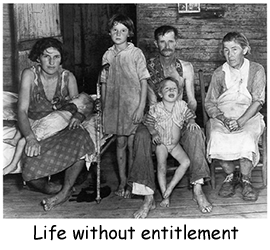
Many pundits point out the financial, commercial reasons for doing this or not doing that—you would think that this ‘acumen’ was the only achievement of the most powerful country in the world. But we showed our greatest power in enduring a Great Depression for ten years and then conquering the world! We weren’t a nation of fat cats, then. Obviously, our greatness came from our rejection of elitism, our respect for each other as equals, and our open-minded-ness towards change.

And social programs (by whatever name) are simply an offshoot of the ideal of equality. There can be no equality between the opportunities available to rich kids and to poor kids. So, government programs that add a feather to the scales on the side of the poor—to offer them the merest inkling of opportunity—are not ‘taxation without representation’ perpetrated against the rich. They are, rather, a tenuous link between rich and poor which allows the poor to feel they’re not being completely played. The super-rich should realize that millions of unemployed citizens are filled with anger and frustration—and it would be a bad thing for us all to turn that blame (and rage) towards the millionaires….

I think the biggest problem is this insistence on black-or-white choices. A lot of what Karl Marx wrote in Das Kapital was, and is, true. By creating a sham model of Marx’s ideas, Communism became a dirty word. This is convenient for the rich, creating a boogey-man that makes unfettered Capitalism seem preferable, even desirable. But Capitalism has recently sidelined millions of once-productive, once-employed citizens–and that could make those unemployed thoughtful enough to realize that Capitalism, founded and maintained by a rich and powerful elite, is nearly as bad as Communism founded and maintained by a greedy and powerful elite. The good ideas that Marx had have been lumped in with all the madness of the Soviets and Red Chinese. The Chinese have seen this problem and have tried to unclench about some of the good things Capitalism has to offer. The USA, and especially its Conservatives, have unfortunately clung to their hatred of any Socialism, however beneficial to our country as a whole, because of its effects on the wealthy.
Sunday, November 11, 2012 7:45 PM
Okay. Sunday night. Veteran’s Day. The real date, although tomorrow is the observed holiday. That ‘eleventh hour of the eleventh day of the eleventh month of 1914’ still gets me—you see, I’m reading “Fall of Giants” by Ken Follett and, while it is historical fiction, there is nothing fictional about his description of the callous decisions of so many nations’ leaders to send millions of young boys to their death. To have a fancy 11th this and 11th that—it’s just typical of the stuffed shirts and nobility of those times to try and aggrandize even the ending of the needless slaughter.
Still tens of thousands without electricity in the NYC Metro Area. Funny how it’s always the low-income neighborhoods that see this kind of neglect. Is there a rule or something? Can’t we at least hand out a bunch of those keychain flashlights that are given out at conventions, just so they can see their way up the stairs? They can’t be that expensive.
I see the news reports of General David Patraeus resigning over an affair—or is it two affairs? Two ladies having an email flame-war over him, something like that? When I first saw this story on the CNN crawl, I thought, “What the hell is the FBI doing investigating the head of the CIA?” But then I remembered a story in the NY Times from a day or two before—that Patreaus was having some trouble due to using military paradigms, but the CIA had always been a tightly knit group, leery of outsiders, used to being treated like a club more than an agency—and definitely not into military-style leadership.
So that made me wonder if the whole scandal thing was just their way of dumping their new boss. If a guy can’t hide his affairs how can he keep America’s more important secrets, eh? But I sympathize with Dave—being married and having two other women fight over you—you know that won’t end well. Still, I think the CIA has a lot of nerve copping a ‘tude—9/11, WMDs in Iraq, Arab Spring, Heavy losses in Afghanistan—will they ever warn us in advance of disasters instead of making excuses after the fact? Do spies even make sense in our present day? Surely very poor spies who do nothing useful can be considered redundant. Maybe they should start poaching personnel from the FBI.
I think a ‘sea-wall’ protecting Manhattan and environs from rising sea-levels and more powerful storms would be an excellent WPA-type project for creating jobs. Infrastructure nationwide should be considered as a part of the unemployment problem—roads, bridges, schools, whatever—and it increases the value of our assets to ‘put some work into the house’, as it were. And this time, along with a salary, we could offer workers credit towards tuitions—so they can get better jobs than pouring concrete, you know?
Just a thought…
 These past few days have given me time to think. I’ve realized that the changes we really want are always hung up in the legislature. Why not hold a referendum on tax hikes for the rich? Is it because everyone already knows there are too few wealthy voters to defeat such a referendum?
“Sometimes,” I can hear the legislators and lobbyists intoning, “the public must be protected from its own impulsiveness. Such issues should be frozen by our endless deliberations for the good of the country.”
What, I’ve always wondered, is the difference between electing a representative and holding a public referendum? In a sensible world (I know, don’t get me started..) we would have all the issues that have lingered too long in the Legislature be automatically put to a public vote—let the people decide the issue and get on with other business. But that doesn’t happen.
My guess is that putting an issue into a referendum is something determined by the same people that block these laws in the House and Senate. Decriminalizing drugs, gay rights, women’s reproductive rights, etc. are measures that seem easily doable. Yet there are other questions that might not suit me: ‘Should we bomb Iran?”; “Should we send troops to Syria?”; “Should we close our borders to immigrants from the Middle East?” –those sorts of questions would make me very nervous.
So, perhaps it is useful to have a deliberative legislature that doesn’t pass any laws until a great many voices have been heard—even, perhaps, until public perception has matured or morphed into a more enlightened point of view. The ache I feel over tragically (to me) unjust policies that see no movement, year after year, is stronger than my easy patience with legislators who introduce (to me) unjust and ignorant bills, knowing it probably won’t go anywhere.
Both sides of the question have their pros and cons. Like the Electoral College of recent interest, the Constitution put a great deal of power in democratically elected office-holders. Regardless of what these candidates said during a campaign, their job, once elected, was to actually put themselves at a distance from the throng, considering not only what the people wanted, but the consequences of implementing those desires—to the poor, to the rich, to the merchants and the consumers, and so forth—and what effects over time, good or bad, might be foreseen.
Once we cast our votes, our officials have no requirement to ask our opinion of his or her decisions—we select a representative and our relationship is over until next election. I will pause here to point out that this isn’t absolutely true—there are impeachments, votes of no-confidence, and such. Also, our officials are not forced to react to our input, but that doesn’t mean they don’t have offices to visit and meetings with community leaders and so on—a good Representative or Senator will not wish to cut themselves off from their constituency (and there is the eternal issue of ‘next term’.)
So we voters do not exactly get to vote for what we want—we get to vote for a person we hope will act in our stead. Whether we approve of the performance of our elected officials or not is a moot point. We can vote for someone else in a few years—that is the only control we actually have.
And as for the candidates we get to choose from, well, we don’t get a resume of every adult in our state and then choose the one we like best. We have party machinery that does a vetting process. We are ‘given’ our candidates by the party organizations that pre-digest our electoral food-candidates. The Primary Race contests in such cases are presented as ‘voted on’ by party supporters—but the entire menu of candidate-choices has been pre-filtered by a small group of people who invest each political party’s infrastructure.
As voters, our control over our destiny is, in fact, severely limited. Still, we brag about our tightly held self-determination—assuming that we have final say over anything and everything important.
But don’t be alarmed by this bit of paradox—the true lack-of-control we have over our legislative process is balanced by our, let’s face it, utter sloth in areas such as ‘knowing the issues’, ‘seeing both sides’, ‘reading the bills’, and even ‘voting’. So forget what I said about referenda—I suppose representatives are the lesser evil. And as for electing more intelligent candidates—well, I didn’t run for any office—did you? A person would have to be crazy… ah, slowly breaks the dawn! I leave you with the question made popular by the comic, Dom Irrera, “I don’t. Do you?”
Sunday, September 30, 2012 3:44 AM
Crime-inciting Laws should be recognized for what they are. The USA went through a violent period of Prohibition and ultimately recognized that a Repeal of Prohibition was the right thing to do. The criminal distribution organizations were defanged by making their products available from a licensed liquor store.
Abortions were illegal for a long time but still happened—malpractice and unwanted children were the result. Rove v. Wade gave us the right to choose abortion, which stopped the horrors of backroom abortions and self-abortion attempts. Couples were able to plan their families—even when the Pill and other contraceptives failed to prevent pregnancies.

In both these cases, everyday citizens who found themselves in desperate straits were forced to go against the law to have a drink or to end an unwanted pregnancy. The fact that people will always seek these things, plus the fact that criminalizing these things did not prevent them from happening, plus the fact that criminals are prone to make money from these situations—all made the decision to legalize them a choice that (when all was said and done) was merely common sense.
How we have gone so many decades ignoring this common sense surrender to human nature with regard to controlled substances is a puzzle to many, myself included. Tons of money, manpower, and international cooperation have gone into the fight to keep society free of drugs—with no effect whatsoever. Anyone can get any drug—they need only ask for them from the criminals who sell them. People even grow or cook up their own drugs without too much difficulty.

Meanwhile, millions in taxes are wasted on the futile War on Drugs; billions in cash flow into the war-chests of the major drug cartels; and millions of otherwise law-abiding citizens are imprisoned on drug charges of a non-violent nature (which wastes more millions in tax money). Plus, there is the health issue—shared needles spreading disease, no help for the addicted, and no quality-control of the drugs being dealt, bought, or used. And, again, we see no change in the status quo. All that wealth, all the blood spilled, all the wasted effort—and drugs are still easily available on any street corner.
Would legalization make the problem better or worse? Well, firstly, how worse can things be? Plenty of people use illegal drugs every day. Will legalization cause an increase in their numbers? I don’t see how—anyone who wants drugs is getting drugs.

I won’t even go into the positive effects legalization could produce—they are not necessary to my argument. The drugs have won every battle in the war on drugs and they have created huge, networked criminal organizations around the world and in all the fifty states. Legalizing drugs would impact the criminal world like a body blow. The war on drugs, oddly enough, can be won by surrender.

The main difficulty is acceptance. No one wants to say, ‘Go ahead, use drugs all you want.’ But legalizing drugs is not an encouragement, but rather a freeing of drug-users from the fear and secrecy that present day drug use entails. And if it turns out that one drug, above all others, is just too dangerous to ignore we will have two advantages: 1) Other drugs can be offered as substitutes, and 2) we can better interdict a single substance than the entire spectrum of controlled substances we are banning at present.
To continue the War On Drugs is just plain stupid. It is a knee-jerk reaction to a situation that requires more thought than reflex.

What if Wealthy Leaches suppress their own Species,
Rationalizing, saying Leadership denied is Chaos
And Freedom must be Framed in a Breadboard
Of Irrational Lives—Half Fear, Half Toil—with
Circuitry of Specie determining the Paths
Open to ‘Freedom’ and Keeping the Power Supply
To Themselves?
.
.
.

What if Wars are the Leaches, Tilting the Pinball Game
Before our Metal Sphere gets the Lay of the Land;
Before we Finish the Thought of What is Real,
What is a Game, and How to Change Our World
Through Sensible Rules that Banish the Laws
Against Our Human Condition, and Allow Us
The Freedom to be Good?
.
.
 We can be Good to Each Other—We can Learn How.
We can Rise above Capitalism’s Enslavement
And Arrive at Livelihoods that Keep us From Evil.
You and I May be Frightened. You and I May be Vicious.
You and I may be Greedy. You and I may be Hopeless—
Hungry, Confused, Subjugate, Excluded, or Hated.
We may all of Us have spent so long Under the Whip
That We can’t even Imagine another Way—
We may Fear our own Freedom.
.
.
 Some will Train, Some will Transport, Some will Arrive
At the Combat Zone—the Zone of Madness,
So familiar with the Gushing of Blood and Screaming of
Townspeople whose Eyes Accuse Some of Us
Of discharging our Firearms, of Murdering Innocents.
Some of Us will Suffer, except for the Fortunate Fallen
Whose War is Over and will Never need to Kill
Again—Some of Us will disperse into a Red Mist
Of Shame and Guilt and Rage and Panic and
Some of Us will feel the Loss of Themselves,
Who used to be People with Freedom.
.
.
 The Leaches will wear Frowns and Speak Seriously
Of the Need for this Insanity—but will still Find
Time to Repress the rest of Us in the Name of Nationality.
The Leaches will Grow Fatter on the Sale of Arms
And the subsequent Sale of Prosthetic Arms.
Pride and Determination will re-echo from their
Megaphones—Sanity will be explained Away—
All of Us will Work Harder, Work Longer,
And spend Less Time asking Questions of
The Whereabouts of our Freedom.
.
 Some of Us will be Shamed and Persecuted.

Some of Us will be Forced to Prostrate Ourselves
To the Employer—The One who Exchanges Bread
For Pride, Fear for Security, and Obedience for Will.
The Institutional Bully of Middle Management will
Both Give and Receive the Torture of Life spent
As Chattel. They will Ape their Top Management
Masters in the Vain Hope of the Same Power
The Top-Most seemingly Own (Though They, too,
Will have an Owner Holding the Leash
Of their Freedom).
 Some of Us will be Driven Mad, finding in our
Delusions the Only
Semblance of
Freedom.
In the old days we were sure that, no matter how perfectly we created a ‘virtual experience’, there would always be a lack—an absence that we would naturally notice—because nothing is as real as reality.

It was sickening, in a way, to discover just how easily we can be confused in our senses—that not only was it eminently doable, but that digital electronics could, without any strain, reproduce sounds and sights with far greater precision than was perceptible by the human ear or eye. ‘Sniffer’ technology, too, is being digitized into a sensor that can sample the ‘air’ environment more sensitively than the nose of a hound dog (which, let me tell you, is no small achievement).

Taste—I dunno—or Texture, Motion, Heat, Balance, Time—our bodies’ sensations of the relative values of these environmental data are still enough of a mystery that we aren’t yet capable of reproducing them. Indeed, we are still trying to understand the connection between our sensoria and our brains’ processing of sensorium-input. At present, no technologies can synthesize even a rough approximation of such sensations as Inertia or Uprightness . So we are not quite ready to fool the human brain.

But, I should think that if we can conquer vision, acoustics, and smell, the rest is just a matter of time. How much time could be counted in years or centuries—I’m no expert—but the tempo of Biomedical Research (and Physics Research) is in high gear. Not only do we build on nearly-daily discoveries, but we build on daily improving electronics and miniaturization. Not only have we made a good start on decoding the Human Genome, but we make progress in nanotechnology—an applied science that could make our bodies self-monitoring, self-repairing, and make it possible to tailor antiviral-or-cancer medicines to the individual patient’s DNA.

I saw a TV show yesterday—researchers tailored a goat-ovum with silkworm genes—the grown goats give milk that is 2% silk. The TV program went on to describe the extraction of silk from the goat-milk and its subsequent drawing-out and production of the first man-made silk thread. I don’t know about you, but that blows my mind. For millennia, up until just this year (or maybe last year—mox-nix) the world has depended on silkworms exclusively for the material in silk threads and the woven-silk cloth that is highly valued for items of clothing and for tremendously strong, lightweight fibers such as those used in parachutes. It made a segment on the science channel or learning channel or NatGeo (who knows?). But fifty years ago it would have been front page news.

That is what makes my jaw drop about the present—so many new things, so often—and many of those are innovations that would have been world-changing, front-page news in its own right. A stereo with no moving parts—smaller than a wallet? No big deal?

While these advances percolate away in the field of medicine, physical therapy, and entertainment, other digital changes occur. We find that robotics is also chugging away. Self-steering, adaptive-pressure gripping, vocal recognition, and exoskeletal-support hardwares/softwares are finding new ways to take over for both the disabled and the automotively challenged. Just think—a few more decades and “DWI” will become an antique term that harkens back to the day when people still drove their own cars. Less frivolously—synthetic limb or organ replacements are proceeding apace. One veteran who had lost both legs was fitted with these new springy synthetics that allow him to run—and it works so well, his eligibility for participation in the London Olympics was seriously debated.

“We can rebuild you—we have the technology!” –well, not quite—the Six-Million Dollar Man is still fiction. But not for much longer—and we know now that prosthetics can be more than replacements—they can be enhancements.

But even beyond these macro-innovations, there are more and more devices that do what electronics do best—they shrink down until they’re miniaturized so small as to fit inside a capsule which a patient can swallow, or into a chip in one’s brain that allows mouse-pointer-control without physical motion. Having gotten proof-of-concept, I seriously doubt that full, brain-only computer interaction will take more than a few more years. How nice it would be for any future ‘Stephen Hawkings’ to have a full Exoskeleton in place of a Wheelchair, to have the ability to type on a Keyboard in his (or hers—let’s not forget the future ‘Stephany Hawkingses’!) Mind. A time will come when healthy people will start to envy some of the prosthetics of the future—then we’ll all be brain-typing, with airbags built into our belts (in case we fall off a building) and cars that read our minds to determine where we want to be driven.

The proximity of our ‘future’ is so close that it has businesses rising and falling as each new thing obsoletes each old thing. And worst of all is always the newest-of-the-old—the i-Phone 5 release is a current news topic and fodder for late-night comics because it made the i-Phone 4 obsolete in less than a year from its own debut. So while bookstores, record stores, gas-only-fueled cars, and ‘landline’ home phones begin their shuffle off to the inevitable, they are being elbowed aside by last year’s cars, last year’s games, last year’s business paradigm—all marching double-time to the scrap heap.

But this is no novel—no Tom Clancy thriller—no Dickens tale of good vs. evil—this is the world, in real life. The wave of the New isn’t a sheet of water so smooth as to reflect our images—it is a thundering crash with all the attendant splashing and spilling.

Let me give an example of one of the little details that we use to cobble together our future-shock-wave. This is a true story—it happened to me just as I describe, and all text has been cut-and-pasted from the original web-page or e-mail. I call it “I’m Going To Jail—But The Internet Made Me Do It!”

There are some oddities about online activity that show the unfair choices forced upon the Webbity-Web, now that it’s been ‘mostly’ commercialized. But please don’t think me dense enough to expect any change in the corporate-ization of onlineTown, USA—if any one person could change the nature of the internet, it wouldn’t be the ‘robust defense measure for national communication’ it was originally designed to be during the Cold War. No, these are just little things now—but I foresee some legal activity on this sort of thing, sooner or later.

To begin with, the internet—or, to be clear, a person’s Internet Service Provider (ISP)—is like automotive insurance—even if someone else is behind your keyboard, you’re still liable for any illegal activity. This is also true of one’s ‘social media’-site accounts, especially YouTube. There are concessions YouTube has been forced to make to stay in business. These concessions apparently include ceding all legal oversight to the owners of copyrights—either Collective Copyright Administrators or the Media Corporation itself.

How does this affect me? Well, the uploads I send to my YouTube account are sometimes titled “Bach Partita No. 1” or “Tchaikovsky’s Waltz of the Flowers”, because these are the piano pieces I had played on my videos.

The YouTube ‘copyright filter’ only looks at the title of the piece and if it matches by 90% or more, I am told that my upload “violates copyright protection laws”. It assumes that I am pirating Glenn Gould’s, or Peter Serkin’s, or Ruth Laredo’s, virtuoso recording—rather than having played the music myself. I know that the ‘amateur-pianist’-demographic is no huge chunk of internet activity, but this is tantamount to saying that such a thing NEVER happens.

But that’s not all the liberty being taken in this situation. There is a ‘copyright claim disputed’ option in YouTube’s ‘notification’ pages—it is quite a winding way for a newcomer (I have had cause to become familiar) but one is finally given a text box wherein the ‘reason’ should be typed. I have done this several times—and I have gotten the status changed to OK for most classical pieces.

But what really gets my goat is the final text display before the text box in which belongs ‘your full name (as signature)’—and that is over and above the fact that I’m being forced to ‘sign’ a legal agreement online by a faceless corporate app. What it says basically is that ‘I understand that if I’m making a false claim I will lose my YouTube account’.

So, to sum up, I am erroneously accused of piracy. I’m asked to plead guilty by clicking on ‘claim recognized’—or—to send in an explanation why I shouldn’t be prosecuted (but only at the risk of losing my YouTube account, if they disagree with my claim).

My YouTube account is several years old—I’ve uploaded over 900 piano videos and am looking at hitting one thousand recordings uploaded sometime early in 2013. That’s a lot riding on fighting off some underdeveloped ‘copyright-app’ every time I play Beethoven!

Below are a few examples of this practice, including my somewhat irritated responses to them—
Three (3) from “Musicke’s Handmaid” (2012Sep22)
Please verify the following information:
Claims to dispute
“A New Ground in E minor Z 682”, musical composition administered by:
One or more music publishing rights collecting societies
Reason for dispute
This video contains the material at issue, but the material is in the public domain or is not eligible for copyright protection.
Explanation
This music is from the Seventeenth Century. If my performance of it violates anyone’s rights, they would be those of Henry Purcell–an Englishman who died before the American Revolutionary War! This business of claiming copyright on ancient pieces of classical music which are clearly in the Public Domain, simply because a single artist’s recording of the piece is uniquely copyrighted by the performer’s representative–is unethical. Please bring this to the attention of whoever is in charge of ethics over there.
I have a good faith belief that the claim(s) described above have been made in error, and that I have the right(s) necessary to use the contents of my video for the reasons I have stated. I have not knowingly made any false statements, nor am I intentionally abusing this dispute process in order to interfere with the rights of others. I understand that filing fraudulent disputes may result in termination of my YouTube account.
Signature
Chris Dunn (xperdunn)
********

YouTube channel Xperdunn copyright infringement claim:
Video Title- Tchaikovsky: “Andante Cantabile” (2011Mar02)
Claims to dispute
“String Quartet No. 1 in D major Op. 11 (version for cello and string orchestra) String Quartet No. 1 in D major Op. 11: II. Andante cantabile (arr. for orchestra)”, musical composition administered by:
One or more music publishing rights collecting societies
“ANDANTE CANTABILE”, musical composition administered by:
One or more music publishing rights collecting societies
UMPG Publishing
Reason for dispute
This video contains the material at issue, but the material is in the public domain or is not eligible for copyright protection.
Please explain briefly:
“I find this completely unfair! These ‘rights collecting societies’ are perfectly well aware of the fact that classical compositions have a multitude of recorded performances.
The ridiculous claim that my piano performance video includes a performance by string quartet (Oh no, wait, it’s a string quartet piece ARRANGED for Orchestra!) is absurd.
But even the Andante Cantabile, which IS a piece for solo piano, is my original performance of the sheet music, not a bootleg of another performer’s recording.
The idea that these ‘rights-collectors’ can accuse me of video-and-audio-piracy just because they own the rights to One, Specific Artist’s performance of a classical work, is outrageous. Finding a 90% match in the Title-text is completely insufficient.
Can’t they be bothered to compare just a few seconds of the video’s audio to a few seconds of the copyrighted recordings which they oversee? Why is the entire onus dumped on a helpless amateur like myself?
It is completely unjust. And it isn’t as though there are a lot of videos out there where the Titles match and the videos don’t. Even a glance at the Duration of their recordings and mine should be enough to indicate that no piracy has occurred.”
I have a good faith belief that the claim(s) described above have been made in error, and that I have the right(s) necessary to use the contents of my video for the reasons I have stated. I have not knowingly made any false statements, nor am I intentionally abusing this dispute process in order to interfere with the rights of others. I understand that filing fraudulent disputes may result in termination of my YouTube account.
Type your full name to serve as your electronic signature
Christopher Dunn
Cancel Continue
Back Cancel Submit Dispute
Are you sure you want to dispute this claim?
OK Cancel
{Notice the unsubtle intimidation implied by the ‘good faith’ check-box.}

{Here’s another, but Kabalevsky, et. al. are modern enough for their compositions to still fall within the composer’s (or the composer’s estate’s) copyright claim.}
Video Title- More Kabalevsky and Others (2011Mar05)
Claims to dispute
Musical Composition administered by:
One or more music publishing rights collecting societies
Reason for dispute
This video uses copyrighted material in a manner that does not require approval of the copyright holder. It is a fair use under copyright law.
Please explain briefly:
“My video is my own, original performance of the works of Kabalevsky and other so-called ‘classical’ composers’ works. It is not a bootleg of an existing, copyrighted recording. Please inform me if I am accused of infringing the copyright of the sheet music or of infringing the copyright of a specific pre-existing, commercially-related recording.”
I don’t see why they publish the sheet music if it’s a crime to play the music in public for free, which is all I have done.”
And on and on:
“my video contains my own, original performance of the sheet music, not a bootleg of another performer’s commercially-available recording!”
And for Satie’s Gnossiennes:
“Only copyrighted in France, Spain, and Portugal”

So that’s what I consider a good-sized mess that will only grow larger with time. I am by no means an accomplished performer—in fact, I rather suck at it. But I approach these issues from the point of view of some future amateur whose own interpretations will be shut out due to increasingly troublesome corner-cutting by the copyright-collectives and big media corporations.
As regards the ISP, their purview includes monitoring my connection for illegal activity—or, to be more precise, they carry out notifications and penalties due to illegal activity as is policed by these same copyright-collectives and big media corporations.
Wednesday, September 12, 2012
RE: OPTIMUM’s “© infringement” email:
I’m not sure what I’m being accused of here. I have allowed my nephew to use this computer recently–maybe he did something. Could you be more specific about the action–did this PC download an mp3, post an mp3, or what? We don’t do that stuff. I don’t know what happened here, but I would not bootleg or pirate mp3s, or anything else for that matter.
Here’s part of the email message I got:
===
We regret having to send notices like this, and we do not wish to alarm you unnecessarily, but we believe it is important to advise you of any notices concerning your account.
Regards,
Ti Chas
Cablevision Registered Copyright Agent
Infringement Notice Details:
Complainant
ID#: 22259478673
Entity: Recording Industry Association of America Inc
Contact:Jeremy Landis
Address: 1025 F Street NW 10th Floor Washington DC 20004
Phone: 1-888-868-2124
Email:riaa.antipiracy@dtecnet.com
Source
Event Time: 2012-08-28 11:28:08.0
IP Address: null
Application: P2P
Username:
Number of Files1
Allegedly Infringed Material
Title: BROTHERS
Filename: The Black Keys – Brothers [2010-MP3-Cov][Bubanee]
URL: null
—Please let me know more about this, especially how I can fix or undo it.
Thanks in advance for your kind attention.
-Chris Dunn

So there you have it. I am innocent of all charges, yet I am harrassed for copyright-violation in page-error notices and property theft in ‘(NoReply)E-Mails’. I love it when I’m accused of a crime in an e-mail that specifically prevents a reply. That, in itself, should be worth a look-see by the legal profession–but what do I know?

