

Friday, November 18, 2016 1:46 PM
Analyze the situation mathematically—one planet, seven billion people. That’s not good—and there’s only one real solution. Before you get all contrary about that statement let me clarify that I am not suggesting moving ourselves and all our stuff up, out of the gravity well we all live at the bottom of. That’s impractical—and it’s not the argument I’m making.
The energy resources and the natural resources available to us at the bottom of our gravity well have been bounteous and convenient. They are far more convenient than the mechanics of humans in space—and we perceive that as a dividing line—but it is not. With robotics, we have explored much of the solar system—and robotic space exploration is still in its infancy, long-term—and robotic asteroid mining is still only in its planning stages.
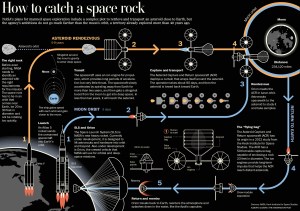
Robotic asteroid mining is therefore a volatile investment, to say the least. If we look at the beginnings of the electronic revolution, we see that many companies came and went—picking the right company would have been the wildest of crap-shoots. But investing in all of them would have meant having a stake in the beginnings of firms like Intel, Sun, IBM, Microsoft and Apple. And robotic asteroid mining will have the same volatility—but it will also end the same way—with a handful of those companies making the earlier investments in the old digital boom seem like small potatoes.
So nobody is getting rich on robotic asteroid mining today—but if you are looking for something that will allow your grandchildren to retire in luxury, one hundred years from now—that is where you put your money. There’s no question about it.

Think of the vastness of space, of our solar system alone—instead of one planet, you have several. And you have those asteroid belts—basically planets’ worth of resources, pre-chewed for your convenience. They come in three popular flavors—mostly ice (meaning water), mostly metal, and the assortment-pack asteroids, which have a little bit of everything in them.
Transportation is the problem. It’s hard to bring anything up there—and it’s hard to bring anything back down. The mechanics of accessing things outside of our gravity well have been considered and summarized many times. It is often referred to as ‘bootstrapping’ humanity’s escape from Earth. It is a zero-sum game—if humanity establishes access to the resources of space, it will survive—if we use up the planet’s resources past the point where we can attempt this, we will be trapped on Earth forever.

Less visionary people will counter that we cannot waste so much of our resources on such an outlandish scheme. They ignore the fact that seven billion people will quickly become fourteen billion, and soon thereafter, twenty-eight billion. The math doesn’t work. The false economy of turning our backs on space merely extends humanity’s expiration by a few years—whereas access to the solar system extends it for the foreseeable far-future.
Notice that I’m not saying ‘the people of Earth’, I’m saying humanity. The people of Earth will over-populate it, they will make a desert of it, and they will die in droves, maybe even die out completely—that’s just math.

I imagine you’re thinking of birth-control—why not have population control? Well, you can’t control population growth—ask the Chinese. Any void created by one group is filled by another—you may suppress foreign workers, or deny them human rights—but they are still mouths to feed and capable of breeding more of themselves. Only a global government could do the job—but an overcrowded planet with dwindling resources is not fertile ground for a global government, is it? Checkmate.

I mean—you could destroy civilization, I guess. That would slaughter most of the people—especially in the developed countries. But people, like weeds, would just grow back—the harder those post-apocalyptic survivors worked to re-build society, the faster we would get right back to where we started. If it seems cold-blooded to destroy civilization, murdering billions—think how psychotic it would be to do all that, just for a ‘delay of game’.

No, people can use tools and think critically—but in our biology we are still no different from fungus—if we run out of room to expand, we fill up the available space until we choke on our own waste. Yet, while the people of Earth face a dire future, humanity itself has an out.
First of all, we don’t need to send everything out of our gravity well—if we can establish a working asteroid-mining system, we can begin to process raw materials in space as well, and manufacture our needs without Earth. Bootstrapping would require a massive amount of Earth’s resources—but once a foot-hold has been established, space-dwellers will eventually free themselves from any needs formerly required from the surface-dwellers.

The automation of factories and the use of robots create problems on Earth—they take jobs away from people. But in space, it is very convenient that we are just now beginning to produce robots with impressive ability. Anyone who goes to space will never do more than supervise the activities of the robots and automated facilities—and they don’t even need to be in space, necessarily, to do the supervising.

The hardest thing about space is growing food there—but while that is difficult, it is not impossible. That too will have to be bootstrapped—biomes will have to be created using soil samples and such from Earth—but once begun, such biomes will be self-sustaining. And, while we could never send all the people into space—we don’t really need to. Just send a few—they’ll take it from there . (Just make sure you have a diverse genetic sampling.)

So, to re-cap, we can do little in space until we’ve developed a foothold, using robotics—and while we can’t send all the people to space, we can send their genome. Humanity saved. But we were speaking of investments in the future. What, you may ask, do I get out of saving humanity?
Here’s the part where luck has something to do with how this all plays out. I don’t know if you’ve heard—but scientists came up with a plan for free energy a long time ago. All you have to do is create solar panels in Earth orbit and transmit the energy to the surface as microwaves. No fuel required, no pollution emitted—unlimited free power. Why don’t we do that? We don’t do that because nobody wants a microwave-cannon with the power of the sun pointed at whatever part of Earth’s surface it happens to be pointed at.

There are many things that science won’t do, or can’t do. If you remember, the space-shuttles always landed dead-stick (in the words of one of the pilots, ‘it flew like a brick’). If asteroid mining developed sufficiently, it could send raw materials back to earth—instead of mining for metal, we could have steel gliders in from space. Sounds crazy, I know—but it can be done.
One of the things science can’t do (right now, at least) is create a material strong enough to support Clarke’s space-elevator. But if we are lucky enough to find such materials and building techniques in the near future, we could create a conveyor belt capable of both sending things to space, and getting stuff back from space, without any great need for energy, or rockets, or rocket fuel.

If we got lucky in that way, then the development of the solar system’s resources wouldn’t just save humanity, it would save the people of Earth as well. It would provide more resources than we could imagine, it would provide a cheap and easy way for people to leave Earth—or return. It would mean that the benefits of going to space would not be confined only to the people in space.
That would be great—a lucky break for everyone. But there is no guarantee that any of this will happen—there isn’t even any guarantee that we will begin to try to do any of this. The only guarantee is that, if we do it, it won’t be easy. My only purpose in writing this is to set the facts in evidence before you.

Establishing a self-sustaining foothold in space is the big issue—everything else is a side-issue: wars, governments, even money are trivial things by comparison. It is human nature to expand—we can’t help ourselves. But we are trapped in a bottle right now, running out of room to grow—running out of materials, destroying environments. You may think of space exploration as childish—but I think of the short-sightedness of failing to go to space as even more childish. It is little different from hiding under the covers, hoping the boogeyman will go away.
In short, investing in space is a long shot, not to mention a really long-term investment that will require decades to make a return. But I believe that if we don’t develop space, no investment in anything has much of a future. So, in balance, it’s where the smart money will go. And remember—it’s not always necessary to be smart—sometimes you can simply listen to what the smart people say. And this is what they are saying, as far as I understand it.

