New Dole

20110326XD-NASA-LightShow(Saturn)

Nice little stormlet—nothing that carries a mortality rate—just school closings and slips on the ice (Nana’s still in a wrist-cast from a week or so ago). It keeps Claire home, though she’s still working in her office all day. I just feel better when she’s around—especially in dicey weather. I’m one of those unfortunate souls for whom the thought of the offspring strikes more bells of alarm than happiness. I love them both so much—but my love is constituted of more than a small percentage of worry and dread, plus all the more kindly affections. So my first thought is always, “Gee, I miss the boy—I hope those Binghamton winters haven’t put him in jeopardy”—so you see, before I even get to the thought of, “I should call him and say hello.”—I’m already worried that he’s in danger. He’s the worst example, because it includes the knowledge that he’s far too far away for me to come immediately to his aid. But daughter has her own special ‘dreading’s, i.e. life in the Big Apple, nighttime streets—her fiancé is always nearby, and she is no slouch when it comes to standing up for herself, either—but she’s so dainty—even in my reduced fitness I can easily lift her up.

So, I appreciate these storms especially—the TV is full of “Don’t leave home today if you can possibly avoid travel.” And the snow just sits because everyone knows it’ll be 50 degrees F for the next few days afterward. It’s a cozy storm. I thank the wheel for being protected from the cold and wind. (It just blew open the door I leave cracked to disperse my smoke—and made me do one of those cartoon-leaning-into-the-wind moves before I could get it closed!) I’m all too aware of how many people are without proper shelter or warm food and drink.

I had a thought while watching CSPAN. What if we created a New Dole, a stipend that worked out to the same net amount as someone making $30,000 per annum. Now, that’s a lot more comfortable than many of the livings being earned by people who are working three jobs and struggling to buy their kids’ school supplies—but it isn’t the life of Riley, either—it still demands a financial scrupling that most upper-middle-class would think of as being ‘poverty’. So it isn’t quite madness, but it is a great deal more generous than what we have now. What actions would follow?

Firstly, a lot of workers would walk quietly away from the slave-labor conditions of their present lifestyle. A large increase in families claiming relief would occur. The amount spent by the Fed to relieve these families would increase drastically. And so, for the moment, it would appear that it hurts, rather than helps us with reducing the Deficit. But what would follow almost immediately?

There would be a dearth of labor on the market—a lot of hard work will have been left deserted. The companies that paid them a slave wage (or part-time, no-benefits minimum wage, if you prefer) would still need their work to be done—but now they will be forced to pay someone a decent wage to do a respectable, full-time job. Outsourcing has its limits—just ask the new Dragon Lady in charge of Google about how much can and can’t be done ‘remotely’. Plus, manufacturing in America is enjoying a resurgence—so we merely have to ‘out-quality’ third-world-slave-labor’s production parameters, and we see an immense potential for employment.

Roosevelt was right about the ‘Fear itself’. Everyone in this economy who is enjoying a comfortable life-style (and that is a surprising majority of us) is scared to death of falling off their own perches. I know, because it is my great fear, too. But we have good reason to fear poverty so much—we treat poor people just a little better than we treat shelter pets. And we appear to have the same rubric in place, as well: ‘We try to save as many as we can, but we only have so much money’. That’s not good enough. That’s a Hell on Earth, and no wonder everyone is permanently panicked about being thrown onto that same trash-heap!

Our unemployment should be a negative value. It should indicate how much we would appreciate having a few more workers than are already busy as bees and happily employed. One thing we should not be doing is borrowing efficiency tips from regimes that put a lower value on human life, and dignity, than we do. We should continue the American tradition of surprising the world demonstrating how much more powerful humane principals are than the so-called ‘hard-nosed business’ perspective. We must take a step back from Fiscal Fascism and distribute our resources in ways that best serve the people. We fought for two decades over the question of foreign involvement—and we still stick ourselves in the middle of things, only citing a ‘War on Terror, rather than ‘Soviet Expansionism’.

Either way, we should recognize the similar threat presented by corporate lobbyists. We try to avoid ‘foreign entanglements’ with little success, but at least we recognize that as a problem. Industrial and financial lobbyists represent ‘foreign value-systems’ that attempt, piece by piece, to slide into place a ‘near enough’, removing the actual ethic for one more conducive to Business than Humanity. And they should be even more urgently avoided.

I hear proponents of Business shouting about how ‘money is the bottom line and you can’t operate in the real world without winning at the money contest’! I hear them, I do. Can’t argue the point, but it doesn’t work that simply. There is the question of how you aim your money-guns. Do we aim them at our competitors, play their game? Our do we try to be ‘American’ (as I’ve always thought it) and point the weapon at the ills of our society? We should beat our opponents by making them slobber with envy at what our nation’s quality of life has become while they were still Mesmerized by the money-changers. Just like we did to the Soviets.

Being rich would become passé. (How do you say ‘thank you’ to MS Word for automatically sticking that accent over the ‘e’ in passé? There, it just did it again! Sorry, what were we talking about?, O yeah…)

The new cool would become living without stress. A nice job, pleasant workplace environment, challenging work (but not overmuch, unless that was how you liked it.) and a nice place, with two bathrooms. We could replace ‘supply and demand’ with ‘don’t call us, we’ll call you’. I suggest that we reverse ‘planned obsolescence’ and ‘go green’ by making as many products as possible last a lifetime or more. Now, the sales department isn’t going to see much good in that—but I don’t see too much good in sales, so we’re even.

We could measure the value of these products as a function of point-of-purchase profit, but with added valuation for the lack of resources required to make new ones every year or two and the reduction in waste products that need composting or recycling. Eternally-rising corporate profits sound good to the owners and managers of the single company, but as a part of the entire economy—maybe not so much.

A great deal of our hi-tech civilization’s energy and resources are spent on inertial running-in-place—every single company has to keep growing or die. We should look at new business models that minimize idle-time costs and look towards products that are manufactured and maintained only occasionally. Tomorrow’s factories will not be predicated on maximum output, but on minimum down-time expense and custom-quality products.

Now, I’m sure this all sounds very Socialist. I am only reacting to the reality I think I’ve gleaned from the media and books and the people around me. I’m no researcher with a huge bibliography to back up my ideas. I’m not even a college graduate (but that didn’t prevent my kids from getting their degrees). I’m just saying—what we’re doing isn’t working. It is causing pain, fear, and stress—it is filthifying our ecosystem—it is using up resources that cannot be replaced once they’re gone—and it keeps even those of us who are snug and satisfied in our cozy, comfy houses living in a state of terror that has nothing to do with Al Qaeda. I don’t know about the rest of you, but I personally also feel guilty about all the people that are already in a place I’m petrified about being damned to.

Fear and guilt do not fit into my idea of the ‘pursuit of happiness’. People argue that government is too big or too small—that’s nothing—what are our goals? And how is the government helping us to reach our goals? It isn’t all about money. Well, it is—but only because of the way it’s set up. We can beat Money, we can tame it, and make it ‘user-transparent’ for all practical purposes.

Just as guns are great tools when used properly, but deadly when misused—money has the capacity to moderate our march towards happiness at the double-step, smoothing the knots of trading one thing for another. We must bend it to our will—not let it continue to make some people dictators and others starved and suffering—that is only what we have foolishly allowed it to become. Just as we try to moderate national arguments with the UN, we should implement a UM that seeks to keep everyone on earth reasonably housed, well-fed and educated (and, if its not too much trouble of course, free internet).

Just as the Hague has a World Court judging international or humanitarian crimes, we need a World Accountant that finds people with just way too much money, and takes half of it—with the promise to return some of it if the person can actually spend the remaining half in their own lifetime. Then the WA would contribute to the UM in its quest to end poverty everywhere on Earth.

And it all starts with our New Dole, a latter-day Emancipation Proclamation that allows everyone to live in relative security and comfort, thus forcing business owners to revalue the salary paid to a working soul. The business advocates don’t want Obama’s new minimum-wage-increase because it will hurt business? Well then, do my idea—it won’t hurt business at all—unless you call forcing them to treat their employees like human beings ‘hurting’ them. A new paradigm beckons us towards a new American Dream—our we could just stick with the seven-billion-man rat-knot that we’re already squirming in.

Absence of Justice

Image

I find it so difficult to accomplish goals nowadays—the fatigue, the distraction, the swiss-cheese of my memory…It’s kinda like Mississippi having only last month completed their official State ratification of the Thirteenth Amendment abolishing slavery—only I’m in their league in neither lag time nor significance of mission. I guess you have to be a government to screw up to that high a degree.

How sad the waste time passed. It has finally come to me (these mills grind slowly…) that the entitled, the wealthy, and the powerful see their cardinal mission as the maintenance of status quo. What all the rest of us want (and our numbers grow, as the aforementioned 0.1% of ‘Dynasts’ shrinks to an even more measly few) is change, substantial change. The Dynasts are careful to couch these things in general terms such as ‘the economy will collapse’ or ‘our military defense will lose its primacy’ or ‘chronic mass unemployment’—but in truth that is only the background to the personal nightmare currently premiering in brains near them, nationwide—the loss of personal power, wealth, security, shelter, food, health, ending ultimately with themselves and their families being at the mercy of the same winds of capitalism, desperation, and pain that storm across the landscape of the rest of us ‘regular people’.

We want big change—they want no change—or, if absolutely necessary, a little, tiny change. They set the odds because they run the table—many of our problems are worsened by misguided argument in the media, which only moves the issue further away from its substance.

We talk about the unlimited sexual assaults by our fighting men and boys, against our fighting women and girls. And they want to talk about ‘under-reporting’, ‘counseling’, and ‘prosecutions’—when what should be the prime issue—why are these men being trained in boot camps and in exercises about how to fight, without covering the important topic of “Don’t rape anyone, but for god’s sake, if you have to, at least don’t rape your own!” Is this something the military is too bashful to talk about in public? Is it so very hard to include, along with say field-drills or gun-cleaning, a few words about how sick and disgusting and sad it is that women who dare to put their lives in the hands of their military leaders—to serve their country—end up being targeted for sexual assault by their own fellow soldiers?

What the hell?

Image

We want to know what the big deal is with increased taxes on people that make more than a million dollars a year—are you kidding me? We got tens of millions without jobs, homes, or even food—and these fat cats want to discuss how ‘business will be hurt’ if our heavy players have to part with more cash flow! I call BS on that one—total BS. It’s time to stop worrying about what would hurt business, and start worrying about what we can do to stop business from hurting people.

It’s time we saw some limits placed on industrial and financial lobbyists—it’s time we created more jobs by increasing the number of regulators watching over every bank, investment house, and trading market. If the derivatives are too complicated for anyone to understand them, then make them against the law—is that some big intuitive leap?

If the NRA lobby pushed through legislation to stop the CDC from recording or reporting any data on gun-related death and injury stats, then let’s take away their permission to be lobbyists—and overturn that bill and any other law that specifically suppresses significant research collection and publication—how is such a law not deemed unconstitutional in the first place? Doesn’t our freedom of speech include the right for our government institutions to freely collect and share health-related data?

Who are these bums on Capitol Hill? Someone please explain how the correct answer could be, “Let’em burn; we’ll start over from the ashes.” Not even in session, lazy bastards, and blaming the ‘advent of sequestration’ on the President. Five years now I’ve been waiting for these closet-red-necked pussies to give our president the respect he deserves—but they’re still trying suck the life out of our country, while pointing at Obama. As if it maybe might work, eventually. Not according to the polls, not for a while now—is it only the Republicans themselves who are convinced of something the whole danged rest of the country has seen through—and been wise to for some time?

Big movie coming out “A Place At The Table” about hunger in America—the tens of millions, largely children, of the greatest food-producing nation in the world that go without enough food to keep them alive. I give up. Starvation? For crying out loud—why isn’t starvation included in any of these political debates over the National Budget—are the Hungry a frickin’ side-issue? What are we?

Okay, enough out of me. The media will continue to emphasize the sensational, diverting attention from the actual substances of our problems—that way, we get to enjoy our empire’s decline on TV, instead of actually pushing back at the darkness that weighs so heavily on us all.

Just think, if we employed one person, and told them their job was to make sure this little girl got three squares a day—then we’d have one more unemployed with a new job, and one less starving child. There, that’s a recovery plan. It’d work great—so much to do, so many people busy, so many kids overeating for the first time in their lives—but you know those suits and talking-head-pundits and power-grabbers would tear it to shreds, and make the tearing to shreds of it last as long as possible. That way, they get us all busy arguing over what a stupid idea it is—you know, distracted—the way they like us.

Image

The Oscars in the Era of Digital Entertainment

20130226XD-Googl-RPO_001

“Ready Player One” by Ernest Cline –an excellent read in its way, a real page-turner–I just finished reading it at 3am earlier this morning—I’ve slept most of the intervening time, but my eyes won’t focus today. See—that’s the difference between age and fatigue—fatigue is something that fades quickly, whereas the limitations of age are more holistic—don’t read an entire book in one day (I was surprised I still could.) if you want to use your eyes for something the next day, and maybe the day after.

20130226XD-Googl-RPO_002(ECline)

Also, the book is set in the near future, but concerns the nineteen-eighties in an OCD-‘Best of the 80s’-treasure-hunt that is central to the tale. I started in the mid-nineteen-seventies (pre-PC, pre-Windows, pre-WWW) with mini-computers—new sensations in the small-business world, particularly the easily computerized industries—insurance, real estate, mailing lists (yes, this was before e-mail and its evil twin, spam, too). But they were still using up an entire room—an air-conditioned room, too.

20130226XD-Googl-RPO_012(matt-groening_Homer)

The micro-computers that started showing up a few years later are now known as PCs—and the first way to hook them together was a Local-Area-Network, or LAN. The first modems had misshapen foam cradles which held the old phones’ receivers and worked by analog audio beeps and chirps. My first PC had a two-megabyte internal hard-drive—it couldn’t hold a single hi-res JPEG by today’s standards.

20130226XD-Googl-RPO_013(Simpsons)

Back then, everything was B&W, just letters and numbers, logic and calculations. When I first saw Windows 2.0 I asked what the point of it was—I was told it made it easier for people to use a computer. I replied that people who didn’t understand how to use a computer weren’t going to have any more luck with a GUI (Graphics User Interface—aka ‘Windows’—except for Macs). What I failed to realize was the pressure digital-era literacy would force on us all—suddenly typists needed to learn Word Perfect and bookkeepers had to learn Lotus 1-2-3 (early spreadsheet software).

20130226XD-Googl-RPO_008(TreyParkerMattStone)

I spent my late teens and early twenties learning computer-literacy and computer maintenance systems that vanished practically overnight, sometime around 1985, and was replaced with home-video games that killed the arcade industry, the WWW, which killed the LAN and WAN industries, and MS Office Suites, CorelDraw Graphics Suites, and Roxio Audio-Visual Suites (and their Mac equivalents)—all of which killed the individual programmer-maven job market. Hot-shot coders were supplanted by Nintendo, Microsoft, Google, YouTube, Facebook, I-Phones and other industrial-sized app- and mega-app-creators.

20130226XD-Googl-RPO_009(SouthPark)

So the 1980s digital watershed as experienced by the writer (I’m assuming) came around the time I was losing the ability to indulge in childish things without embarrassment. For instance, Matthew Broderick, a central figure in the book, is much younger than I am—and I won’t get into how depressing it is to see him graying with age in the present day. Yes, boys and girls, if you live long enough, even the sci-fi makes you feel old.

20130226XD-Googl-RPO_010(SouthPark_last-supper)

By 1980, I was in my mid-twenties—this made me a generation older than the oldest man in the book. So, I’m reading a sci-fi thriller set in the near future and all I feel is ‘old’—that’s just so wrong. But enough of my whining… let’s discuss.

Society used to imply a fixed point of geography—but no more. The way I see it, any place or time that has fixed morals applicable only to that place or time, is a ‘society’. For instance, Commuter Traffic is its own society—indeed, commuting has at least three societies—the drivers, the bus and train-takers, and the walkers.

20130226XD-Googl-RPO_011(Book_of_Mormon)

Walking the sidewalks of mid-town Manhattan during the morning rush seems very cattle-like, especially to the people in its grip. But it actually requires a very heads-up approach—you need to watch the whole 360 degrees around you, your pace should be brisk but not breakneck, and the only real crime is to behave as if it weren’t rush hour, when personal stopping and going and distraction won’t impact the entire flow of the press of people all around such an out-of-place fool.

Walking is usually the last step in the journey. And there are many who go by subway—but in my relative inexperience, I leave its description to someone more inured to its ways. Nevertheless I have spent years on both of the other circuits, ‘driving in’—and ‘taking the train’.

20130226XD-Googl-RPO_007(ThCleveShow)

Taking the Saw Mill River Parkway into Manhattan’s West Side Highway is not for the faint of heart. Its lanes were designed for the days when it was truly a scenic parkway—and for cars which topped out at, maybe, 30 mph. It’s modern reality is a cross between Disney World’s Space Mountain and the Grand Prix—hurtling cubes of steel, inches apart, doing 60, 65—and some of them are in a bigger hurry than the rest—these restless souls try to pass other cars as they go and will push their driving skills to the limit. This forces anyone in the lane beside them to be just as razor-sharp in controlling a vehicle that may not have the road-hugging quality of a BMW.

Taking the Harlem-Hudson line into Grand Central has had many changes since my day—the locomotives were diesel, there was always at least one smoking car and the night-time commuter trains had a bar car, which was an automatic smoker. The seats were upholstered but badly sprung—and larger. But some things remain the same—the etiquette of boarding as a group, of sitting beside a stranger (don’t read their paper—get your own!)

And the strange race for pole-position when debarking at Grand Central. This took planning. Firstly, one had to rise when the train had neared its platform, and move towards the doorway. If you weren’t first in the doorway, there was no way you would have a chance to sprint towards the exit ramp with the other contenders. The choice of when to rise was a personal one—some rose quite early and simply stood in the doorway for a good ten minutes, others waited until the last minute and relied strongly on line-cutting bravado. Once the train stopped, there were maybe fifty yards of empty platform which the prepared passenger sprinted across, hoping to avoid the human condensation that made that exit a twenty minute delay for those who took their time getting off the train.

20130226XD-Googl-RPO_006(american-dad)

This was the most cattle-car moment of any commute—people actually touched each other while we crowd-shuffled towards the open terminal beyond the platform gate. This was a world-class pot-luck situation—the people who crushed against one could be very attractive or quite repellent, even odiferous. There was no logic to the Brownian motion of the crowd—you couldn’t position yourself to mash against someone of your own choosing.

Eye contact, personal space, split-second go/no-go choices made at traffic-lit corners or when spotting an unmarked traffic cop car in the work-ward rally—all these and more were self-imposed by the natural human reactions to the different intimacies of rush-hour mass motion. And, not surprisingly, all these societies have a night-time, complimentary society, with different rules respecting the fact that everyone is in an even bigger hurry to get home than they were to get to work that morning, but with the luxury that no one got fired for getting home late.

These societies have a geographical ‘location’ (if an unsupervised racetrack can be called a location) but they come into being for a few hours in the morning and again at night, each time fading away almost as soon as it peaks, barring delays and bad weather. The ‘train stuck in a blizzard’ has a society, too—which only comes sporadically and can skip whole years at times.

familyguy_seth7

Talking on the phone is a society—or, again, several societies, based on context. A phone conference, a sales call, a relative calling to gab, a friend calling with an invitation—each one has its own little head-dance and body language. And we could hardly leave out Facebook or the internet in general, when cataloguing the many sub-societies we join and quit all through our days.

These were my musings on Society this morning after I read the New York Times Art Section article reviewing the Oscars and the reviews others gave it, particularly PC groups that disapproved of the irreverence and insensitivity of the jokes and songs—and of Seth McFarlane, personally. The Times article pointed out the discrepancy between the Academy’s need to bring in ratings, especially from the younger demographic (call it the “Family Guy”-factor) and to appear sensitive to the community-watchdog groups that have been attacking “Family Guy” since its premiere in 1999.

Seth McFarlane is a media juggernaut with three (yes,3!) TV series now in operation: [Family Guy (1999–2002, 2005–now), “American Dad!” (2005–now), “The Cleveland Show” (2009–now)]. His ‘tastelessness’ finds favor with a younger audience because it embraces (as far as a TV show can) the new Internet society—which has few editors and even less censors. This younger entertainment society accepts the crassness as ‘bold honesty’ of a sort (which dawned, IMHO, upon the Seinfeld episode when Jerry, et.al. all repeat the phrase “Not that there’s anything wrong with that.” until the defensiveness of PC-speak becomes its own post-modern joke/attitude).

familyguy_seth7

PC-abandonment is the new humor in this society—if it makes old people like me wince, it’s funny. And television, in many ways, is still bound hand and foot by wincing old people. These dinosaur-people miss the point—we joke because we love—and we love ourselves—even our bigoted, foul-mouthed selves. And we won’t pussy-foot around about it anymore. Any old geezer that can’t let go of the militancy that served human rights so well in the twentieth century can’t help but be scandalized by our new-minted idols, like Seth, who are comfortable making a joke about Lincoln being shot in the head without being suspected of hidden racism or some twisted fundamentalism.

I would like to join in—but I’m too old and set in my ways to reinvent myself as an aging hipster—besides, comedy was never my strong suit… But my point is this: we have two major societal paradigms that are at something of a disconnect—Network TV and the World Wide Web. I can’t get in the spirit of it—for me, half the fun of a show is watching it when it’s aired. The feel of live TV—even scheduled, recorded, first-run TV shows—is lost for me whenever I have to find the show on the cable-box’s VOD menu—but my son watches all his ‘TV’ online, using our Netflix account. And I grew up admiring martyrs to the cause of civil and gender rights—I’ll never be able to speak lightly of those momentous changes that informed my lifespan.20130226XD-Googl-RPO_004(SMcFarlane)

I can handle Seth McFarlane, Matt Stone, Trey Parker, Matt Groenig—all the new-wave, internet-capable entertainers, but my laughs are a little repressed by the sheer effrontery of their attitudes. When I was a boy I wondered why it was so hard for my parents to see my point—now I understand—by their standards, I didn’t have a point. I wasn’t seeing everything through their experiences, I was seeing everything as new and without emotional context. And now I’m trapped in my memories of what our children see as ‘history’, if they notice it at all. Paperless, wireless, unconventional families, uncensored entertainment, the disintegration of traditional religious institutions’ power to shape people and events, access to everything—information, encyclopediae, maps and navigators, definitions, language translations, 24-hour news cycles—all the things that have remade what was once my stable little spot on the Earth—our children take them as givens—the same way we took drinking from our lawn hoses for granted (back when people still felt safe drinking from ground wells).

So, in the end, Seth McFarlane did a great job hosting the Oscars—he also did a terrible job—it depends on your age.

Ben Affleck

Info Wars

Bacchus

Bacchus (c. 1596)
-by Michelangelo Merisi da Caravaggio [September 28th, 1571–July 18th, 1610]

An informed electorate is necessary to a functioning democracy. The freedoms of assembly, of speech, and of the press are included in our rights because we must have debate and a free exchange of ideas before we can make an informed choice of one candidate over all the others. And we need to know not only about the candidates but also about the conditions of our own nation, state, county and community.

We must be kept informed. When years ago the tobacco industry fought court battles over their liability for smoking victims—and against anti-smoking legislation, they hid internal memos and reports from the courts that had a bearing on all those cases. Once that information was made available to the public by tobacco industry whistle-blowers, the industry continued to fight for the suppression of that information. But information has power—the tobacco industry’s efforts to sequester that now-public information was short and sweet—where their original secret-keeping strategy stymied health and safety advocates for years, even decades.

Even more troubling is the issue of ‘Big-Pharma’ cherry-picking which drug studies are kept confidential and which are made public—there have even been instances where some studies’ key data were kept confidential while the otherwise positive study-results were made public! And we should remember that the same sort of hard-working chemists who invented children’s aspirin also invented the gas-canisters for Nazi death chambers—that is, just because they make medicines, that doesn’t make their corporations good for our health.

Car manufacturers have had scandals which publicly exposed their manipulation of data to obscure bad car parts and design flaws that would otherwise force them to issue very expensive recalls on well-respected car brands. And it is a fact that these corporations shamelessly make calculations based on the cost of liability lawsuits compared to the cost of the recall—and when car-buyers being injured or killed is the less expensive of the two, that is the course they will follow.

I hesitate to bring up HMOs and shoddy health insurance ethics—their depraved indifference to their customers has been fodder for many a thriller’s plotline, to the point where we are numb to their disgraceful lack of ethical conscience. However, in all such instances, keeping some data secret (or falsely representing data) plays a large role in allowing these corporate pirates to continue unimpeded and unpunished.

The Catholic Church is also guilty of keeping horrible secrets with regard to their nuns’ and priests’ behavior in their diocese. At times in our more recent history we have found the Office of the Executive also being less than forthcoming.

We hear of banks foreclosing on solvent mortgages in good standing—and, in a twist, we find that this is a problem due to their inability (or lack of interest) in going over the mountains of data represented by their thousands upon thousands of mortgage loans. No one could be bothered to read it all—the vast majority of them were bad credit (just the way they had sold them) so they just foreclosed on all of them, ignoring the lone few who had actually made an honest go of their home investment, and made their payments on time.

Equally mind-numbing tsunamis of printed data confront everyone who wishes to be kept informed of our legislative process—bill-proposals with page-counts requiring hand-trucks (that’s plural) to deliver a single copy are the norm. Even the legislators can’t make time to re-read their own ‘product’—they get synopses from legal aides who spend days poring over the verbiage, trying to whittle down these paper mountains into digestible spoonfuls.

Now we are told that NRA lobbyists have successfully blocked the CDC from including ‘gun violence data’ in their reports on health and safety. This is a new low—the lobbyists for the arms industry are actively legislating against free speech—shamelessly advocating the suppression of the truth from the electorate.

4:11 PM

I took a break and watched some TV. The entertainment industry is the worst when it comes to dishonesty—and I guess it is their stock-in-trade, after all. I have watched a documentary that Cablevision has listed as a documentary released in 2012. I come back here to say a few words about it and—what do-you-know!—iMDB says the documentary was actually released in 2008. I’ve also had this problem with printed fiction (novels, that is) when they slap a new cover on something 15 years old and sell it to me as if for the first time—until I start reading it, and then feeling a little too familiar with the story, and then checking my two-car library to see the same damn book, bought in 1995! But with science fiction, fifteen years is old (with a capital O)—and by the same token, a film documentary should have the correct date label, as if they were newspaper editions. What’s a documentary for if it isn’t giving us new information?

So anyway, I’ve just seen this 2008 documentary, “Kiran Bedi : Yes Madam, Sir” which chronicles the career of Kiran Bedi, who became India’s very first female Police Officer in 1972. She (and they have ‘stills’ of this) faced down a sword-wielding Delhi mob (from which the rest of her fellow officers were retreating) alone, with a police baton in her hand. As she continued to serve she ran into an unethical system. But she didn’t just refuse to participate in the endemic, well-entrenched corruption—she wouldn’t acquiesce to it, either.

Her superiors felt (and still felt comfortable, as of the documentary’s making in 2008, to repeat their unfounded allegations) that she was rocking the boat, and she was sent to be Inspector General of the Tihar Jail, a notorious pit of a prison, at that time, in which she was expected to fail completely. Bedi instantly implemented prison reforms that included mass meditations with no guards present. She started a daycare/school for the prisoners’ children, who lived in the prison with them until age six. She transformed a prison system into an Ashram, but she is hounded from the post, re-assigned as IG to a more rural region. After being dishonestly besmirched by her political and civil enemies, she is sent to run an infamous police training academy, which produced virtually untrained fodder for the existing chain of corruption—and which she also transforms into an Ashram.

Her well-trained, spiritually enlightened recruits began to cause friction with the ‘status quo’ police forces they joined upon graduation. Her enemies were determined to ruin her reputation and drove her from the training academy. Then she is awarded the Magsaysay Award, Asia’s ‘Nobel Peace Prize’ for idealism and integrity in public service, in 1994. She was chosen by UN Secretary-General Kofi Annan as UN Civilian Police Advisor in 2003. Since then she has seen her critics forced to withdraw all their false allegations and her government has officially recognized her humanitarian programs and reforms.

What a gal, as they used to say. What an incredible champion for truth and justice!

I saw another documentary a few days ago—“Pink Saris” (2010)—this Indian woman, Sampat Pal Devi, goes to the homes of mistreated girls and young women trapped in prostitution and publicly admonishes the men who are abusing these girls—whether their fathers or their husbands or their uncles—insisting that they be decent human beings in their treating with the females of either the family or the brothel; that they let their daughters go to school, that they stop practicing domestic sexual abuse against the women, which the police turn a blind eye to—and then this incredible lady excoriates the policemen who are standing around doing nothing, telling them they should arrest this husband or father or pimp.

She blatantly shames these losers—and the camera catches the truth in their faces—that they know they are doing wrong. The women she wrests away from the pimps are all given pink saris to wear– Sampat Pal Devi makes them all members of the Gulabi (‘Pink’) Gang.

But my most favorite is a Pakistani girl, Malala Yousafzai, from the Swat valley. Responding to the recently-empowered Taliban’s forbidding education for girls in 2009, this little eleven-year-old, at the wish of her father, Ziauddin, became a public speaker for women’s literacy and an activist advocating women’s education. Her speaking out for women’s rights brought attention throughout her country, not only in the issue, but in her, personally. In October of 2012, Taliban would-be assassins hijacked her school bus, where one of them climbed aboard, looked for her, and shot her twice, in the head and neck. They ran off immediately and she was very close to a hospital at the time—a main reason for her survival—and she has since been flown to Great Britain for surgery. She is almost fully physically recovered now (one photo showed her sitting up in her hospital bed and reading) and I take great pleasure at the thought of the humiliation those Taliban bastards must feel.

And so, we see that we are in a global information war—but we aren’t just fighting for access or openness, we are fighting for the truth and we are fighting against the lies. We are fighting over the legends for the pie chart graphs, for the test results the drug company was very unhappy about, for the safety of our food, our medicine, our homes, cars, children—ourselves. And some people are employed by corporations—and their job is to front for the lies and spin the truth.

We see that our schools are the assembly line of our future, deserving of at least as much funding as our military—for without a future for America, what is it our military is defending? We see that lobbyists, business leaders, and politicians are often more interested in being left to their own devices, to generate revenue, than in being a positive part of our future. We learn that enough money can turn the truth to a lie and lies into facts. We understand that power-seekers are the worst possible candidates for positions of authority. And we stand in wonder at these fearless women—each one a self-contained fighting machine for truth and justice; a white tornado of change that no amoral power-machine can withstand.

Anyway, what I started out to say was that the gun lobby’s suppression of CDC data gathering is a public monstrosity—and a far more important factor of this issue than whatever Ted Nugent has on his beer-soaked mind.

The Tyranny of Cash

Image

I have to connect to people—but I’m so wrapped up in myself that I’m never actually communicating—I’m expressing myself instead. My generation was very big on expressing ourselves: protest signs, silkscreen T-shirts, buttons, fashion statements, arguing over ethics with our school-teachers, targeted boycotts, song lyrics (with no small amount of encouragement from Paul Simon, Joni Mitchell and Leonard Cohen) and daily, personal journals.

When I think of what I want to say, I’m always thinking about my disagreements with the status quo—thus casting my readers in the role of ‘those who need educating’ rather than simply as ‘people who see things differently’. In this way, I avoid the nasty question of whether I’m always right or I’m just very opinionated. But is there a difference? All the changes made to our society have been propelled by people whose sense of ‘wrongness’ about one thing or another is so strong that they sway our minds to a new point of view.

Yet there is another side to the question—if powerful people couch their rhetoric in the style of the public reformer, and then broadcast their message with the full power of our mass media, they create a skewed playing field wherein the true idealist must do more than present a case—he or she must include a defense against the message of the rich and powerful. As an example, we can recall that brief moment of news-reporting during our last presidential campaign when it was found that the majority of Republicans favored a tax policy that would cost themselves more money—simply because their allegiance to the GOP (or bitterness towards the ‘leftist elite’) came from an emotional place—not from reasoned examination of the facts.

And this can be said of most voters, me included. We get far more excited about the tones and the personalities of our political champions than we ever get about reading the bill(s) in question—indeed, the congresspersons themselves have neither the time nor the propensity to read a 1000+ page legislative bill. It has always made me wonder, ‘Who writes them?” And, do they stick in little jokes just because no one ever reads that last 100 pages? (I would.)

So, I asked myself why our world is so crazy. Silly me—there was a popular tune after the War of Independence—“The World Turned Upside-Down”—which shows that not only are we the ones to blame (the New World colonists) but also that people have asked my simple-minded question for well over two centuries now. Not to mention the distinct possibility that people often felt the same way back in the Old World but chose to avoid being burned at the stake for questioning either ‘God’s creation’ or the monarchial system they once governed themselves by.

Then I saw a powerful analogy. In the last several decades, our laws have evolved to seek out domestic and private abuses of power such as corporal punishment in public schools, police brutality, domestic violence, and predatory, pederast priests. We’ve taken away people’s sense of entitlement about drunk driving, sexual harassment in the workplace, and smoking in shared spaces. We are ever refining our idea of a peaceful but free and equal society.

We do not, however, make much headway on the macroscopic scale. If Syria’s Assad was my next door neighbor, I’d have him arrested for firing his guns in public and endangering the whole neighborhood. If Kim Jong Un lived in Lincolndale, I’d have him arrested for using fireworks without the supervision of the Fire Department. If BP was burning leaves on the front lawn, they’d get shut down with a fine and a warning—and if the pollution persisted he’d eventually do real time for being a scoff-law. If the Amazon Rain Forest was part of our community and a developer tried to level it and pave it over, we’d at least have the opportunity of standing up in Somers Town Hall and railing against this obvious threat to our community’s aesthetic—not to mention its real estate values.

We confine ourselves (at least here in the USA) with far greater severity than the UN is capable of, on a sovereignty level, and we see the occasional crazed gun-nut as a major threat to our way of life—where, in many other countries, the crazed gun-nut is the guy in power. We do our best to be good little citizens of a country that idealizes equality and fairness—in spite of the reality that not all of us are on the same page (or even the same book). I feel a personal affront whenever a third-world power-person criticizes our culture as decadent and stupid. We may not be angels on Earth, but we don’t impose our religion on anyone, we don’t impose second-class status on women, and we protect our children from authority figures who would abuse their power—up to and including the parents themselves.

We have had some trouble lately with religious zealots, particularly in what’s known as the ‘Bible Belt’. With the complete secularization of our social mores, we have deprived the USA’s most active and populous churches of the ability to pollute our society with hate-speech about women, LGBTs, Muslims, Jews or any other ‘minority’ that, taken all together, actually encompass 99% of our citizenry. They have lost the ability to impose their narrow morality on our legislation—they have gone from long-time insiders to fringe-ward outsiders in our present public policy debates. Gays can marry, Women can enter combat, children can refuse to include the phrase ‘under God’ when they pledge allegiance in class each morning.

And we know who the ‘Evangelists’ of the Global Community are—the bankers and arms manufacturers and multi-national corporations. They won’t be going down any time soon and, if they ever do, it won’t be through some namby-pamby election process! No, these powerful groups worship Currency—a god far stronger than the God of Abraham—and they don’t recognize anyone else’s freedom of speech, only their own—plus, they have all the weapons.

But a cardinal problem with these enemies of our freedom is that many of them are an inextricable part of our great nation. The energy combines, particularly the petroleum industries, have a knife of disaster at our throats. The banks and investment companies make up their own rules as they stumble along—but without the bank that unfairly forecloses on our neighbor’s house, we won’t have the bank we need to lend us mortgages for our future houses. The arms-makers are part of an industry that helps America stay strong—even if they also do business with all of our enemies.

No, money is the glue of our civilization, at least for the moment. But we can take solace in the fact that money was not always the sine qua non of our civilization—and there’s hope that someday, it will be no longer. I figure in a world that can get all of New York City to stop smoking in bars and pick up the poop from their dogs’ walks, anything is possible.

Traditionally, We Don’t

There are a great many traditions. Some are fun—like costumes and trick-or-treating; some are bitter—like tearing clothes and covering mirrors; and a few are surprisingly important—like standing when hearing the National Anthem—and singing along. I was reminded of this recently, at the end of “The Comedy Central Roast of Roseanne Barr”, when the Roastee, Roseanne, sang the last few bars of the anthem: “…o’er the laa-a-a-nd of the frre-e-e-e-e, and the hooome of the bra-a-a-a-ave!” with the voice of an angel—the complete opposite of her ‘comedic character’ performance at the start of baseball game, way back when, wherein she screeched and scratched herself and spit—just like some old baseball player before the days of the tight-shot on the players at the sidelines and bullpens.

Some people got it. But the ones who didn’t get it, as always, ended up fodder for the media-made scandal over ‘Roseanne’s insulting of the whole country’. Roseanne issued a statement afterwards, when told of the witless people who didn’t get, or like, her comedy, saying “I was doing a routine, it was all in fun.” But the media always ignores anything that actually settles a ruckus—they work too hard to create them to let any common-sense-spouter come along and ruin their fun. So, fin de siècle, Roseanne closed what may have been her final appearance on a stand-up comedy program by singing the song with perfect pitch and a surprisingly sweet tone. Back when the whole thing was a media firestorm (Roseanne, back when she was big, was BIG!) I remember sympathizing with her—she was obviously mugging her way through the stadium routine—and only the stupidest, most myopic cretin could have honestly seen it as an affront to the only nation that could have given rise to a ‘Roseanne’-type celebrity.

People seem to like accusing their enemies of lack of patriotism or loyalty—or, better yet, of immorality and blasphemy. But that’s just on the TV. In real life, if I don’t get along with someone all that well, I can recognize it as personal outlooks clashing, or mismatched personalities. No one in my neighborhood ever gets accused of treason or evil—and you never hear about anyone famous being accused of it either—until they get famous enough to become targets of all the embittered activists and scandalized ‘Mothers Against [enter cause here]’.

I can feel the pull of its gravity myself. When someone like Paul Ryan gets me all riled up, I get that urge. I wanna go get this guy! I wanna shout to the rooftops, “Can’t you see he’s an evil, lying, classist?!” Or when someone really gets under my skin, like Adele, I want to send her fan-mail. I’ve never talked to the woman in my life, but suddenly I want to communicate with her. Thankfully, I don’t follow through on those urges because I remind myself that I’m just drawn to the flame of attention. No one who ever gets a good dose of it fails to regret it, yet it lives on in all of us—we wanna be paid attention to. We have no reason, no great message to share—we just want everyone to look, look at me, look over here.

In our celebrity-oriented society, there are some new traditions. There’s the tradition of winning a talent show on TV, most notably American Idol, then getting a recording contract and then touring to promote the new CD—then going on the talk shows (morning and evening) to plug the new CD and to debut before the TV audience as a fully-vetted mini-celebrity. After that, there are forks in the road—movies, reality shows, big-time touring—these ‘winners’ have as many opportunities as they have the stamina and the talent for. But the first part, the enthronement process, if you will, is a familiar process by now—almost a tradition.

The talk-show circuit is its own tradition—no longer the plugging-directly-into-the-pulse-of-the-nation, as with the old, network-TV era of Johnny Carson’s “Tonight Show”, et.al.—but a more standardized program format there never was. Traditionally, Letterman, Leno, Conan, Ellen, Stewart, Colbert, Kimmel, Fallon, or Craig will do five-to-ten minutes of stand-up monologue based on the day’s news and the latest gossip and politics. Then we see the host do a bit: audience interaction, pre-taped clips of ‘funny’, Top Ten, Today’s Word, Back in Black, whatever. Then the lead celebrity is brought on. Film-pluggers and new TV-series stars always have a ‘clip’ to watch, and then host and guest discuss the film, or book, or Gold Medal—whatever. And that is the traditional way for an American to go to sleep at night, to dream of expensive products and exciting shows they will acquire and attend tomorrow.

There’s another new tradition. But it will wait. I plan to come back to this topic—not only to examine other, newer traditions but also to examine the changing nature of what is a ‘tradition’. Later….

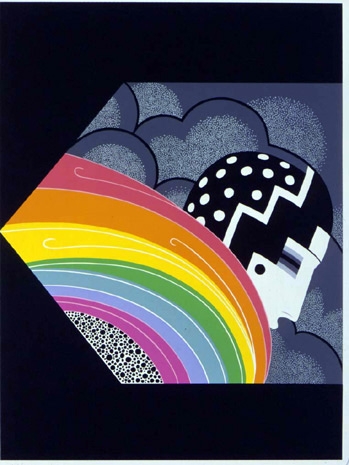
Tempest by Erte

Tempest by Erte